
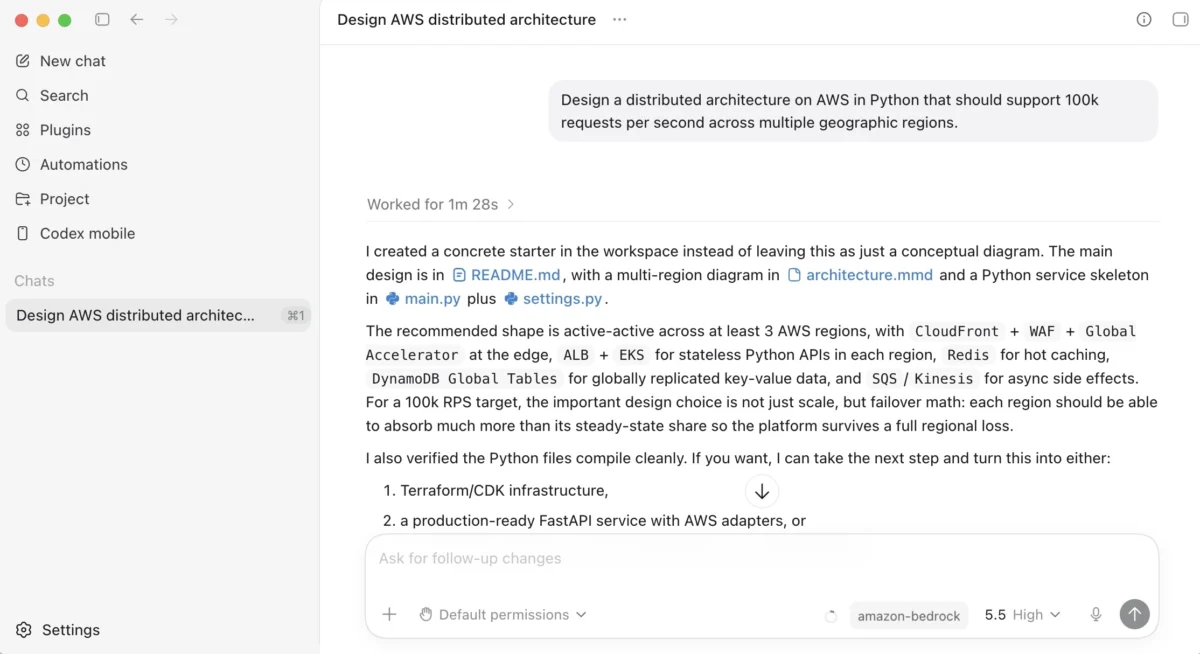

Amazon Web Services (AWS) has officially announced the general availability of OpenAI’s cutting-edge GPT-5.5 and GPT-5.4 models, alongside the powerful Codex coding agent, on its fully managed service, Amazon Bedrock. This strategic integration, initially previewed during the "What’s Next with AWS 2026" event, marks a significant milestone in making frontier generative AI capabilities more accessible and deployable for enterprises globally. The move is set to empower developers with advanced tools for coding, complex reasoning, and sophisticated agentic workflows, all within the secure and scalable AWS cloud environment.
Background: The Evolution of Generative AI and Cloud Integration
The journey of artificial intelligence has seen rapid acceleration in recent years, particularly with the advent of large language models (LLMs) and generative AI. These models, capable of understanding, generating, and manipulating human-like text, have revolutionized various industries, from content creation and customer service to scientific research and software development. However, deploying and managing these complex models at scale has presented significant challenges for many organizations, often requiring specialized infrastructure, deep AI expertise, and robust security measures.
Amazon Bedrock was launched by AWS as a response to these challenges, providing a fully managed service that offers a choice of high-performing foundation models (FMs) from leading AI companies, along with a broad set of capabilities to build generative AI applications. Bedrock simplifies the process of accessing FMs through a single API, allowing customers to experiment with different models, fine-tune them with their own data, and integrate them into their applications with ease. The service’s focus on enterprise-grade security, reliability, and scalability has positioned it as a critical platform for organizations looking to harness the power of generative AI without the operational overhead.
OpenAI, a leader in AI research and deployment, has been at the forefront of developing powerful LLMs. Their GPT series models have consistently pushed the boundaries of what AI can achieve, while Codex has demonstrated remarkable capabilities in code generation and assistance. The decision to make these models available on Amazon Bedrock underscores a growing trend of collaboration between leading AI developers and major cloud providers, aiming to democratize access to advanced AI technologies and accelerate their adoption across various sectors. This partnership allows OpenAI to extend its reach into the vast AWS enterprise customer base, while AWS enhances Bedrock’s offering with some of the most sought-after models in the market.
Unlocking New Capabilities with GPT-5.5 and GPT-5.4
The general availability of OpenAI’s GPT-5.5 and GPT-5.4 models on Amazon Bedrock brings a new echelon of intelligence to the platform. According to OpenAI, these models represent significant advancements in their ability to handle intricate tasks, particularly in areas such as coding, advanced reasoning, and complex professional work.
-
GPT-5.5: The Powerhouse for Demanding Workloads
Positioned as the flagship model, GPT-5.5 is designed to tackle the most demanding customer workloads. Its enhanced capabilities in reasoning and understanding make it exceptionally suited for scenarios requiring deep analytical thinking, multi-step problem-solving, and nuanced content generation. Enterprises dealing with highly complex data analysis, sophisticated legal or medical documentation, intricate financial modeling, or advanced research can leverage GPT-5.5 for superior performance and accuracy. Its robust architecture and training on vast datasets enable it to maintain coherence and relevance even in extended, multi-turn interactions, making it ideal for building highly intelligent virtual assistants or sophisticated knowledge management systems. -
GPT-5.4: Optimal Price-Performance for Scalable Applications
While GPT-5.5 targets peak performance, GPT-5.4 is optimized for the best price-performance ratio. This model provides a compelling option for organizations looking to deploy generative AI across a broader range of applications without compromising significantly on quality or capability. It remains highly effective for coding, general reasoning, and agentic workflows, making it suitable for scalable applications like enhanced customer support chatbots, automated content generation for marketing, or streamlined internal communication tools. The availability of GPT-5.4 allows businesses to balance cost efficiency with advanced AI capabilities, enabling wider adoption and integration of generative AI into their operational frameworks.
Both models are accessible through the Responses API on Amazon Bedrock’s next-generation inference engine. This engine is specifically engineered for high performance, reliability, and security, ensuring that enterprises can run their AI applications with confidence, even under heavy load. The Responses API also facilitates model-managed multi-turn state, hosted tools, function tools, and richer tool orchestration, crucial for developing sophisticated, context-aware AI agents and applications that can handle complex, multi-step tasks.
Codex: Revolutionizing Software Development with AI

The integration of OpenAI’s Codex, powered by GPT-5.5 for inference, on Amazon Bedrock is set to profoundly impact the software development landscape. Codex is widely recognized as a pioneering AI coding agent, and its availability through Bedrock brings a new level of intelligence and efficiency to developers.
-
Accelerating the Development Lifecycle:
OpenAI reports that over 4 million developers currently use Codex weekly for a variety of critical tasks, including writing new code, refactoring existing code, debugging issues, generating test cases, and validating code across extensive codebases. With GPT-5.5 underpinning its inference capabilities, Codex introduces a new class of intelligence specifically optimized for complex, long-horizon developer workflows. This means Codex can not only generate isolated code snippets but also assist in larger architectural decisions, understand broader project contexts, and contribute to more strategic coding efforts. This level of assistance can significantly reduce development cycles, improve code quality, and free up developers to focus on higher-level problem-solving and innovation. -
Seamless Integration into Developer Ecosystems:
Codex offers multiple avenues for integration into a developer’s workflow, ensuring maximum flexibility and ease of use. Developers can utilize the standalone Codex App, the Codex Command Line Interface (CLI), or integrate it directly into popular Integrated Development Environments (IDEs) such as Visual Studio Code, JetBrains products, and Xcode. All model inference for these integrations is routed through the secure and high-performanceResponsesAPI on Amazon Bedrock. This native integration minimizes disruption to existing workflows, allowing developers to leverage AI assistance directly within their preferred coding environments. -
Practical Implementation:
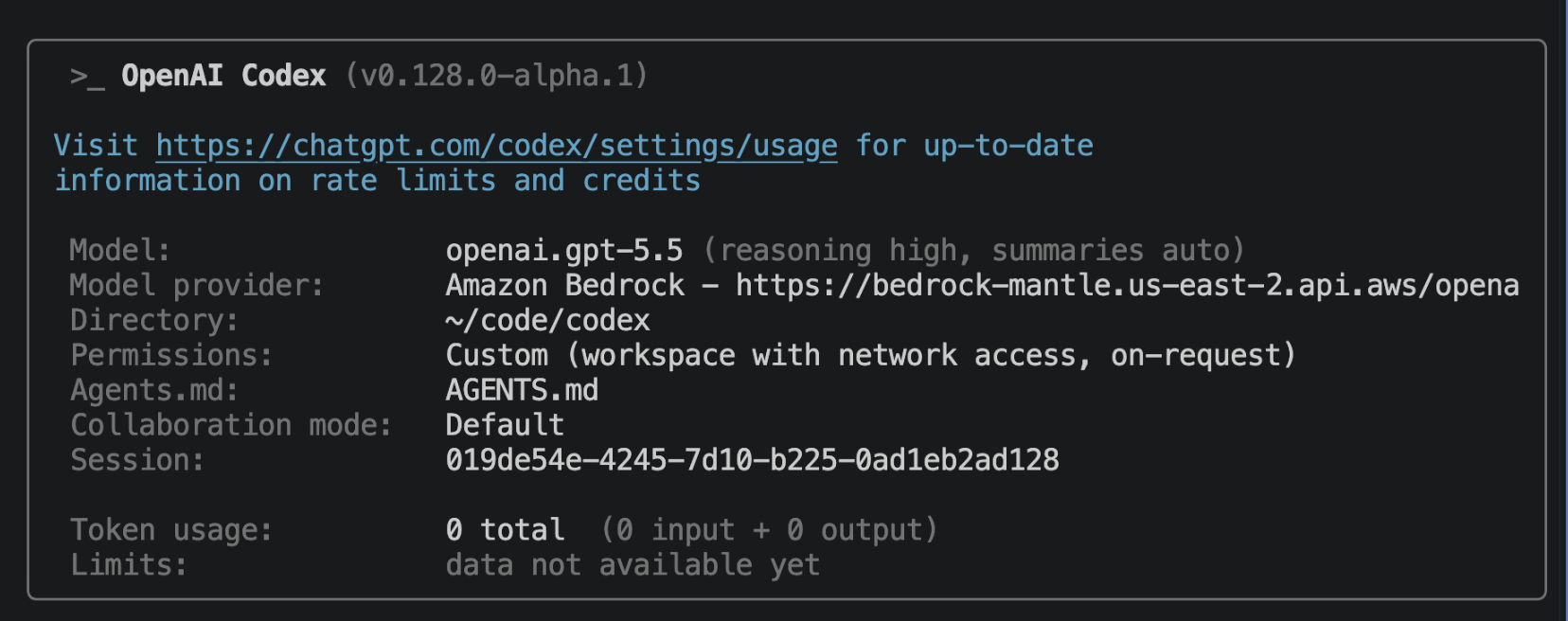
To get started, developers can configure Codex to use Bedrock for model inference. This involves setting environment variables for authentication, either via an Amazon Bedrock API key or the AWS SDK credential chain. By specifying themodelasopenai.gpt-5.5(oropenai.gpt-5.4,openai.gpt-oss-120b,openai.gpt-oss-20b) andmodel_providerasamazon-bedrockin the~/.codex/config.tomlfile, developers can direct Codex requests through their chosen Bedrock region. This straightforward setup ensures that all the benefits of Bedrock’s managed service, including data residency and performance, are applied to Codex operations. The visual feedback within the Codex CLI’s/statustab or the desktop app confirms successful integration, providing a seamless user experience.
Security, Data Residency, and Cost-Effectiveness
A critical advantage of accessing these OpenAI models through Amazon Bedrock is the inherent security, compliance, and data residency features provided by AWS. For customers with stringent data residency requirements, all processing associated with the models remains within the specific Bedrock Region selected by the user. This addresses a major concern for enterprises operating in regulated industries or geographies, ensuring sensitive data does not leave designated boundaries.
Furthermore, Amazon Bedrock offers a flexible, pay-per-token pricing model. This eliminates the need for seat licenses or per-developer commitments, making advanced AI capabilities more financially accessible and scalable for businesses of all sizes. Organizations only pay for the actual usage, allowing for cost optimization and efficient resource allocation. This consumption-based model is particularly attractive for development teams experimenting with AI or for applications with fluctuating demand, as it avoids prohibitive upfront costs and fixed subscription fees.
Strategic Implications and Market Impact
The general availability of OpenAI’s GPT-5.5, GPT-5.4, and Codex on Amazon Bedrock carries significant strategic implications for the broader AI and cloud computing markets.
- Strengthening Bedrock’s Position: This integration significantly bolsters Amazon Bedrock’s appeal as a premier platform for generative AI development. By offering access to frontier models from a leading AI innovator like OpenAI, AWS solidifies Bedrock’s competitive standing against other cloud providers and direct-to-model API access options. It provides enterprises with a compelling reason to standardize their generative AI initiatives on AWS, leveraging the platform’s comprehensive ecosystem of services.
- Accelerating Enterprise AI Adoption: The combination of OpenAI’s powerful models with Bedrock’s managed service simplifies the adoption curve for enterprises. The reduced operational burden, coupled with enhanced security and scalability, will likely encourage more organizations to experiment with and deploy generative AI solutions across various business functions, from automating routine tasks to powering innovative new products and services.
- Democratizing Advanced AI: By making these sophisticated models accessible through a managed cloud service, AWS and OpenAI are further democratizing access to cutting-edge AI. Small and medium-sized businesses, as well as startups, can now leverage capabilities previously exclusive to large corporations with extensive R&D budgets, fostering innovation across the industry.
- Impact on Software Development: The enhanced capabilities of Codex, particularly when powered by GPT-5.5, are poised to transform software development practices. The potential for AI-assisted coding to improve productivity, reduce errors, and accelerate time-to-market is immense. This could lead to a fundamental shift in how software is designed, developed, and maintained, enabling developers to focus on higher-level architectural challenges and creative problem-solving rather than boilerplate code generation.
- Competitive Landscape: This announcement intensifies the competition among cloud providers in the generative AI space. Microsoft, with its deep partnership with OpenAI, and Google Cloud, with its Vertex AI platform, are also vying for enterprise AI workloads. AWS’s move to directly integrate OpenAI’s latest models demonstrates its commitment to offering a diverse choice of top-tier FMs to its customers, ensuring it remains a central player in the evolving AI ecosystem.
Availability and Future Outlook
As of the announcement, the GPT-5.5 model is generally available in the US East (Ohio) Region, while the GPT-5.4 model is accessible in both the US East (Ohio) and US West (Oregon) Regions. Customers are advised to check the official AWS documentation for the full list of regions and any future updates on model availability.
The integration of these advanced OpenAI models into Amazon Bedrock represents more than just a product launch; it signifies a pivotal moment in the ongoing evolution of enterprise AI. It empowers developers and organizations to build more intelligent, more efficient, and more innovative applications, pushing the boundaries of what is possible with artificial intelligence. AWS encourages developers to explore the capabilities of GPT-5.5, GPT-5.4, and Codex on Amazon Bedrock today, providing channels like AWS re:Post for Amazon Bedrock and existing AWS Support contacts for feedback and assistance. The future roadmap includes console support for these GPT models, further enhancing their accessibility and ease of use. This continuous development underscores AWS’s commitment to delivering state-of-the-art AI solutions to its global customer base.
