


OpenRouter has unveiled Fusion, an innovative API that challenges the dominance of expensive, high-end AI models by proposing a novel approach: combining the strengths of multiple cost-effective models to achieve comparable, and in some cases superior, performance. This ambitious strategy is built on the premise that a carefully orchestrated ensemble of less costly AI agents can rival the capabilities of a single, premium offering, exemplified by Anthropic’s recently restricted Claude Fable 5. The timing of Fusion’s release is particularly noteworthy, coinciding with a significant regulatory development that has impacted the accessibility of Fable 5, creating an immediate market opportunity for OpenRouter’s disruptive solution.
The Fusion API operates on a sophisticated parallel processing and synthesis model. When a user submits a prompt, Fusion distributes it simultaneously to a curated panel of AI models. Each of these models is equipped with access to web search and bash tools, enabling them to gather information and execute commands relevant to the query. Following the individual model responses, a dedicated "judge" model meticulously analyzes the outputs. This judge identifies points of consensus, discrepancies, and overlooked aspects across the various responses. Subsequently, a "synthesizer" model, defaulting to Claude Opus 4.8, integrates this comprehensive analysis to construct a singular, well-grounded, and coherent final answer. This multi-stage process aims to leverage the diverse strengths and knowledge bases of the individual models while mitigating their weaknesses.
A Market Disrupted by Regulatory Action
The launch of Fusion occurred against a backdrop of significant regulatory shifts in the AI landscape. Just days prior to Fusion’s announcement, Anthropic, a leading AI research company, was compelled to suspend its Fable 5 and Mythos 5 models for all non-U.S. individuals. This directive stemmed from a U.S. export control measure citing a disputed finding related to AI model "jailbreaking," a technique that bypasses safety restrictions. The abrupt unavailability of these powerful models created a void in the market, particularly for organizations and researchers outside the United States seeking cutting-edge AI capabilities.
OpenRouter wasted no time in capitalizing on this development. The company took to X (formerly Twitter) the following day, directly addressing the emergent gap in the market with a bold promise: "Fable-level intelligence at half the price." This strategic positioning highlighted Fusion’s potential as an immediate and cost-effective alternative for users who were suddenly cut off from Fable 5. The tweet, posted on June 13, 2026, accompanied by a visual explainer, quickly garnered attention, signaling OpenRouter’s intent to redefine the competitive dynamics within the AI model API space.
The Mechanics of Cost-Effective Intelligence
The technical architecture of Fusion is designed for efficiency and effectiveness. The parallel distribution of prompts ensures that multiple AI perspectives are gathered concurrently. The provision of web search and bash tools to each model in the panel allows for dynamic information retrieval and task execution, mirroring the advanced capabilities of leading single models.

The critical innovation lies in the post-response processing. The judge model acts as an intelligent arbiter, capable of discerning subtle nuances and critical differences between the individual model outputs. This rigorous evaluation prevents the final answer from being unduly influenced by any single model’s potential biases or errors. The subsequent synthesis step, orchestrated by a robust model like Opus 4.8, ensures that the aggregated information is not merely a collection of disparate facts but a cohesive and well-reasoned response. This approach addresses a common critique of ensemble methods, where the final output can sometimes lack coherence.
Users can integrate Fusion into their workflows in several ways. The simplest method is to switch their model string to "openrouter/fusion," which activates a default panel of AI models. For more granular control, developers can incorporate a "fusion tool" into their existing applications, allowing specific prompts to be routed to the Fusion API selectively. Furthermore, OpenRouter offers a no-code "Fusion chatroom" where users can construct custom panels of AI models tailored to their unique requirements, democratizing the creation of sophisticated AI ensembles.
Benchmarking Fusion’s Performance
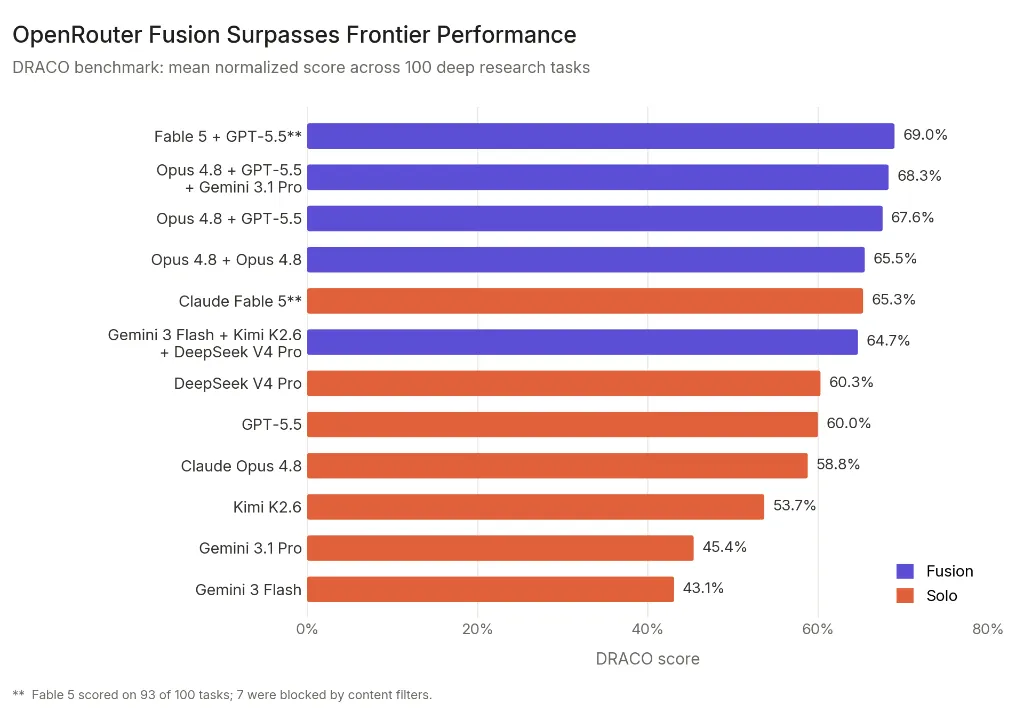
To substantiate its claims, OpenRouter subjected Fusion to rigorous testing using DRACO, a benchmark developed by Perplexity based on real-world, in-depth user research requests. In a critical evaluation, a Fusion panel comprising Gemini 3 Flash, the open-source Chinese models Kimi K2.6 and DeepSeek V4 Pro, and synthesized by Opus, achieved an impressive 64.7% score. This result not only surpassed the performance of solo GPT-5.5 (60%) and solo Opus 4.8 (58.8%) but also landed within a single percentage point of Fable 5, all at approximately half the cost.
Further analysis revealed the synergistic effect of the Fusion approach. Even pairing Opus 4.8 with a separate instance of itself resulted in a 65.5% score, a significant 6.7-point improvement over solo Opus. OpenRouter attributes approximately three-quarters of this gain to the synthesis step itself, with the remaining portion stemming from the genuine diversity of model perspectives. This finding underscores the power of intelligent aggregation in enhancing AI performance.
In another experimental setup, Fable 5, when paired with OpenAI’s GPT-5.5 and synthesized by Opus, topped the chart with a score of 69%. However, solo Fable 5 achieved a score of 65.3%. Notably, seven of the 100 tasks in this test failed to run due to Fable 5’s own content filters, highlighting a potential limitation even for leading models.
Addressing Benchmark Contamination
During the benchmarking process, a minor issue arose where providing the AI panel with live web access inadvertently allowed models to surface DRACO’s grading rubric within search results. OpenRouter acknowledged this as a "coincidental" contamination risk rather than a deliberate manipulation. The company swiftly implemented a fix by configuring the search tools to exclude the benchmark’s hosting domains. All published performance figures reflect the results obtained after this correction, ensuring the integrity of the evaluation. This transparency in addressing and resolving such issues is crucial for building trust in AI performance claims.
Implications and Future Outlook
While OpenRouter is transparent that Fusion is not a complete substitute for Fable 5, particularly in areas requiring extended reasoning or complex coding tasks, its value proposition is undeniable. For everyday operations and queries where a single model might overlook critical details, Fusion’s multi-perspective approach offers a distinct advantage. The collaborative nature of the Fusion panel is particularly beneficial for tasks involving deep research, intricate planning, and scenarios where identifying and reconciling contradictions is paramount.
The success of Fusion on benchmarks like DRACO suggests a paradigm shift in how organizations can access high-level AI capabilities. The era where only the most expensive, proprietary models could deliver top-tier results appears to be waning. A combination of accessible, cost-effective models, intelligently fused, can now compete directly with the performance of premium offerings, all while significantly reducing operational costs.
The reception to Fusion has been largely positive, with sentiment tracking on the launch thread indicating a two-to-one ratio of positive to negative reactions. Prominent AI researcher Andrew Trask described Fusion as "a way bigger deal than it seems," suggesting that frontier AI labs may no longer hold a monopoly on cutting-edge capabilities. He posited that this approach could democratize access to advanced AI and challenge the traditional dominance of a few key players.
However, some skepticism has also been voiced. Critics have pointed to perceived weaknesses in Fusion’s coding capabilities and tool-calling functions, along with concerns about a lack of direct comparative data given the current inaccessibility of Fable 5. The fact that Fusion relies on models routed through OpenRouter’s infrastructure means it does not inherently resolve the export control issues affecting models like Fable 5 at their source.
Nevertheless, for entities facing restrictions on access to premium AI models, Fusion presents a viable alternative. Other options include backend model swaps like DeepClaude, which aim to preserve the agentic capabilities of models like Claude Code while offering cost savings, or open-weight alternatives such as China’s GLM-5.2, which, while not necessarily superior, provide a competitive enough performance for their price point.
The broader implication of OpenRouter’s Fusion API is the acceleration of a trend towards more modular, composable, and democratized AI systems. By proving that the sum can be greater than its individual parts, and that cost-effectiveness can be achieved through intelligent orchestration, OpenRouter is poised to influence the future development and deployment of AI, potentially leveling the playing field and fostering greater innovation across the industry. The competitive pressure exerted by Fusion on established AI providers is likely to spur further advancements in model efficiency, cost optimization, and novel integration strategies.
