
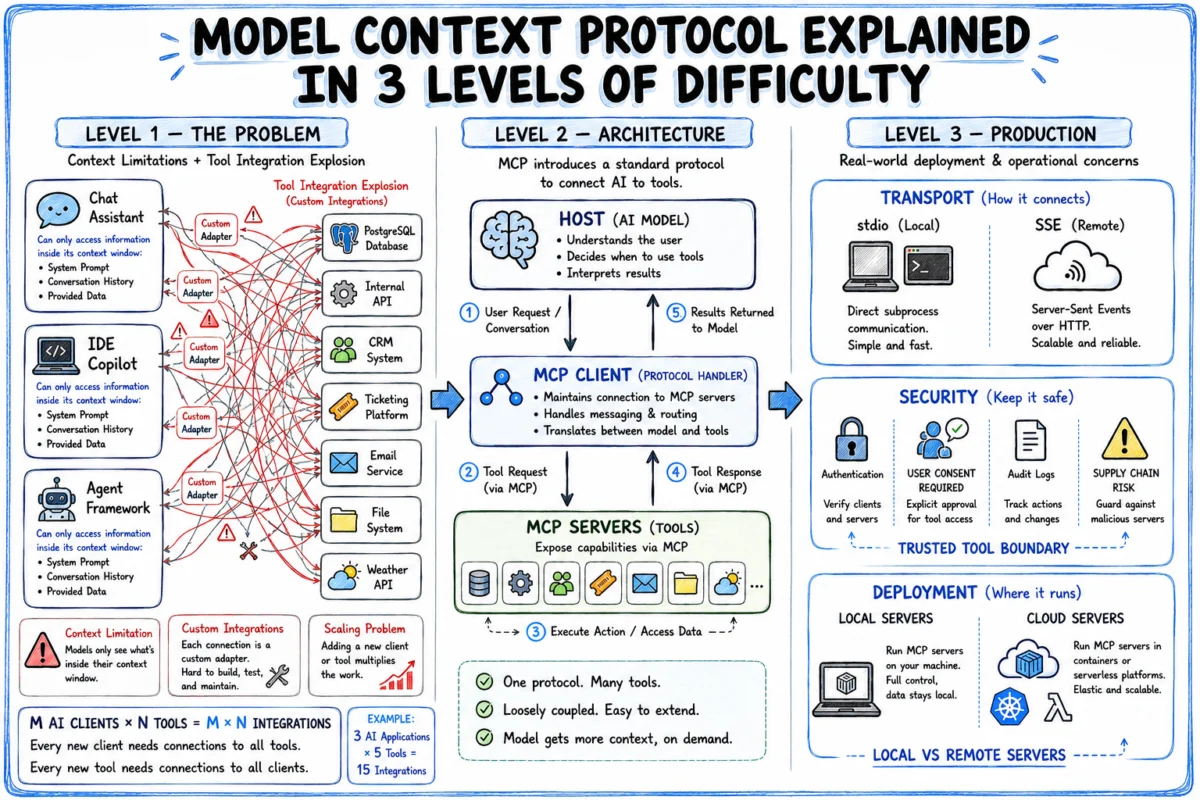

Every large language model (LLM) possesses a fundamental limitation: its operational knowledge is strictly confined to its training data. This inherent constraint means that asking an LLM about a contemporary event, a proprietary document on a local machine, a specific entry in a corporate database, or a newly arrived email will typically result in a failure to respond accurately or, at best, a speculative guess. The model operates in a silo, disconnected from the dynamic, real-world systems that modern applications rely upon, leaving developers with the significant challenge of bridging this gap.
Historically, the prevalent method for connecting AI models to external data and functionalities has involved writing custom integrations. This often translates into a patchwork of bespoke functions and tool definitions designed to funnel external data into the model’s context window. While functional for small-scale projects or proof-of-concepts, this approach quickly becomes unwieldy. As the number of AI models and external services proliferates within an organization, developers find themselves maintaining a complex matrix of one-off adapters. Each adapter frequently carries its own authentication logic, schema assumptions, and unique failure modes, creating a significant technical debt. The introduction of a new model or a new external service necessitates a laborious rework of this entire integration matrix, hindering agility and scalability. Industry reports suggest that developers can spend upwards of 30-40% of their time on integration and maintenance tasks, a figure exacerbated by the lack of standardization in AI ecosystems.
The Model Context Protocol (MCP), an open standard spearheaded by Anthropic, offers a transformative solution to this pervasive integration problem. Instead of each AI application developing unique connectors for every external system, MCP proposes a shared protocol that both sides implement. An external service, once configured as an MCP server, exposes its capabilities in a standardized manner, allowing any MCP-compatible client to seamlessly interact with it. This paradigm shift from a fragmented, custom-integration landscape to a unified, protocol-driven ecosystem promises to streamline AI application development, enhance interoperability, and significantly reduce operational overhead.
This comprehensive article delves into the intricacies of MCP, dissecting its mechanics across three escalating levels of understanding. We will first explore the fundamental rationale behind MCP and its core innovative concept, addressing the "why." Subsequently, we will unravel its architectural components and illustrate the typical flow of a request, detailing the "how." Finally, we will scrutinize the critical production-level considerations, including transport mechanisms, security imperatives, and deployment strategies, providing insights into the "where and what if."
The Genesis of the Integration Challenge in AI
The evolution of artificial intelligence has been marked by continuous breakthroughs, none more impactful in recent years than the advent of large language models. These sophisticated models, trained on vast datasets, demonstrate remarkable capabilities in understanding, generating, and processing human language. However, their prowess is intrinsically linked to the static nature of their training data. For AI applications to move beyond mere conversational interfaces and become truly intelligent agents capable of performing real-world tasks, they must interact with dynamic, external environments.
The concept of "tool calling," also known as "function calling," emerged as an initial response to this need. Platforms like OpenAI’s API enabled models to declare their intent to use external functions, with the application layer executing these requests and feeding the results back into the model’s context. This allowed LLMs to, for example, query databases, invoke APIs, interact with file systems, or send emails. While a significant step forward, this approach quickly exposed a new set of challenges related to integration complexity.
Consider a scenario where an enterprise deploys multiple AI applications—perhaps a customer service chatbot, an internal knowledge management assistant, and an automated data analysis agent. Each of these applications might need to access a diverse array of internal and external tools, such as a CRM system, an ERP database, a project management tool, and a third-party analytics service. Without a universal standard, each AI client typically requires a custom-built integration for every tool it needs to interact with. This leads to an "M × N" integration problem, where ‘M’ represents the number of AI applications and ‘N’ represents the number of external tools. If, for instance, an organization has three AI applications requiring access to five different tools, it could necessitate the development and maintenance of fifteen distinct integrations. Adding a new tool would require integrating it with all existing clients, and adding a new client would demand integration with every available tool, creating an exponentially growing burden.
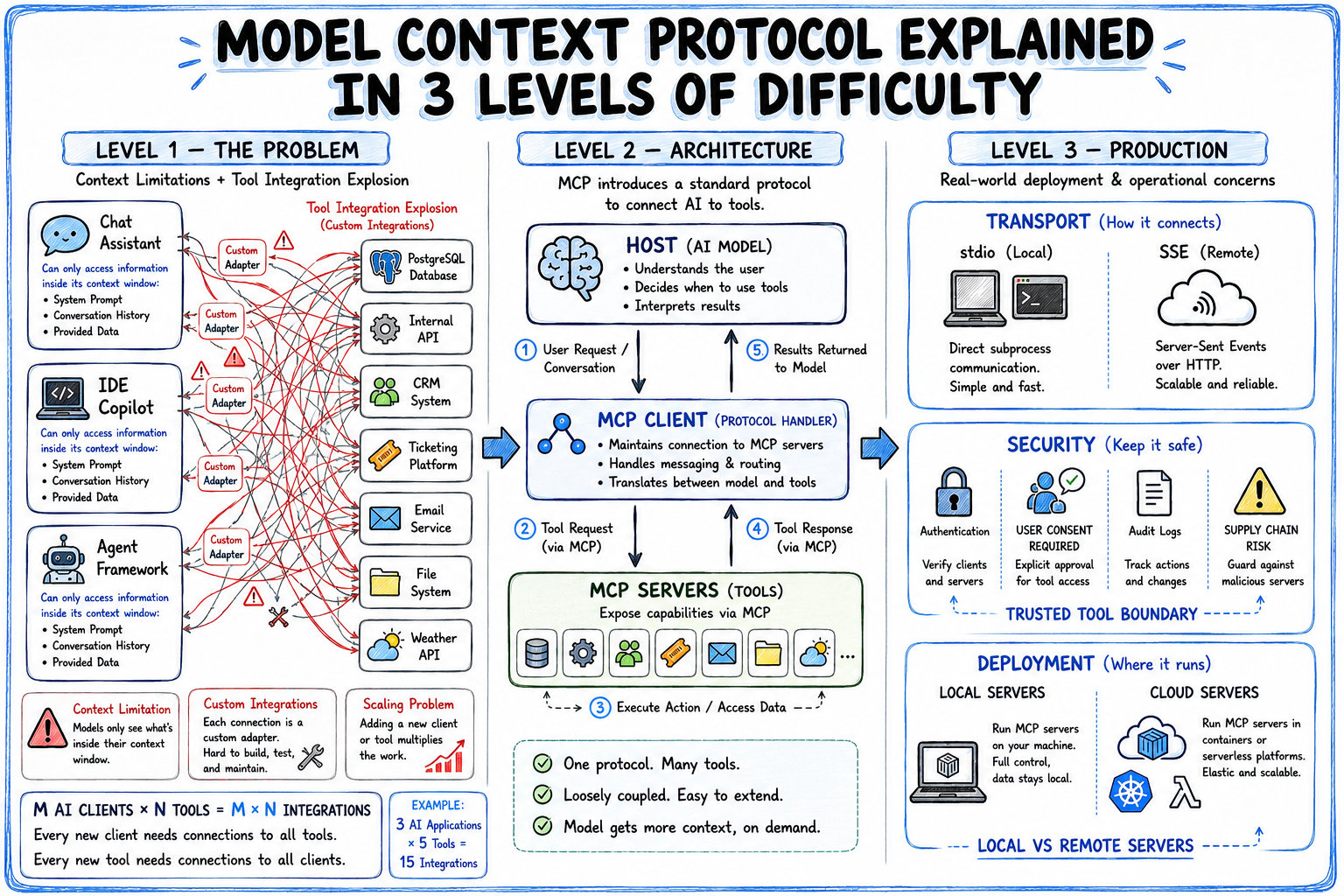
MCP directly addresses this combinatorial explosion by introducing a shared protocol. Instead of M × N custom adapters, each client implements the MCP specification once, and each tool exposes its capabilities as an MCP server once. This transforms the integration surface from M × N custom adapters to approximately M + N protocol implementations, drastically simplifying the architecture and reducing development effort. This shift enables a more composable and resilient AI ecosystem, where an MCP server exposing, say, a PostgreSQL database or an internal ticketing system, can be leveraged by numerous assistants, integrated development environments (IDEs), and agent frameworks through a single, standardized interface.
Architectural Blueprint: Host, Client, and Server Dynamics
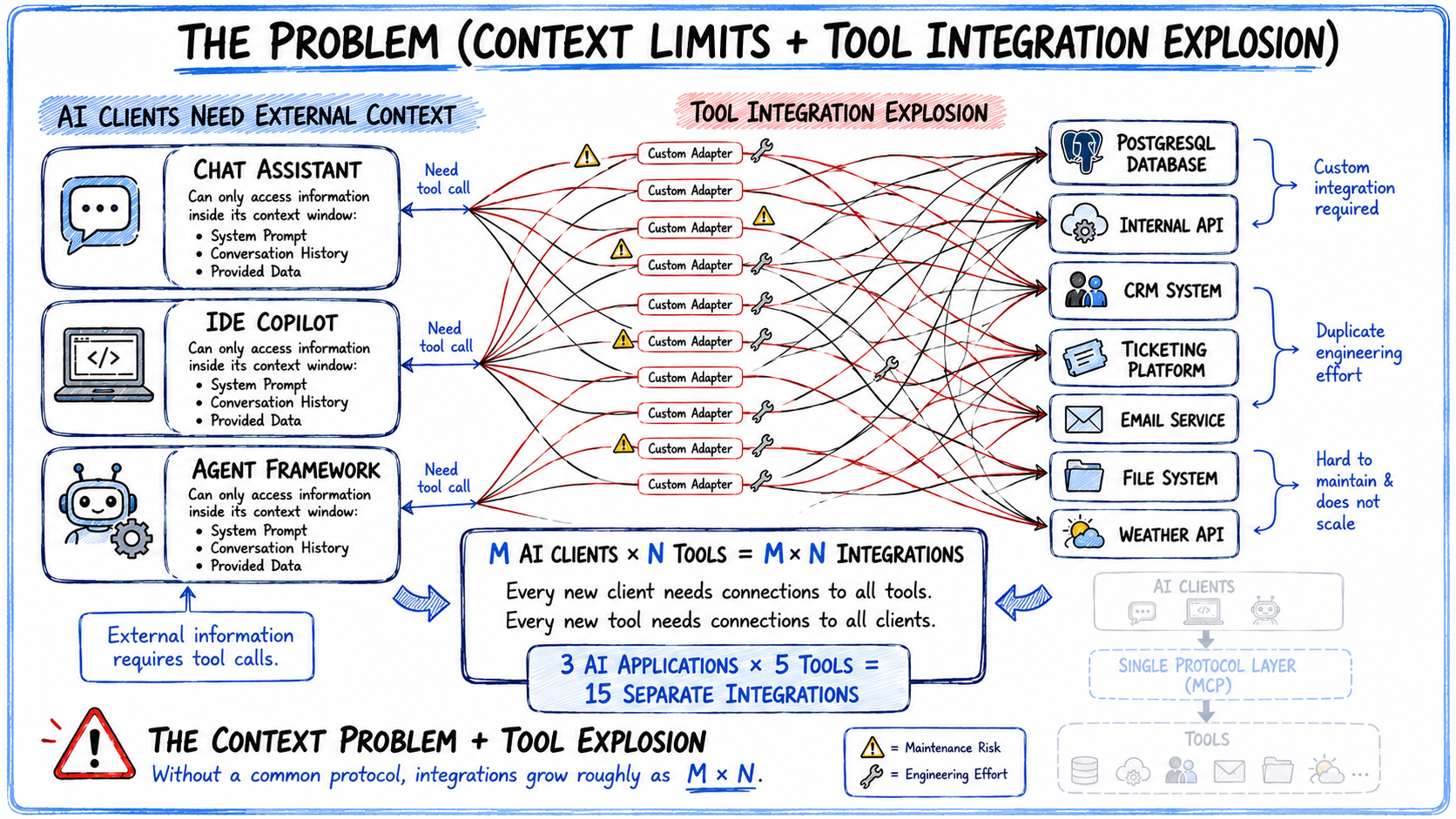
MCP defines a clear architectural framework involving three primary components: the host, the client, and the server. Understanding their interplay is crucial to grasping how MCP facilitates seamless AI-tool interaction.
The Host
The host is the user-facing application where the AI interaction originates. This could manifest as a conversational interface like a chatbot, an AI-powered IDE assisting developers, or a complex custom agent orchestrating multiple tasks. The host essentially houses the large language model and manages the overall conversation or workflow. When the model determines that it requires external information or action, the initial decision to "reach out" to an external system is made within the host environment.
The Client
Nestled within the host, the MCP client is the sophisticated intermediary responsible for managing the protocol’s mechanics. Its duties include maintaining a comprehensive registry of all available MCP servers and their exposed capabilities. When the language model expresses a need for an external function, the client translates the model’s high-level request into a properly formatted MCP call, ensuring adherence to the protocol’s specifications. It then dispatches this call to the appropriate MCP server, handles the communication, and finally converts the server’s response back into a format that the model can readily interpret and utilize. From the model’s perspective, the client handles all the underlying "plumbing," abstracting away the complexities of external system interaction.
The Server
The MCP server acts as the secure gateway to an external system. It is responsible for registering its specific capabilities—detailing the tools it offers, the data it can provide, and any relevant metadata. Upon receiving a request from an MCP client, the server executes the required operation on the underlying external system. For instance, a server fronting a database would take a structured tool call from the client, securely run the appropriate query, and return the results in a standardized format consumable by the model. Critically, the server encapsulates all the implementation details of that external system; the client and the model only ever interact with the standardized MCP interface, maintaining a clean separation of concerns.
To illustrate this dynamic, consider a user instructing an AI assistant: "Retrieve the Q2 revenue figures from the financial database and then draft a summary email for the executive team." The AI model, analyzing this request, identifies two distinct tasks beyond its intrinsic capabilities. The MCP client, referencing its registry, locates a database_query tool exposed by a financial data MCP server and an email_draft tool provided by an email service MCP server.
The model first invokes the database_query tool, passing parameters such as "Q2 revenue" and "financial database." The client forwards this request to the financial data server. The server, in turn, executes a secure query against the actual database, formats the retrieved revenue numbers, and sends them back to the client. The client then relays these real figures to the model. With the necessary data at hand, the model then calls the email_draft tool, providing parameters like recipient list, content (based on the Q2 data), and subject. The email server processes this request, drafting and potentially sending the email, and then confirms success to the client, which informs the user. Crucially, neither MCP server had direct knowledge of the other’s existence or functionality. The model orchestrated the workflow, the client handled all protocol translations, and the developer was spared from writing any bespoke integration code between the model and either external system.
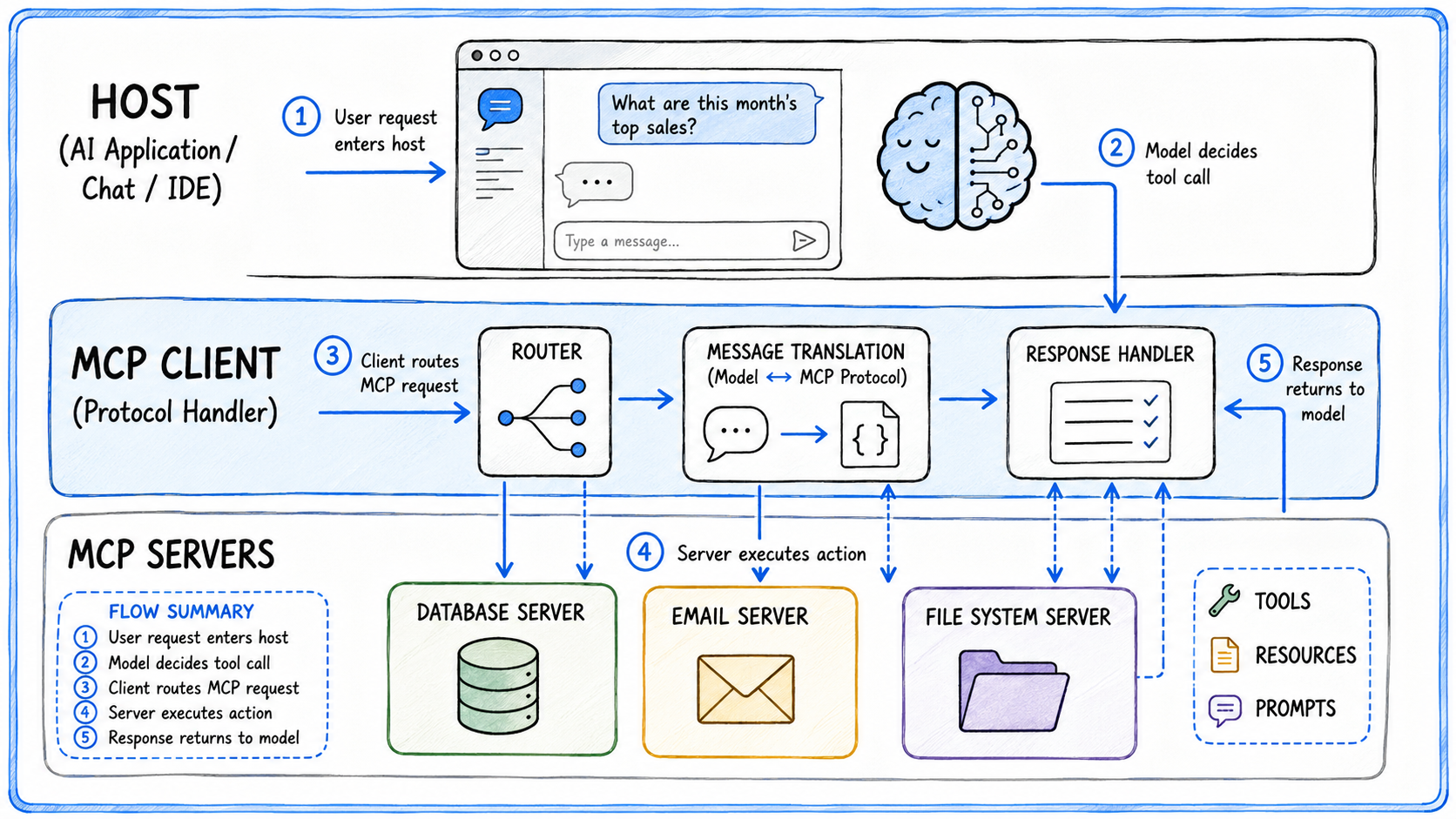
MCP servers expose three distinct categories of capabilities:
- Tools: These represent actionable operations that modify an external system or trigger a side effect. Examples include
send_email,create_ticket,update_record, orprocess_payment. Calling a tool typically involves a higher level of risk and therefore warrants stringent authorization. - Resources: These refer to passive data retrieval operations that do not alter the state of the external system. Examples include
read_document,get_user_profile, orlist_files. Reading resources is generally considered lower risk than executing tools. - Prompts: These are pre-defined textual instructions or templates that can be dynamically populated and presented to the model. While less about direct system interaction, prompts help guide the model’s behavior or provide structured input for specific tasks.
The clear distinction between tools and resources is operationally significant. It allows for the application of different authorization policies and security controls. For instance, an AI agent might have broad permissions to read various resources but require explicit user consent or a more restrictive access policy before executing a tool that writes to a production system.
Under the Hood: Transport, Security, and Deployment Considerations
Moving beyond conceptual understanding, the practical viability of an MCP deployment hinges on robust solutions for message transport, stringent security measures, and flexible deployment strategies. These are the aspects that determine an MCP system’s resilience and trustworthiness in a production environment.
How Client and Server Actually Communicate: Layers of Abstraction
MCP meticulously separates communication into two distinct layers to ensure flexibility and maintainability:
- Data Layer: This layer defines the logical structure of the messages exchanged, specifying the format of tool calls, resource requests, and responses. It dictates what information is communicated.
- Transport Layer: This layer handles the physical transmission of these messages, determining how they are sent between the client and server.
This architectural separation is a cornerstone of MCP’s design. Two MCP servers, even if exposing identical tools, can operate over entirely different transport mechanisms without affecting the data layer’s understanding of the tool’s behavior. This allows for swapping or upgrading transport technologies without requiring modifications to the core logic of how tools are invoked or how data is structured.
MCP currently defines two primary transport protocols:
- HTTP (Hypertext Transfer Protocol): A stateless, request-response protocol widely used across the internet. It is well-suited for typical API interactions where a client sends a request and expects a single response. Its ubiquity and established security mechanisms make it a robust choice for many MCP deployments.
- WebSocket: A full-duplex communication protocol over a single TCP connection, allowing for real-time, bidirectional data transfer. WebSocket is ideal for scenarios requiring persistent connections, streaming data, or rapid, event-driven interactions, where the overhead of repeatedly establishing HTTP connections would be detrimental.
The choice between HTTP and WebSocket depends on the specific requirements of the external system and the AI application. For instance, querying a database or sending an email might effectively use HTTP, while monitoring a live data stream or receiving continuous updates from an IoT device might necessitate WebSocket.
The Trust Problem and Security Imperatives
The power of MCP lies in its ability to grant AI models direct access to critical enterprise systems. This power, however, introduces significant security considerations, particularly concerning the "trust problem." A compromised or malicious MCP server could potentially expose sensitive data, execute unauthorized actions, or even be leveraged for lateral movement within a network. Mitigating these risks is paramount, and the MCP security best practices provide a comprehensive framework:
- User Consent and Transparency: Before an AI agent acts or shares data via an MCP server, obtaining explicit user consent is crucial. Transparency about what actions the agent intends to take builds user trust and helps prevent unintended operations.
- Principle of Least Privilege: MCP servers should be configured with the narrowest possible scope of access to external systems. Limiting what a server can see or do minimizes the impact of a potential breach. For example, a server for a file system should only access designated directories, not the entire root.
- Vetting Tool Descriptions: While MCP servers provide self-descriptions of their tools and resources, these descriptions should not be implicitly trusted. Organizations must vet and validate the actual functionality of a server’s exposed capabilities, especially if the server is developed by a third party or is new to the environment.
- Input/Output Sanitization: Data flowing into and out of the model through MCP must be rigorously sanitized. Malicious input could lead to injection attacks (e.g., SQL injection through a database query tool), and unsanitized output could inadvertently expose sensitive information in logs or to users.
- Robust Auditing and Logging: Comprehensive auditing of all tool activity is essential. Detailed logs tracking which agent called which tool, with what parameters, and at what time, enable detection of misuse, compliance checks, and forensic analysis in case of a security incident.
A distinct exposure problem also exists: a malicious server could, during routine OAuth discovery or capability advertisement, provide URLs pointing to internal IP addresses or cloud metadata endpoints. Furthermore, local MCP servers, if not properly sandboxed, execute with the user’s own privileges, potentially allowing unreviewed startup commands to access the local filesystem directly. The countermeasures involve: validating authentication tokens to ensure they were issued for the intended client, binding sessions to real user identities, granting narrowly defined scopes for server access, and critically, sandboxing local servers rather than trusting them by default. These measures collectively establish a robust security posture for MCP deployments.
Google’s overview of MCP further emphasizes these security tenets, advocating for continuous vigilance and proactive security engineering. Industry reports highlight that inadequate API security is a leading cause of data breaches, and MCP, by standardizing these interfaces, offers an opportunity to embed security more deeply into AI integrations rather than treating it as an afterthought.
Choosing Where MCP Servers Run
The decision of where to deploy MCP servers mirrors the transport choice, often aligning with a local-versus-remote split based on data sensitivity, performance requirements, and operational control.
- Local Deployment: Running MCP servers directly on a user’s machine or within a private network is ideal for interacting with highly sensitive local data (e.g., personal files, proprietary enterprise databases behind firewalls) or for rapid development and testing. This approach minimizes data transit risks and maintains data residency.
- Remote Deployment: Deploying MCP servers on cloud platforms or centralized enterprise servers offers scalability, accessibility for multiple clients, and simplified management. This is suitable for public-facing tools, shared services, or data that can be securely accessed over a network.
On the hosting side, cloud providers offer a spectrum of options. Serverless platforms like Google Cloud Run are well-suited for simple, stateless tools that can scale down to zero instances when idle, optimizing cost and operational overhead. For stateful applications or those requiring finer-grained control over infrastructure, managed Kubernetes environments provide robust orchestration, high availability, and the ability to handle high-throughput, complex workloads. The decision between managed hosting and self-hosting on proprietary hardware often boils down to compliance requirements, data residency constraints, and internal operational capabilities. Managed services handle uptime, scaling, and maintenance, trading full control for convenience and reduced operational burden, while self-hosting offers maximum control but demands significant internal expertise and resources.
A Growing Ecosystem to Build On and Future Outlook
MCP is not merely a theoretical construct; it is an actively developing open standard with a burgeoning ecosystem. Open-source SDKs are available for major programming languages, enabling developers to easily build both MCP clients and servers. A steadily growing collection of ready-made MCP servers for common enterprise systems, such as GitHub, Slack, and PostgreSQL, significantly reduces the barrier to entry, often eliminating the need to build connectors from scratch. Client support is also expanding, with leading IDEs like Visual Studio Code and prominent AI assistants like Claude integrating native MCP capabilities.
This widespread adoption and collaborative development signal MCP’s trajectory towards becoming a foundational layer for AI application development. Industry analysts predict that as AI becomes more embedded in enterprise workflows, the demand for seamless, secure, and standardized integration will only intensify. MCP’s approach to abstracting away integration complexities is poised to accelerate innovation, allowing developers to focus on core AI logic rather than connectivity plumbing. Furthermore, by embedding robust security principles directly into the protocol, MCP is instrumental in fostering a more trustworthy AI landscape, addressing growing concerns about data privacy and system integrity.
In conclusion, MCP provides a critical solution to a pervasive integration problem encountered by anyone building AI-powered applications. The protocol offers a clean, standardized separation between the AI application and external capabilities, ensuring a well-defined and secure interface. As its adoption continues to grow, MCP is rapidly solidifying its position as a common foundation for constructing AI systems that can reliably and securely interact with the vast array of software and data upon which modern enterprises depend. This standardization is not just a technical convenience; it represents a strategic enabler for the next generation of intelligent applications.
