

Amazon Web Services (AWS) today announced the launch of AWS Lambda MicroVMs, a groundbreaking new serverless compute primitive designed to revolutionize how developers run user-generated or AI-generated code in highly isolated, stateful execution environments. This innovation addresses a critical gap in the serverless landscape, offering virtual machine (VM) level isolation, near-instant launch and resume capabilities, and direct control over environment lifecycle and state, all while abstracting away the complexities of infrastructure management and specialized virtualization expertise. Powered by Firecracker, the same lightweight virtualization technology that underpins over 15 trillion monthly AWS Lambda function invocations, Lambda MicroVMs promise to unlock new possibilities for multi-tenant applications requiring robust security and persistent state.
The Evolving Landscape and the Need for a New Paradigm
The rapid evolution of cloud computing has led to a proliferation of serverless architectures, lauded for their scalability, cost-efficiency, and reduced operational overhead. However, certain emerging application patterns have consistently challenged the capabilities of existing serverless and containerized solutions. Over the past few years, a distinct class of multi-tenant applications has surged in popularity, each sharing a fundamental requirement: the need to provide individual end-users with their own dedicated, secure execution environment to run code not written by the application developer. This category includes a diverse range of use cases such as sophisticated AI coding assistants, interactive code development environments, collaborative data analytics platforms, automated vulnerability scanners, and even game servers that execute user-supplied scripts.
Developers building these applications have historically faced a difficult compromise. Traditional virtual machines offer the strongest isolation guarantees, critical for security when running untrusted code, but their lengthy startup times, often measured in minutes, make them unsuitable for interactive, low-latency user experiences. Conversely, containers, while launching in seconds, operate on a shared-kernel architecture. This design inherently requires significant custom hardening and advanced security configurations to safely contain untrusted code, a complex and error-prone endeavor that few organizations have the deep expertise to manage effectively. Functions-as-a-Service (FaaS) platforms, such as traditional AWS Lambda functions, excel at event-driven, request-response workloads, but they are fundamentally stateless and optimized for ephemeral execution. They are not designed to maintain long-running interactive sessions or retain environment state across user interactions, which is crucial for a seamless user experience in many modern applications.
This dilemma has forced developers into a difficult choice: either accept trade-offs between performance and isolation, or invest substantial engineering resources into building, operating, and maintaining custom virtualization infrastructure. Such an undertaking demands deep expertise in kernel-level security, low-level system programming, and complex distributed systems, diverting precious engineering time and talent away from developing the core product features. AWS Lambda MicroVMs have been purpose-built to bridge this critical gap, offering a serverless solution that delivers both strong isolation and interactive performance without the operational burden.

Introducing Lambda MicroVMs: Bridging the Gap
Lambda MicroVMs represent a significant leap forward, providing three previously unavailable capabilities in a single AWS compute service. These capabilities collectively enable a new generation of secure, responsive, and cost-effective multi-tenant applications.
Virtual Machine-Level Isolation: Uncompromising Security
At the heart of Lambda MicroVMs’ security model is Firecracker, the open-source virtualization technology developed by AWS. Each user session within a Lambda MicroVM runs in its own dedicated, lightweight VM. This architecture ensures a strict "shared-nothing" isolation model, meaning there is no shared kernel or shared resources between different user environments or with the underlying host system. This level of isolation is paramount when executing untrusted code. Should a malicious or buggy user-supplied script attempt to breach its boundaries, it is contained entirely within its dedicated MicroVM, preventing any access to other users’ environments, sensitive application data, or the underlying AWS infrastructure. This inherent security posture significantly reduces the attack surface and minimizes the need for complex custom security hardening, democratizing advanced virtualization security for a broader developer audience. The operational maturity derived from Firecracker’s deployment across trillions of Lambda function invocations instills confidence in its robustness and scalability.
Rapid Launch and Resume: Instant Responsiveness
One of the most compelling features of Lambda MicroVMs is its ability to achieve near-instant startup latency for both initial launches and subsequent resumes. This is facilitated by an innovative "image-then-launch" model. Developers begin by creating a MicroVM Image, typically by providing a Dockerfile and their application code packaged as a zip artifact in Amazon S3. AWS Lambda then processes this Dockerfile, initializes the application within a temporary environment, and crucially, takes a Firecracker snapshot of the running environment’s memory and disk state.
Every subsequent MicroVM launched from this pre-initialized image does not undergo a cold boot process. Instead, it resumes directly from this snapshot. This means that when a user initiates a session, their application is already initialized, dependencies loaded, and ready to serve requests the moment the MicroVM is launched. Similarly, when a user returns to an idle session, the MicroVM resumes from its suspended state with the application fully intact, eliminating the frustrating wait times associated with traditional VM startups. Even complex interactive sessions involving multi-gigabyte memory footprints can come back online quickly enough to feel entirely responsive to the end user, dramatically enhancing the user experience for interactive applications.
Stateful Execution and Cost Efficiency: Persistent Sessions
Unlike traditional FaaS functions, a running Lambda MicroVM retains its complete state throughout the user’s session. This includes memory contents, disk state (such as installed packages, cached data, and working filesets), and all running processes. This statefulness is vital for applications that require persistence across user interactions, such as an AI coding assistant maintaining context or a data analytics platform preserving intermediate results.

Further enhancing its appeal, Lambda MicroVMs offer a clever mechanism for cost efficiency during idle periods. A MicroVM can be suspended, either explicitly via an API call or automatically based on a configurable idle policy. When suspended, its memory and disk state are preserved, but the compute resources are deallocated, significantly reducing running costs. When traffic arrives for a suspended MicroVM, it is rapidly resumed with its application state fully intact, providing a seamless experience for the end user who perceives no interruption. This feature makes it highly suitable for applications with unpredictable usage patterns or extended idle times, allowing for products as varied as software vulnerability scans that complete in minutes, data analytics applications that run for hours, and interactive coding sessions with extended breaks. Lambda MicroVMs support up to 8 hours of total runtime, offering ample duration for most interactive and batch processing tasks. It’s important to note that applications generating unique content, establishing network connections, or loading ephemeral data during initialization may need to integrate with service-provided hooks for compatibility when resuming from snapshots.
Practical Implementation: A Streamlined Developer Experience
Getting started with Lambda MicroVMs is designed to be straightforward, leveraging familiar AWS interfaces and tools. Developers can navigate to the AWS Lambda console, where Lambda MicroVMs now appear in the left-hand navigation menu, or use the AWS Command Line Interface (CLI).
The process begins with creating a MicroVM Image. A developer would package their application (e.g., a Flask web app) and its Dockerfile into a zip file, then upload it to an Amazon Simple Storage Service (Amazon S3) bucket. Using a command like aws lambda-microvms create-microvm-image, specifying the S3 artifact URI, image name, a base image ARN (e.g., al2023-minimal), and an IAM build role, Lambda retrieves the zip file. It then executes the Dockerfile, initializes the application, and takes a Firecracker snapshot of the running disk and memory state. Build logs stream in real-time to Amazon CloudWatch, providing transparency into the image creation process. Once the image is ready, it appears in the console with its Amazon Resource Name (ARN) and version number.
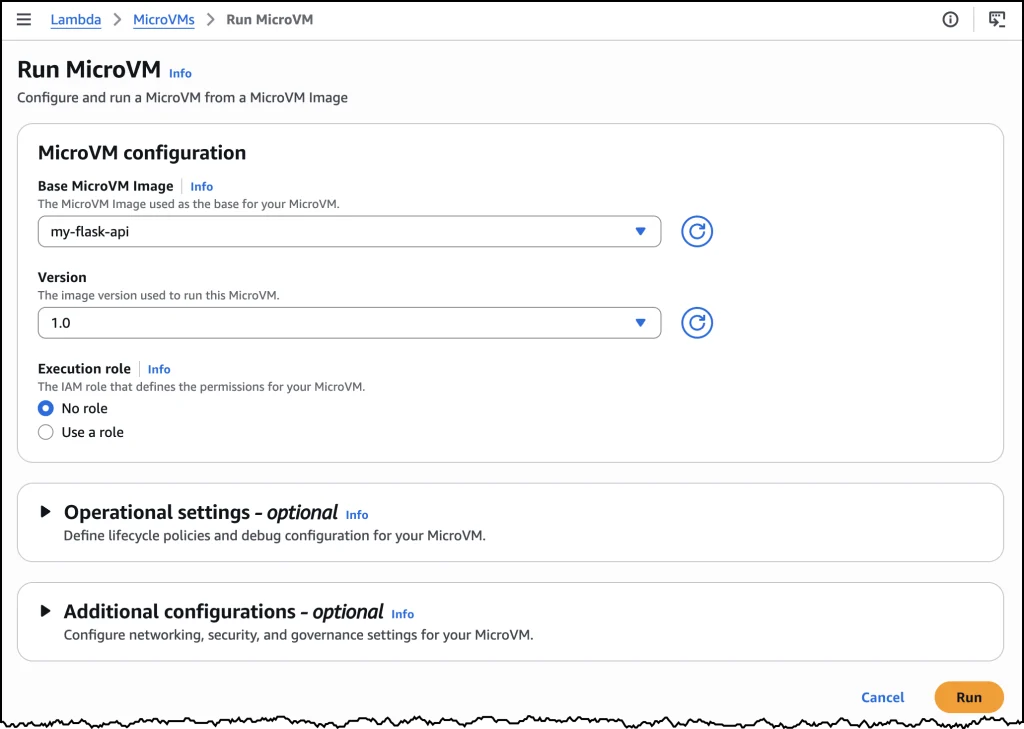
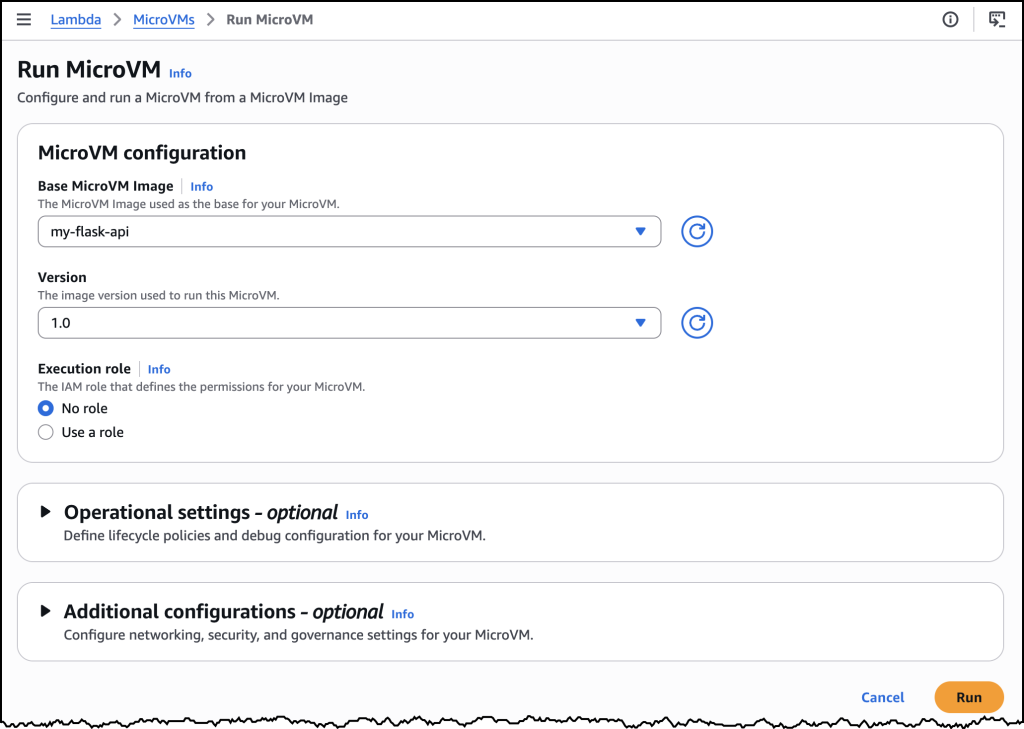
Launching a MicroVM is equally simple, achievable via the AWS Console or the CLI using aws lambda-microvms run-microvm. Developers specify the image ARN, an execution role, and an idle policy. For instance, an idle policy could be configured to automatically suspend the MicroVM after 15 minutes of inactivity and auto-resume upon the next incoming request. AWS Lambda handles all networking setup, assigning the MicroVM a unique ID and returning a dedicated endpoint URL. Because the MicroVM starts from a pre-initialized snapshot, the application is already running the moment the launch completes, offering a fully bootstrapped compute environment with just one API call.
To interact with the running MicroVM, a short-lived authentication token can be generated via the CLI and attached to a standard HTTPS request using the X-aws-proxy-auth header. The request is immediately routed to the running application. The system elegantly handles idle periods: if a MicroVM sits idle past its configured suspend threshold, it is automatically suspended, with its memory and disk state snapshotted and stored. When another request arrives, the MicroVM resumes with the application state fully intact, creating a seamless experience where, from the client’s perspective, the pause never occurred. This rapid and transparent suspend-resume cycle is a cornerstone of the MicroVMs’ design, balancing performance with cost efficiency.

Under the Hood: Firecracker and AWS Operational Maturity
The robust foundation of Lambda MicroVMs lies in Firecracker, an open-source virtualization technology that has been instrumental in the success and scale of AWS Lambda and AWS Fargate. Firecracker provides lightweight virtual machines (microVMs) that are purpose-built for creating and managing secure, multi-tenant container and function services. Its design focuses on minimal overhead, fast startup times, and enhanced security, making it an ideal choice for serverless environments.
Firecracker’s proven track record, having powered trillions of AWS Lambda function invocations monthly, speaks volumes about its reliability, performance, and security at an unprecedented scale. By leveraging this mature and battle-tested technology, AWS Lambda MicroVMs inherit the operational excellence and hardening accumulated over years of running critical customer workloads. This means developers gain the benefits of advanced virtualization without needing to worry about the underlying complexities of hypervisor management, security patching, or performance tuning. AWS manages the entire virtualization stack, allowing developers to focus purely on their application logic.
Target Use Cases and Industry Impact
The introduction of Lambda MicroVMs is poised to significantly impact various industries and application categories that require secure, stateful, and interactive execution of untrusted code.
- AI Coding Assistants and Interactive Development Environments (IDEs): These platforms require a dedicated, isolated sandbox for each user to compile, run, and debug code snippets without impacting others or the host system. The rapid launch and statefulness of MicroVMs make them ideal for providing a responsive and persistent coding experience. Users can leave their session and return later, finding their workspace exactly as they left it.
- Data Analytics and Machine Learning Platforms: Many data science workflows involve running complex, potentially long-running scripts (e.g., Python notebooks, R scripts) supplied by users. MicroVMs offer a secure environment for these computations, retaining intermediate results and installed libraries across sessions, while also pausing to save costs during periods of inactivity.
- Software Vulnerability Scanners: These tools often execute untrusted code or interact with potentially malicious binaries to identify security flaws. The strong isolation provided by MicroVMs ensures that these scans are contained and do not pose a risk to the scanning platform itself or other users.
- Game Servers Running User-Supplied Scripts: Modern games increasingly allow players to create and run custom scripts or mods. MicroVMs can provide a secure and isolated environment for executing these scripts, preventing cheating or malicious code from affecting the game server or other players.
- Educational Platforms and Sandboxes: Online learning platforms that offer interactive coding challenges or virtual labs can use MicroVMs to provide each student with a dedicated, pre-configured environment that resets or persists as needed, without the overhead of full VMs.
This new primitive democratizes advanced virtualization capabilities, making it accessible to a broader range of developers and organizations. It lowers the barrier to entry for building sophisticated multi-tenant applications that were previously too complex or costly to implement securely and efficiently. Industry analysts suggest that this offering could accelerate the adoption of serverless architectures for use cases that previously necessitated more heavyweight compute options, leading to increased innovation in interactive, user-driven applications.
AWS Lambda Ecosystem: Complementary Services
AWS Lambda MicroVMs are a new resource within the broader AWS Lambda ecosystem, featuring a distinct API surface. It is crucial to understand that Lambda MicroVMs do not replace traditional AWS Lambda Functions; rather, they complement them.
AWS Lambda Functions remain the optimal choice for event-driven, ephemeral, and request-response workloads. They are designed for short-lived, stateless computations triggered by events like API calls, database changes, or file uploads. For these scenarios, their rapid cold starts and pay-per-execution model are highly efficient.
Lambda MicroVMs, on the other hand, are purpose-built for multi-tenant applications that need to provide each end user or session with an isolated, stateful, and potentially long-running environment to execute user- or AI-generated code. The two services can work seamlessly together. For instance, an application could use Lambda Functions for its event-driven backend, handling user authentication, data processing, and orchestration. When a user requests an interactive coding session or initiates a vulnerability scan, a Lambda Function could then call into Lambda MicroVMs to provision and manage the dedicated, isolated execution environment. This hybrid approach allows developers to leverage the best features of both serverless paradigms, creating highly efficient, scalable, and secure applications. AWS emphasizes that developers bring the application logic, and the service delivers the execution environment, simplifying the entire development lifecycle.
Availability and Pricing
AWS Lambda MicroVMs are available today in key AWS Regions, including US East (N. Virginia), US East (Ohio), US West (Oregon), Europe (Ireland), and Asia Pacific (Tokyo). The service currently supports the ARM64 architecture, offering up to 16 vCPUs, 32 GB of memory, and 32 GB of disk storage per MicroVM, providing substantial compute resources for demanding applications.
Idle MicroVMs can be suspended explicitly through an API call or automatically through a configurable lifecycle policy. This suspension mechanism significantly reduces the running cost while preserving the full state for fast resume, ensuring that developers only pay for the active compute time. Detailed pricing information, which is structured to reflect the compute duration, memory usage, and storage for both active and suspended states, can be found on the AWS Lambda pricing page. This cost model aligns with the serverless philosophy of paying only for what is used, extended now to include stateful, interactive sessions.
To begin exploring the capabilities of this new serverless primitive, developers can visit the AWS Lambda console, where the new MicroVMs section is integrated. Further details and comprehensive documentation are available on the Lambda MicroVMs product page and in the dedicated Lambda MicroVMs Developer Guide, providing resources for architects and developers to design and implement their next-generation applications. The launch of Lambda MicroVMs marks a pivotal moment in the evolution of serverless computing, offering a robust solution for a growing class of complex, security-sensitive, and interactive workloads.
