
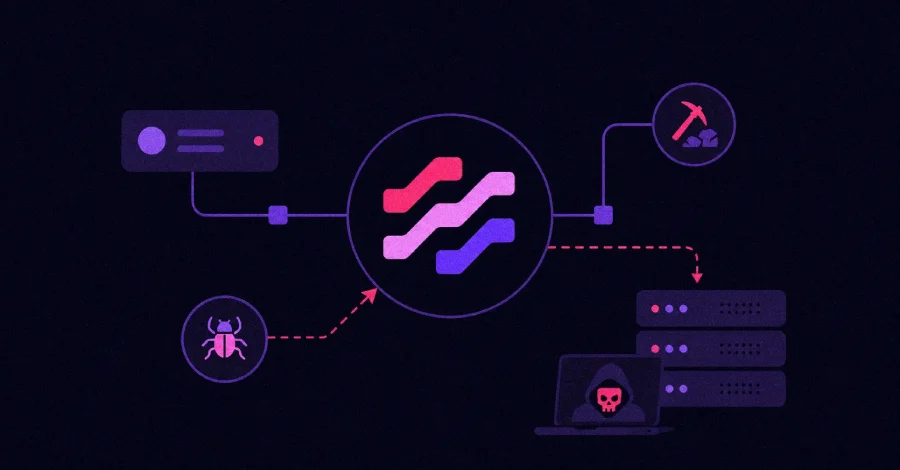

Cybersecurity researchers have uncovered an ongoing campaign where threat actors are actively exploiting a critical unauthenticated remote code execution (RCE) vulnerability in Langflow, identified as CVE-2026-33017 (CVSS score: 9.3), to deploy a Monero cryptocurrency miner. This sophisticated operation specifically targets exposed artificial intelligence (AI) application endpoints, leveraging them as an initial access vector into enterprise networks. The observed attack activity spanned a 19-day period, from March 27 to April 15, 2026, highlighting the persistent and evolving nature of threats against burgeoning AI infrastructure.
The core of this attack hinges on a single, insidious line of Python code executed within an unauthenticated Langflow API endpoint. This seemingly innocuous command initiates a multi-stage infection chain: it pulls down a shell script, subsequently fetches a custom miner binary, and then launches it in a detached process to covertly mine Monero. Trend Micro researchers Simon Dulude and John Zhang, who detailed these findings in a recent technical report, underscored the significance of this vector, stating, "In this campaign, a single line of Python code evaluated inside an unauthenticated Langflow API endpoint pulls down a shell script, fetches a miner binary, and launches it detached." This method bypasses traditional security layers, as it leverages a legitimate, albeit vulnerable, component of the AI development stack.
Understanding the Critical Vulnerability: CVE-2026-33017
Langflow, a prominent open-source visual programming framework designed for building and deploying large language model (LLM) applications, has emerged as a high-value target for threat actors. Its increasing adoption in enterprise environments means that a vulnerability within its core can have far-reaching consequences. CVE-2026-33017, an unauthenticated remote code execution flaw, represents a particularly severe risk. The term "unauthenticated" implies that an attacker does not need any legitimate credentials or prior access to the system to exploit it. "Remote code execution" means the attacker can run arbitrary commands on the vulnerable server from a remote location.
For organizations leveraging Langflow for their AI initiatives, this vulnerability translates into a direct pipeline for attackers to gain full control over the underlying server. This control not only enables cryptomining but also opens doors to data exfiltration, further network compromise, or the deployment of more destructive malware. The high CVSS score of 9.3 underscores the extreme severity, indicating that the flaw is easy to exploit and has a devastating impact on confidentiality, integrity, and availability. Compromising AI infrastructure can lead to significant resource drain, intellectual property theft, and disruption of critical AI-driven operations.

The Attack Chronology: From Exploitation to Cryptomining
The attack campaign meticulously observed by Trend Micro provides a clear timeline of the threat actors’ modus operandi. The 19-day window between late March and mid-April 2026 saw a concentrated effort to identify and exploit vulnerable Langflow instances. The process unfolds as follows:
- Initial Reconnaissance and Scanning: Threat actors actively scan the internet for publicly exposed Langflow instances, specifically targeting endpoints susceptible to CVE-2026-33017. These scans are often automated, broad, and relentless, designed to find low-hanging fruit.
- Exploitation: Upon identifying a vulnerable endpoint, the attackers inject a specially crafted Python command. This command leverages the RCE flaw to execute arbitrary code on the target system.
- Dropper Deployment: The executed Python code acts as a minimal dropper. Its primary function is to download a remote shell script from a command-and-control (C2) server. This shell script is the next stage of the attack, designed to be more comprehensive in its malicious capabilities.
- Miner Binary Fetch and Execution: The downloaded shell script then checks for the presence of a binary named "lambsys." If not found, it proceeds to download this ELF executable (written in Go) onto the compromised machine, typically using
curlorwget. Once downloaded, "lambsys" is immediately launched as a detached process, ensuring it continues to run even if the initial shell script or Python process is terminated. - Lateral Movement: A critical aspect of this campaign is the miner’s ability to propagate. It scans for and reuses existing SSH keys on the compromised host to authenticate and spread to other SSH-reachable systems within the victim’s network. This turns a single compromised Langflow instance into a beachhead for broader network intrusion, significantly increasing the attack’s footprint and potential damage.
This systematic approach demonstrates a high level of planning and execution, emphasizing the attackers’ goal of maximizing their illicit mining operations across as many hosts as possible.
The "Lambsys" Cryptominer: A Deep Dive into its Malicious Capabilities
The "lambsys" binary is far from a simple cryptominer; it is a sophisticated piece of malware designed for resilience, stealth, and competitive advantage in the underground world of cryptojacking. Its functions extend beyond merely mining Monero, encompassing a wide array of anti-detection, anti-competition, and persistence mechanisms:
Anti-Competition Tactics
Cryptojacking operations often compete for system resources. "Lambsys" is engineered to eliminate rivals:
- Termination of Competing Miners: It actively scans for and terminates processes associated with other well-known cryptojacking groups, including Kinsing, WatchDog, Rocke, and Outlaw. This ensures "lambsys" can monopolize CPU cycles for its own Monero mining.
- Deletion of Rival Wallet/Key Material: To further cripple competing operations, "lambsys" deletes wallet and key material belonging to other miners, preventing them from resuming or accessing their illicit gains.
Host-Level Security Evasion
A hallmark of advanced malware, "lambsys" attempts to dismantle or bypass host-level security controls:

- Disabling Security Frameworks: It targets and disables critical Linux security mechanisms such as AppArmor (a mandatory access control system for Ubuntu), SELinux (Security-Enhanced Linux), and the kernel NMI watchdog. Disabling these significantly reduces the system’s ability to detect or prevent malicious activity.
- Firewall Manipulation: The miner disables Ubuntu’s Uncomplicated Firewall (UFW) and directly manipulates
iptablesrules, effectively opening the system to external connections and facilitating its own C2 communication. - Cloud Agent Disablement: In a specific nod to cloud environments, "lambsys" is designed to disable Alibaba Cloud’s Aliyun agent, suggesting that cloud-hosted Langflow instances are a primary target.
Persistence and Stealth
To ensure long-term operation and evade detection, "lambsys" employs several techniques:
- Cron-based Persistence: It establishes persistence through cron jobs, scheduling itself to restart periodically or after system reboots, ensuring continuous operation.
- Log Removal: The malware meticulously removes system logs to cover its tracks, making forensic analysis significantly harder for administrators attempting to identify the initial compromise or the miner’s activities.
- Immutable Attribute Manipulation: A particularly clever tactic involves manipulating the "immutable attribute" (
chattr +i) on critical files and directories (e.g.,~/.ssh/,~/.ssh/authorized_keys,/etc/crontab,/etc/ld.so.preload,/tmp/,/var/tmp/,/var/spool/cron). Illicit cryptomining operations commonly set this attribute to prevent their files from being modified or deleted, even by root. "Lambsys" is aware of this and temporarily removes the immutable attribute from these locations, makes its own modifications (e.g., to establish persistence or facilitate lateral movement), and then reapplies the immutable attribute to/tmp/and/var/tmp/. This reflects the threat actor’s deep understanding of rival cryptojacking groups’ methods and their strategies to maintain control.
Operational Intelligence and Miner Deployment
The final stages of the "lambsys" operation involve deploying the actual mining component and gathering intelligence:
- Custom XMRig Miner: The binary contacts the same C2 server (
83.142.209[.]214:80) to fetch a TAR archive containing a bespoke XMRig miner. XMRig is a legitimate, high-performance Monero miner often abused by threat actors. Once extracted and executed, the archive file is promptly deleted from the file system to reduce forensic artifacts. - Geolocation for Optimization: "Lambsys" sends a request to
ipinfo[.]ioto obtain the host’s public IP address and geographical location. This intelligence serves two critical purposes for the threat actors:- Pool Selection: Mining pools are often geographically distributed. By knowing the victim’s location, the miner can connect to a geographically proximate pool, minimizing network latency and maximizing the hash rate, thereby increasing profitability.
- Geo-fencing: This information allows threat actors to exclude victims in certain regions, potentially to avoid detection in highly monitored areas, comply with internal operational rules, or target regions with cheaper electricity or less stringent cybersecurity enforcement.
Design for Reliability Over Stealth
Trend Micro researchers highlighted an interesting design choice in "lambsys": it "forks a cascade of short-lived sh -c subprocesses, each executing one shell command (one pkill, one chattr, one sysctl)." This design, while potentially less stealthy due to the creation of numerous subprocesses, prioritizes reliability. If one pkill command fails, it’s contained to that subprocess, allowing the other commands to proceed unhindered. This robustness ensures that the cryptominer can effectively neutralize competing operations and establish itself, even in complex environments.
Broader Context: Langflow as a Repeated Target
The exploitation of CVE-2026-33017 is not an isolated incident but rather part of a growing trend targeting AI application infrastructure. Langflow, given its role in developing sophisticated AI applications, has repeatedly fallen victim to threat actors. In June 2025, another critical vulnerability, CVE-2025-3248 (CVSS score: 9.8), was actively abused to distribute the Flodrix botnet malware. Furthermore, an unpatched flaw, CVE-2026-5027, has also been identified as being under active exploitation. This pattern underscores that AI development platforms are increasingly seen as lucrative entry points into enterprise networks. The computational power and data access inherent in these systems make them attractive targets for various malicious activities, from cryptojacking to data theft and botnet recruitment.
Implications and Recommendations for Cybersecurity
This campaign represents a significant shift in attack vectors, even if the payload—a cryptominer—is familiar. The fact that AI application endpoints are becoming "a new front door into enterprise environments," as noted by Trend Micro, demands a recalibration of cybersecurity strategies.

Financial and Operational Impact
For compromised organizations, the immediate impact includes a significant drain on computational resources, leading to increased cloud infrastructure costs or degraded performance of critical systems. Beyond the direct financial burden, there’s the risk of reputational damage, potential data breaches due to broader network compromise, and the substantial cost of incident response and remediation. The disabling of security controls further exposes the network to future, potentially more damaging, attacks.
Mitigation Strategies
To counter such sophisticated threats, organizations must adopt a multi-layered security approach:
- Immediate Patching: The most critical step is to apply patches for CVE-2026-33017 and any other known vulnerabilities in Langflow or similar AI development tools without delay.
- Vulnerability Management: Implement robust vulnerability scanning and management programs specifically tailored for AI application endpoints and underlying infrastructure. Regular audits should ensure that all components are up-to-date and securely configured.
- Network Segmentation and Access Controls: Isolate AI development and deployment environments from the broader corporate network. Implement strict network segmentation and enforce least-privilege access controls, limiting who and what can access these critical systems.
- Endpoint Detection and Response (EDR): Deploy EDR solutions on all endpoints, including AI servers, to detect and respond to suspicious activities, such as unusual process execution, unauthorized file modifications, or attempts to disable security services.
- Behavioral Monitoring: Monitor for unusual resource consumption (CPU, memory, network bandwidth) that could indicate cryptomining activities. Baseline normal operational parameters to quickly identify deviations.
- SSH Key Management: Regularly audit and rotate SSH keys. Implement strong passphrase protection and restrict SSH access to only necessary personnel and systems.
- Log Management and Integrity: Ensure that system logs are securely collected, centrally managed, and protected from tampering. Implement integrity monitoring for critical system files and configurations.
- Security Awareness Training: Educate developers and IT staff working with AI tools about the risks of open-source vulnerabilities, secure coding practices, and the importance of prompt patching.
- Cloud Security Posture Management (CSPM): For cloud-hosted AI environments, utilize CSPM tools to continuously monitor configurations, identify misconfigurations, and ensure adherence to security best practices.
Conclusion
The exploitation of Langflow’s CVE-2026-33017 for Monero cryptomining serves as a stark reminder that the rapid advancement of AI technology is accompanied by an equally rapid evolution of cyber threats. Threat actors are keenly observing and exploiting vulnerabilities in emerging technologies, turning AI infrastructure into a new battleground. The "lambsys" cryptominer exemplifies the sophistication of these attacks, showcasing an awareness of competitive tactics, robust evasion techniques, and intelligent operational decisions. As enterprises increasingly integrate AI into their core operations, securing these foundational platforms will be paramount, demanding proactive vigilance, continuous monitoring, and a comprehensive defense strategy to safeguard against financial losses, operational disruptions, and broader network compromises. The cybersecurity community must continue to collaborate, share intelligence, and develop advanced defenses to protect the future of AI.
