
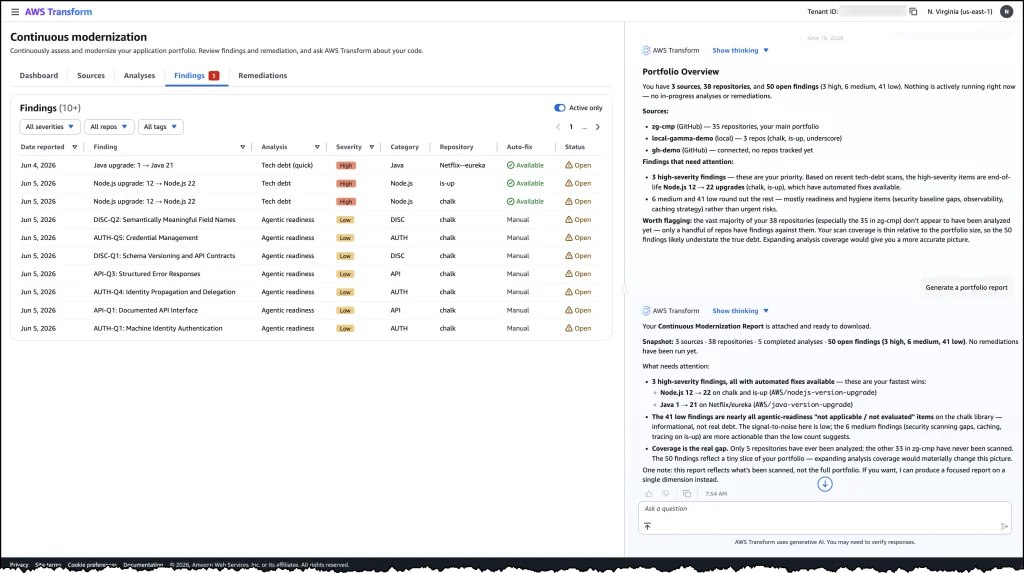

Seattle, WA – Amazon Web Services (AWS) today announced the preview launch of AWS Transform – continuous modernization, a significant new capability designed to autonomously analyze, prioritize, and remediate technical debt across enterprise codebases at an unprecedented scale. This expansion of the existing AWS Transform service aims to address a critical challenge for organizations: the escalating burden of maintaining complex software systems and keeping them current in an era of rapid technological change and AI-accelerated development. The new offering promises to provide full visibility into the state of codebases across thousands of repositories, deliver prioritized findings, and automatically generate pull requests to implement necessary fixes, thereby freeing up engineering teams from the laborious, undifferentiated work of software maintenance.
The announcement comes as enterprises grapple with mounting technical debt, a pervasive issue that can stifle innovation, increase operational costs, and introduce security vulnerabilities. Industry analyses consistently highlight technical debt as a major drain on IT budgets, with some estimates suggesting it consumes up to 30% of an organization’s IT spend. This financial burden is compounded by the opportunity cost: developers spend a significant portion of their time on maintenance tasks rather than on developing new features or driving strategic initiatives. Traditional approaches to managing technical debt often involve a patchwork of point solutions—one for dependency issues, another for vulnerabilities, and yet another for code quality—none of which provide a continuous, integrated, and scalable remediation strategy. The result is a manual, application-by-application cycle that exhausts engineering capacity and provides a lagging, often incomplete, view of an organization’s true technical debt landscape.
The Growing Challenge of Technical Debt in a Dynamic Software Landscape
Technical debt, analogous to financial debt, accumulates when expedient, short-term solutions are chosen over optimal, long-term ones during software development. This can manifest in various forms: outdated dependencies, deprecated frameworks, inconsistent coding standards, security vulnerabilities, or simply code that is difficult to understand or modify. While some level of technical debt is inevitable, its unchecked growth can severely impede an organization’s agility and competitiveness.
In recent years, several factors have exacerbated this challenge:
- Rapid Development Cycles: Agile methodologies and DevOps practices accelerate software delivery, but without robust guardrails, they can also accelerate technical debt accumulation.
- Microservices Architecture: While offering flexibility, microservices environments introduce a proliferation of services, languages, frameworks, and dependencies, making holistic management more complex.
- Cloud Adoption and Modernization: As enterprises migrate legacy applications to the cloud and modernize them, they often uncover decades of accumulated technical debt that must be addressed.
- AI-Assisted Development: The rise of AI-powered coding agents and generative AI tools, while boosting developer productivity, also increases the velocity of code generation. If not properly managed, this can lead to an even faster accumulation of technical debt, making human developers struggle to keep pace with remediation.
- Evolving Security Landscape: New vulnerabilities are constantly discovered, requiring continuous updates and patches to maintain a strong security posture.
Against this backdrop, the need for a comprehensive, automated solution that goes beyond mere detection to continuous remediation has become paramount. Engineering leaders are increasingly demanding tools that provide "ground truth" about their codebase, eliminate manual reporting, and empower platform teams to maintain high standards across vast portfolios of applications.
Introducing AWS Transform – Continuous Modernization: A Deep Dive
AWS Transform – continuous modernization is designed to meet these sophisticated demands by providing a two-pronged approach: continuous analysis and autonomous remediation at scale.
Real-time Visibility Through Continuous Analysis
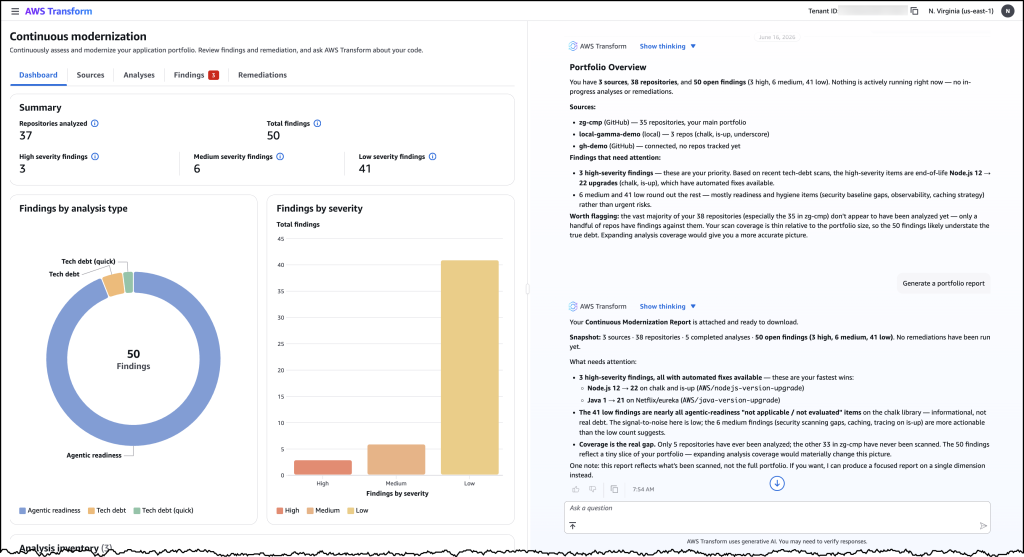
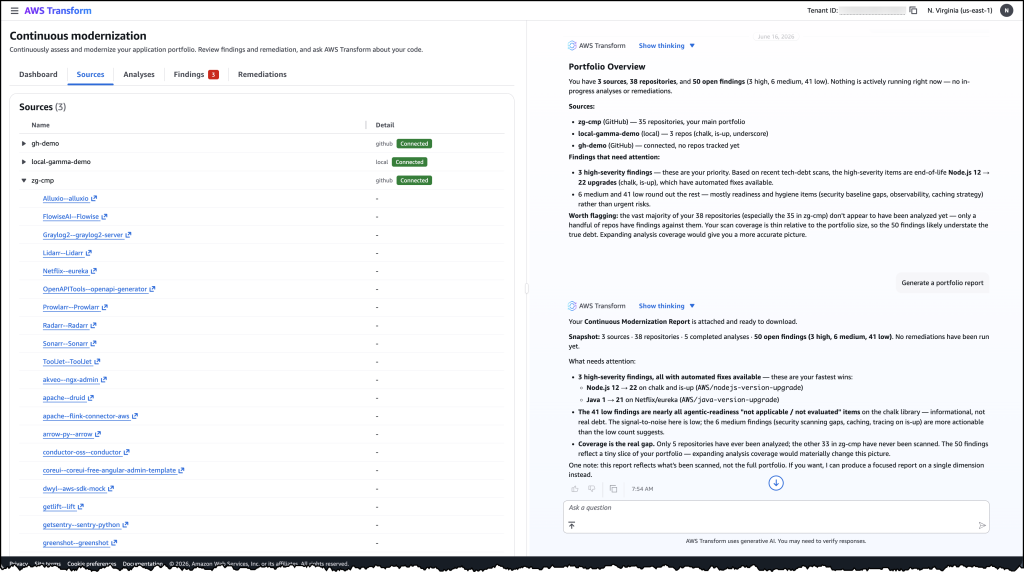
The continuous analysis component of the new capability offers unparalleled visibility into an organization’s codebase. It automatically scans code repositories against configurable baselines, generating detailed findings within hours, a dramatic improvement over traditional weeks-long manual audits. Out-of-the-box policies detect common sources of technical debt, such as end-of-life dependencies and deprecated frameworks. Crucially, organizations can extend these policies with their own custom remediation patterns, incorporating internal coding standards, approved libraries, or specific tech debt policies enforced by their platform teams. For example, if a company has deprecated an internal library or standardized on a particular logging pattern, these rules can be codified and applied continuously across all repositories.
This continuous monitoring provides an always-current view of the technical debt landscape, eliminating the need for periodic manual efforts, status check-ins, or subjective team reports. When a repository deviates from its baseline, platform teams receive immediate notification, clearly indicating which components are affected and the extent of the deviation. This data-driven approach ensures that decisions are based on the actual state of the code, not on lagging or incomplete self-reported statuses.
Automated Remediation at Scale
Beyond mere detection, AWS Transform – continuous modernization offers autonomous remediation capabilities. Once technical debt findings are identified and prioritized, organizations can configure the system to automatically generate pull requests (PRs) for affected repositories. This feature includes out-of-the-box remediation transformations for common scenarios like Java version upgrades, SDK migrations, and library updates. Enterprises also have the flexibility to create custom transformations for organization-specific patterns, ensuring that the remediation process aligns with their unique architectural and operational requirements.

When a remediation campaign is launched, the continuous modernization capability creates a dedicated pull request for each affected repository. The owning team is notified with a clear message, such as: "This repository is behind on your organization’s baseline for this dependency. Here’s a PR that resolves it." Teams can then review and merge the proposed PR, or if they prefer, choose to implement the fix using their own internal processes. The system’s continuous analysis then detects when the fix has been applied, providing definitive "ground truth" without requiring any manual confirmation from the development team. This closed-loop system ensures that identified debt is not only addressed but also verified, providing a transparent and efficient remediation workflow.
Integrated Security and Compliance
A critical aspect of technical debt often involves security vulnerabilities. AWS Transform – continuous modernization integrates seamlessly with AWS Security Agent to detect and remediate security vulnerabilities directly at the source-code level. This integration ensures that security findings flow into the same prioritized list and pull-request workflow as other forms of technical debt. By unifying security and technical debt management, organizations can proactively identify and address risks, enhance their overall security posture, and ensure compliance with internal and external regulations. This holistic approach prevents security issues from becoming isolated, reactive problems and integrates them into a continuous improvement cycle.
Background: The Evolution of AWS Transform
The new continuous modernization capability builds upon the foundation of the existing AWS Transform service, which has been helping enterprises with large-scale migration and modernization efforts. Launched to streamline the complex journey of moving applications from on-premises data centers to AWS, AWS Transform has focused on:
- Data Center Exits: Facilitating the migration of entire application portfolios.
- Mainframe Modernization: Breaking down monolithic mainframe applications into cloud-native services.
- Windows Application Modernization: Updating and migrating legacy Windows workloads.
- Undifferentiated Software Maintenance: Handling routine tasks like upgrading Java versions, swapping deprecated frameworks, and updating AWS Lambda runtimes before they reach end-of-life.
The introduction of continuous modernization signifies AWS’s strategic expansion beyond project-based transformations to address the ongoing, day-to-day operational challenges of maintaining modern software estates. It acknowledges that modernization is not a one-time event but a continuous journey.
Chronology of Development and Preview Launch
While specific development timelines are not publicly detailed, the release of AWS Transform – continuous modernization in preview likely follows a typical product development lifecycle within AWS. This would involve:
- Problem Identification (Ongoing): AWS, through its deep engagement with enterprise customers, continually identifies persistent challenges like technical debt.
- Solution Conceptualization & Design: Architecting a scalable, automated solution leveraging AWS’s cloud infrastructure and AI/ML capabilities.
- Internal Development & Alpha Testing: Building the core features and testing them internally with AWS teams.
- Beta Program/Early Adopter Phase: Engaging a select group of customers to test the service in real-world scenarios, gather feedback, and refine the offering.
- Preview Announcement (Today): Making the service available to a broader audience for testing and feedback before general availability. This allows AWS to gather further insights and ensure the service meets a wide range of customer needs.
The preview status indicates that AWS is inviting customers to explore the capabilities, provide feedback, and help shape the final product, demonstrating a commitment to customer-driven development.
Statements and Industry Reactions
An AWS spokesperson, potentially the Head of Engineering Transformation, commented on the release: "Technical debt has long been a silent killer of innovation and a major drain on IT budgets. Our customers tell us they are overwhelmed by the sheer volume and complexity of keeping their codebases current, especially with the accelerating pace of change driven by AI-assisted development. AWS Transform – continuous modernization is purpose-built to automate this undifferentiated heavy lifting. By providing continuous visibility and autonomous remediation, we are empowering engineering teams to focus on what matters most: building new value for their businesses, rather than getting bogged down in endless maintenance cycles. This capability is a game-changer for enterprises committed to continuous modernization and operational excellence."
Industry analysts are expected to view this announcement positively, recognizing AWS’s move to address a pervasive enterprise pain point. "This offering from AWS is a timely response to a growing problem," stated a leading analyst in cloud computing. "As software systems become more distributed and complex, and as AI tools accelerate code generation, the challenge of managing technical debt has become more acute. AWS Transform – continuous modernization has the potential to significantly improve developer productivity, enhance security, and reduce the massive operational costs associated with legacy code. Its focus on autonomous remediation, rather than just detection, sets it apart and could become a critical tool for organizations striving for a truly modern, agile software factory."
Implications for Enterprises and Software Development
The implications of AWS Transform – continuous modernization for enterprises are far-reaching, promising to reshape how organizations approach software development and maintenance:
- Significant Cost Savings and Operational Efficiency: By automating the detection and remediation of technical debt, organizations can drastically reduce the manual effort and developer hours currently allocated to these tasks. This translates directly into substantial cost savings and allows IT budgets to be reallocated towards strategic initiatives.
- Accelerated Innovation and Developer Productivity: Freeing developers from the drudgery of routine maintenance empowers them to spend more time on innovation, developing new features, and improving user experiences. This can significantly accelerate an organization’s ability to bring new products and services to market.
- Enhanced Security Posture and Compliance: The integration with AWS Security Agent ensures that security vulnerabilities are identified and addressed proactively at the source-code level. Continuous analysis helps maintain compliance with internal standards and external regulations by ensuring codebases adhere to predefined policies.
- Improved Code Quality and Maintainability: By continuously enforcing coding standards and updating dependencies, the service inherently improves the overall quality and maintainability of an organization’s software assets, reducing future technical debt accumulation.
- Strategic Cloud Migration and Modernization: This capability becomes an integral part of an enterprise’s broader cloud migration and modernization strategy. It ensures that applications, once modernized or migrated, remain current and compliant, preventing a recurrence of the same problems in the cloud environment.
- Data-Driven Decision Making for Engineering Leaders: The real-time dashboard and prioritized findings provide engineering leaders with unprecedented insights into the health of their software portfolio, enabling data-driven decisions about resource allocation and strategic investments.
Two Approaches to Modernization: Continuous and Campaign Modes
AWS Transform – continuous modernization supports two distinct, yet complementary, approaches to code modernization:
- Continuous Mode: This is designed for the day-to-day, high-volume work of keeping codebases current. It handles tasks like routine library upgrades, applying security patches, and enforcing organizational coding standards as baselines evolve. It’s about maintaining a healthy, up-to-date software estate on an ongoing basis.
- Campaign Mode: For larger, more complex modernization projects, such as migrating an entire application portfolio from one framework to another, or upgrading a major runtime version across hundreds of applications, the existing AWS Transform capabilities, including custom transformations, continue to provide the flexible primitives for these targeted, project-based efforts.
The new continuous modernization capability is purpose-built for the recurring, high-volume tasks that platform teams manage every day, ensuring that the foundational health of the software remains robust.
Availability and Next Steps
AWS Transform – continuous modernization is available today in preview. Organizations can begin exploring its capabilities through the AWS Transform web application. Further integration options are available via AWS Transform Kiro Power, MCP, and through skills designed for integration with existing coding agents and development workflows. AWS encourages interested parties to consult the AWS Transform documentation for comprehensive details on how to get started and leverage this powerful new tool in their modernization journey. As the service moves through its preview phase, customer feedback will be crucial in refining its features and ensuring it delivers maximum value to enterprises worldwide.
