
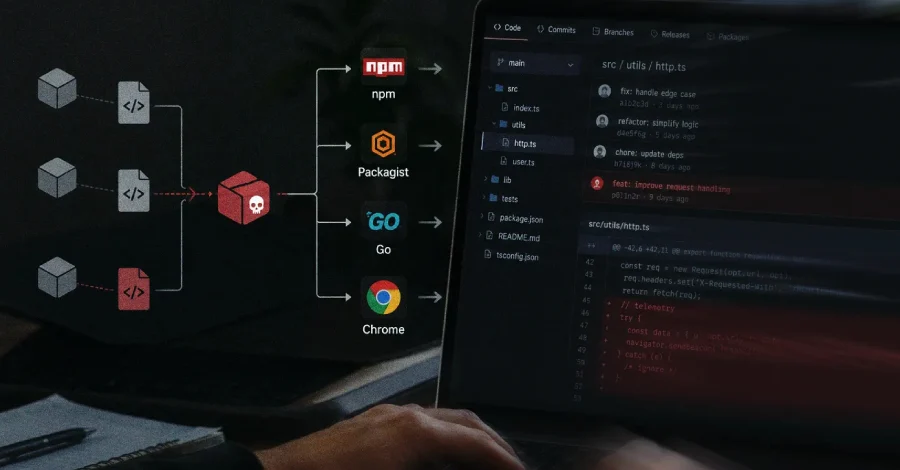

North Korean threat actors, widely recognized for their affiliation with the persistent "Contagious Interview" campaign, have dramatically escalated their malicious activities by publishing 108 unique packages and web browser extensions across prominent software registries including npm, Packagist, Go, and Google Chrome. This expansive and ongoing operation has been designated "PolinRider" by cybersecurity researchers, signaling a sophisticated and multifaceted assault on the global software supply chain. The campaign’s continued dynamism underscores a critical and evolving threat landscape, with experts warning that new malicious packages are highly probable as these state-sponsored actors refine their tactics to compromise maintainer accounts, subtly modify legitimate repositories, and release infected package versions wherever they can secure or retain registry access.
Understanding the Scale and Scope of PolinRider
The sheer scale of the PolinRider campaign is a cause for significant concern within the cybersecurity community. According to an analysis published by Socket security researcher Karlo Zanki, the campaign has manifested in a staggering 162 malicious release artifacts. These artifacts span multiple release versions and correspond to 108 unique packages and extensions, meticulously distributed across key developer platforms. Specifically, the observed malicious releases include 19 npm libraries, which are foundational components for JavaScript development; 10 Composer packages, essential for PHP projects; 61 Go modules, integral to applications built with Google’s Go language; and at least one insidious Google Chrome extension, targeting web developers and users alike. This broad targeting strategy highlights the attackers’ intent to cast a wide net, infiltrating diverse programming environments and maximizing their potential for compromise.
The proliferation of these malicious artifacts across such varied platforms demonstrates a strategic understanding of modern software development workflows. By compromising packages within these ecosystems, the threat actors gain a powerful vector for injecting malicious code into countless projects and applications downstream. This approach exploits the inherent trust developers place in package managers and open-source libraries, turning commonly used tools into conduits for sophisticated cyber espionage and financial illicit activities. The continuous nature of this campaign, as emphasized by Zanki, suggests a well-resourced and highly persistent adversary committed to long-term infiltration rather than opportunistic strikes.
The "Contagious Interview" Precursor: A Social Engineering Masterpiece
PolinRider is not an isolated endeavor but a direct evolution of the North Korea-aligned campaign known as "Contagious Interview." This precursor campaign, active since at least 2023, has become notorious for its highly sophisticated social engineering tactics, primarily targeting software developers and individuals operating within the lucrative cryptocurrency sectors. The core methodology of Contagious Interview revolves around weaponizing job recruitment processes. Threat actors masquerade as legitimate recruiters or potential collaborators on popular professional networking sites like LinkedIn, developer platforms such as GitHub, and various freelance marketplaces.
To enhance their credibility and build trust, these attackers often go to great lengths to establish elaborate front companies, complete with convincing, often AI-generated, employee profiles. This meticulous preparation allows them to engage targets in persuasive job interviews and seemingly legitimate technical assessments. The ultimate objective, however, is to trick unsuspecting victims into executing malicious code, often disguised as part of a technical challenge or a necessary tool for the "new role." This initial compromise frequently provides the foothold required for subsequent stages of attack, including the deployment of supply chain elements like those seen in PolinRider. The use of AI-generated profiles and sophisticated narratives speaks to the increasing sophistication of state-sponsored social engineering, making it exceedingly difficult for even vigilant individuals to discern legitimate opportunities from carefully crafted traps.
Chronology and Tactical Evolution: From GitHub Implants to VS Code Auto-Run Tasks

The PolinRider campaign has undergone several significant evolutions, demonstrating the threat actors’ adaptability and persistent innovation. Its origins can be traced back to March 2026, when the OpenSourceMalware team first flagged the activity. Initially, researchers described PolinRider as involving the implantation of malicious, obfuscated JavaScript payloads into hundreds of public GitHub repositories. These repositories, belonging to various unique owners, were used to deliver a new variant of BeaverTail, a known JavaScript malware intimately associated with the broader Contagious Interview campaign. This initial phase underscored a direct manipulation of code repositories, a critical node in the software development lifecycle.
By April 11, 2026, the campaign had expanded its reach dramatically, compromising an estimated 1,951 public GitHub repositories associated with 1,047 unique owners. This exponential growth in compromised repositories highlights the effectiveness of their initial infiltration methods and their ability to scale operations rapidly. Concurrently, PolinRider demonstrated a tactical merger with another cluster of activity dubbed "TaskJacker." TaskJacker’s distinct modus operandi involves dropping malicious VS Code task files into existing GitHub users’ repositories. These VS Code tasks leverage a critical feature: the "runOn: 'folderOpen'" option. This insidious setting ensures that arbitrary malicious code is automatically triggered and executed the moment the affected folder is opened as a workspace in popular Integrated Development Environments (IDEs) like VS Code or Cursor. This particular vector is highly effective as it targets the developer’s immediate working environment, ensuring execution during routine coding activities.
A crucial insight into the attackers’ methodology is that they are not primarily relying on stolen GitHub credentials. Instead, the compromise of victim accounts is believed to occur through malicious VS Code extensions or npm packages, which are themselves supply chain vectors. This suggests a multi-stage attack where an initial infection via a malicious package or extension grants the attackers access to a maintainer’s development environment, subsequently allowing them to modify repositories. It is suspected that the attackers achieve this through methods such as expired domain takeover or other account recovery paths, enabling them to seize control of legitimate maintainer accounts and inject their malicious code with apparent legitimacy.
Technical Anatomy of the Malware and Evasion Techniques
Once executed on a compromised system, the PolinRider malware initiates a targeted search for specific configuration files commonly found in web development projects. These include files such as "postcss.config.mjs," "tailwind.config.js," "eslint.config.mjs," "next.config.mjs," "babel.config.js," and "app.js." If found, the malware proceeds to append additional malicious JavaScript code to these legitimate files. This technique allows the attackers to embed their payload within existing, trusted project files, making detection more challenging and ensuring persistence within the codebase.
Beyond code injection, the threat actors employ sophisticated stealth and evasion techniques to obscure their tracks. A notable method involves the use of a Windows batch script designed to stealthily modify the last commit in a repository, making it appear as if the malicious changes were made by the original, legitimate author. This Git history rewriting capability is a powerful tool for maintaining stealth and hindering forensic analysis. It is also suspected that similar tools are being utilized to rewrite Git history for other operating systems, including Linux and macOS, indicating a cross-platform capability for obfuscating their activities.
Socket’s analysis highlights the consistent core tradecraft across the entire campaign: "threat actors plant obfuscated JavaScript loaders in legitimate repositories, conceal the code through whitespace padding or fake .woff2 font files, and trigger execution through developer tooling such as VS Code task files." The use of whitespace padding and disguised font files are clever methods to visually hide malicious code within seemingly benign files, making manual inspection incredibly difficult. The reliance on developer tooling like VS Code task files ensures that the malware is executed within the context of a trusted development environment, often with elevated permissions, thereby increasing its efficacy.
The Latest Payload Wave: RATs, Stealers, and Blockchain Infrastructure
The latest wave of PolinRider attacks reveals an even more advanced and financially motivated payload delivery mechanism. The initial payload functions as a JavaScript malware loader, which then reaches out to decentralized blockchain infrastructure. Specifically, the attackers leverage services on TRON, Aptos, and BNB Smart Chain to fetch an encrypted second-stage payload. This use of blockchain technology for command and control (C2) infrastructure adds another layer of resilience and obfuscation, making it harder for traditional security mechanisms to detect and block communication with malicious servers.

Once retrieved, this encrypted second-stage payload unpacks to deliver two potent pieces of malware: DEV#POPPER RAT (Remote Access Trojan) and OmniStealer. DEV#POPPER RAT provides the attackers with comprehensive remote control over the compromised system, allowing for data exfiltration, further payload deployment, and persistent surveillance. OmniStealer, as its name suggests, is designed to exfiltrate sensitive information, likely targeting cryptocurrency wallets, credentials, intellectual property, and other valuable data. This attack chain was meticulously detailed by eSentire in March 2026, providing crucial insights into the ultimate objectives of the PolinRider campaign, which extend beyond mere initial access to sophisticated data theft and espionage, often with a clear financial motivation tied to North Korea’s state interests.
Broader Implications and Essential Defense Strategies
The PolinRider campaign, as an extension of Contagious Interview, represents a severe threat to the integrity and security of the global software supply chain. By targeting the very foundations of modern software development—package managers, code repositories, and developer tools—these North Korean actors can achieve widespread and stealthy compromise. The implications are profound, affecting not just individual developers but potentially entire organizations whose applications rely on these compromised components.
The sophisticated evasion techniques, particularly Git history rewriting and anti-dated commits, pose significant challenges for detection. As Karlo Zanki from Socket emphasized, these methods "make the GitHub landing page and visible commit history unreliable indicators of compromise." Defenders must therefore adopt a more proactive and in-depth approach to security.
For developers and organizations, the recommended defense strategies are multi-faceted and immediate:
- Assume Compromise: Any environment where these malicious packages have been installed should be treated as compromised.
- Secret Rotation: Exposed secrets (API keys, credentials, tokens) must be rotated from a clean, uncompromised machine.
- Clean Rebuilds: Affected versions of packages should be removed, and projects should be rebuilt from a known good lockfile, ensuring no malicious dependencies are reintroduced.
- Comprehensive Audits: Developer workstations and repositories require thorough auditing for hidden execution paths or suspicious commits.
- Configuration File Review: Specific attention should be paid to changes in critical configuration files such as ".vscode/tasks.json," "config.js," "vite.config.js," and "eslint.config.js," as these are prime targets for malware injection and execution triggers.
- Activity Log Analysis: Reviewing repository activity logs and package release metadata can reveal unauthorized modifications or suspicious publication events.
- VS Code Task Configuration Scrutiny: Developers should regularly inspect their VS Code task configurations for any unknown or automatically executing tasks.
The cybersecurity industry has also been actively tracking related activities, underscoring the interconnected nature of these campaigns. JFrog recently uncovered another cluster of npm packages linked to Contagious Interview, some of which mimicked legitimate Rollup polyfill tools to enable remote access and data theft. Earlier in the year, another set of npm and Go packages was identified for incorporating VS Code auto-run tasks to execute JavaScript payloads disguised as fake font files. These discoveries highlight tactical overlaps and shared methodologies between "Fake Font," "TaskJacker," and "PolinRider," indicating a coordinated and evolving strategy from the same threat actor group.
In conclusion, the PolinRider campaign represents a significant escalation in North Korea’s cyber warfare capabilities, particularly its focus on supply chain attacks targeting the software development ecosystem. The persistent nature, sophisticated social engineering, technical prowess in malware development, and advanced evasion techniques employed by these actors demand heightened vigilance from individual developers and robust security measures from organizations. As the digital landscape continues to evolve, so too does the sophistication of state-sponsored threats, making continuous monitoring, education, and proactive defense paramount to safeguarding critical infrastructure and sensitive data.
