
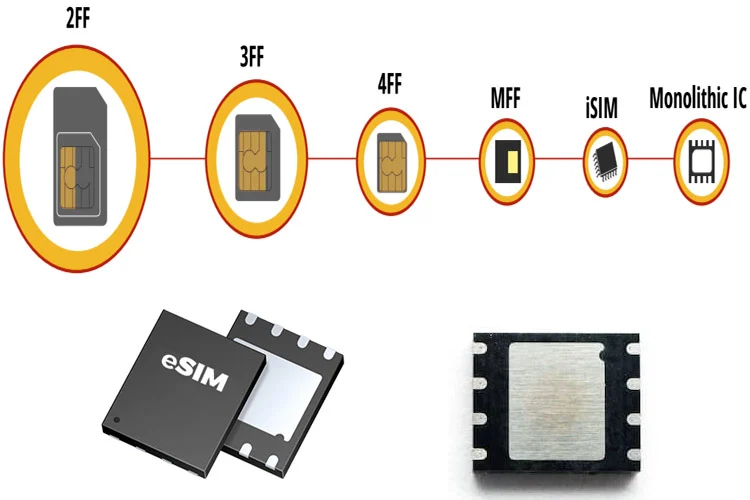

The telecommunications landscape is currently undergoing its most significant structural transformation since the introduction of the digital SIM card in the early 1990s. As mobile devices become increasingly integrated into every facet of daily life, the hardware that connects these devices to cellular networks is evolving from a removable plastic card to a permanent, embedded component known as the eSIM. This shift represents more than just a change in form factor; it signifies a move toward a fully digitized, software-driven approach to mobile identity and network management. An eSIM, or embedded Subscriber Identity Module, is a small chip soldered directly onto a device’s motherboard, functioning as a digital version of the traditional SIM card. This technology stores the subscriber’s profile and network authentication keys, allowing users to activate cellular plans without the need for a physical piece of plastic.
The Evolution of the SIM: A Brief Chronology
To understand the impact of the eSIM, one must look at the timeline of SIM technology, which has consistently moved toward miniaturization and integration. The original SIM card, introduced in 1991 by Giesecke & Devrient, was the size of a credit card. As mobile phones shrunk, so did the SIM. The Mini-SIM arrived in 1996, followed by the Micro-SIM in 2003, and the currently ubiquitous Nano-SIM in 2012.
The first consumer-facing implementation of eSIM technology appeared in 2016 within the Samsung Gear S2 Classic 3G smartwatch. However, the technology gained mainstream momentum in 2018 when Apple integrated eSIM capabilities into the iPhone XS and XR alongside a physical SIM slot. A definitive turning point occurred in 2022, when Apple announced that all iPhone 14 models sold in the United States would ship without a physical SIM tray, relying exclusively on eSIM technology. This move forced carriers and consumers alike to adapt to a digital-first connectivity model, setting a precedent that the rest of the industry is now following.
Technical Mechanisms: How eSIM Functions
The technical foundation of the eSIM is the eUICC (Embedded Universal Integrated Circuit Card). Unlike traditional SIM cards, which are "read-only" in terms of carrier branding and hardwired to a specific network provider, the eUICC is rewritable. This allows for Over-the-Air (OTA) provisioning, where a mobile network operator (MNO) can send a digital profile to the device via an encrypted internet connection.
When a user initiates an eSIM activation, the device communicates with a Subscription Manager Data Preparation (SM-DP+) server. This server securely packages the carrier’s credentials and downloads them to the eUICC chip. Once the profile is installed, the device can authenticate with the cellular network just as it would with a physical SIM. Because the chip is rewritable, it can hold multiple profiles—typically up to eight or more on modern smartphones—though usually only one or two can be active simultaneously.
Market Data and Global Adoption Trends
According to industry data from GSMA Intelligence, the number of eSIM-capable smartphone models has grown by over 150% since 2020. Market analysts project that by 2025, there will be over 2.4 billion eSIM smartphone connections globally, accounting for approximately 33% of the total mobile market. This growth is driven not only by flagship smartphones but also by the expansion of the Internet of Things (IoT) and wearable technology.
In the enterprise sector, the adoption of eSIM is expected to reduce operational costs significantly. Research indicates that logistics and administrative overhead related to physical SIM card management—such as shipping, storage, and manual installation—cost the global telecom industry billions of dollars annually. By transitioning to eSIM, carriers can automate the onboarding process, leading to higher efficiency and lower customer acquisition costs.
Strategic Advantages of Embedded SIM Technology
The transition to eSIM offers several distinct advantages for consumers, manufacturers, and service providers.
- Space Efficiency in Hardware Design: By removing the physical SIM tray and its internal mechanism, manufacturers can reclaim valuable internal space. This allows for larger batteries, better water resistance (due to fewer openings in the chassis), or the inclusion of additional sensors.
- Enhanced Security: A physical SIM card can be easily removed if a device is stolen, preventing the owner from tracking the phone via cellular data. An eSIM cannot be removed, meaning a stolen device remains connected to the network, making it significantly easier to locate through "Find My" services.
- Streamlined International Roaming: For frequent travelers, eSIM technology eliminates the need to visit a local kiosk to buy a physical SIM card upon arrival in a new country. Users can download a local or travel-specific eSIM profile before they even land, ensuring immediate connectivity.
- Environmental Sustainability: The production of billions of plastic SIM cards annually contributes to plastic waste and carbon emissions from shipping. Digital provisioning removes the need for plastic manufacturing and the logistical footprint of physical distribution.
Device Compatibility and Industry Support
While the technology is becoming standard, it is currently most prevalent in high-end and mid-range devices.
- Apple: Every iPhone model from the XS/XR series onward supports eSIM. The US versions of the iPhone 14, 15, and 16 series are eSIM-only.
- Samsung: The Galaxy S series (starting from the S20), the Note 20 series, and all Galaxy Z Fold and Flip models support eSIM.
- Google: The Pixel line has supported eSIM since the Pixel 2, with modern iterations offering robust dual-SIM (eSIM + physical SIM) capabilities.
- Wearables and Laptops: Devices like the Apple Watch (GPS + Cellular), Samsung Galaxy Watch, and various LTE-enabled laptops from Dell, HP, and Microsoft utilize eSIM to maintain connectivity without bulky card slots.
The Activation Process: A Step-by-Step Overview
Activating an eSIM is designed to be a frictionless process, though it varies slightly between platforms. Most carriers provide a QR code, which acts as a "key" to download the profile.
For iOS Devices:
- Navigate to Settings > Cellular.
- Tap Add Cellular Plan or Add eSIM.
- Use the camera to scan the QR code provided by the carrier.
- Follow the on-screen prompts to label the plan (e.g., "Primary" or "Travel").
For Android Devices:
- Navigate to Settings > Network & Internet > SIMs.
- Tap Add SIM or the "+" icon.
- Select Download a SIM instead?
- Scan the QR code and confirm the activation.
Many modern carriers also offer app-based activation, where the user simply logs into their account on the carrier’s app, and the eSIM profile is pushed to the device automatically without needing a QR code.
Industry Perspectives and Regulatory Reactions
The shift to eSIM has met with mixed reactions from traditional mobile operators. While Tier 1 carriers in the US and Europe have embraced the technology for its efficiency, some regional carriers initially expressed concern. The primary fear was "churn"—the ease with which a customer can switch providers. With a physical SIM, switching carriers requires waiting for a new card to arrive; with eSIM, a customer can switch in minutes via an app, increasing market competition.
Regulatory bodies have also taken notice. In the United States, the Department of Justice previously investigated whether certain carriers were colluding to limit eSIM features that would make it easier for consumers to switch networks. Today, however, the consensus among regulators is that eSIM promotes competition and consumer choice, leading to better pricing and service quality.
Comparative Analysis: eSIM vs. Physical SIM
The decision between using an eSIM or a physical SIM often comes down to the user’s specific hardware and lifestyle. Physical SIM cards remain advantageous for users who frequently swap their "main" card between different devices, as this can be done instantly without carrier intervention. However, for the average user, the eSIM offers superior convenience.
| Feature | Physical SIM | eSIM |
|---|---|---|
| Durability | Vulnerable to damage/loss | Permanent and protected |
| Ease of Switching | Requires physical swap | Software-based (instant) |
| Security | Low (can be stolen) | High (linked to device) |
| Device Space | Requires dedicated slot | Integrated into motherboard |
| Multiple Profiles | One per card | Multiple stored digitally |
Future Implications: The Road to a Cardless Era
As we look toward the future, the physical SIM card is likely to become a relic of the past, similar to the 3.5mm headphone jack. The next phase of this evolution is the iSIM (Integrated SIM), which integrates the SIM functionality directly into the device’s main processor (SoC) rather than a separate chip. This will further reduce power consumption and save even more space, paving the way for a new generation of ultra-compact IoT devices, smart glasses, and medical implants.
The transition to eSIM is a fundamental component of the broader digital transformation in telecommunications. By decoupling the subscriber’s identity from a physical object and turning it into a secure digital profile, the industry is enabling a more flexible, secure, and environmentally friendly future for global connectivity. Whether for the international traveler, the enterprise manager, or the everyday smartphone user, the eSIM represents a significant leap forward in how we connect to the world around us.
