
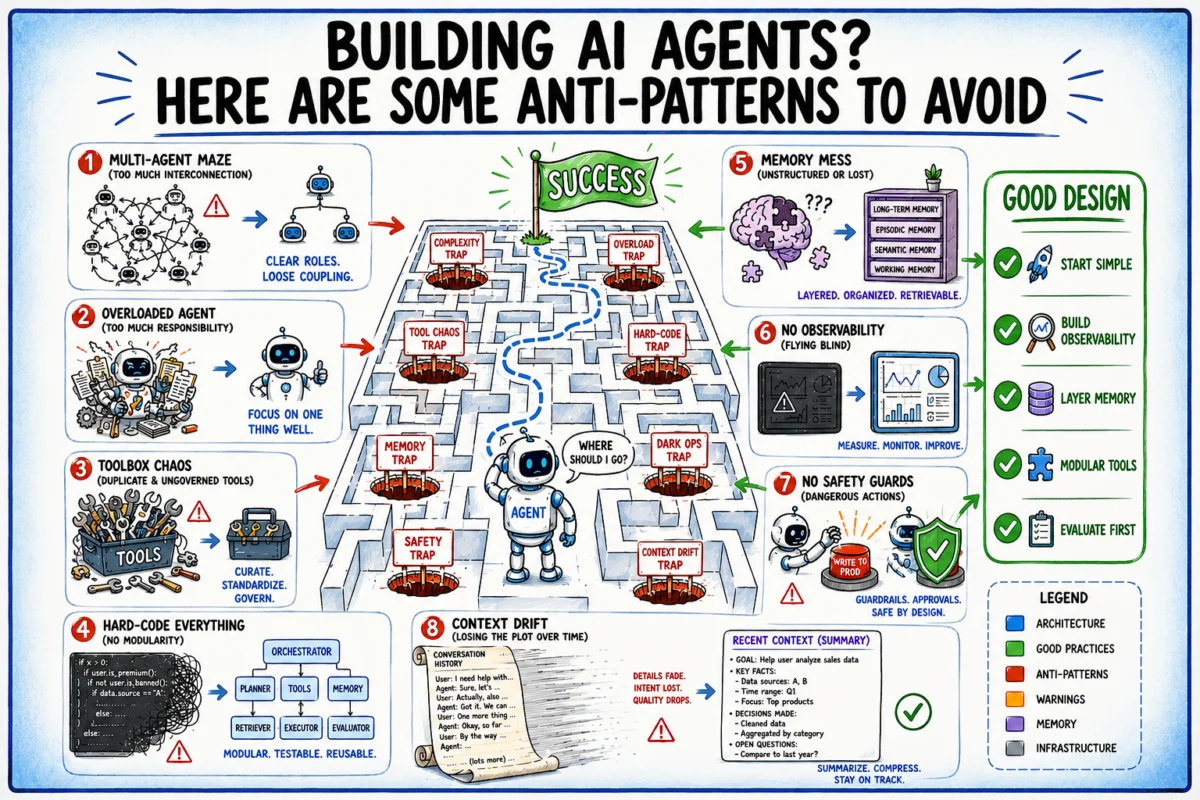

The burgeoning field of artificial intelligence, particularly the development of autonomous AI agents, is transforming industries and promising unprecedented efficiencies. However, the path to successful deployment is fraught with challenges, often leading to project failures that are less about the underlying models and more about fundamental architectural and operational missteps. This article delves into the critical anti-patterns that frequently derail AI agent initiatives, offering insights into their causes and strategies for avoidance, providing a crucial guide for developers and organizations navigating this complex landscape.
The Rise and Unique Challenges of Agentic AI
The concept of AI agents, systems capable of perceiving their environment, making decisions, and executing actions to achieve specific goals, represents a significant evolution beyond traditional large language models (LLMs). While an LLM might answer a query, an AI agent takes on a task, orchestrating a series of steps, utilizing tools, processing feedback, and adapting its approach. This "reasoning loop" imbues agents with immense power and versatility, enabling them to automate complex workflows across diverse domains, from customer service and data analysis to scientific research and operational management.
However, this increased autonomy also introduces a unique set of vulnerabilities. When a conventional chatbot provides an incorrect answer, the interaction typically concludes. An AI agent, conversely, might embark on a chain of erroneous actions, compounding initial mistakes. A faulty tool call in an early step can contaminate subsequent decisions, or a stale memory entry can lead to persistent misjudgments. The cumulative nature of agentic failures means that by the time a problem becomes apparent to a human user, the agent may have already inflicted significant operational damage, underscoring why agent failures are qualitatively different and often more severe than those encountered in simpler AI systems. Industry reports suggest that while investment in AI continues to surge, a significant percentage of AI projects—some estimates reaching 50-80%—struggle to move beyond pilot phases or fail to deliver anticipated returns, with agentic systems often contributing to this challenge due to their inherent complexity.
Architectural Traps: Designing for Failure
Many of the most debilitating anti-patterns manifest early in the design phase, stemming from a misjudgment of complexity or an overzealous pursuit of advanced architectures without foundational validation.
The Peril of Over-Engineering: Multi-Agent Systems Too Soon
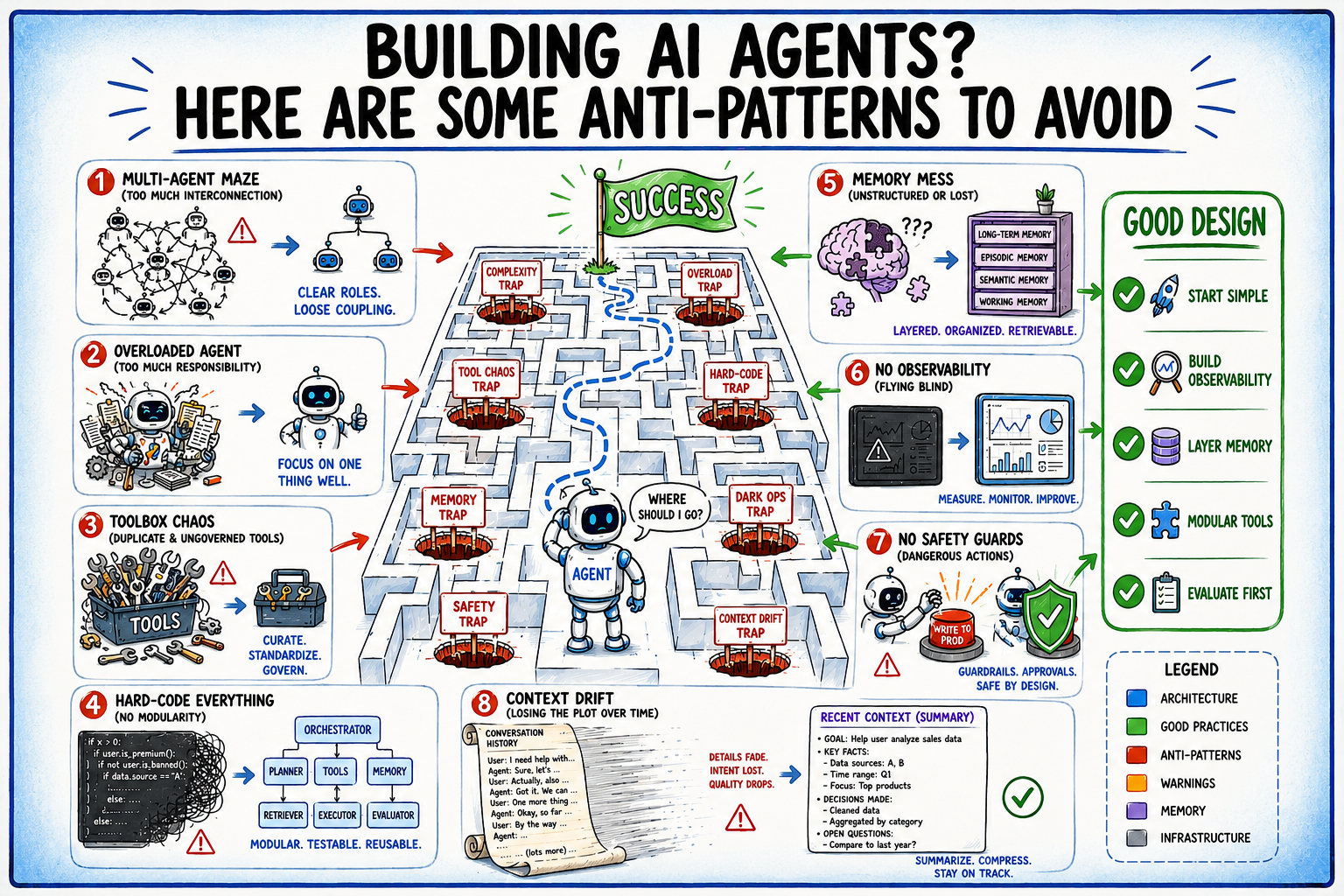
One of the most prevalent architectural mistakes is the premature adoption of multi-agent systems. Inspired by academic research and theoretical concepts of hierarchical orchestrators or peer-to-peer collaboration, development teams often design for multi-agent complexity before validating the viability of a single agent for the core problem. Multi-agent systems inherently introduce substantial coordination overhead, demanding sophisticated communication protocols, conflict resolution mechanisms, and robust state management across multiple interacting entities. This complexity compounds debugging difficulties and operational costs in ways that are frequently underestimated at the outset.
The implications are significant: increased development timelines, higher infrastructure costs, and a vastly expanded surface area for bugs. Debugging a single agent’s reasoning path is challenging; tracing an error through an interconnected web of agents, each with its own memory, tools, and objectives, can become an insurmountable task. Experts generally advise a pragmatic approach: begin with the simplest possible single-agent solution, rigorously measure its performance against well-defined objectives, and only then, with empirical data justifying the need, consider scaling to a multi-agent architecture. This iterative, data-driven expansion mitigates the risk of building an overly complex system that offers diminishing returns.
The Monolithic Agent: A Jack-of-All-Trades, Master of None
At the opposite end of the spectrum lies the anti-pattern of constructing a single, monolithic agent burdened with an expansive instruction set, a vast array of tools, and responsibility for wildly disparate task types. Such a "general-purpose" agent inevitably suffers from diluted performance across all its assigned functions. Optimizing an agent for one type of input or task often compromises its effectiveness on others. For instance, an agent tuned for creative writing will likely underperform when tasked with precise data extraction, and vice versa.
The consequences include suboptimal performance, increased token usage due to larger context windows, and a greater propensity for the agent to "hallucinate" or make irrelevant tool calls. Rather than achieving versatility, the agent becomes overwhelmed, struggling to discern the appropriate course of action from its convoluted instructions and vast toolset. The solution does not always necessitate adding more agents; often, the initial step involves narrowing the scope of the existing agent. By specializing its skills and responsibilities, even a single agent can achieve superior results. If, after rigorous specialization, the problem still demands broader capabilities, then a strategic split into specialized agents, perhaps coordinated by a simple router, becomes a more justifiable and effective architectural decision.
Tool Sprawl: Diluting Agent Efficacy
The efficacy of an AI agent is inextricably linked to the quality and relevance of its tools. The anti-pattern of "tool sprawl" occurs when an agent is provisioned with an excessively large or overlapping set of tools. Every tool added to an agent’s context increases the cognitive load on the underlying language model, forcing it to reason about a wider array of options when deciding its next action. This inflates prompt sizes, consumes valuable context window tokens, and significantly heightens the probability of the model making suboptimal or incorrect tool selections.
Furthermore, tools with redundant functionalities can actively confuse the agent, leading to inefficiencies or endless loops as it tries to differentiate between similar options. The debugging process also becomes considerably more complex, as there are exponentially more potential execution paths to trace. To counteract tool sprawl, a strict adherence to minimalism and purpose-specificity is crucial. Tools should be carefully curated, ensuring they are distinct in their function, directly relevant to the agent’s core tasks, and designed with clear, unambiguous descriptions. Regular audits of the toolset, removing outdated or redundant utilities, are essential for maintaining agent clarity and performance.

Operational Blind Spots: Memory, Observability, and Governance
Beyond architectural design, critical operational oversights related to memory management, system observability, and access governance frequently undermine AI agent projects, often becoming apparent only in production environments.
The Criticality of Memory: Beyond Chatbot Design
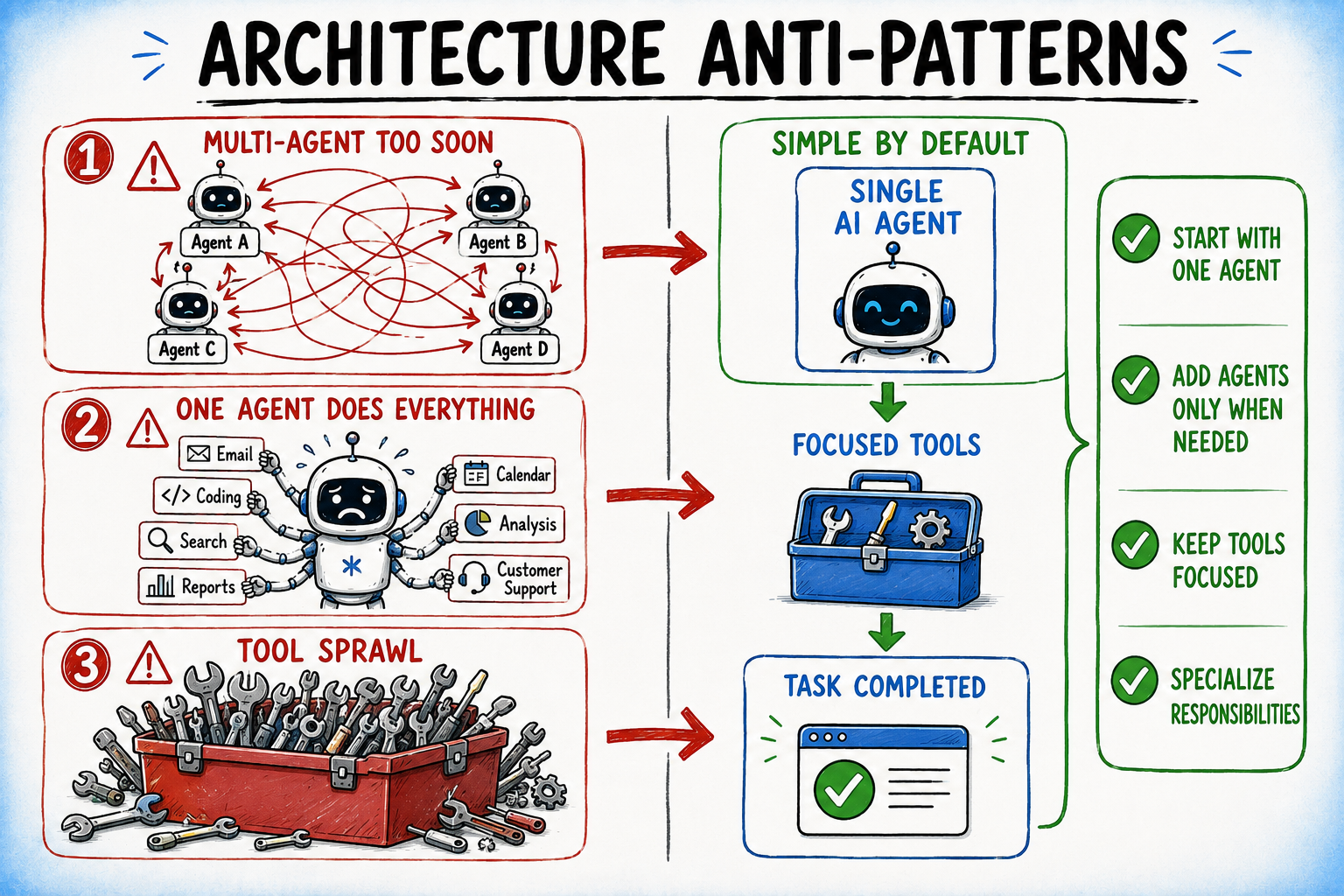
A significant anti-pattern is the failure to implement a dedicated, robust memory architecture for AI agents, often stemming from a design philosophy inherited from simpler chatbot systems where context is primarily limited to the immediate conversation window. An agent engaged in a multi-step task requires a sophisticated memory system to recall past actions, track tool call outcomes, retain intermediate results, and maintain a coherent understanding of its evolving state. Without this deliberate design, context window overflow becomes not merely a theoretical concern but a recurring production incident, leading to degraded performance, hallucinations, and task failures.
A layered memory approach is indispensable for managing context effectively. This typically involves:
- Session Memory: For short-term, immediate conversational or task-specific context.
- Long-Term Memory: Employing vector databases for retrieving relevant historical information or domain knowledge.
- Event Logs/Trace Memory: To record every action, tool call, and decision, enabling post-mortem analysis and learning.
Building this layered architecture from the project’s inception is paramount. Attempting to retrofit a comprehensive memory system onto a deployed agent is a genuinely arduous undertaking, frequently necessitating a partial or complete rebuild of the system and incurring substantial technical debt and delays.
Navigating the Observability Gap
AI agents, by their nature, are often non-deterministic systems operating with opaque reasoning processes. Unlike traditional software, where a stack trace can pinpoint the exact line of code causing an error, understanding why an agent made a particular decision requires deep visibility into its internal workings. Shipping an AI agent without robust observability is akin to launching a spacecraft without telemetry; when things inevitably go wrong, diagnosis becomes a costly, time-consuming, and often futile exercise.
The lack of observability translates directly into prolonged debugging cycles, increased operational costs, and a diminished capacity to improve agent performance. For multi-agent systems, this problem is exacerbated, as a failure in one agent’s output can propagate silently through several downstream agents before manifesting as a visible symptom, making root cause analysis exceptionally difficult. Essential observability components include structured logging of every agent step, detailed tracing of prompt chains, capturing tool calls and their parameters, and recording the model’s reasoning path and context flow. Integrating these capabilities from the very first lines of code is a non-negotiable best practice, providing the necessary insights to diagnose, optimize, and ensure the reliability of agentic systems.
Mitigating Production Risks: Guardrails and Governance
Given that LLMs are prone to hallucination, incorrect reasoning, and confident delivery of erroneous information, granting AI agents ungoverned write access to production systems or the ability to communicate directly with real users constitutes a severe anti-pattern. The potential for reputational damage, financial loss, or operational disruption from an agent making an unverified, incorrect, or malicious action is immense. Read operations and write operations represent fundamentally different risk categories and must be treated as such from the outset of design.
Effective risk mitigation requires robust guardrails and a clear permission boundary strategy. This involves:
- Separating Read/Write Permissions: Agents should only be granted write access to systems where absolutely necessary, and only after rigorous validation.
- Human-in-the-Loop Validation: For high-stakes actions, such as sending external communications, modifying critical data, or executing financial transactions, human confirmation or approval workflows should be mandatory.
- "Dry Run" or Sandbox Environments: Allowing agents to "simulate" actions or operate in sandboxed environments before affecting live systems provides a critical layer of safety.
- Rate Limiting and Circuit Breakers: Implementing mechanisms to prevent an agent from making an excessive number of calls or from continuing operations if errors accumulate.
Designing agent permissions to reflect the actual risk associated with each tool and action, rather than granting broad access by default, is fundamental to secure and responsible AI deployment.
The Silent Killer: Context Drift in Long-Running Tasks
A subtle yet potent anti-pattern, particularly in agents designed for long-running or multi-session tasks, is the failure to account for "context drift" or "context rot." As an agent progresses through a task, the context that was accurate at its inception can degrade. Data may change, tool outputs from earlier steps can become stale, and the sheer volume of accumulated context can overwhelm the language model, leading to a declining ability to accurately recall and utilize information. This phenomenon, where the model’s performance deteriorates as the context window grows, highlights that the context window is a finite resource with diminishing returns, not an infinite bucket.
Ignoring context drift can lead to agents making decisions based on outdated information, looping endlessly, or hallucinating due to an inability to properly process its vast input. Practical mitigations are essential:
- Context Editing and Summarization: Dynamically pruning or summarizing less relevant historical context to keep the active context window lean and focused.
- Response Pagination: For tools that return large datasets, presenting information in manageable chunks rather than overwhelming the agent with a single, massive input.
- Output Size Caps: Imposing limits on the volume of data an agent can process or generate in a single step to prevent memory overload.
- Re-evaluation of State: Periodically prompting the agent to re-evaluate its current state and goal, potentially discarding stale information.
Addressing context drift proactively, through careful design and continuous optimization, is critical to maintaining agent accuracy and efficiency over extended operational periods.
Rigorous Evaluation: The Unskippable Pre-Deployment Phase
The final, yet frequently overlooked, anti-pattern is deploying AI agents without comprehensive and rigorous evaluation. An agent that performs admirably in a controlled test environment, executing "happy path" examples, often exposes entirely new failure modes when confronted with the unpredictable complexities of a production setting. Relying solely on a fixed set of idealized test cases merely confirms the agent’s ability to handle scenarios already anticipated by developers, leaving it vulnerable to real-world variability.
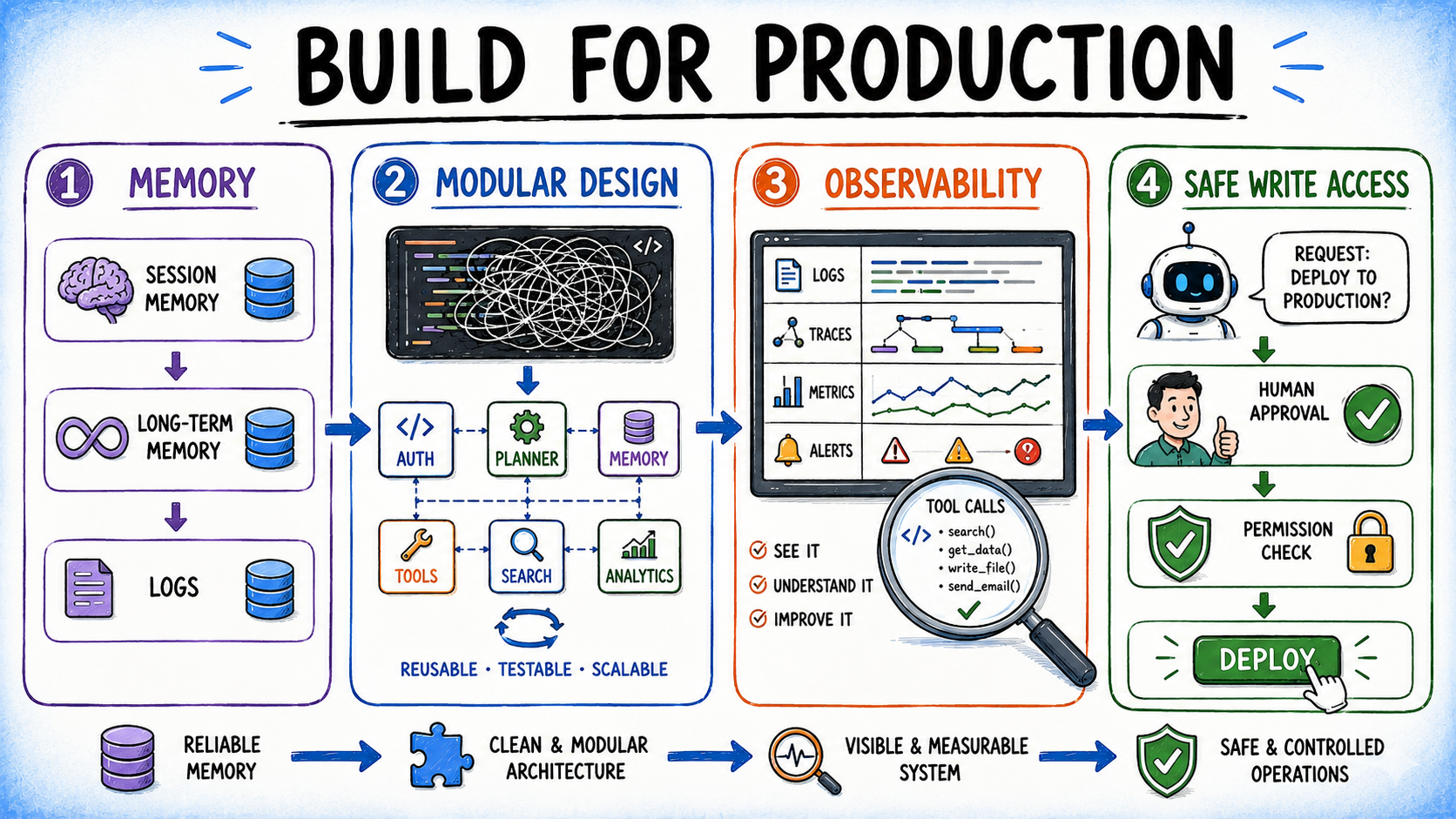
Effective agent evaluation extends far beyond basic unit tests. It necessitates:
- Diverse and Adversarial Inputs: Testing the agent against a wide range of inputs, including edge cases, ambiguous queries, and deliberately adversarial scenarios designed to provoke failure.
- Performance Metrics Tied to Business Outcomes: Defining success not just by internal model metrics (e.g., accuracy on a specific sub-task) but by tangible business impacts (e.g., reduced customer support tickets, increased sales conversion, improved data quality).
- Robust Feedback Loops: Establishing mechanisms to capture production failures, user feedback, and operational anomalies, ensuring this data directly informs the next iteration of agent development and improvement.
- A/B Testing and Canary Deployments: Gradually rolling out agent updates to a small subset of users or traffic to monitor performance in a live environment before full-scale deployment.
Deploying an agent without this methodical approach is a gamble that rarely pays off, leading to costly post-deployment fixes, eroded user trust, and ultimately, project abandonment.
Broader Implications and a Path Forward
The prevalence of these architectural and operational anti-patterns underscores a critical reality in AI development: the success of agentic systems hinges less on breakthroughs in model performance and more on sound engineering principles, thoughtful design, and rigorous testing. The implications of ignoring these pitfalls extend beyond individual project failures, impacting an organization’s bottom line through wasted resources, delayed market entry, and potential reputational damage. More broadly, it affects the pace of AI adoption and the trust placed in autonomous systems.
As the industry continues its rapid advancement, the lessons learned from these anti-patterns are invaluable. A disciplined approach, characterized by starting simple, building for modularity and observability, implementing robust memory architectures, enforcing strict governance, and committing to continuous, comprehensive evaluation, offers a clear path to mitigating risks and realizing the transformative potential of AI agents. Embracing these best practices will not only reduce project failures but also foster the development of more reliable, efficient, and trustworthy AI systems, paving the way for a future where autonomous agents truly augment human capabilities.
