
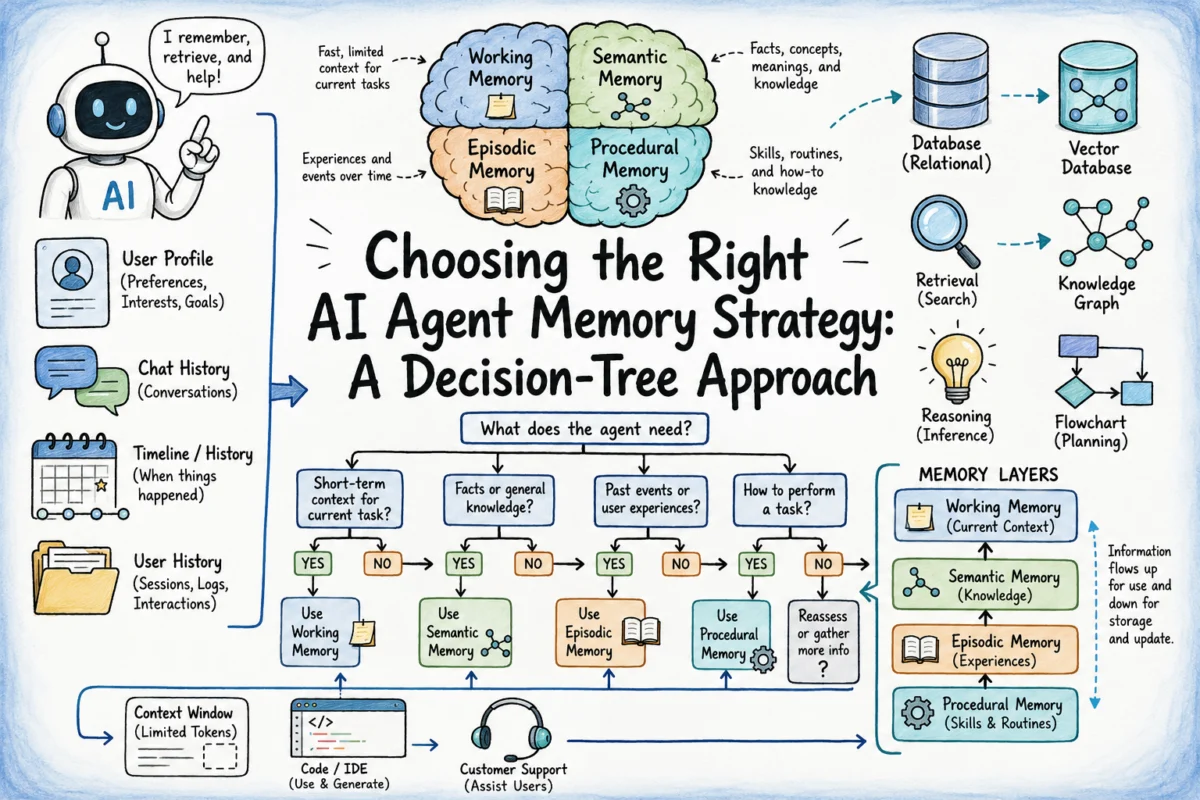

The efficacy and intelligence of an artificial intelligence agent hinge significantly on its ability to recall and utilize information appropriately. While often relegated to an afterthought in the design process, memory is a foundational capability for any sophisticated AI system, directly impacting its performance, user experience, and overall utility. Many AI agents today suffer from a fundamental mismatch between the information they are expected to retain and the mechanisms employed to store and retrieve it. This can manifest as agents forgetting crucial details users expect them to remember, or conversely, being saddled with overly complex memory infrastructures that introduce unnecessary overhead and complexity. The core challenge often boils down to a critical design question: determining the optimal lifespan for different categories of information and establishing the most effective retrieval strategies for each.
The Evolving Landscape of AI Agents and the Memory Imperative
The field of artificial intelligence has witnessed a paradigm shift towards "agentic AI systems" — autonomous entities designed to perceive environments, make decisions, and execute actions to achieve specific goals. This evolution moves beyond simple question-answering systems to agents capable of complex tasks, requiring sustained context, learning, and interaction over extended periods. Early AI systems, such as rule-based expert systems, relied on static knowledge bases. The advent of neural networks introduced the concept of learned representations, but even advanced Large Language Models (LLMs) inherently possess a limited "context window" – a short-term memory that resets with each new interaction, unable to recall information from past conversations or learned experiences without external assistance.
This limitation spurred intensive research into external memory systems, transforming what was once a secondary concern into a primary design consideration. The integration of robust memory architectures is now recognized as vital for agents to maintain coherence, personalize interactions, and learn from experience. From customer service chatbots remembering past purchase history to coding assistants recalling project specifications, and even autonomous robots learning optimal navigation paths, effective memory is the linchpin. Industry reports indicate a surge in demand for AI agents capable of continuous learning and long-term retention, with market analyses projecting significant growth in the agentic AI sector. However, a common stumbling block remains the absence of a standardized, systematic approach to memory design. A recent survey of AI developers highlighted that nearly 45% struggle with integrating efficient and scalable memory solutions, often resorting to ad-hoc methods that lead to suboptimal performance.
The Cruciality of Differentiated Memory Layers
Unlike the orchestration patterns that govern an agent’s workflow, memory is rarely a singular architectural choice. A user’s current conversation, their stated preferences, historical interactions, and learned operational routines represent distinct categories of information. Each of these categories possesses unique characteristics regarding its volatility, persistence requirements, and retrieval patterns, thus necessitating a differentiated memory strategy. Attempting to force all types of information into a single memory system invariably leads to inefficiencies, whether it’s slow retrieval, irrelevant results, or information decay.
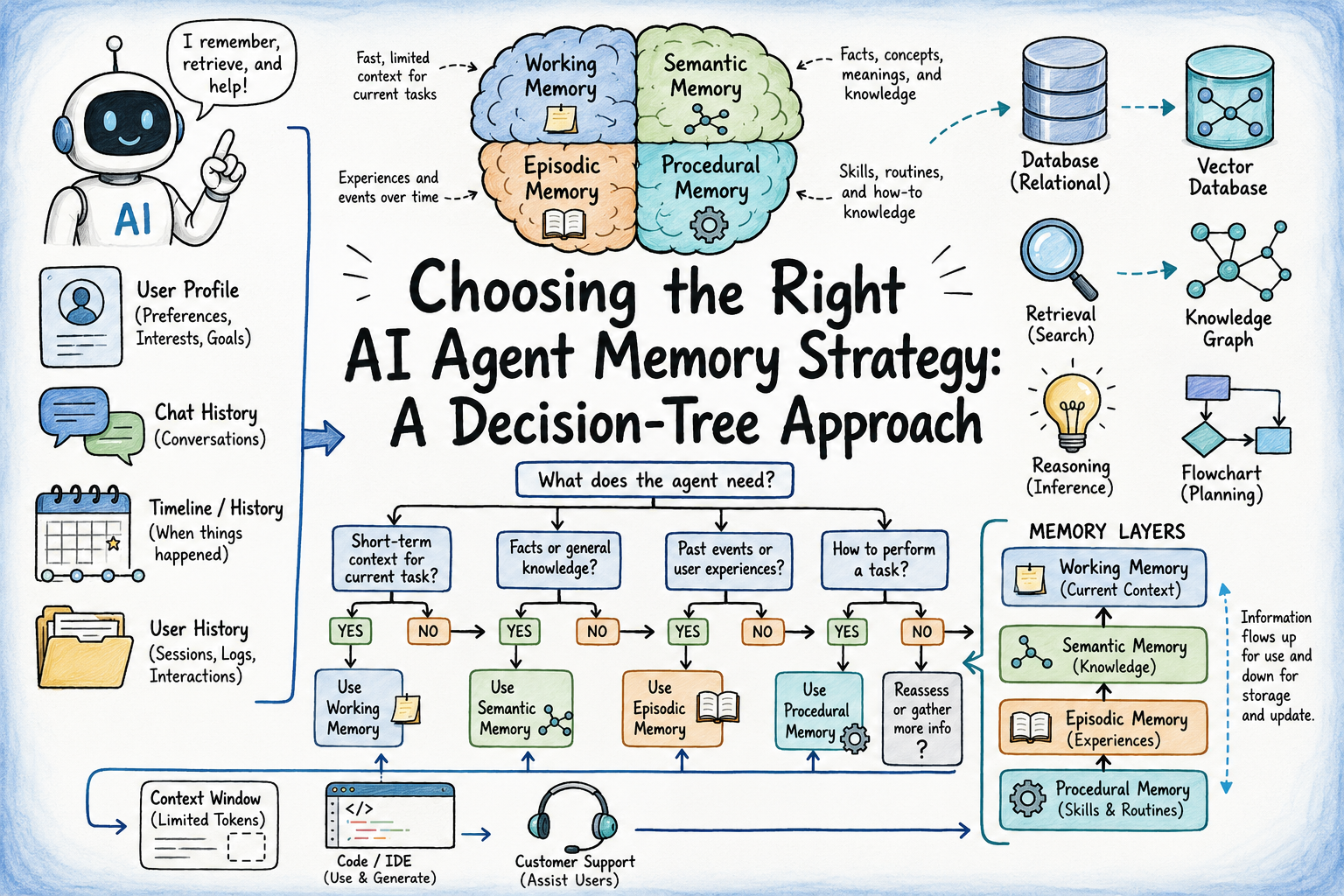
Cognitive science offers a useful parallel, categorizing human memory into distinct types like working, semantic, episodic, and procedural memory. AI agent memory architectures often borrow this vocabulary, reflecting similar functional divisions:
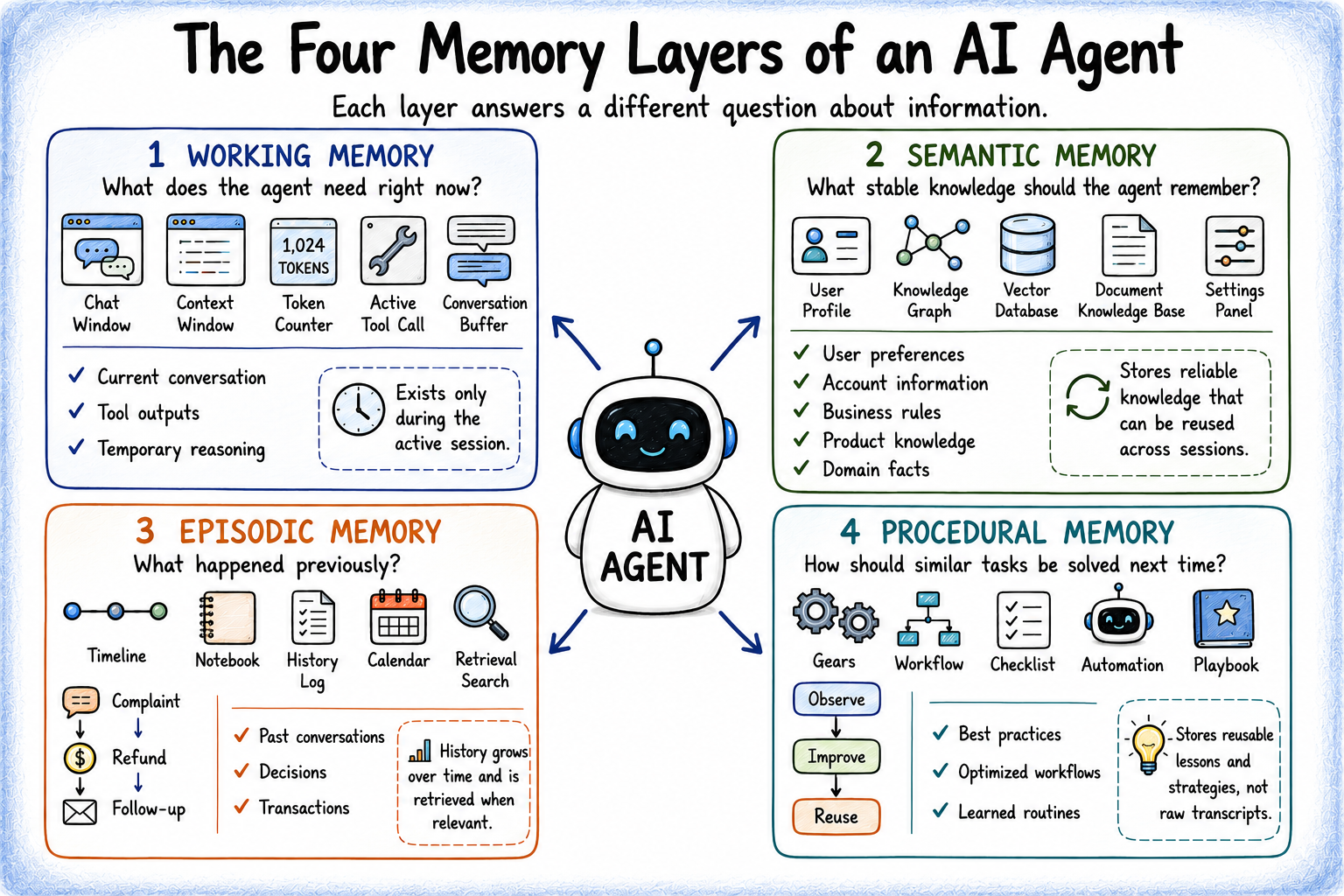
- Working Memory: For information needed immediately and temporarily, such as the current conversational turn or active task parameters. It’s akin to human short-term memory.
- Semantic Memory: Stores stable facts, generalized knowledge, and conceptual understanding that persists across sessions. This includes user profiles, domain knowledge, or product specifications.
- Episodic Memory: Records specific past events, interactions, and experiences, often with a temporal component. This could be a log of past complaints, a history of user queries, or system alerts.
- Procedural Memory: Encapsulates learned routines, skills, and reusable workflows that improve with repetition. This allows agents to apply proven strategies to similar tasks in the future.
Most production-grade agents rely on a combination of these layers. For instance, a sophisticated customer support agent might keep the current ticket details in working memory, the customer’s subscription tier in semantic memory, a log of past support interactions in episodic memory, and a learned, optimized routine for handling common refund requests in procedural memory. Each layer serves a distinct and vital purpose. Problems emerge when information is mismatched to its memory layer—for example, storing stable customer profile data in a dynamically searched vector store (which is better suited for semantic search of nuanced text) instead of a structured database, leading to slower, less reliable retrieval and higher operational costs. Similarly, searching an entire, unpruned interaction history can surface stale or contradictory information, hindering effective context engineering. Memory is just one source of context vying for a limited context window, emphasizing the need for highly targeted and relevant retrieval.
A Systematic Approach: The AI Agent Memory Decision Tree
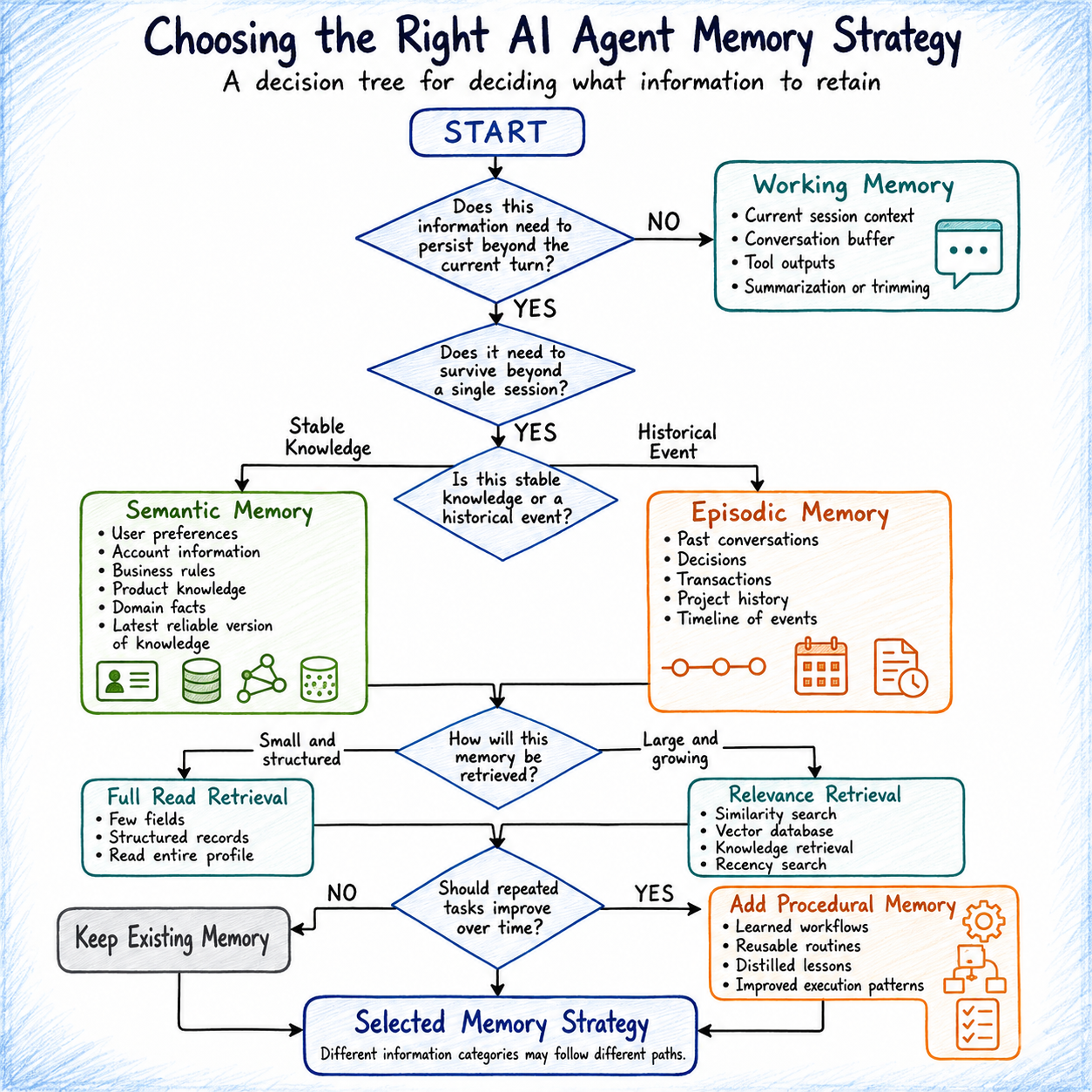
To address these challenges, a structured decision tree provides a clear, step-by-step methodology for selecting the appropriate memory strategy for different information categories. It emphasizes running the tree once per category of information, rather than once for the entire agent, acknowledging the multifaceted nature of an agent’s knowledge base. A single agent might manage "current task parameters," "user profile details," and "historical task logs" as three distinct categories, each potentially leading to a different memory solution.
Question 1: Does This Information Need to Persist Beyond the Current Turn?
This initial question acts as a filter, distinguishing information that genuinely requires a memory layer from transient data. If the information is entirely self-contained within a single interaction turn—meaning it’s fully present in the current prompt and its relevance expires immediately after the agent’s response—then no dedicated memory layer is necessary. The agent’s immediate context window is sufficient. Examples include processing a one-off query or generating a response based solely on the current input. If, however, the information must be carried forward to influence subsequent turns within the same conversation or future interactions, then it moves to Question 2. Over-allocating memory for transient data leads to unnecessary complexity and resource consumption.
Question 2: Does It Need to Survive Beyond a Single Session?
This question differentiates between short-term, session-scoped memory and durable, long-term memory. If the information’s relevance is confined to the duration of a single interaction session (e.g., the current chat conversation or task execution), then working memory is the appropriate solution. This typically involves conversation buffers with strategies for trimming or summarization to keep the context manageable within the LLM’s token limits. Conversely, if the information needs to outlive the current session and be accessible in future interactions (e.g., user preferences, accumulated knowledge), it proceeds to Question 3. A common design pitfall here is treating session-scoped state as permanent, or conversely, building persistent memory infrastructure for data that is only relevant during a brief interaction. For instance, a user’s current shopping cart items typically belong to working memory for that session, while their shipping address is a persistent detail.
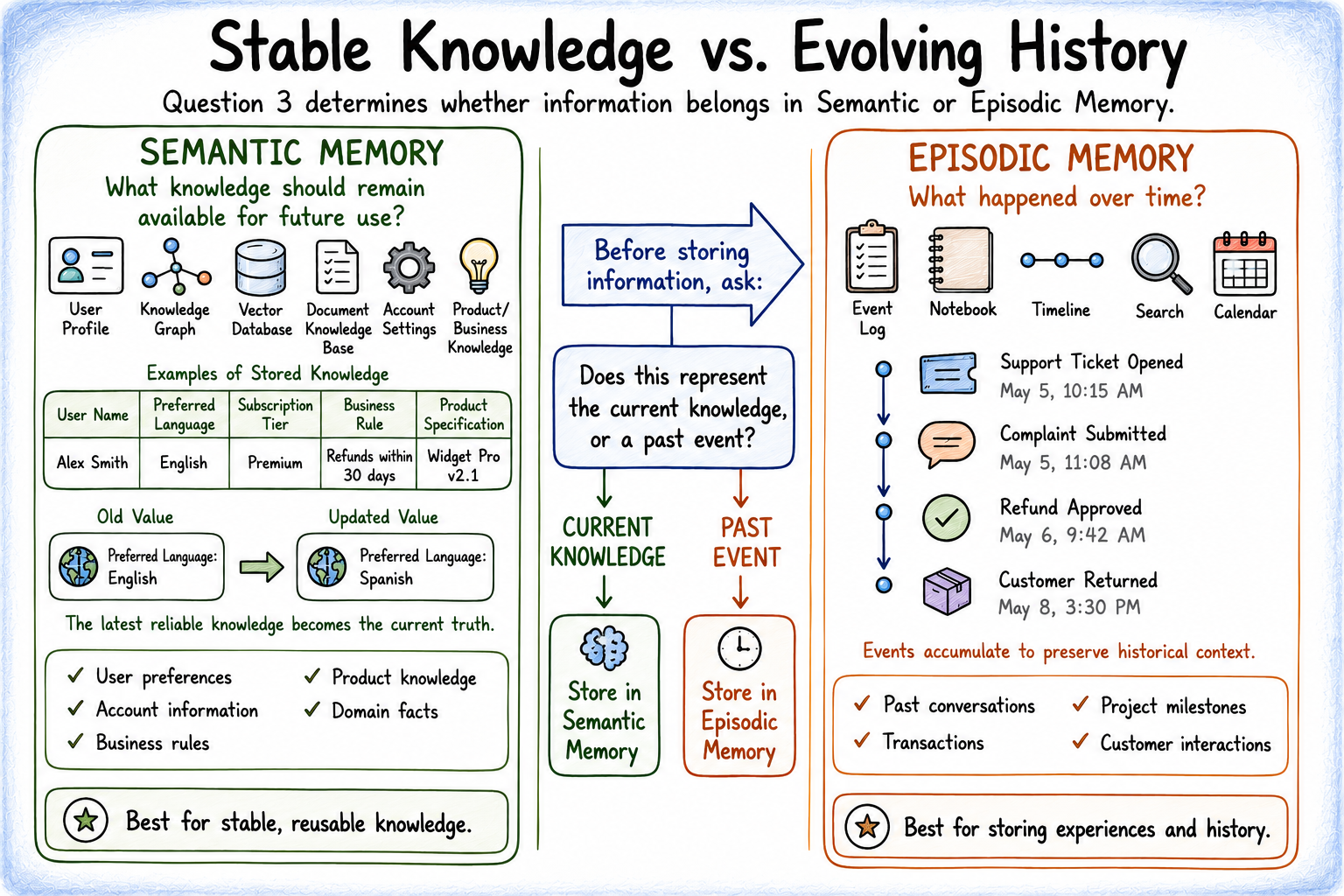
Question 3: Is This a Stable Fact or an Evolving Event?
This critical distinction is often overlooked, leading to heterogeneous data being haphazardly combined in a single store. Memory architectures draw inspiration from cognitive science, separating "semantic memory" (stable, generalized knowledge) from "episodic memory" (specific past events).
- Stable Facts: These are pieces of information that are largely static or change infrequently, such as a user’s subscription tier, product specifications, company policies, or foundational domain knowledge. They belong in semantic memory. Implementations vary from structured databases for user attributes, knowledge graphs for complex relationships, or vector databases for semantically searchable domain knowledge. Retrieval for smaller stores might involve direct lookups, while larger knowledge bases benefit from similarity search. Frameworks like Zep model facts on a knowledge graph, incorporating validity windows to manage factual evolution gracefully, preventing superseded information from silently contradicting newer data.
- Evolving Events: These represent dynamic occurrences, interactions, or states that accumulate over time, such as a user’s interaction history, system logs, or a sequence of actions. They belong in episodic memory, which is typically structured as a growing log. Older entries might require summarization or pruning to remain efficient.
Mismatched storage here can lead to significant issues. Storing stable facts in a system designed for evolving events might make updates cumbersome, while storing events in a rigid semantic store can lead to data loss or a lack of temporal context.
Question 4: How Will This Memory Be Retrieved?
This question focuses on optimizing retrieval mechanisms based on the size, structure, and growth rate of the memory store. It’s not uncommon for an agent to require multiple retrieval patterns.
- Direct Lookup/Full Read: Ideal for small, structured semantic stores where specific facts (e.g., a user ID linked to an account tier) need to be retrieved quickly and completely. This method is highly reliable but not scalable for large, unstructured data.
- Similarity Search: Essential for large semantic knowledge bases (e.g., product documentation, research papers) or episodic logs where exact matches are unlikely, and the agent needs to find semantically relevant information based on query embeddings. Vector databases are a prime example of this.
- Recency/Relevance Search: Primarily for episodic memory, where the most recent interactions or those most relevant to the current context are prioritized. This often involves filtering and ranking mechanisms applied to logs.
Selecting the correct retrieval strategy ensures that the agent can access the needed information efficiently without being overwhelmed by irrelevant data or suffering from slow response times. For example, a customer support agent needs a direct lookup for a customer’s ID (semantic memory) but a similarity search over their past complaint history (episodic memory).
Question 5: Does the Agent Need to Learn Reusable Procedures?
This final question introduces the concept of procedural memory, which operates as an overlay rather than a replacement for semantic or episodic layers. If the agent is expected to improve its performance on recurring tasks through repetition, by distilling successful steps, strategies, or workflows, then procedural memory is necessary. This involves extracting "lessons learned" from past experiences (often stored in episodic memory) and codifying them into reusable routines.
Procedural memory is critical for agents designed for autonomy and continuous improvement, such as task automation agents or coding assistants that refine their bug-fixing strategies. It allows the agent to move beyond merely recalling past events (episodic memory) to actively applying proven methodologies to future, similar tasks. The key design decision here is what gets written to procedural memory: raw logs of past runs (which belong to episodic memory) versus distilled, generalized lessons and successful patterns. A useful procedural store is explicitly designed for future application, allowing the agent to directly invoke proven workflows, significantly enhancing efficiency and reliability.
Combining Memory Layers for Holistic Intelligence
Running the decision tree for each distinct category of information typically produces a "memory profile" rather than a single solution for the entire agent. Combining these profiles reveals a sophisticated, multi-layered memory architecture tailored to the agent’s specific needs. For instance, a complex coding agent might employ:
- Working Memory: For current session edits and open file states.
- Semantic Memory: For user preferences, coding standards, and tooling knowledge.
- Episodic Memory: For the chronological history of code changes across projects and past error logs.
- Procedural Memory: For reusable test-and-verify workflows that improve with repeated use and successful resolution patterns.
In contrast, a simple FAQ agent might only require working memory if its information needs do not extend beyond the current conversation. Both scenarios are valid outcomes of the same decision process, underscoring that the ideal memory architecture is determined by the specific types of information an agent needs to retain and how it must utilize that information.
| Layer | What It Is For | Typical Implementation |
|---|---|---|
| No persistence | Self-contained information with no carry-forward | Rely on the context window alone; no dedicated memory layer. |
| Working memory | Continuity within a single session | Conversation buffer with trimming or summarization, often managed within the LLM’s context window. |
| Semantic memory | Stable facts and generalized knowledge persisting across sessions | Stored in structured profiles (e.g., relational databases), knowledge graphs for relationships, or vector databases for semantic retrieval. Retrieved through full reads for small stores or similarity search for larger knowledge bases. |
| Episodic memory | Evolving history that persists across sessions | Growing log (e.g., document databases, time-series databases), retrieved by recency, relevance search, or temporal queries, often requiring summarization or pruning for scale. |
| Procedural memory | Recurring task patterns that should improve with repetition | Distilled, reusable routines, often stored as executable scripts, refined prompt templates, or learned policy networks, layered on top of an existing semantic or episodic store, enabling direct application of proven workflows. |
Common AI Agent Memory Pitfalls and Remedial Strategies
Even with a well-chosen memory layer for each information category, implementations can encounter predictable challenges. Proactive identification and resolution of these issues are crucial for maintaining agent performance and reliability.
| Issue | Likely Cause | Fix |
|---|---|---|
| Agent re-asks for information already given this session | Working memory trimmed too aggressively, or summarization drops relevant detail. | Widen the retained context window or improve the summarization algorithm to prioritize and keep relevant details, rather than immediately introducing a complex long-term memory layer for session-scoped data. |
| Retrieval returns irrelevant or contradictory results | Stable facts and evolving events mixed into one undifferentiated store. | Implement a clear separation: utilize a small, structured store (e.g., a profile database) for stable facts and a distinct, chronologically ordered log (e.g., an event store) for evolving events. This prevents semantic ambiguity and ensures data integrity. |
| Semantic memory gets overwritten with bad information | No validation or versioning at write time. | Incorporate robust data validation, confirmation steps, or versioning mechanisms before new information replaces existing facts. For critical data, a human review step might be necessary to maintain accuracy and prevent malicious or erroneous updates. |
| Procedural memory never seems to improve anything | The store holds raw replays of past runs rather than distilled lessons. | Focus on writing the digested lesson learned—the generalized strategy, successful pattern, or refined prompt—rather than merely a transcript of a past attempt. This requires an abstraction layer that synthesizes experience into actionable knowledge. |
| One memory system handles facts, history, and session state all at once | Every category of information was forced through the same store instead of being classified separately. | Re-evaluate the agent’s information categories. Run the decision tree for each distinct category (e.g., "user preferences," "current task state," "past interactions") and allow each to land on the memory layer that genuinely meets its specific persistence, retrieval, and evolution requirements. |
Conclusion and Future Outlook
The deliberate design of AI agent memory is paramount for the development of intelligent, reliable, and user-centric AI systems. By transforming memory design from a default, often overlooked step into a series of clear, structured choices, developers can build more robust agents. The decision tree framework outlined above provides a practical methodology, compelling designers to ask critical questions: how long should this information persist, is it a stable fact or a dynamic event, how will it be retrieved efficiently, and does it represent a reusable behavior that can improve future task execution?
The understanding that working, semantic, episodic, and procedural memory serve distinct purposes and necessitate different storage and retrieval strategies is fundamental. Effective agents are those that judiciously combine these layers, optimizing for information persistence, retrieval efficiency, and the capacity for continuous learning. As AI agents become increasingly sophisticated and integrated into complex workflows, the strategic management of their memory will become an even more critical differentiator. The next logical step for practitioners involves exploring and evaluating the various agent memory frameworks and tools available in the market, aligning them with the specific requirements identified through this decision-tree approach to build the next generation of truly intelligent and adaptive AI.
