
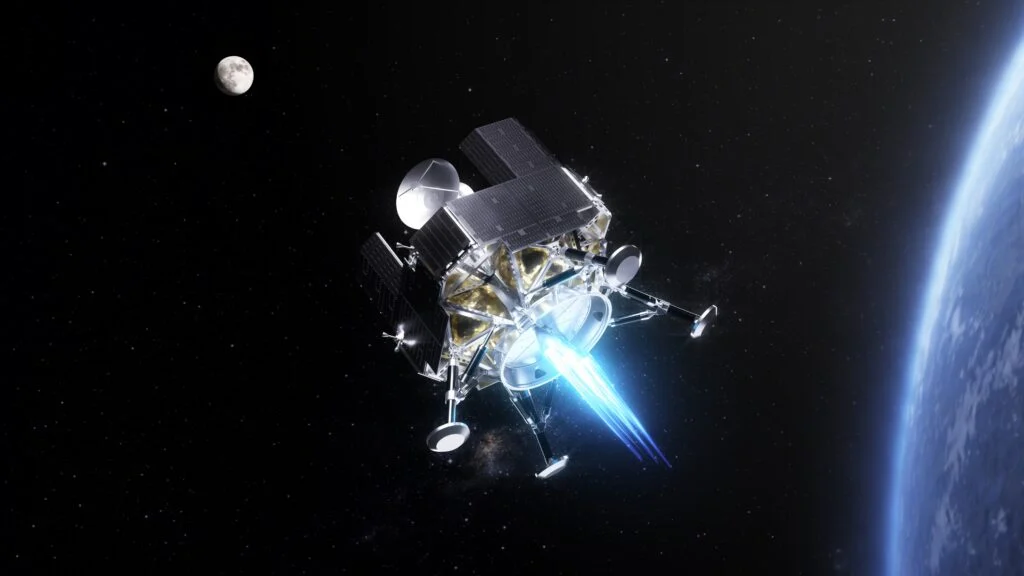

The Japanese aerospace sector reached a significant milestone on July 16, 2024, as Sky Perfect JSAT, Asia’s largest satellite operator, and ispace, inc., a pioneer in private lunar exploration, announced the signing of a Memorandum of Understanding (MoU) to collaborate on deep space communication infrastructure. This strategic alliance focuses on establishing robust, reliable communication links between ground stations on Earth and ispace’s next-generation "ULTRA" lunar lander, which is currently slated for deployment during the company’s Mission 3 in 2028. Under the terms of the agreement, the two entities will engage in a series of technical information exchanges and system compatibility studies to ensure that Sky Perfect JSAT’s specialized "JSAT Space Line" ground station services can seamlessly support the high-demand data requirements of future lunar missions.
The partnership represents a critical step in the commercialization of cislunar space—the region between Earth and the Moon—as it seeks to transition lunar communications from purely government-managed networks to a diversified, commercially viable ecosystem. By leveraging Sky Perfect JSAT’s extensive experience in satellite operations and ispace’s cutting-edge lander technology, the collaboration aims to build a sustainable bridge for data transmission that will support not only ispace’s proprietary missions but potentially the broader international lunar exploration community.
Technical Synergy and the JSAT Space Line Infrastructure
At the heart of this agreement is the technical integration of the JSAT Space Line with ispace’s ULTRA lander. The ULTRA lander is designed to be a high-performance spacecraft capable of carrying significant payloads to the lunar surface and into lunar orbit. Given the complexities of deep space communications—including signal attenuation over 384,400 kilometers, Doppler shifts, and the requirement for precise pointing—the compatibility studies will focus on frequency coordination, modulation techniques, and protocol standardization.
Sky Perfect JSAT, which operates a fleet of approximately 17 satellites in geostationary orbit, has recently been expanding its "JSAT Space Line" brand. This service is specifically tailored to provide ground segment support for New Space companies and government agencies involved in deep space exploration. The MoU outlines plans to explore the feasibility of demonstration activities, which would involve live testing of the communication uplink and downlink capabilities between the ULTRA lander and JSAT’s domestic ground stations in Japan. This domestic focus is particularly vital for Japan’s strategic autonomy in space, ensuring that the nation possesses the end-to-end capability to manage its own lunar assets without total reliance on foreign infrastructure.
Redundancy and Global Integration: The ESA Connection
One of the most pragmatic aspects of the partnership is the exploration of JSAT Space Line as a backup to the European Space Operations Centre (ESOC) ground station network. Currently, ispace utilizes the European Space Agency’s (ESA) tracking station network (ESTRACK) for its mission control requirements. While the ESA network provides world-class coverage, the growing number of lunar missions globally is expected to create a bottleneck in ground station availability.
By integrating Sky Perfect JSAT’s infrastructure as a redundant service provider, ispace enhances its mission assurance. In the event of network congestion or technical maintenance at ESA sites, the JSAT Space Line could provide the necessary telemetry, tracking, and command (TT&C) services to maintain contact with the ULTRA lander. This multi-node approach is becoming the industry standard for high-stakes missions where the loss of communication for even a few hours could jeopardize years of development and millions of dollars in investment.
The Evolution of ispace: From HAKUTO to the ULTRA Lander
To understand the significance of Mission 3, one must look at the trajectory of ispace. Founded in 2010, the company initially competed in the Google Lunar XPRIZE as Team HAKUTO. While the prize went unclaimed, ispace successfully transitioned into a commercial enterprise, launching Mission 1 in December 2022. Although the Mission 1 lander (HAKUTO-R Mission 1) narrowly missed a soft landing in April 2023 due to a software-related altitude miscalculation, it achieved several historic milestones, including the first successful private lunar orbit insertion and the transmission of data from deep space.
Building on those lessons, ispace is currently preparing for Mission 2, scheduled for launch in late 2024, which will feature a lander similar in design to Mission 1 but with improved software and sensor suites. Mission 3, however, represents a technological leap. The ULTRA lander is being developed to handle larger payloads and more complex mission profiles, including those required by NASA’s Commercial Lunar Payload Services (CLPS) program. The integration of Sky Perfect JSAT’s communications expertise for Mission 3 indicates that ispace is preparing for a higher volume of data-intensive scientific and commercial payloads, ranging from high-definition video feeds to complex geological sensor data.
Chronology of the Partnership and Key Milestones
The development of this partnership follows a clear timeline of Japanese space industry acceleration:
- 2010: ispace is founded, marking the beginning of Japan’s private lunar ambitions.
- 2022 (December): ispace launches Mission 1, testing the initial ground station configurations with international partners.
- 2023 (April): Mission 1 reaches the Moon, providing critical data on the challenges of lunar descent and communication during the "seven minutes of terror."
- 2024 (Early): Sky Perfect JSAT announces the expansion of its "JSAT Space Line" to cater to the growing deep space market.
- 2024 (July 16): The official signing of the MoU between Sky Perfect JSAT and ispace is announced, targeting Mission 3.
- 2024 (Q4 Expected): Scheduled launch of ispace Mission 2.
- 2025–2027: Expected period for system compatibility studies and ground station testing between JSAT and ispace.
- 2028: Targeted launch window for ispace Mission 3 featuring the ULTRA lander.
Economic and Strategic Implications for the Lunar Economy
The collaboration between these two Japanese giants arrives at a time when the "lunar economy" is shifting from theoretical projections to tangible market activity. According to various industry analyses, the cislunar market is expected to reach a valuation of over $100 billion by 2040. This growth is driven by a combination of government programs, such as NASA’s Artemis and the Artemis Accords, and private sector interest in resource utilization, such as water ice mining for fuel and lunar regolith for construction.
For Sky Perfect JSAT, the move into lunar communications is a strategic pivot. As the traditional satellite broadcasting market faces pressure from terrestrial streaming services, the "Space Business" sector—including Earth observation, debris removal, and deep space ground stations—offers a high-growth alternative. By securing a partnership with a leading lander company like ispace, Sky Perfect JSAT positions itself as a primary gatekeeper for data flowing between Earth and the Moon.
For ispace, the partnership reduces operational risk and costs. Establishing a dedicated commercial ground station link in Japan allows for more flexible mission planning and data management. Furthermore, it strengthens the "All-Japan" approach to space exploration, which has been a priority for the Japanese government and the Japan Aerospace Exploration Agency (JAXA).
Leadership Perspectives and Industry Reaction
Takeshi Hakamada, the founder and CEO of ispace, emphasized the broader industrial impact of this agreement. In a statement following the announcement, Hakamada noted that the collaboration is not merely a technical checkbox for Mission 3 but a fundamental effort to strengthen the foundation of Japan’s space industry. He highlighted that validating the technical effectiveness of the JSat Space Line would pave the way for other commercial entities to utilize Japanese ground station infrastructure, thereby fostering a more robust domestic ecosystem.
While Sky Perfect JSAT’s leadership has focused on the technical readiness of their ground segments, industry analysts suggest that this MoU could be the precursor to a more formal service contract. If the compatibility studies are successful, Sky Perfect JSAT could become the primary communications provider for ispace’s subsequent missions (Missions 4 and 5), which are expected to involve even more frequent lunar surface operations and potentially a lunar orbiting relay satellite.
Future Outlook: Building the Cislunar Internet
The long-term vision shared by both companies aligns with the concept of a "Cislunar Internet." As more landers, rovers, and eventually human habitats are established on the Moon, the need for a continuous, high-bandwidth communication network becomes paramount. The current model of direct-to-Earth communication is limited by the Moon’s rotation and the need for massive ground antennas.
The JSAT-ispace partnership could eventually evolve into a network of lunar relay satellites. Such a system would allow for constant communication even when a lander is on the "far side" of the Moon or in deep craters at the lunar poles. By starting with ground-to-lander compatibility for the ULTRA lander, the two companies are laying the groundwork for the protocols and hardware standards that will define how data is moved across the solar system in the decades to come.
As the 2028 launch date for Mission 3 approaches, the aerospace community will be watching the results of the JSAT Space Line studies closely. Success here would not only validate ispace’s "ULTRA" lander platform but also cement Sky Perfect JSAT’s role as a vital infrastructure provider in the new era of deep space commerce. The partnership underscores a fundamental shift in space exploration: it is no longer just about reaching the destination; it is about staying connected once you arrive.
