

The rapid evolution and enterprise adoption of generative artificial intelligence have fundamentally transformed modern software architectures, introducing unprecedented efficiencies alongside complex security vectors. When Anthropic released its Model Context Protocol (MCP) into production in late 2024, the framework spread across the technology sector with extraordinary velocity. Designed to act as a standardized bridge between AI agents and diverse enterprise tools and databases, MCP was swiftly embraced by industry giants including Microsoft, Google, and OpenAI. Maintenance of the protocol was subsequently transitioned to the Linux Foundation, cementing its status as critical infrastructure.
However, as organizations rushed to integrate MCP servers into their workflows, many treated the protocol like any other traditional integration standard. Developers installed the architecture, integrated the necessary components, and trusted default configurations. By 2026, a consensus emerged within the cybersecurity community: the vulnerability did not lie within the core infrastructure of the protocol itself, but rather in the permissive credential architectures operating beneath it.
The Evolution of Non-Human Identities and Standing Credentials
The architectural mismatch between legacy security assumptions and autonomous AI operations has become one of the most pressing challenges for modern security teams. Unlike traditional software integrations governed by deterministic logic and human-triggered inputs, AI agents operate with a high degree of autonomy, making decisions, executing code, and interacting with external APIs independently.
Empirical data underscores the magnitude of this shift. According to the SANS 2026 Identity Threats Survey, which gathered insights from more than 500 cybersecurity professionals, 76 percent of surveyed businesses reported a noticeable increase in non-human identities within their ecosystems. Furthermore, 74 percent of organizations indicated that they currently deploy AI systems that rely on permanent, standing credentials to execute tasks independently. Most alarmingly, the survey revealed that fundamental protective measures—such as rigorous approval workflows, comprehensive sandboxing, and granular activity logging—are implemented by fewer than 40 percent of businesses.
This reliance on standing privileges has created a fertile ground for sophisticated cyber threats. Security researchers have categorized these exploits into distinct operational patterns. Tool poisoning occurs when a malicious actor embeds hidden instructions within a server’s tool descriptions, manipulating the AI agent into executing unauthorized actions. Concurrently, the classic "confused deputy" problem manifests when an autonomous agent inherits a broad scope of trust that vastly exceeds the requirements of the specific task assigned to it.
Chronology of Vulnerabilities: From GitHub to Asana
The limitations of default permission settings became glaringly apparent through a series of high-profile security incidents that plagued early MCP deployments.
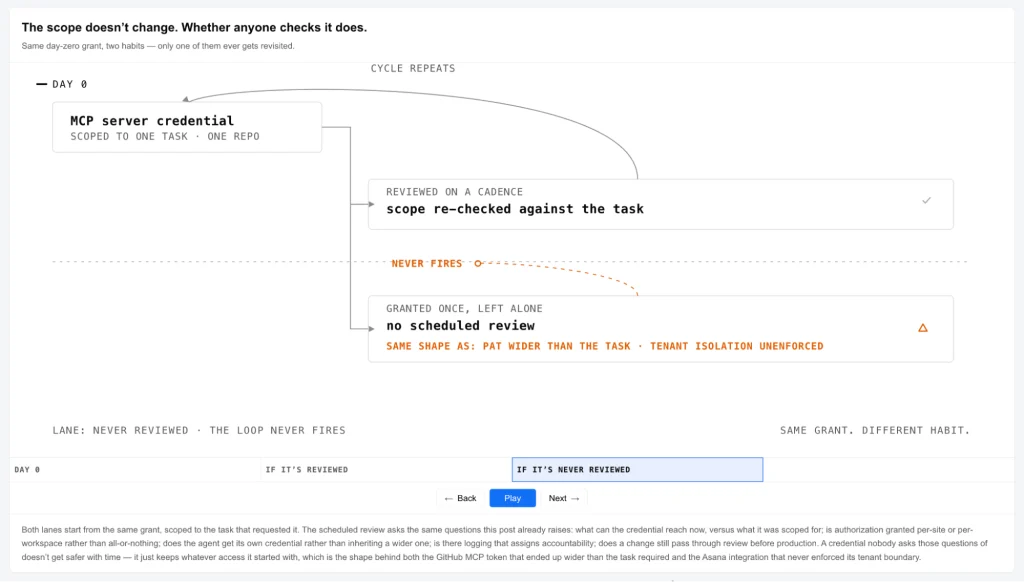
In May 2025, security researchers demonstrated an attack exploiting the GitHub MCP server. By leveraging prompt injection techniques against the server, attackers successfully extracted private repository data. Crucially, this breach did not stem from a traditional software bug within the MCP server itself. Instead, the vulnerability arose because the personal access token (PAT) backing the server was scoped with far broader privileges than the task demanded.
Days later, a separate logic flaw within an Asana MCP integration exposed customer data across organizational boundaries. The permission layer failed to enforce strict isolation barriers between distinct tenants, allowing cross-tenant access simply because the underlying authorization model lacked context-aware boundaries.
These incidents highlighted a systemic flaw in how enterprises provision access for artificial intelligence. Security patches could resolve specific bugs on individual servers, but they failed to answer a fundamental, uncomfortable question: why did that particular server require access to resources it never needed to touch in the first place?
Redesigning Permissions: Compartmentalization and Dynamic Credentials
In response to these recurring security failures, industry experts and engineering teams have begun advocating for a fundamental redesign of permission frameworks. Rather than relying solely on automated vulnerability scanners, organizations are urged to implement strict access compartmentalization.

Guidance published on the GitHub Engineering Blog regarding the development of secure remote MCP servers outlines several essential security tenets. Every MCP instance must utilize isolated secrets dedicated exclusively to a specific task. All incoming requests must be strictly limited to the acting user, and authorization must be validated based on explicit, real-time actions rather than assumed trust following initial user authentication. Furthermore, organizations are advised to replace fixed, permanent tokens with dynamic, short-lived credentials generated on the fly.
Leading technology companies are actively adjusting their security postures to reflect these realities. Webflow, for instance, treats MCP integrations with the same rigorous scrutiny applied to any third-party component possessing access to sensitive customer data.
To evaluate the security posture of an MCP integration effectively, security teams must interrogate several critical dimensions:
- Current Reach vs. Intended Scope: What resources can the credential actually access at present, compared to the narrow scope for which it was originally provisioned? Access creep is common, and without routine audits, these permissions expand unchecked.
- Granularity of Authorization: Is access granted on a localized basis—such as per-site, per-repository, or per-workspace—or is it delivered via an all-or-nothing organizational scope? Integrations that lack granular scoping mechanisms at connection time present an immediate risk.
- Credential Inheritance: Does the AI agent inherit the human user’s exact permissions, or does it generate entirely separate credentials that inadvertently bypass established user limitations?
- Accountability and Logging: Do audit logs attribute agent actions with the same granular accountability applied to human operators? If an agent’s activities remain invisible or unattributable, incident response efforts are severely compromised.
- Production Safety Gates: Do modifications generated by the agent flow directly into production environments, or are they subjected to human-in-the-loop review mechanisms, such as draft states, branching workflows, and explicit approval queues?
The Identity Crisis: Agents, OAuth, and Lifespan
Beneath the conversation surrounding permission scopes lies a deeper, unresolved identity crisis. When security professionals ask what an agent is permitted to do, they are frequently confronted with a foundational ambiguity: what, precisely, is an agent from an identity perspective?
In the current technological landscape, the pragmatic answer across much of the industry is unsettlingly simple: an agent is effectively a human’s OAuth token wearing a trenchcoat. Most autonomous agents lack a distinct, native identity. Instead, they inherit the privileges, blast radius, and literal credentials of the human operator who initiated them.
This architecture was adequate when AI agents were strictly ephemeral—spinning up for a few minutes to execute a script, then terminating. However, as enterprise use cases shift toward persistent agents designed to operate autonomously for weeks or months, borrowed identities become a severe liability. Just as organizations would never issue a permanent security badge to an afternoon contractor, they cannot justify granting long-running autonomous agents the same standing privileges as permanent enterprise systems.
The structural mismatch with OAuth further exacerbates the problem. OAuth was engineered around a human consent model, assuming a user would actively review a permission dialog and make an informed choice. In practice, human users routinely bypass this friction by clicking "allow" without reading scope lists. When applied to autonomous processes operating without human oversight, this consent model collapses entirely. The core OAuth specification contains no native conceptual framework for defining a client as an autonomous agent or bounding a grant to a specific operational lifecycle.
While emerging Internet Engineering Task Force (IETF) drafts have begun exploring proposals to bind token lifetimes directly to task lifecycles and assign stable agent identities distinct from human users, these standards remain in early developmental stages. Organizations are left to navigate the delicate balance between short-lived, broad-access tasks and long-running, strictly locked-down agents.
Implications and the Path Forward
Securing AI agent architectures requires a holistic approach that simultaneously addresses protocol design, identity management, and dynamic permissions. These three layers are interdependent; strengthening one while neglecting the others yields negligible security improvements.
Creating a properly scoped credential on day one provides little long-term security if no mechanism exists to verify its ongoing validity. Conversely, developing advanced identity protocols is futile if underlying integrations continue to default to standing, all-or-nothing access privileges.
Ultimately, the organizations successfully navigating the security challenges of the AI era are those moving beyond the traditional paradigm of evaluating scope, identity, and lifespan as isolated, one-time checkpoints. By treating these elements as a unified, continuously evaluated configuration tied directly to the lifecycle of the agent, enterprises can build resilient architectures capable of supporting autonomous innovation without compromising security.
