


Amazon Web Services (AWS) has officially announced the general availability of native vector search capabilities within Amazon DynamoDB, marking a significant evolution for the widely utilized NoSQL database service. This new feature enables developers to store vector embeddings directly alongside operational data within a single database table, eliminating the historical necessity of provisioning and maintaining separate, dedicated vector stores. By integrating similarity search directly into its serverless architecture, AWS aims to simplify the infrastructure stack required for modern artificial intelligence applications, including retrieval-augmented generation (RAG), recommendation engines, and agentic memory systems.
The rollout addresses longstanding architectural challenges faced by enterprise engineering teams building applications powered by large language models (LLMs) and machine learning models. Previously, implementing semantic search alongside transactional workloads required a fragmented approach: operational data lived in DynamoDB while vector embeddings were pushed to external vector databases. Maintaining synchronization between these separate services introduced operational friction, data movement costs, synchronization pipelines, and latency hurdles at scale. With the new release, vectors and transactional data share identical serverless infrastructure, utilizing the established pay-per-request pricing model and operating under uniform governance standards.
Technical Architecture and Performance Metrics
At its core, vector search in DynamoDB is engineered to handle massive workloads without requiring manual capacity planning or server management. AWS reports that the service supports single-digit millisecond latency while maintaining a recall accuracy rate of 99 percent or higher. Furthermore, the architecture is designed to scale horizontally across trillions of vectors without storage limitations, maintaining zero-downtime maintenance standards consistent with modern cloud-native databases.

To utilize the capability, developers generate numerical representations of unstructured data—such as text, images, or audio—using embedding models such as Amazon Bedrock Titan Text Embeddings, Cohere Embed, or various OpenAI text embedding models. These embeddings are stored as a standard list of floating-point numbers within a DynamoDB table item via a conventional PutItem or UpdateItem API call.
Once stored, users create a dedicated vector index on the attribute containing the embeddings. The indexing process requires specifying the number of dimensions—supporting up to 4,096 dimensions—and choosing a distance function to measure semantic proximity. DynamoDB supports three primary distance metrics:
- Cosine Distance: Measures the angle between vectors, ideal for determining semantic similarity in text regardless of magnitude.
- Euclidean Distance: Calculates the straight-line distance between two points in vector space.
- Dot Product: Evaluates both magnitude and angle, frequently used in optimized recommendation systems.
Additionally, the implementation supports inline filtering, allowing developers to restrict similarity searches using non-vector attributes (such as category or region) at query time. This is managed through partition keys designed to distribute vector data efficiently, ensuring queries are scoped to specific partitions to maintain predictable performance under heavy traffic loads.
Chronology and Industry Context
The introduction of native vector search in DynamoDB reflects an industry-wide race among major cloud providers to embed artificial intelligence capabilities directly into foundational data infrastructure. Over the past twenty-four months, enterprise adoption of generative AI has shifted from experimental proof-of-concept projects to core production systems. As organizations deploy conversational agents, automated assistants, and semantic search interfaces, the demand for low-latency retrieval mechanisms has surged.

Historically, the database market split into distinct categories: relational databases, NoSQL operational stores, and specialized vector databases. However, operational complexity and data synchronization bottlenecks have driven a strong developer preference for convergence. Competitors across the cloud landscape have similarly introduced vector extensions to relational and document databases throughout 2023 and 2024. By bringing native vector search to DynamoDB—one of the world’s most heavily relied-upon serverless NoSQL databases—AWS is positioning its flagship key-value store to capture a substantial share of generative AI operational workloads.
The path to this general release involved extensive architectural engineering to ensure that vector indexing operations would not interfere with standard transactional read and write latencies. By leveraging DynamoDB’s existing data types, such as Lists for float arrays, AWS avoided imposing disruptive schema migrations on existing customer bases. Developers can upgrade current tables simply by appending embedding attributes and defining index parameters through the AWS Management Console, CLI, SDKs, or infrastructure-as-code tools like AWS CloudFormation.
Practical Implementation and Walkthrough
To illustrate the practical mechanics of the new feature, AWS outlined a standard workflow using an online sporting goods catalog. In an existing table designated as ProductCatalog, each item contains operational attributes such as productId, category, description, marketplace, and price.
The integration process follows three primary phases:
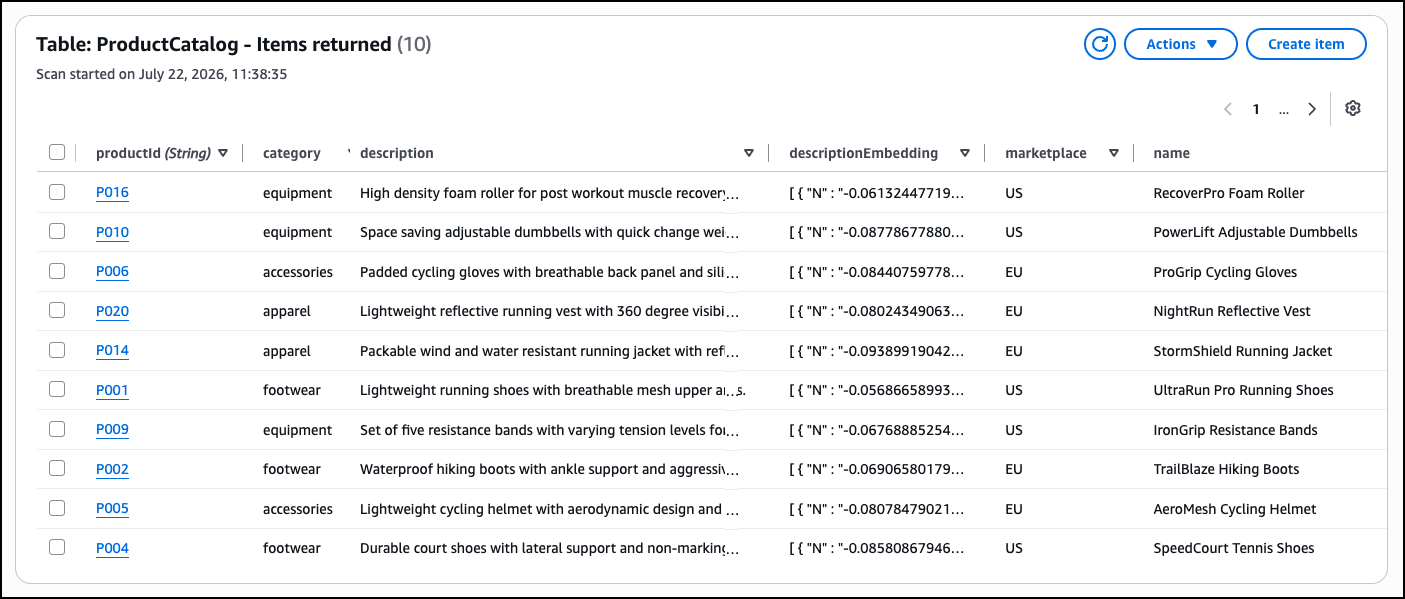
- Embedding Generation and Storage: The enterprise utilizes an embedding model—such as Amazon Bedrock Titan Text Embeddings—to convert product descriptions into dense numerical vectors. These vectors are added to existing records as a new attribute named descriptionEmbedding via standard update operations. Because DynamoDB stores these as native list types containing numbers, no specialized data types or complex migrations are required.
- Vector Index Creation: Database administrators navigate to the DynamoDB console, select the ProductCatalog table, and initiate the creation of a vector index named ProductDescriptionIndex. Parameters specified include the target vector attribute, the dimension count matching the embedding model, and Cosine as the distance function. Administrators can also designate partition keys, such as a marketplace identifier, to isolate data geographically or logically, along with inline filter attributes like product categories for precise retrieval scoping.
- Execution of Semantic Queries: When a user enters a natural language query—such as "lightweight running shoes for summer"—the application converts the search phrase into a query vector using the identical machine learning model. Through the newly introduced SearchVectors API, the system queries the index, applies inline filters (e.g., restricting results to the footwear category within the US marketplace), and retrieves the top-k most similar items ranked by numerical similarity scores.
Industry Implications and Economic Analysis
Market analysts view the integration of vector search into operational databases as a pivotal moment for enterprise software architecture. From an economic perspective, reducing the number of distinct database engines within an organization’s stack translates directly to lower total cost of ownership (TCO). Enterprises save on licensing fees, infrastructure provisioning, cross-service data egress fees, and the engineering hours previously dedicated to building and debugging custom data synchronization pipelines.
Furthermore, the serverless nature of DynamoDB means organizations do not need to over-provision vector infrastructure to handle peak loads or unpredictable query volumes. The pay-per-request pricing model ensures that organizations pay only for the compute and storage resources consumed during actual read, write, and search operations. This cost predictability lowers the financial barrier to entry for small and medium-sized businesses looking to deploy sophisticated artificial intelligence features.
Security and compliance are additional areas impacted by this architectural consolidation. By keeping vector embeddings and operational data within the same secure database boundary, enterprises simplify their compliance postures. Data governance policies, encryption at rest and in transit, and access control mechanisms (such as AWS Identity and Access Management) apply uniformly to both transactional data and semantic indices, reducing potential security blind spots associated with third-party data replication.
Broader Market Impact and Future Outlook
The general availability of vector search in Amazon DynamoDB underscores a broader maturation phase in cloud computing, where artificial intelligence is no longer treated as an isolated workload requiring specialized, siloed infrastructure. Instead, AI capabilities are rapidly becoming standard features embedded deeply into core data persistence layers.

As developer ecosystems adapt to these unified architectures, the adoption velocity of generative AI features in consumer and enterprise applications is expected to accelerate. Tools such as the AWS MCP Server and AI coding assistant plugins are already being updated to support programmatic interaction with DynamoDB’s vector search APIs, enabling developers to build, test, and deploy semantic applications with greater velocity.
Vector search in Amazon DynamoDB is now generally available across all commercial AWS Regions, as well as AWS GovCloud (US) Regions. As enterprises continue to evaluate their long-term data strategies, the ability to execute high-performance semantic retrieval directly over transactional data without administrative overhead is likely to redefine architectural standards for cloud-native application development.
