

Understanding the fundamental infrastructure driving the digital economy requires looking past abstract concepts like the cloud and examining the tangible hardware and software architectures that power global networks. Every digital interaction, from executing a high-frequency financial trade to streaming high-definition media, relies ultimately on processing power housed in real-world facilities. As organizations continually assess their computational needs, the debate between utilizing dedicated physical servers, commonly known as bare metal, and deploying agile virtual servers remains a cornerstone of enterprise IT strategy.
To comprehend the distinct operational advantages of each approach, industry stakeholders must examine how these architectures are constructed, how their underlying technologies evolved, and the specific metrics that guide modern deployment strategies. While virtualization currently dominates global server workloads, physical infrastructure retains a vital, specialized role in mission-critical applications where raw performance and absolute isolation are paramount.
Historical Context and the Evolution of Enterprise Infrastructure
In the early decades of commercial computing, particularly throughout the 1990s and into the early 2000s, enterprise IT was defined almost exclusively by physical architecture. Companies purchased discrete, tangible servers—ranging from desktop towers to massive rack-mounted chassis containing dedicated central processing units, memory, and storage—to power individual applications. A single server typically ran a single operating system and hosted one primary application, such as an email gateway or a corporate database.
This model, while robust, introduced significant inefficiencies. Hardware utilization rates during this era frequently hovered below fifteen percent, as organizations routinely over-provisioned physical machines to handle peak workloads that occurred only briefly. Maintaining separate physical hardware for every minor application inflated capital expenditures, increased data center floor-space requirements, and drove up electricity and cooling costs.
The landscape transformed fundamentally with the mainstream commercialization of server virtualization in the mid-2000s, pioneered by companies like VMware. By introducing a software layer known as a hypervisor between the physical hardware and the operating system, IT engineers discovered they could abstract computing resources. A single powerful physical machine could suddenly be sliced into multiple isolated digital replicas, each functioning as an independent virtual server with its own assigned CPU, memory, and storage allotments.
This architectural shift catalyzed the modern cloud computing revolution. Hyperscale cloud providers, including Amazon Web Services, Microsoft Azure, and Google Cloud Platform, built massive data centers filled with standardized physical hardware, renting out virtual slices to millions of global customers. This on-demand elasticity drastically lowered the barrier to entry for startups and allowed multinational enterprises to scale operations globally within minutes rather than weeks.
Anatomy of a Physical Server
A physical server, or bare metal server, is a tangible piece of computing hardware designed specifically to run continuously, typically 24 hours a day, seven days a week. Unlike standard consumer desktop computers, physical servers are engineered for extreme durability, featuring redundant power supply units, advanced cooling systems, error-correcting code (ECC) memory, and enterprise-grade network interface cards.
The primary architectural characteristic of a physical server is exclusivity. All computational resources—including the processor cores, graphical processing units, random-access memory, and disk storage—belong entirely to the operating system and applications installed directly onto that machine. There is no intermediary software layer or hypervisor consuming system overhead.
Key technical features of physical servers include:
- Unrestricted Resource Access: Applications running on bare metal do not contend with other workloads for processor cycles or memory bandwidth, ensuring maximum possible throughput and low latency.
- Complete System Ownership: Organizations that own or lease dedicated bare metal maintain absolute control over firmware updates, hardware configurations, and security patches.
- Enhanced Physical Security: Because the hardware is not shared with multi-tenant cloud environments, the attack surface related to hypervisor vulnerabilities is completely eliminated.
Despite the proliferation of cloud computing, physical servers remain heavily utilized across specific, high-stakes industries. Financial institutions rely on bare metal for algorithmic trading platforms where microsecond latency differences dictate profitability. Government agencies, defense contractors, and healthcare organizations utilize physical servers to satisfy stringent regulatory compliance mandates regarding data sovereignty and physical isolation. Furthermore, aerospace engineering, media rendering, and large-scale manufacturing operations depend on the raw, unthrottled computing power of physical servers to process massive, complex datasets.
Anatomy of a Virtual Server
A virtual server, frequently referred to as a virtual machine (VM), is a software-based emulation of a physical computer. Created through a process called hardware virtualization, virtual servers operate by dividing the physical resources of a host machine among multiple isolated guest environments.
The mechanism relies on a hypervisor, which allocates specific fractions of the underlying physical server’s CPU, memory, and storage to each virtual instance. From the perspective of the operating system running inside it, a virtual server behaves precisely like an independent physical computer, complete with its own virtualized hardware drivers, IP addresses, and application stacks.
Key technical features of virtual servers include:
- Rapid Deployment and Provisioning: Virtual servers can be created, duplicated, or deleted in a matter of seconds using software automation templates and management dashboards.
- Resource Pooling and Efficiency: Multiple virtual servers sharing a single physical host dramatically increase hardware utilization rates, often pushing capacity past eighty percent and reducing overall data center footprints.
- Hardware Independence: Virtual servers are decoupled from the underlying physical hardware. If a physical host machine fails, a virtual server can be migrated to a different physical node with minimal downtime.
The use cases for virtual servers are virtually limitless, spanning every major commercial sector. Enterprises deploy virtual servers to host dynamic web applications, establish scalable development and testing environments, run containerized microservices architectures, and power enterprise resource planning (ERP) systems. Additionally, virtual desktop infrastructure (VDI) relies on virtual servers to deliver secure, centralized desktop environments to remote workforces globally.
Comparative Analysis: Physical Versus Virtual Infrastructure
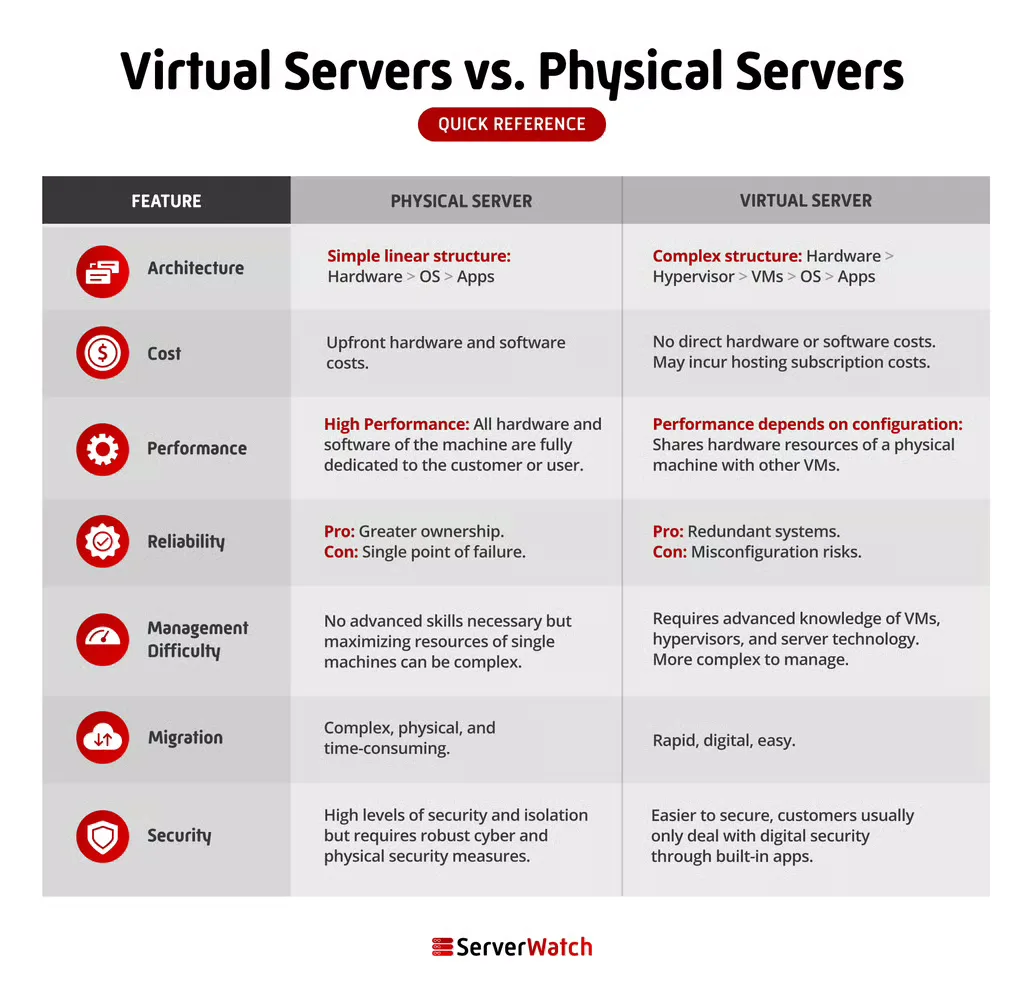
When designing modern IT architecture, system administrators must evaluate several critical vectors when choosing between physical and virtual servers.
Architecture and Deployment Structure
The fundamental difference lies in structure. Physical servers feature a direct, single-tier architecture where the operating system interfaces directly with the hardware components. Virtual servers utilize a multi-tier architecture where a hypervisor sits between the physical hardware and the guest operating systems, enabling multiple virtual instances to coexist on a single chassis.
Cost Dynamics and Financial Modeling
Financial considerations often dictate infrastructure choices. Virtual servers typically offer superior cost-efficiency at scale. Organizations pay only for the compute capacity they consume, avoiding substantial upfront capital expenditures for hardware acquisition. Furthermore, cloud-based virtual server subscriptions generally transfer hardware maintenance, physical security, cooling, and power costs to the third-party vendor. Conversely, physical servers demand higher initial capital outlays and ongoing operational expenditures for facilities, power, and manual maintenance, though they can prove more cost-effective for permanently saturated, high-load workloads that would require massive cloud resource allocations.
Performance Benchmarks
Performance capabilities depend heavily on configuration and workload type. For raw, uncompromised computing power, physical servers generally hold an advantage because they lack the slight computational overhead introduced by hypervisors. However, for most standard enterprise applications, virtual servers deliver performance that is virtually indistinguishable from bare metal, provided the host machine is appropriately provisioned and not oversubscribed.
Reliability and Disaster Recovery
Both paradigms can achieve high levels of reliability through redundancy, but their methodologies differ starkly. Physical server reliability relies on redundant hardware components within the machine, such as dual power supplies and RAID disk arrays. If a physical server fails catastrophically, recovery requires physical intervention or hardware replacement. Virtual server reliability is heavily tied to software orchestration. Because virtual servers exist as digital files, they can be continuously backed up, snapshotted, and automatically failed over to secondary hardware nodes during an outage, offering superior disaster recovery speeds.
Management Complexity and Operational Overhead
Managing physical servers involves hands-on administrative tasks, including manual firmware updates, physical hardware repairs, and inventory tracking. Virtual servers streamline management significantly. Administrators can execute updates, scale resource allocations dynamically, and monitor health metrics via centralized software dashboards. When utilizing external cloud vendors for virtual servers, hardware-level management responsibilities are entirely outsourced.
Migration and Scalability
Migration represents one of the starkest contrasts between the two technologies. Virtual servers can be migrated seamlessly across physical hosts—a process known as live migration—with little to no service interruption. Scaling a virtual server requires simply adjusting resource allocations through software. Physical server migration, by contrast, is a labor-intensive, physical endeavor requiring the manual relocation of heavy hardware, physical reconfiguration of network connections, and offline data transfers.
Security Profiles
Security must be evaluated through different lenses for each model. Physical servers offer complete physical isolation, ensuring no neighboring tenant can access system memory or storage channels. This makes them exceptionally secure against multi-tenant vulnerabilities. However, securing physical infrastructure requires robust on-premise security measures. Virtual servers offer strong logical isolation via hypervisor boundaries, but they introduce a broader threat landscape related to cloud misconfigurations, software vulnerabilities in the hypervisor layer, and potential risks associated with multi-tenant hardware sharing.
Strategic Industry Implications and Future Outlook
The ongoing coexistence of physical and virtual servers reflects the diverse and demanding requirements of the contemporary digital economy. While virtualization and cloud computing continue to capture the vast majority of enterprise workload growth due to their unmatched agility, cost-efficiency, and scalability, bare metal physical servers remain indispensable for specialized, high-performance, and ultra-secure applications.
Enterprise IT decision-makers increasingly favor hybrid deployment models. These strategies leverage virtual servers for scalable web applications, development pipelines, and general business software, while reserving physical bare metal servers for high-frequency financial transactions, intensive database management, and heavily regulated data storage. By carefully aligning workload requirements with the appropriate architectural foundation, organizations can optimize both performance and expenditure as digital demands continue to evolve.
