
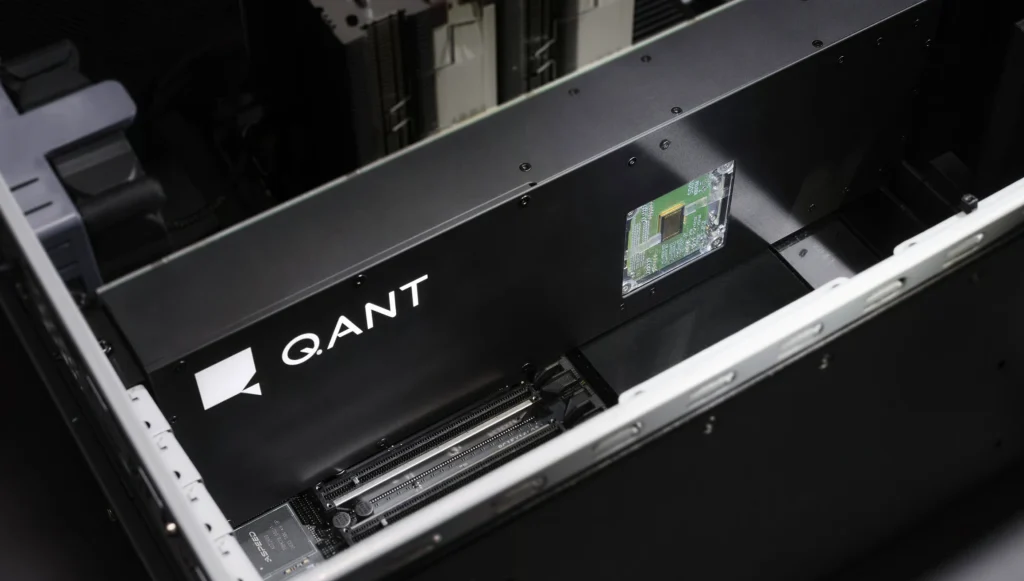

The landscape of artificial intelligence infrastructure is undergoing a subtle yet profound shift as hardware developers look beyond traditional electronic semiconductors to overcome looming physical and thermal bottlenecks. Q.ANT, an emerging deep-tech startup based in Stuttgart, Germany, is taking a decisive step toward challenging the electronic status quo by launching an open-source software development kit designed for photonic processors. These advanced chips utilize light rather than electricity to execute complex mathematical operations foundational to artificial intelligence, promising remarkable energy efficiency.
By releasing the Q.ANT Native Computing Toolkit to GitHub under a permissive license that permits commercial applications, the company is allowing software engineers and developers to begin writing, building, and testing programs tailored for light-based architectures without requiring physical access to the proprietary hardware. This strategic maneuver mirrors the historic playbook written by industry heavyweight Nvidia, which long ago recognized that hardware dominance is inextricably linked to accessible, robust software ecosystems. Through this initiative, Q.ANT hopes to lay the groundwork for a broader industry migration from digital electronic computing to optical computing methodologies.
Main Facts of the Photonic Software Release
The newly introduced Q.ANT Native Computing Toolkit represents a pivotal milestone for the Stuttgart-based enterprise. Available for free on GitHub, the software package enables developers to work using popular programming languages such as Python and C. At the heart of the toolkit is an advanced software simulator designed to accurately mimic the behavior of Q.ANT’s photonic processors on standard, off-the-shelf desktop computers without necessitating specialized proprietary drivers.
Despite its forward-looking architecture, the current iteration of the software has specific operational boundaries. The artificial intelligence tools integrated into this initial version are explicitly focused on inference—the execution of pre-trained models—rather than the intensive training phase. Demonstrative examples included within the repository showcase the processor’s capability to read handwritten digits, identify distinct objects within photographic frames, and outline intricate shapes within visual data. Meanwhile, resource-heavy model training operations continue to rely on conventional central processing units (CPUs) and graphics processing units (GPUs).
Furthermore, while developers can freely experiment with the simulator, direct physical access to Q.ANT’s actual hardware remains restricted. The company’s second-generation photonic chips are currently operational in limited high-performance environments, leaving everyday developers reliant on upcoming cloud access avenues or localized server deployments to test their programs on silicon.
Chronology and Development Timeline
The path leading to the open-source software release spans several years of rigorous research, technological iteration, and strategic funding rounds within the European deep-tech ecosystem.
- 2017: The foundational concept of utilizing optical architecture for neural networks gains mainstream academic attention, highlighted by early research developments such as MIT’s experimental photonic processors designed for optical computing workloads.
- March 2025: Q.ANT marks a major hardware milestone by successfully deploying its second-generation photonic processors at the Leibniz Supercomputing Centre (LRZ) located near Munich, Germany. Initial performance disclosures indicate dramatic speed and efficiency gains over previous iterations.
- July 2025: The company secures a substantial €62 million funding round led by prominent institutional venture capital firms including Cherry Ventures, UVC Partners, and imec.xpand, providing the financial runway required to scale engineering and software development efforts.
- Current Week: Q.ANT officially releases the Q.ANT Native Computing Toolkit to GitHub, marking its transition from a pure hardware research venture into a platform-oriented ecosystem builder.
Supporting Data and Technical Architecture
The core value proposition of photonic computing centers on thermodynamics and energy conservation. Modern artificial intelligence accelerators face severe efficiency limits because traditional silicon chips burn immense amounts of electrical energy continuously moving data back and forth between physical memory banks and processor logic units. Q.ANT attempts to bypass this fundamental limitation by performing specific mathematical computations natively via light waves.
Specifically, the photonic processors manipulate wave-shaped functions—such as cosine operations—that standard digital chips must compute through sequential arithmetic steps. According to internal technical documentation and performance benchmarks published by Q.ANT following the deployment at the Leibniz Supercomputing Centre, models built around these optical wave functions achieve comparable or superior analytical results while utilizing fewer parameters. Because deep learning parameters dictate the internal memory footprint and computational overhead of a model, reducing their quantity directly correlates with smaller model sizes, reduced data movement, and significantly lower power consumption.
Comparative benchmarks released by the company indicate that its second-generation chips operate more than 50 times faster at specific core mathematical workloads heavily relied upon by contemporary AI models, while consuming up to six times less energy on standard operational tasks compared to legacy architectures. However, independent industry analysts note that while these specific metrics are contextualized against older generations of the company’s hardware, broader claims boasting up to 30 times better overall energy efficiency require additional third-party validation to establish baseline standards.
Industry Context and Competitive Landscape
Q.ANT’s strategic focus on photonic computing places it within a small, highly specialized cohort of companies attempting to reinvent computational physics for the artificial intelligence era. Lightmatter, widely regarded as one of the most prominent players in the optical computing sector, has similarly explored light-based routing technologies, though its recent commercial strategies have emphasized inter-chip data transfer through products like Passage rather than direct optical arithmetic. Meanwhile, quantum computing pioneers such as Xanadu have maintained open-source software frameworks for light-based systems since 2018, establishing a precedent for developer-first optical ecosystems.
Despite technological promise, the historical graveyard of specialized artificial intelligence hardware startups serves as a cautionary tale for any firm challenging electronic hegemony. Nvidia’s nearly two-decade refinement of its CUDA programming platform has created an entrenched software moat that virtually guarantees developer loyalty, a reality underscored by Nvidia’s ongoing expansions into native Python support. Conversely, alternative architectures with compelling hardware designs—such as British AI chip pioneer Graphcore—ultimately struggled to build sustainable developer ecosystems and were absorbed by larger conglomerates like SoftBank in 2024.
Recognizing these historical hurdles, Q.ANT leadership has explicitly framed the software release as a critical community-building exercise. Michael Förtsch, founder and chief executive officer of Q.ANT, described the GitHub release during communications as the "Linux moment" of photonic computing, emphasizing that sustainable technological ecosystems cannot rely on hardware performance alone but must be cultivated through open, collaborative software foundations.
Official Responses and Market Implications
Reaction from the broader enterprise software and deep-tech investment communities has been cautiously optimistic, reflecting both the immense potential and the transitional nature of optical computing technologies.
Industry analysts point out that while the release of the Q.ANT Native Computing Toolkit lowers the barrier to entry for curious engineers, practical enterprise adoption will hinge heavily on infrastructure availability. At present, Q.ANT’s physical infrastructure is constrained to specialized research computing centers. Broader market access is slated to arrive in the coming months through cloud-based availability provided by German telecommunications and hosting provider IONOS, alongside dedicated on-site server hardware units directly distributed by Q.ANT.
Furthermore, the immediate utility of the software kit remains bounded. Because the current toolkit supports inference workloads rather than full-scale model training, data scientists and enterprise machine learning engineers cannot yet retrain their proprietary foundation models directly onto the photonic architecture. Training continues to demand the massive parallel processing capabilities of high-end electronic GPUs, positioning optical chips for now as specialized co-processors designed to optimize deployment efficiency rather than replace traditional training infrastructure entirely.
Broader Impact and Future Outlook
The implications of Q.ANT’s open-source strategy extend far beyond a single startup’s commercial roadmap. As global data center energy consumption skyrockets due to the insatiable electricity demands of generative artificial intelligence, the search for alternative energy-efficient paradigms has transitioned from an academic curiosity to an urgent industrial necessity.
Photonic computing offers a compelling theoretical escape hatch from the physical limits of Moore’s Law and copper-based electronic interconnects. By harnessing the speed and physical properties of light, engineers can theoretically process massive parallel matrix multiplications with near-zero latency and minimal thermal dissipation.
However, translating these physical principles into commercially viable data center components requires overcoming significant manufacturing, calibration, and integration hurdles. By placing its development kit into the hands of global programmers today, Q.ANT is crowdsourcing the creation of the algorithms, compilers, and workflows that will eventually determine whether optical AI processors remain an experimental footnote or evolve into the foundation of next-generation sustainable computing infrastructure.
