

The Evolution of Model Performance in Production
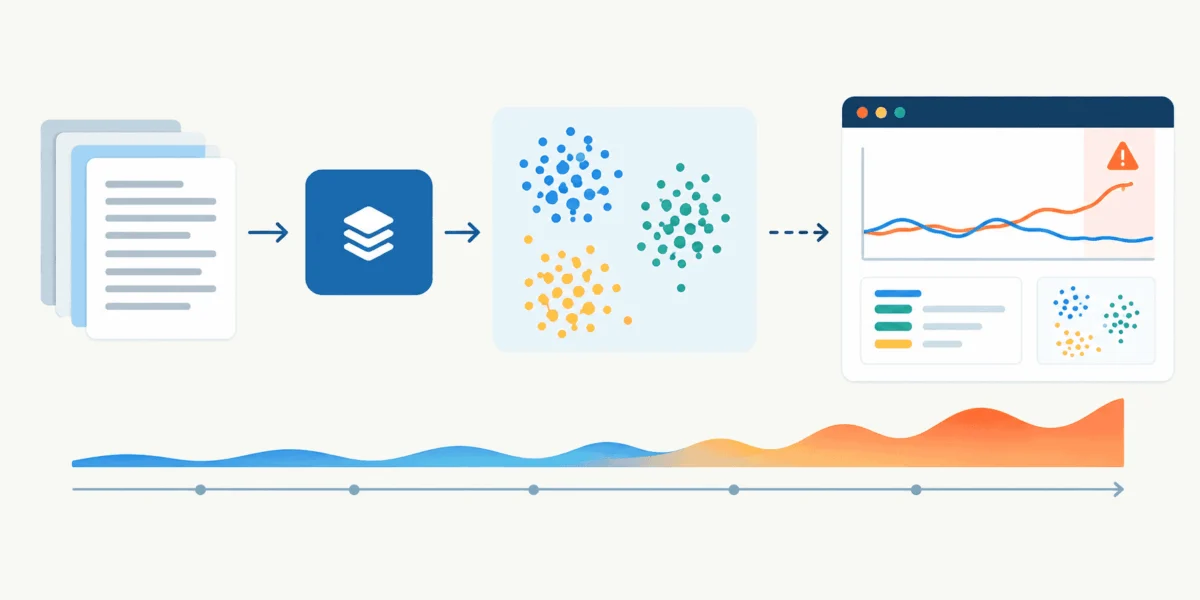
When a Large Language Model (LLM) is initially deployed, it is typically calibrated against a static benchmark or a curated training dataset. However, the operational environment is rarely static. In production, user queries, document uploads, and external data sources evolve continuously. Because LLMs rely on converting raw text into high-dimensional numerical vectors, known as embeddings, any significant shift in the nature of incoming data can cause a phenomenon known as "embedding drift."
Embedding drift occurs when the distribution of the input data in the vector space shifts away from the distribution observed during the model’s development or initial training phase. This divergence can lead to a degradation in model accuracy, hallucinated responses, or failure in retrieval-augmented generation (RAG) pipelines, where the model may no longer correctly associate user queries with relevant vector-stored documents.
Chronology of Data Drift Detection
The concept of monitoring data drift is not new; it has been a cornerstone of classical machine learning for decades. Historically, drift detection focused on tabular data, where individual features (such as user age or transaction amount) could be monitored for changes in mean or variance. However, the rise of vector-based models has rendered these traditional methods insufficient.
In the early 2020s, as transformer-based architectures became the industry standard, practitioners began to recognize that high-dimensional embeddings—often consisting of 384, 768, or even 1,536 dimensions—do not behave like standard tabular features. Statistical tests like the Kolmogorov-Smirnov test, while effective for one-dimensional data, struggle to capture the complex, non-linear relationships present in high-dimensional embedding spaces. Consequently, the industry shifted toward more sophisticated, model-based detection techniques around 2023 and 2024, emphasizing the need for automated MLOps pipelines that can signal the necessity for model retraining or fine-tuning.
Methodologies for Detecting Embedding Drift
To effectively mitigate the risks associated with model degradation, organizations have adopted two primary strategies for detecting drift: the Domain Classifier approach and the Centroid Distance method.
1. The Domain Classifier (Model-Based Detection)
The Domain Classifier approach utilizes a machine learning model, such as a Random Forest or a Gradient Boosting machine, to act as an adversarial monitor. In this setup, a classifier is trained to distinguish between "baseline" embeddings (the data used during training) and "production" embeddings (new, incoming data).
If the model can accurately classify whether a given embedding belongs to the baseline or production group, it serves as evidence that the two distributions have diverged. If the model achieves a high Area Under the Receiver Operating Characteristic curve (ROC-AUC)—typically above 0.65—it triggers an alert. This method is highly effective because it treats the problem as a classification task, allowing the detector to identify subtle, multi-dimensional shifts that a simple average would overlook.
2. The Centroid Distance (Center of Mass) Method
For organizations requiring a lighter, less computationally intensive solution, the Centroid Distance method is often preferred. This technique involves calculating the mean vector (centroid) of the baseline dataset and comparing it to the mean vector of the production data using distance metrics such as Cosine Distance or Euclidean distance.
While this method is significantly faster to execute, it provides a more granular view of the data. It assumes that if the "center of mass" of the data has moved, the model is likely operating on different types of information than those it was originally optimized for. However, analysts caution that this method may miss multi-modal drift, where the average position remains stable but the underlying data distribution becomes fragmented or changes shape.
Implementation Frameworks and Scikit-LLM
The integration of libraries such as Scikit-LLM has streamlined the implementation of these monitoring pipelines. By acting as a wrapper for LLM services, Scikit-LLM allows developers to generate, store, and compare embeddings within a unified Pythonic interface.
When deploying these systems, the standard workflow involves:
- Data Baseline Establishment: Generating a representative set of embeddings from the initial training corpus.
- Production Monitoring: Periodically sampling live data, generating embeddings via the same transformer model, and batching them for comparison.
- Alerting Logic: Implementing threshold-based triggers that alert engineering teams when the ROC-AUC or Cosine Distance crosses pre-defined stability boundaries.
Technical Implications and Data Integrity
The implications of ignoring embedding drift are substantial. In a RAG architecture, if a user queries the system about "cryptocurrency" but the vector database was populated with "IT support" manuals, the system will fail to retrieve contextually relevant information. The model may then hallucinate or provide generic, unhelpful answers, leading to a loss of user trust and potential business disruption.
Industry experts emphasize that detection is only the first step. Once drift is identified, the response must be structured. This usually involves:
- Data Analysis: Investigating whether the drift is a transient spike or a fundamental, long-term change in user behavior.
- Dataset Augmentation: Incorporating the new, drifted data into the training pipeline to ensure the model remains robust.
- Model Retraining: Updating the embedding model or the retrieval index to better reflect the current reality of the input domain.
Broader Impact on AI Governance
The rise of automated drift detection aligns with broader trends in AI governance. As companies face increasing scrutiny regarding the reliability and safety of their AI systems, the ability to demonstrate "monitoring" becomes a regulatory requirement. Implementing a drift detection pipeline provides an audit trail, proving that an organization is actively managing the performance of its models rather than relying on a "deploy and forget" strategy.
Furthermore, the shift toward using specialized embedding models (like all-MiniLM-L6-v2) in conjunction with monitoring tools suggests that companies are moving away from monolithic, black-box AI deployments. Instead, the current best practice favors modular, observable, and continuously updated pipelines.
Future Outlook
As LLM adoption grows, the infrastructure for monitoring will likely become more integrated into cloud platforms. Current efforts are focused on reducing the latency of these checks, ensuring that detection happens in near-real-time without adding significant overhead to the user experience. By bridging the gap between static model training and dynamic production environments, tools like Scikit-LLM are enabling a more mature, reliable era of AI development.
For engineering teams, the takeaway is clear: embedding drift is not a failure of the model, but an inevitable consequence of an evolving, real-world data ecosystem. By anticipating this drift and implementing the diagnostic frameworks discussed, organizations can maintain the integrity of their AI services and ensure consistent, high-quality performance in the face of ever-changing user demands.
