
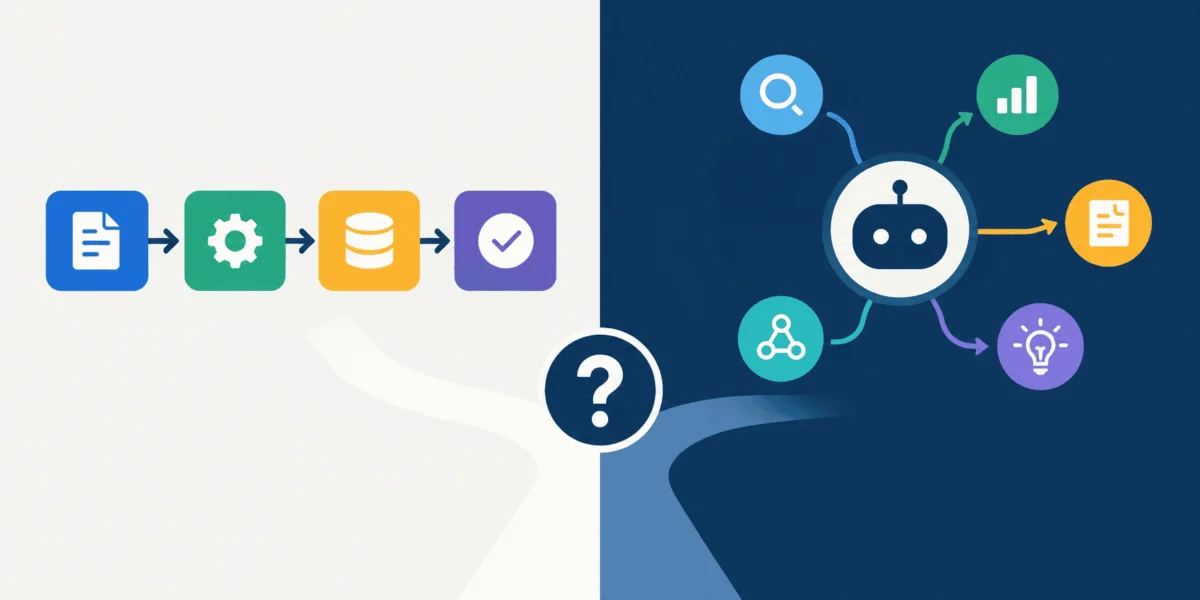

In the current landscape of rapid generative AI adoption, engineering teams are increasingly confronted with a critical architectural dilemma: whether to implement a structured, deterministic AI workflow or a dynamic, autonomous AI agent. This distinction has become the focal point of modern software engineering as developers attempt to balance the allure of "agentic" capabilities with the harsh realities of production reliability, cost management, and system predictability.
The Semantic Inflation of the Term "Agent"
The term "agent" has suffered from significant semantic inflation since the widespread adoption of large language models (LLMs). In the early stages of the generative AI boom, industry nomenclature was relatively precise. However, market pressures and the tendency to label any system involving an LLM as an "agent" have blurred the lines between sophisticated automation and basic prompt-chaining.
Market research indicates that over 70% of enterprise AI projects currently labeled as "autonomous agents" are, in fact, rigid, deterministic workflows. This misclassification creates significant technical debt, as developers often build overly complex, non-deterministic architectures to solve problems that could be handled more efficiently by traditional, state-machine-driven pipelines. An agent, by rigorous technical definition, is a system where the control flow—the sequence of logic and tool invocation—is determined by the model at runtime based on its interpretation of the environment. In contrast, a workflow is a predefined, hard-coded sequence of operations, even if those operations involve an LLM for intelligence or data transformation.
Chronology of the Shift Toward Autonomy
The transition toward agentic architectures can be traced back to the release of early frameworks like LangChain and AutoGPT in early 2023. These tools provided the first accessible interfaces for developers to create loops where an LLM could "observe, think, and act."
- Early 2023: The emergence of "Chain of Thought" prompting demonstrated that LLMs could break down complex problems into smaller, sequential steps.
- Mid-2023: The introduction of OpenAI’s Function Calling capability allowed models to reliably trigger external APIs, effectively turning LLMs into controllers for software systems.
- Late 2023 to Early 2024: The industry saw a proliferation of agentic frameworks, including CrewAI and Microsoft’s AutoGen, which moved beyond single-agent architectures toward multi-agent orchestration.
- Present Day: Industry focus has shifted from "can we build an agent?" to "should we build an agent?" as developers realize that non-deterministic systems often fail in high-stakes production environments due to hallucinations or infinite loop cycles.
Distinguishing Characteristics: Workflow vs. Agent
To understand the operational differences, one must analyze where the "decision-making authority" resides. In a workflow, the developer acts as the architect of the logic. Even if an LLM is used to classify a document, the developer has already dictated that the system must read, then classify, then route to a specific database. The path is immutable and audit-friendly.
In an agentic system, the developer provides a high-level objective, a set of tools, and a "system prompt" that acts as a set of guardrails. The agent then navigates the problem space. For instance, in a system designed for incident response, an agent might decide to ping a server, realize the response is timeout-based, backtrack, and instead choose to query the logs. The sequence of actions is discovered during execution. This provides immense flexibility but introduces the potential for unexpected outcomes—a critical risk in regulated sectors like finance or healthcare.
Data-Driven Decision Frameworks
When assessing whether to employ an agent, engineering leads should evaluate the application against specific metrics. Industry data suggests that workflows outperform agents by approximately 40% in terms of latency and cost-efficiency for tasks requiring high throughput.
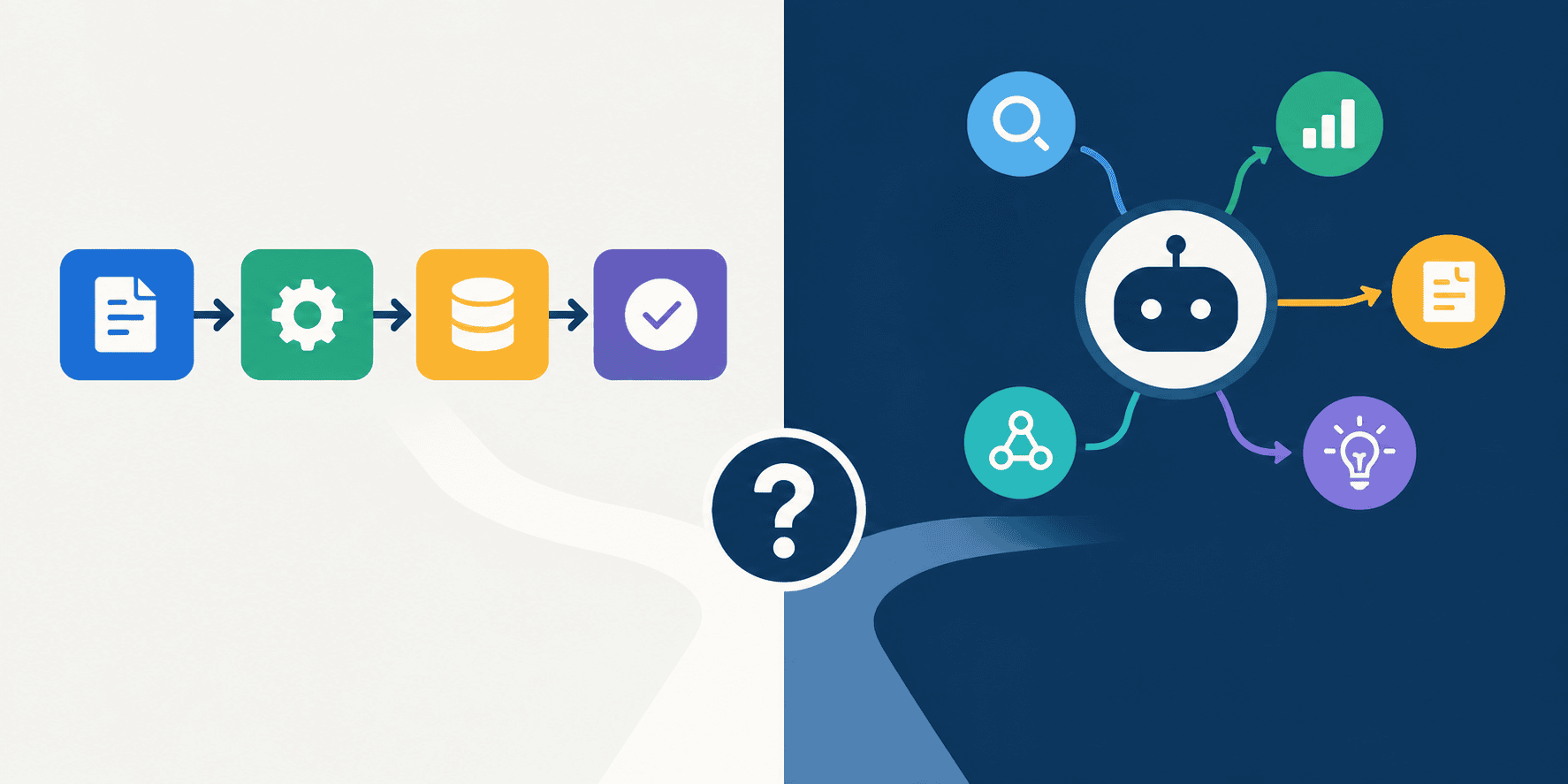
- Complexity and Predictability: If a task can be mapped on a flowchart, a workflow is superior. If the problem space is too expansive to map—such as open-ended research or debugging unknown system failures—an agent is more appropriate.
- Compliance and Auditability: Regulated industries require deterministic behavior. In a workflow, every step is logged and reproducible. Agents, which may change their reasoning path based on minor variations in input, often fail compliance audits that require "identical path" execution.
- Cost and Latency: Agents consume significantly higher token counts because they must perform reasoning cycles before and after every action. In high-volume customer service scenarios, this can result in costs that are 5x to 10x higher than a structured workflow.
Industry Perspectives and Expert Consensus
Leading AI researchers have recently emphasized the importance of "constrained autonomy." The consensus among systems architects at major tech firms is that the "agentic" label should be reserved for systems that truly require iterative reasoning.
"The most effective systems we see today are hybrid," notes one lead AI engineer at a Fortune 500 firm. "We use a deterministic workflow for 90% of the data processing and only trigger an agentic sub-routine when the workflow encounters an edge case it cannot resolve via predefined rules."
This "Human-in-the-loop" or "Workflow-first" approach is becoming the gold standard. It acknowledges that while LLMs possess remarkable reasoning capabilities, they lack the structural reliability of traditional procedural programming. By treating an agent as a "specialist" within a larger, well-defined workflow, organizations can capture the benefits of LLM intelligence without compromising system stability.
Implications for Future Architecture
The broader implication of this distinction is a shift in how we hire and train AI engineers. There is a growing need for "AI Orchestrators"—professionals who understand not just how to prompt a model, but how to design robust, fail-safe systems where models are relegated to specific, bounded tasks.
As the industry matures, the excitement surrounding "autonomous agents" is being tempered by the reality of production uptime requirements. The future of AI software engineering lies in the thoughtful integration of these technologies. Instead of asking how to make an agent do everything, the current trend is toward asking which parts of a task require agentic behavior.
Conclusion: A Strategic Checklist
Before writing code, developers should undergo a rigorous self-assessment. If the process is repetitive and predictable, utilize a workflow. If the process requires contextual discovery and the path is dynamic, consider an agent—but do so with the understanding that you are trading predictability for flexibility.
The most successful AI implementations of the next decade will likely be those that prioritize simplicity. By starting with a flowchart, measuring failure points, and only introducing agentic complexity where strictly necessary, engineers can build systems that are not only intelligent but also scalable, maintainable, and reliable. The goal is to move beyond the hype and toward a pragmatic engineering discipline where the architecture serves the objective, not the other way around.
