
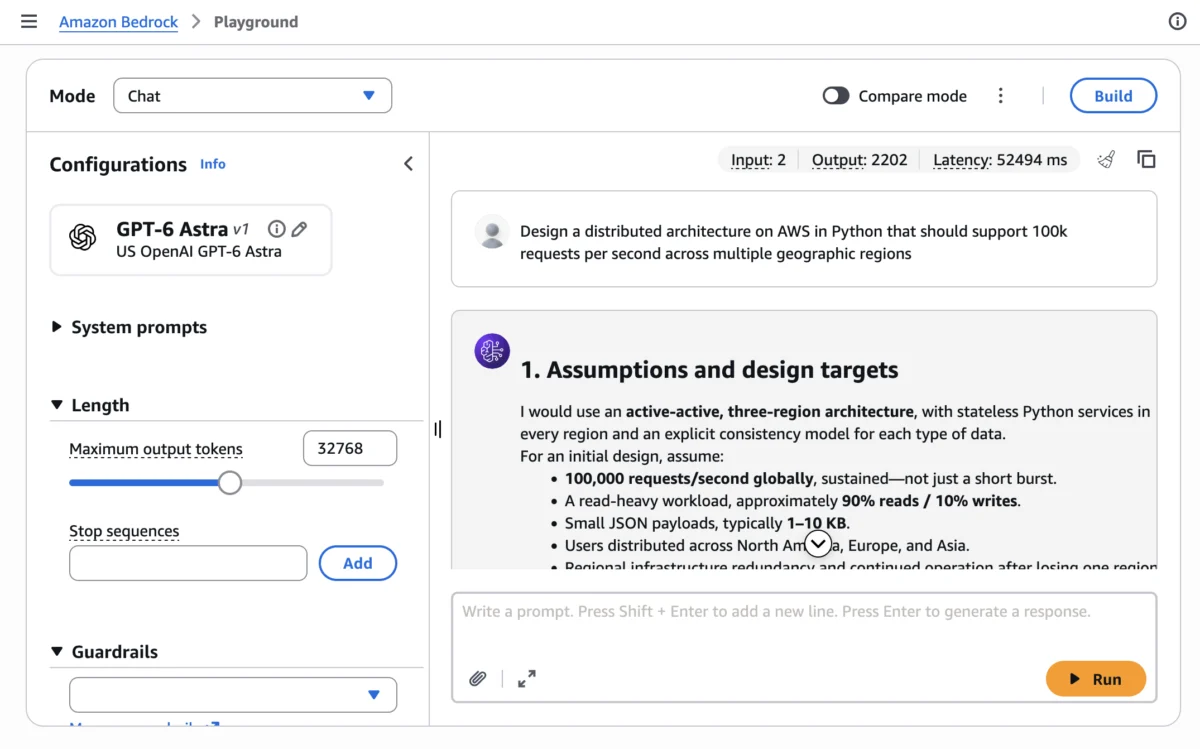

The landscape of enterprise artificial intelligence experienced a significant evolution with the official general availability of OpenAI’s GPT-6 Astra model on Amazon Bedrock. Announced during a period of accelerated technological deployments in New York, this integration combines OpenAI’s most advanced reasoning architecture with the enterprise-grade security, scalability, and governance framework of Amazon Web Services (AWS). Designed to tackle exceptionally complex workloads, GPT-6 Astra introduces a massive leap forward in automated reasoning, professional-grade content generation, and advanced computer-use capabilities for corporate environments.
For enterprise organizations seeking to harness cutting-edge foundation models without compromising data privacy or operational security, this release bridges the gap between state-of-the-art AI research and rigorous corporate compliance. As businesses increasingly shift from experimental AI deployments to core operational integration, the arrival of GPT-6 Astra on Amazon Bedrock provides the computational muscle and security controls required for mission-critical applications.
Main Facts and Core Capabilities of GPT-6 Astra
GPT-6 Astra represents OpenAI’s most sophisticated and capable frontier model to date. Unlike previous iterations that focused primarily on conversational fluidity or isolated text generation, GPT-6 Astra is engineered for deep reasoning, nuanced judgment, and multi-step execution. The model is specifically optimized to handle demanding business workflows that require synthesizing disparate pieces of information, reconciling competing regulatory or technical inputs, and executing complex software engineering tasks.
One of the most notable technical specifications of GPT-6 Astra is its expansive context window, which supports up to 1 million input tokens. This vast capacity fundamentally changes how organizations can interact with large repositories of data. Enterprises can now upload entire codebases, multi-year financial audits, extensive legal contracts, or comprehensive documentation libraries into a single prompt session. The model can analyze these monolithic inputs simultaneously, cross-referencing clauses, identifying architectural flaws, or reconciling conflicting data points with unprecedented precision.
Furthermore, GPT-6 Astra introduces advanced computer and browser-use capabilities. This functionality enables the model to interact directly with software interfaces, navigate web applications, and execute workflows that traditionally required human intervention across multiple digital tools. To support this, OpenAI has introduced new enterprise plugins for ChatGPT Work, extending Astra’s browser navigation capabilities across standard corporate software suites.
Integration and Security Architecture on Amazon Bedrock
Deploying a model of this magnitude within an enterprise environment requires robust infrastructure and uncompromising data governance. Through Amazon Bedrock, developers and system administrators can invoke GPT-6 Astra via standardized, supported APIs. Additionally, organizations can configure ChatGPT Work and Codex to utilize the model directly within their existing AWS architectures.
A critical concern for enterprise adopters is the confidentiality of proprietary data. AWS and OpenAI have structured the Amazon Bedrock integration to ensure strict data isolation. Inference data transmitted to GPT-6 Astra via Amazon Bedrock is explicitly excluded from being used to train or fine-tune underlying OpenAI models. This guarantee addresses the primary barrier to AI adoption in regulated industries such as finance, healthcare, and legal services.
To ensure compliance, organizations can leverage established AWS security controls. These include Identity and Access Management (IAM) policies, AWS CloudTrail auditing for model invocation activity, and Virtual Private Cloud (VPC) configurations that secure data in transit and at rest. These mechanisms allow chief information security officers (CISOs) to maintain granular visibility and control over how artificial intelligence is deployed across corporate departments.
Chronology and Background Context
The release of GPT-6 Astra on Amazon Bedrock is the culmination of a multi-year shift in how cloud providers and artificial intelligence laboratories collaborate. In the early stages of the generative AI boom, foundational models were frequently restricted to proprietary consumer applications or fragmented API endpoints that lacked standardized enterprise controls.
Over the past several years, platforms like Amazon Bedrock have emerged as neutral hubs, allowing enterprises to choose from a diverse portfolio of foundation models—including models from Anthropic, Cohere, Meta, Mistral, and now deeper integrations with OpenAI—all governed by a single cloud architecture. The development path leading to GPT-6 Astra involved significant architectural breakthroughs in transformer efficiency, enabling the processing of million-token context windows without catastrophic degradation in retrieval accuracy or reasoning coherence.
The timing of this general availability aligns with a broader industry push toward autonomous AI agents. While initial waves of generative AI focused on passive content creation, the current paradigm emphasizes agency: models that can read a codebase, execute tests, browse documentation, and deploy fixes autonomously. GPT-6 Astra’s computer-use features are a direct response to this market demand.
Supporting Data and Market Implications
The enterprise generative AI market has transitioned rapidly from proof-of-concept projects to widespread production deployment. According to recent enterprise technology surveys, over 70 percent of Fortune 500 companies have integrated foundational models into at least one core business workflow. However, infrastructure constraints, latency issues, and data leakage fears have historically slowed the adoption of frontier-class models.
By launching GPT-6 Astra on Amazon Bedrock, AWS and OpenAI are targeting the high-complexity segment of the enterprise market. Models with million-token context windows drastically reduce the need for complex Retrieval-Augmented Generation (RAG) pipelines in certain scenarios, allowing the model to reason over raw, unindexed data repositories natively. While RAG remains essential for petabyte-scale data lakes, the ability to ingest hundreds of thousands of lines of code or hundreds of pages of legal documentation in a single context window significantly accelerates analysis time.

From a productivity standpoint, early enterprise benchmarks indicate that models equipped with advanced reasoning and browser-use capabilities can reduce the time required for complex software refactoring, compliance audits, and contract analysis by upwards of 40 to 60 percent. However, analysts note that realizing these gains requires organizations to fundamentally adapt their internal workflows rather than simply layering new tools onto legacy processes.
Official Reactions and Industry Perspectives
While third-party observers and market analysts are still evaluating the full operational footprint of GPT-6 Astra, early feedback from enterprise developers participating in early-access previews highlights the model’s distinct advantages in cross-domain synthesis.
Software engineering leads have praised the model’s ability to maintain context across massive, multi-file codebases, noting a sharp decrease in hallucinations when tasked with refactoring legacy systems. Legal and compliance departments have similarly pointed to the utility of the 1-million-token context window in streamlining multi-jurisdictional regulatory reviews, where missing a single cross-reference can result in severe compliance liabilities.
Technology executives emphasize that the true value of the Amazon Bedrock integration lies in operational continuity. By keeping model inference within the familiar AWS ecosystem, organizations avoid the administrative overhead of managing separate billing relationships, security protocols, and compliance frameworks for distinct AI vendors.
Broader Impact and Future Outlook
The general availability of OpenAI’s GPT-6 Astra on Amazon Bedrock signals a maturing cloud-AI ecosystem. As foundational models become increasingly powerful, the competitive differentiator for cloud providers is no longer merely hosting the model, but providing the orchestration, security, and governance layers that make powerful AI safely usable at scale.
Looking ahead, industry experts anticipate that the proliferation of million-token context windows and autonomous computer-use capabilities will accelerate the transition from human-in-the-loop assistance to human-on-the-loop oversight. As agents take on heavier analytical and operational burdens, IT departments will increasingly focus on auditability, cost management, and fine-grained access control.
For developers and enterprise architects, the immediate task involves assessing where deep reasoning and autonomous browser navigation can be integrated safely into existing pipelines. With AWS providing the foundational guardrails and OpenAI supplying the cognitive engine, organizations now possess the infrastructure necessary to take on their most ambitious and data-intensive workloads. As the corporate calendar rolls forward into the busy autumn deployment season, this release sets a new benchmark for what enterprise artificial intelligence can achieve.
