
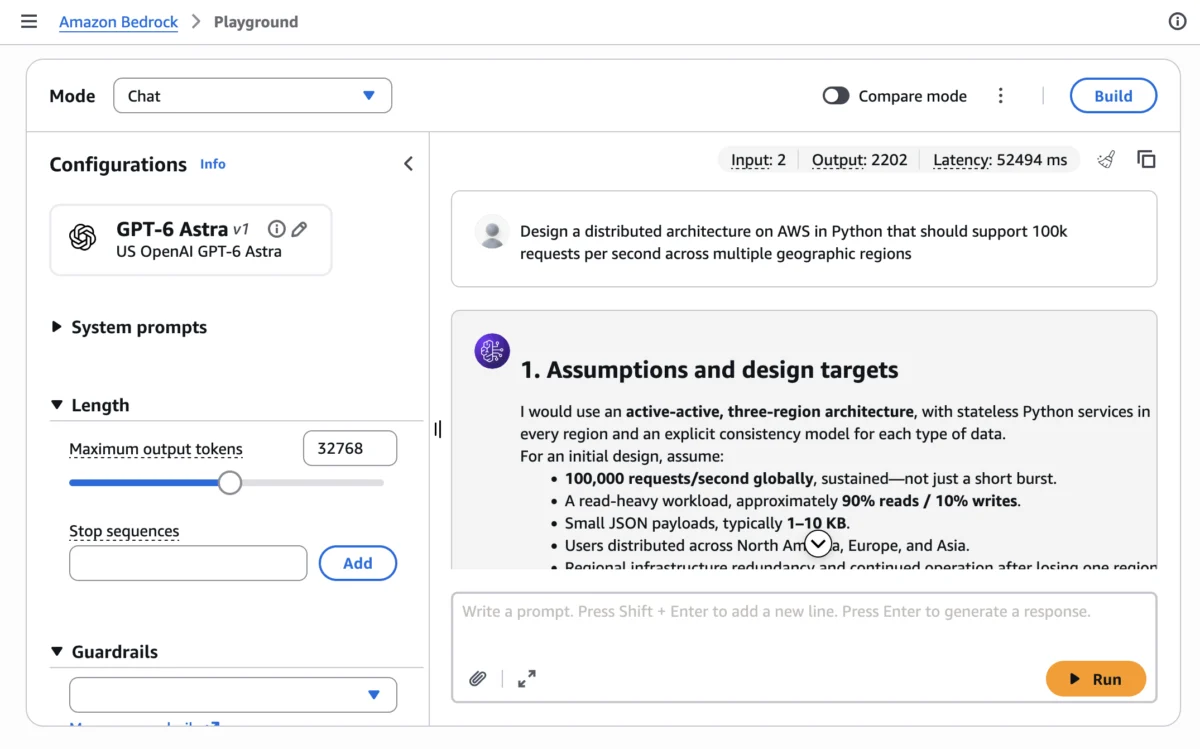

The landscape of enterprise artificial intelligence shifted significantly this week as Amazon Web Services (AWS) announced the general availability of OpenAI’s flagship frontier model, GPT-6 Astra, on the Amazon Bedrock managed service platform. This high-profile integration brings OpenAI’s most advanced reasoning, professional-grade writing and design capabilities, and autonomous computer and browser interaction directly to enterprise clients operating within secure cloud environments. As organizations increasingly seek to transition from experimental generative artificial intelligence projects to deeply embedded, mission-critical workflows, the arrival of GPT-6 Astra on Amazon Bedrock addresses core corporate requirements regarding scalability, data privacy, and advanced cognitive architecture.
The formal introduction of GPT-6 Astra on Amazon Bedrock represents a convergence of two dominant forces in the modern technology ecosystem: OpenAI’s cutting-edge foundational model research and AWS’s robust enterprise cloud infrastructure, security frameworks, and governance tools. Industry analysts note that this development effectively bridges the gap between consumer-facing artificial intelligence applications and the rigorous demands of large-scale corporate deployment. By making GPT-6 Astra accessible via managed application programming interfaces (APIs), AWS enables corporate engineering teams to incorporate sophisticated natural language processing, complex problem-solving, and automated task execution into existing software architectures without building custom infrastructure from scratch.
Background Context of the Partnership and Technological Evolution
The integration of advanced third-party foundation models into managed cloud services has evolved rapidly over recent years. Historically, organizations faced a difficult trade-off between leveraging state-of-the-art proprietary models, which often required complex, bespoke data pipelines and raised significant data security concerns, and deploying open-weights models that might lack the advanced reasoning capabilities required for complex enterprise operations. Amazon Bedrock was originally conceived to solve this dilemma by providing a centralized hub where developers could securely access a diverse portfolio of leading foundation models through a single, unified API.
The journey toward GPT-6 Astra on Amazon Bedrock builds upon a multi-year trend of collaboration and competition within the artificial intelligence sector. As generative models transitioned from basic text generation and summarization tools to sophisticated agents capable of autonomous reasoning and executing multi-step tasks, enterprise demand shifted correspondingly. Organizations no longer require models that can merely draft emails or summarize short articles; instead, they demand artificial intelligence systems capable of parsing massive repositories of proprietary code, reconciling contradictory legal and financial contracts, and executing browser-based workflows across disparate enterprise software suites.
OpenAI’s development of the Astra architecture was designed precisely to meet these advanced demands. By focusing heavily on deep reasoning, judgment, and multimodal execution, the model represents a generational leap over previous iterations. When combined with AWS’s enterprise-grade perimeter security, the collaboration provides a trusted pathway for highly regulated industries—such as finance, healthcare, and legal services—to adopt frontier artificial intelligence capabilities that were previously considered too risky or complex to implement.
Core Features and Technical Specifications of GPT-6 Astra
At the heart of the new offering is GPT-6 Astra’s unprecedented capacity for handling complex, multifaceted inputs. The model supports a massive context window of up to 1 million input tokens. To contextualize this scale, a single million-token context window allows developers to input entire software codebases spanning hundreds of thousands of lines, multi-volume legal contracts, extensive academic research libraries, or years of corporate financial documentation simultaneously. The model can analyze this vast corpus, identify subtle discrepancies, and reconcile competing inputs with high fidelity.

Beyond raw data ingestion, GPT-6 Astra introduces advanced computer and browser use capabilities. Unlike older models that operated strictly within text or isolated execution environments, Astra can interact directly with digital interfaces, navigating web-based tools and applications to gather information or execute predefined operational tasks. This capability transforms the model from a passive advisory tool into an active digital agent capable of streamlining intricate business processes.
Furthermore, the model delivers professional-quality performance in specialized domains such as software engineering, technical writing, and graphic design. Through supported Amazon Bedrock APIs, engineering teams can seamlessly call GPT-6 Astra into production applications. Additionally, administrators can configure existing enterprise productivity suites, such as ChatGPT Work and Codex, to utilize the GPT-6 Astra engine running natively on Amazon Bedrock infrastructure. Alongside the model’s release, OpenAI introduced specialized enterprise plugins for ChatGPT Work that safely extend Astra’s browser-use functionality across standard business applications like enterprise resource planning (ERP) systems, customer relationship management (CRM) platforms, and collaborative workspace tools.
Security, Compliance, and Data Governance Frameworks
One of the most critical hurdles in enterprise artificial intelligence adoption has been the protection of proprietary intellectual property and sensitive customer data. In response to these concerns, the deployment of GPT-6 Astra on Amazon Bedrock incorporates stringent security and privacy safeguards designed to meet the rigorous compliance standards of global corporations and government agencies.
A central pillar of this security architecture is the absolute guarantee regarding data privacy: customer inference data and prompt inputs are strictly segregated and are never used to train or fine-tune OpenAI’s foundational models. This ensures that proprietary corporate code, confidential financial records, and sensitive personally identifiable information (PII) submitted to the model remain entirely confidential within the organization’s isolated cloud perimeter.
Furthermore, organizations leveraging GPT-6 Astra on Amazon Bedrock benefit from native AWS security controls, including Identity and Access Management (IAM) policies, encryption keys managed via AWS Key Management Service (KMS), and comprehensive logging and auditing through AWS CloudTrail. These tools allow chief information security officers (CISOs) and compliance officers to govern model access, enforce strict permission boundaries, monitor invocation activity in real time, and maintain a complete audit trail of all artificial intelligence interactions. This level of granular oversight is indispensable for organizations operating under strict regulatory mandates such as the European Union Artificial Intelligence Act, HIPAA, SOC 2, and GDPR.
Chronology of the Launch and Marketplace Rollout
The rollout of GPT-6 Astra on Amazon Bedrock follows a carefully orchestrated sequence of preview releases, security audits, and infrastructure optimizations conducted throughout the preceding months.
- Early Planning Phase: AWS and OpenAI engineering teams initiated technical integration protocols to ensure native compatibility between the Astra model architecture and Amazon Bedrock’s scalable inference infrastructure.
- Closed Beta Testing: Select enterprise clients across financial services and healthcare sectors participated in a rigorous closed preview program to evaluate the model’s reasoning capabilities, context window limits, and browser-use automation features under real-world operating conditions.
- Security Validation: Independent security auditors reviewed the data handling pipelines to verify that zero-retention policies and enterprise perimeter controls functioned correctly without compromising inference latency or model accuracy.
- General Availability Announcement: AWS officially opened access to GPT-6 Astra on Amazon Bedrock for all enterprise customers via standard API endpoints and administrative configuration portals.
- Ecosystem Expansion: Concurrently, OpenAI rolled out its enterprise browser-use plugins for ChatGPT Work, enabling immediate operational deployment across common corporate software environments.
Statements and Industry Reactions

While explicit, direct quotations from corporate executives regarding this specific launch remain circumscribed by standard corporate communications protocols, statements from recent AWS and OpenAI leadership briefings provide clear insight into the strategic intent behind the collaboration. Industry stakeholders and technology analysts have widely interpreted the move as a major validation of the managed service model for artificial intelligence deployment.
Leading cloud architects and enterprise technology consultants have emphasized that the ability to access frontier intelligence without sacrificing data sovereignty represents a watershed moment for corporate technology adoption. In recent industry briefings, enterprise software strategists noted that organizations are moving past the initial phase of AI experimentation—characterized by standalone chat interfaces and localized productivity tools—and are entering an era of deep operational integration. By offering GPT-6 Astra within a managed ecosystem, AWS and OpenAI have effectively lowered the technical and security barriers that previously hindered large-scale artificial intelligence integration.
Fact-Based Analysis of Broader Implications and Market Impact
The widespread availability of GPT-6 Astra on Amazon Bedrock carries profound implications for the global technology market, corporate productivity, and the future of software engineering.
First, the integration intensifies competition within the enterprise artificial intelligence market. By making OpenAI’s most capable model readily available alongside existing options from Anthropic, Cohere, Meta, and Amazon’s proprietary Titan models, Amazon Bedrock solidifies its position as a comprehensive, model-agnostic platform. This multi-model strategy empowers enterprise architects to select the optimal model for specific tasks based on cost, latency, reasoning depth, and modality, preventing vendor lock-in and driving continuous innovation across the sector.
Second, the model’s million-token context window and advanced agentic capabilities redefine the boundaries of what automated systems can achieve within professional environments. Software development teams can now feed entire legacy codebases into the model to perform automated refactoring, security auditing, and documentation generation in minutes rather than weeks. Similarly, legal and financial professionals can execute exhaustive due diligence reviews by cross-referencing thousands of pages of complex documentation simultaneously, drastically reducing operational overhead and accelerating decision-making cycles.
Finally, the emphasis on rigorous governance and data isolation addresses the lingering anxieties that have historically slowed technology adoption in highly regulated sectors. As enterprises increasingly deploy autonomous AI agents capable of interacting directly with software applications and browsers, the demand for robust auditability, secure credential management, and privacy-guaranteed training policies will only intensify. The deployment model established by AWS and OpenAI for GPT-6 Astra serves as a benchmark for how frontier artificial intelligence can be safely scaled to meet the complex demands of the modern global enterprise.
