

The Evolution of RAG and the Chunking Bottleneck
The development of RAG systems has progressed rapidly since the popularization of generative AI in late 2022. Early implementations often relied on naive "fixed-size" chunking—a method that splits text every n tokens regardless of semantic coherence. While computationally inexpensive, this approach often fractures logical arguments, disrupts table structures, and separates entities from their defining descriptions.
Industry data suggests that improper chunking is the leading cause of retrieval failure. Recent benchmarks from major vector database providers indicate that when semantically related information is split across two disparate chunks, the retrieval engine’s recall rate drops by as much as 40%. This has prompted a shift toward more sophisticated, structure-aware methodologies that prioritize context preservation over simple, uniform slicing.
The Strategic Decision Framework
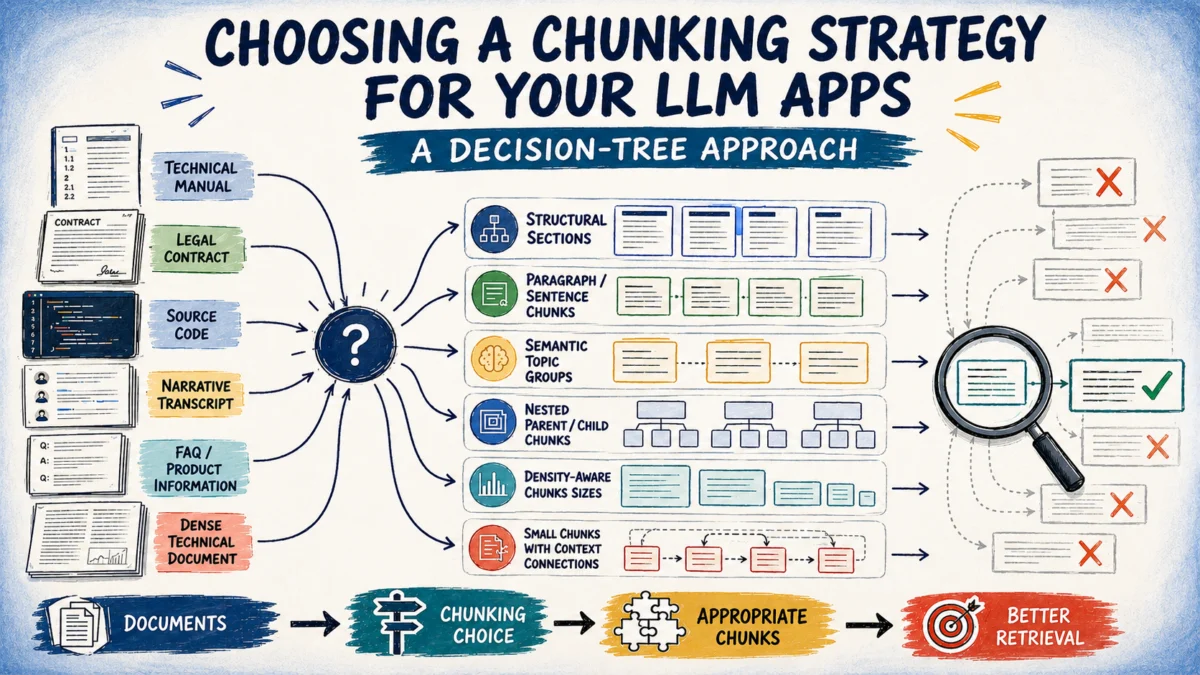
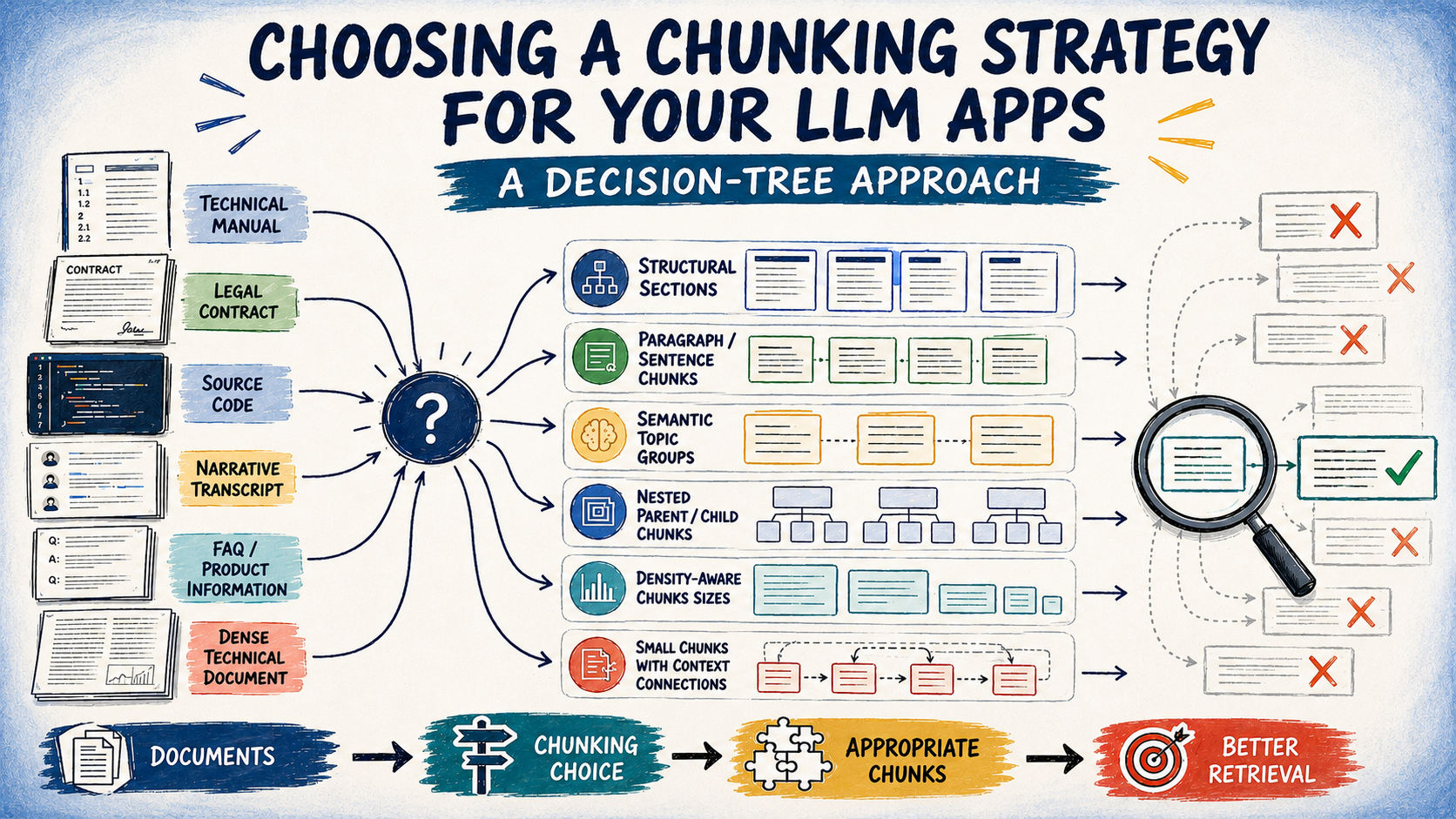
To navigate the complexity of document preprocessing, engineers must treat chunking not as a configuration setting, but as a deliberate architectural decision. The following decision tree provides a systematic approach to selecting the optimal strategy based on document typology and retrieval requirements.
Phase 1: Contextual Assessment and Structural Audit
The initial phase involves determining whether the document requires fragmentation at all. For high-density, low-volume content—such as FAQ databases, individual policy pages, or specific configuration files—the overhead of chunking often outweighs the benefits. If a document fits within the model’s context window and maintains a singular topical focus, embedding the text as a complete unit preserves the highest level of semantic integrity.
When documents are heterogeneous, containing varied structural markers like HTML tags, Markdown headers, or formal paragraph breaks, "document-based" or "structural" chunking becomes the preferred path. By aligning boundaries with the document’s inherent hierarchy, the RAG system maintains the relationship between headings and their subsequent content. This is particularly critical in legal and technical documentation, where a section header often provides the necessary context for the sub-points that follow.
Phase 2: Addressing Complexity and Density
As the scope of the corpus increases, developers often encounter documents with varying information densities. In such cases, "recursive" chunking serves as the industry standard. By recursively splitting text at paragraph, sentence, and word levels, the system maintains a balance between structural awareness and fixed-size constraints.
However, for datasets where information density shifts unpredictably, "adaptive" or "hierarchical" chunking is increasingly favored. Hierarchical chunking, which generates both small, highly specific chunks and larger, summary-level chunks, allows the system to answer both nuanced queries ("What is the exact penalty for clause X?") and broad thematic questions ("What are the risks associated with this contract?") with equal efficiency.
Chronology of Implementation
For organizations migrating from legacy systems, the implementation of a robust chunking strategy typically follows a standardized timeline:
- Inventory Analysis (Weeks 1-2): Cataloging the corpus to identify file formats, average document length, and the presence of internal structural markers.
- Strategy Selection (Week 3): Applying the decision-tree framework to match document types with appropriate chunking logic (e.g., semantic for unstructured text, structural for code repositories).
- Pilot Testing (Weeks 4-6): Evaluating retrieval precision through A/B testing different chunk sizes and overlap percentages.
- Optimization (Weeks 7+): Refining threshold settings for semantic chunking and caching strategy decisions to minimize latency in production environments.
Data-Driven Insights on Performance
Technical analysis confirms that the "overlap" parameter is as vital as the chunk size itself. A common pitfall observed in early-stage RAG systems is the absence of sufficient overlap, which leads to a "context cliff" at the boundaries of chunks. Industry consensus suggests an overlap of 10% to 20% of the total chunk size is optimal for most use cases, ensuring that transitionary information is captured in both the preceding and succeeding segments.
Furthermore, the integration of "late chunking" has emerged as a high-performance alternative for long-context applications. By embedding the entire document using a long-context model before partitioning, the resulting chunks retain a latent representation of the entire document’s context, effectively solving the issue of fragmented dependencies in technical specifications or long-form narrative reports.
Professional Perspectives and Industry Standards
Leading AI architects emphasize that there is no "silver bullet" for chunking. "The goal of a RAG pipeline is to ensure that the retrieved information is as close to the ground truth as possible," notes a lead engineer at a major cloud infrastructure firm. "When we force a rigid structure onto fluid, human-written text, we introduce noise. The best strategies are those that respect the document’s original intent."
The shift toward "Agentic Chunking"—where an LLM or specialized agent acts as a pre-processor to determine the most effective split points for each unique document—represents the current frontier of the field. While this increases computational costs during the indexing phase, the significant improvement in retrieval precision justifies the expenditure for high-stakes enterprise applications.
Broader Implications and Future Outlook
The shift toward context-aware chunking has profound implications for the cost-efficiency of generative AI. By reducing the number of irrelevant "hallucination-inducing" chunks retrieved by the system, organizations can lower their token consumption while simultaneously improving the accuracy of the output.
Looking forward, the integration of multimodal chunking—capable of handling text, images, and embedded tables simultaneously—is expected to become the next major hurdle. As documents become increasingly multi-dimensional, the techniques developed today for text-based chunking will serve as the foundation for more advanced, graph-based retrieval architectures.
Conclusion: A Disciplined Approach to Preprocessing
The path to a successful RAG implementation is paved with diligent preprocessing. By systematically moving through the decision-tree logic—from determining if a document needs to be split, to evaluating the necessity of hierarchical or agentic approaches—engineers can mitigate the risks of data loss.
The primary takeaway for organizations is to prioritize simplicity where possible but to remain ready to adopt more complex strategies when the data demands it. By aligning the chunking strategy with the inherent properties of the document, practitioners can move beyond the limitations of basic RAG and unlock the full potential of their data, ensuring that the retrieval process is not just a search for keywords, but a sophisticated extraction of meaning. In an era where information velocity is increasing, the precision of one’s retrieval pipeline is no longer just a technical detail; it is a competitive advantage.
