


The digital landscape, once a realm of seamless connectivity, has increasingly transformed into a perilous terrain, particularly within the confines of personal messaging applications. Users worldwide report a daily barrage of unsolicited communications, ranging from seemingly innocuous messages from friends and family to official notifications from service providers like WhatsApp. However, these legitimate interactions are frequently interspersed with insidious attempts at fraud, often disguised as urgent alerts from governmental bodies such as the DGT (Dirección General de Tráfico), parcel delivery updates from postal services like Correos, or critical notifications from financial institutions. Historically, discerning these fraudulent messages often required no more than a cursory glance, as tell-tale signs like glaring grammatical errors or dubious sender addresses were readily apparent. Today, this simplistic approach has become largely ineffective, as cybercriminals have adopted advanced methodologies that render their deceptive tactics remarkably sophisticated.
The advent of generative artificial intelligence (AI) has democratized powerful tools, making them accessible not only to legitimate innovators but also to malicious actors. This technological duality has ushered in an era of hyper-realistic and deeply personalized phishing scams, meticulously crafted to be devoid of linguistic imperfections and imbued with an alarming capacity for persuasion. The efficacy of these AI-enhanced frauds is such that even seasoned cybersecurity professionals often grapple with identifying fraudulent messages that flawlessly mimic legitimate services. This escalating sophistication necessitates an equally advanced countermeasure, leading to the development and deployment of AI-driven solutions designed to combat these evolving threats. Among these, a notable development comes from NordVPN, which has introduced a free, browser-based "Scam Text Checker," empowering individuals to leverage AI in their personal defense against digital deception.
The New Frontier of Cybercrime: Generative AI and Phishing
The landscape of cybercrime has undergone a radical transformation with the widespread adoption of generative AI. What began as rudimentary phishing attempts characterized by poor grammar, generic salutations, and suspicious links has evolved into a highly refined and dangerously effective form of digital deception. Generative AI tools, capable of producing human-quality text, images, and even voice, provide cybercriminals with an unprecedented arsenal. They can now craft messages that are not only grammatically perfect but also contextually relevant, personalized with details gleaned from publicly available information, and adept at replicating the specific tone and style of legitimate organizations.

This shift has profound implications. Scammers can now create persuasive narratives that exploit human psychology more effectively, leveraging fear, urgency, curiosity, or the promise of gain. They can generate convincing fake websites that are virtually indistinguishable from their authentic counterparts, complete with high-resolution logos, professional layouts, and seemingly legitimate URLs. The ability to mass-produce these high-quality fraudulent assets at scale means that the volume and success rate of phishing campaigns have surged. Reports from leading cybersecurity firms indicate a consistent year-over-year increase in phishing attacks, with some estimates suggesting a double-digit percentage rise in successful breaches attributable to sophisticated social engineering tactics. The financial ramifications are staggering, with billions of dollars lost annually by individuals and organizations globally. For instance, data from the FBI’s Internet Crime Complaint Center (IC3) consistently places phishing among the top reported cybercrimes, accounting for significant financial losses.
NordVPN’s Proactive Defense: The Scam Text Checker
In direct response to this escalating threat, NordVPN has launched its "Scam Text Checker," a user-friendly and highly accessible online utility. This tool represents a significant stride in democratizing advanced cybersecurity defenses, making AI-powered analysis readily available to the general public without the need for complex software installations or subscription fees. The free, browser-based nature of the Scam Text Checker means it can be accessed from any device with an internet connection, eliminating barriers to entry that often deter individuals from adopting robust security measures. Crucially, it does not require users to create an account or log in, ensuring privacy and ease of use.
At its core, the Scam Text Checker operates on a sophisticated combination of massive data analysis, machine learning algorithms, and natural language processing (NLP). When a user inputs a suspicious message, the tool initiates a multi-layered analysis. Firstly, it meticulously extracts any URLs, email addresses, or phone numbers present within the text. These identifiers are then cross-referenced against vast, real-time updated databases of known malicious domains, blacklisted IPs, and reported scam numbers. This initial scan provides a rapid assessment of whether the embedded links or contact details are associated with documented threats.
Beyond mere blacklisting, the tool’s AI capabilities delve deeper into the linguistic and psychological dimensions of the message. It is designed to identify typical patterns of social engineering—the art of manipulating people into divulging confidential information or performing actions they wouldn’t normally do. This includes detecting:
- Intimidation Tactics: Language designed to instill fear or panic, often threatening legal action, account suspension, or severe penalties.
- Coercive Language: Phrases that pressure the recipient into immediate action, implying dire consequences for delay.
- False Urgency: Statements like "You have 24 hours to pay this charge" or "Your account will be locked if you don’t respond immediately," designed to bypass rational thought and provoke impulsive compliance.
- Impersonation Cues: Analyzing the subtle linguistic fingerprints that suggest a message is attempting to mimic a legitimate entity, but with slight deviations that AI can flag.
- Grammatical Analysis: While AI-generated scams are often grammatically perfect, the tool can also identify patterns that deviate from the standard communication style of the purported sender, or even flag "too perfect" grammar if it doesn’t match the typical communication style of a known entity.
This comprehensive approach allows the Scam Text Checker to provide a nuanced assessment, not just flagging known malicious links but also warning users about the manipulative psychological techniques employed within the text itself.
A Seamless User Experience: Simplicity Meets Sophistication
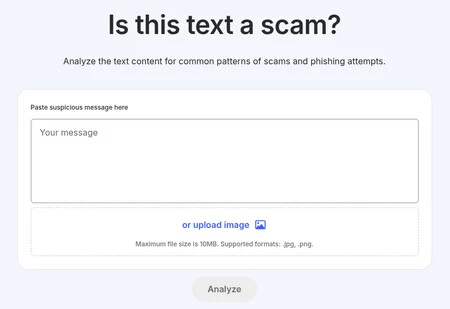
The design philosophy behind NordVPN’s Scam Text Checker prioritizes extreme simplicity and accessibility, understanding that effective security tools must be easy to use for broad adoption. The interface is minimalist, featuring little more than a clean text input field and clear instructions. This uncluttered design ensures that users, regardless of their technical proficiency, can quickly grasp its functionality.
The tool’s responsiveness is a key feature, adapting flawlessly across various devices—from desktop computers and tablets to the compact screens of smartphones. This cross-device compatibility is crucial in an era where most personal communications, including scam attempts, are received and managed on mobile devices.
The user workflow is streamlined for maximum convenience:
- Text Copy-Paste: For messages received via messaging apps (WhatsApp, Telegram, SMS), users can simply long-press on the suspicious text to copy it. A quick navigation to the Scam Text Checker website, a long-press on the input field, and a paste action are all that’s required. The analysis is typically instantaneous, providing results within a second.
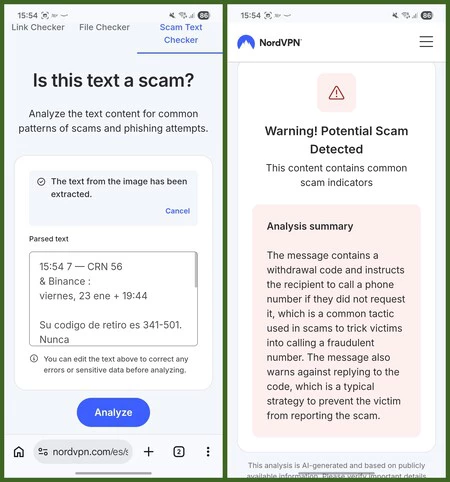
- Image Upload with Optical Character Recognition (OCR): Recognizing that many users might prefer to screenshot suspicious messages, particularly SMS or app notifications, the tool also supports image uploads (JPG or PNG formats). Its integrated OCR technology efficiently extracts text from these images, performing the same rigorous analysis as with direct text input. This functionality is particularly useful for users who receive a high volume of visual notifications or prefer a less manual method.
During testing, the tool demonstrated remarkable reliability. When fed with various messages of dubious origin, it consistently identified them as fraudulent attempts. It visually highlights suspicious elements, marking detected malicious links in red and providing warnings about identified manipulation tactics. While the detailed explanations for these tactics are currently presented in English, the core detection functionality is effective across multiple languages.
The Broader Ecosystem: A Trident of Digital Defense
The Scam Text Checker is not an isolated solution but part of a more comprehensive suite of free utilities offered by NordVPN, forming a "trident" of digital defense for everyday users. These complementary tools enhance the overall security posture:
- Link Checker: A more focused utility designed specifically for analyzing URLs. Users can paste any suspicious link, and the Link Checker will scan it against malware databases, check for phishing indicators, and verify its authenticity, providing an immediate assessment of whether it leads to a safe or malicious website.
- File Checker: This tool allows users to upload any file (e.g., attachments from suspicious emails) for a thorough malware scan. It leverages advanced antivirus engines and threat intelligence to identify and flag any embedded malicious code or viruses, preventing potential infections before they can harm a device.
By combining these three tools—the Scam Text Checker for contextual message analysis, the Link Checker for URL verification, and the File Checker for attachment scrutiny—NordVPN provides a holistic, accessible, and powerful defensive framework. The ease of adding these web-based tools as direct shortcuts to a mobile device’s home screen further integrates them into a user’s daily digital routine, making proactive security checks a seamless part of online interaction.
Implications and the Future of Cybersecurity
The launch of tools like NordVPN’s Scam Text Checker signifies a critical juncture in the ongoing cybersecurity arms race. As cybercriminals increasingly weaponize generative AI, the development of AI-powered defensive measures becomes not just beneficial but imperative. This technological tug-of-war highlights several key implications:
- Empowering the End-User: By providing free, accessible tools, cybersecurity firms are shifting some of the responsibility and capability for threat detection back to the individual user. This democratization of advanced security is vital, as the first line of defense often lies with the recipient of a scam.
- The AI Arms Race: The battle between offensive and defensive AI is intensifying. As scamming AI becomes more sophisticated, so too must detection AI. This necessitates continuous research, development, and real-time updates to threat databases and detection algorithms.
- Shifting Paradigms in User Education: Traditional advice on spotting typos or odd email addresses is becoming obsolete. User education must now focus on understanding social engineering tactics, verifying information through independent channels, and leveraging advanced detection tools.
- Industry Responsibility: Cybersecurity companies bear an increasing responsibility to innovate and provide effective, user-friendly solutions that can keep pace with evolving threats. The free availability of tools like NordVPN’s Scam Text Checker demonstrates a commitment to broader public safety.
- Collaboration and Data Sharing: The effectiveness of AI-driven detection tools relies heavily on comprehensive, up-to-date threat intelligence. This underscores the need for greater collaboration among cybersecurity firms, law enforcement agencies (like the DGT in Spain), and financial institutions (banks) to share data on emerging threats and attack vectors. Official bodies frequently issue warnings about specific scam campaigns, and integrating this real-time intelligence into AI models is crucial.
- Multi-Layered Defense: While AI tools are powerful, they are not infallible. The best defense remains a multi-layered approach combining technological solutions (like the Scam Text Checker, antivirus software, firewalls, and multi-factor authentication) with strong user awareness and best practices. Users must remain vigilant, question unsolicited communications, and always verify information through official channels before clicking links or sharing personal data.
In conclusion, the proliferation of sophisticated, AI-powered phishing attacks represents a formidable challenge to digital security. NordVPN’s Scam Text Checker emerges as a timely and crucial response, offering an accessible, AI-driven defense mechanism that empowers everyday users to identify and thwart these increasingly deceptive threats. As the digital landscape continues to evolve, the ongoing innovation in AI-powered security tools, coupled with persistent user education and vigilance, will be paramount in safeguarding individuals and organizations against the relentless tide of cybercrime.
