


In an unexpected yet strategically significant move, Samsung Electronics has unveiled Hearapy, a groundbreaking application designed to mitigate motion sickness through a specific low-frequency audio stimulus. This initiative marks a distinct departure from the conventional enhancements seen in wireless earbuds, such as advanced noise cancellation, improved call quality, or real-time translation capabilities. Instead, Hearapy zeroes in on a prevalent physiological challenge, aiming to leverage audio technology for a novel health application.
The Hearapy app, now available for free download on Google Play, introduces a unique methodology: it generates a precise 100 Hz grave tone intended to stimulate the inner ear’s vestibular system, which is critical for maintaining balance and spatial orientation. Samsung recommends users engage with this therapy prior to commencing travel, specifically endorsing its use with the Galaxy Buds4 Pro for optimal efficacy. The company posits that even a brief pre-journey session can offer considerable relief during transit. This development underscores Samsung’s evolving vision for audio devices, positioning them not merely as tools for entertainment or communication but as integral components of a broader health and wellness ecosystem.
The Scientific Underpinnings of Auditory Vestibular Stimulation
At the core of Hearapy’s functionality lies a highly specific scientific principle. The application emits a 100 Hz sinusoidal wave for a duration of 60 seconds. Samsung advises users to maintain an approximate volume of 85 dB during this period to ensure the signal’s effectiveness. According to the app’s own explanation, this precise tone is engineered to activate the inner ear’s balance system, thereby enhancing the body’s ability to process motion stimuli more efficiently. This, in turn, is theorized to alleviate the disorienting sensations associated with motion sickness. Samsung claims that the alleviating effects of a single pre-travel session can extend for up to two hours, offering a practical window of relief for many travelers.
Crucially, Samsung grounds this innovative concept in established scientific research. The company explicitly references a study conducted by Nagoya University in Japan, which investigated the optimal frequency for stimulating the vestibular system. While specific details of the study’s findings are not extensively elaborated in the initial announcement, the underlying thesis is straightforward: by pre-conditioning the inner ear to better interpret certain signals before movement begins, the app aims to reduce the sensory conflict between visual input and bodily sensation. This conflict is widely recognized as a primary trigger for motion sickness, a condition arising when the brain receives conflicting signals from the eyes (seeing a static car interior), the inner ear (sensing movement), and proprioceptors (feeling the car’s vibrations).
Motion sickness, also known as kinetosis, is a common affliction affecting a significant portion of the population. Studies suggest that nearly one in three people are highly susceptible to it, while almost everyone can experience it under extreme conditions. Symptoms range from nausea and vomiting to dizziness, cold sweats, and headaches, severely impacting travel comfort and productivity. Current remedies often involve over-the-counter medications like antihistamines, prescription drugs, or behavioral strategies such as focusing on the horizon, avoiding reading, and ensuring proper ventilation. Hearapy represents a novel, non-pharmacological approach that integrates directly into everyday consumer technology.

Samsung’s Broader Strategic Play in Health Technology
This venture into motion sickness relief is not an isolated incident but rather a clear manifestation of Samsung’s long-term strategic pivot towards integrating advanced health and AI functionalities into its diverse portfolio of consumer electronics, particularly wearables. For years, the tech giant has been steadily enhancing its smartwatches and earbuds with health-monitoring capabilities, ranging from heart rate tracking and ECG measurements to sleep analysis and fitness coaching. The introduction of Hearapy signifies a bold step beyond passive monitoring, venturing into active, therapeutic-adjacent applications.
The global market for wearable technology is experiencing exponential growth, driven by increasing consumer interest in personal health management and fitness. Within this landscape, audio wearables like earbuds are becoming increasingly sophisticated, evolving beyond mere sound reproduction. Companies are exploring how these devices, with their intimate contact with the user and advanced sensor arrays, can offer more personalized and impactful health insights and interventions. Samsung’s move with Hearapy positions it as a leader in this emergent segment, pushing the boundaries of what audio devices can achieve.
This strategic direction aligns with a broader industry trend where major tech players are investing heavily in health tech. Apple, Google, and Amazon, among others, are all vying for a share of the burgeoning digital health market, integrating health features into their smartwatches, phones, and even smart home devices. For Samsung, leveraging its established hardware ecosystem, particularly the popular Galaxy Buds series, to deliver innovative health solutions provides a competitive edge and reinforces its brand image as an innovator dedicated to improving user well-being.
Technological Precision: Why Galaxy Buds4 Pro are Key
While the Hearapy app is available on Google Play, suggesting broader compatibility, Samsung emphatically highlights the Galaxy Buds4 Pro as the optimal device for its use. This recommendation is rooted in the technical specifications and acoustic capabilities of these particular earbuds. Samsung explains that the Galaxy Buds4 Pro are uniquely engineered to deliver a "clean and powerful" 100 Hz sound signal. The integrity and strength of this specific frequency are paramount for the stimulation of the vestibular system to be effective.
The efficacy of Hearapy relies heavily on the precise delivery of the low-frequency tone to both ears simultaneously and clearly. Inferior audio hardware might introduce distortion, lack the necessary bass response to accurately reproduce 100 Hz at the recommended 85 dB, or suffer from inconsistent channel balance, any of which could compromise the therapeutic effect. By linking Hearapy to the Galaxy Buds4 Pro, Samsung ensures that users have access to a controlled and optimized audio environment, maximizing the potential for the app to function as intended. The product’s official description on the Hearapy app page further solidifies this exclusive endorsement, stating the Buds4 Pro as the ideal pairing.
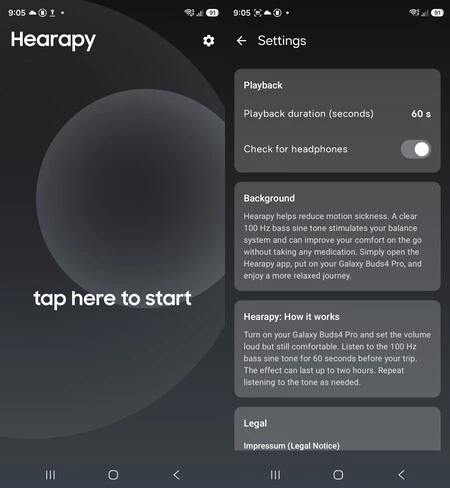
This emphasis on specific hardware for a health-oriented application also serves a commercial purpose, encouraging adoption of Samsung’s premium audio devices. It creates a synergistic relationship where the app enhances the value proposition of the hardware, and the hardware unlocks the full potential of the app. This ecosystem approach is a hallmark of modern tech giants, aiming to create seamless, integrated user experiences across their product lines.
Broader Implications and Future Outlook
The launch of Hearapy is significant not just for its immediate application but for what it portends for the future of audio technology and consumer health. It demonstrates a concrete example of how sound, long studied for its psychological and physiological effects, can be harnessed for practical, everyday health challenges. Research into sound therapy, binaural beats, and specific frequencies has explored their impact on mood, sleep, concentration, and even pain management. Samsung’s initiative brings a highly specific application of this research into the mainstream consumer market.
Industry analysts suggest that this trend of "audio health" is likely to accelerate. As earbuds become more sophisticated, incorporating advanced sensors, haptic feedback, and more precise audio control, their potential for health interventions will expand exponentially. Imagine earbuds that not only cancel noise but also deliver personalized soundscapes to reduce stress, improve focus, or even assist with conditions like tinnitus or vertigo, going beyond motion sickness.
However, it is crucial to temper expectations with a clear understanding of the limitations and ethical considerations. Samsung itself explicitly states that Hearapy is not intended to replace medical treatments or offer a miraculous cure. It functions as a complementary aid, a preparatory measure, rather than a definitive medical intervention. The variability of human physiology means that efficacy will likely differ among individuals, and a placebo effect cannot be entirely discounted.
The regulatory landscape for such health-focused consumer apps is also evolving. While Hearapy does not make claims that would classify it as a medical device requiring FDA or similar regulatory body approval, the line between wellness aid and medical treatment can sometimes blur. Companies venturing into this space must navigate these distinctions carefully, ensuring transparent communication about the app’s intended use and limitations. This transparency is vital for building consumer trust and avoiding potential misuse or misinterpretation of the technology.
In conclusion, Samsung’s Hearapy app for motion sickness is more than just another feature for its Galaxy Buds4 Pro. It represents a bold and intriguing step into a new frontier for wearable technology, showcasing the potential for audio devices to transcend entertainment and communication, becoming active tools for personal health management. By grounding this innovation in scientific research and delivering it through a dedicated, user-friendly application, Samsung is not only addressing a common ailment but also signaling its commitment to pushing the boundaries of what consumer electronics can achieve in the realm of health and wellness. This unconventional innovation warrants close attention, as it may well be a precursor to a wave of future health applications integrated into our daily tech.
