

The landmark Artemis II mission has successfully concluded, marking a pivotal moment in human space exploration as the first crewed journey around the Moon in over five decades. This monumental 10-day endeavor saw four dedicated astronauts — Reid Wiseman, Victor Glover, Christina Koch, and Jeremy Hansen — venture further into space than any human since Apollo 17 in 1972, leaving behind a breathtaking visual legacy that has already captivated the world. Among the spectacular photographs beamed back to Earth, some were famously captured using consumer technology, notably an iPhone, underscoring the accessibility and evolving nature of space photography.
A New Era of Lunar Exploration: The Artemis Program Context
The Artemis Program represents humanity’s ambitious return to the Moon, spearheaded by NASA, with the ultimate goal of establishing a sustainable human presence on the lunar surface and paving the way for future missions to Mars. Artemis II was a crucial test flight, designed to validate the Orion spacecraft’s life support systems and demonstrate the crew’s ability to live and operate in deep space conditions before the program’s next phase, Artemis III, which aims to land humans on the Moon. The program is not merely a repetition of Apollo but an evolution, seeking to land the first woman and the first person of color on the lunar surface, fostering a more diverse and inclusive era of space exploration. This mission builds upon the successful uncrewed Artemis I flight, which rigorously tested the Space Launch System (SLS) rocket and Orion capsule in a similar lunar flyby trajectory, proving the hardware’s readiness for human occupation.
The Ten-Day Odyssey: A Chronology of Artemis II
The Artemis II mission began with a flawless launch from NASA’s Kennedy Space Center in Florida, propelled by the colossal Space Launch System (SLS) rocket, the most powerful rocket ever built. After successfully separating from the SLS upper stage, the Orion spacecraft embarked on its meticulously planned trajectory. Key milestones during the mission included a critical Trans-Lunar Injection (TLI) burn, a powerful engine firing that propelled Orion out of Earth’s orbit and onto a path towards the Moon. The crew meticulously performed system checks, communications tests, and maneuvers, ensuring the spacecraft’s readiness for deep space operations. Orion executed a precise lunar flyby, approaching within approximately 10,200 kilometers (6,300 miles) of the Moon’s far side before slingshotting back towards Earth. This close approach provided unique perspectives of the lunar surface and the Earth beyond. Throughout the 10-day journey, the astronauts remained in constant communication with mission control, providing invaluable data and observations. The mission culminated in a successful splashdown in the Pacific Ocean, where recovery teams awaited the crew and the invaluable data recorded by Orion.
Meet the Crew: Pioneers of the New Lunar Age
The four individuals aboard Artemis II are trailblazers, each bringing a unique set of skills and experiences to this historic mission. Commander Reid Wiseman, a seasoned NASA astronaut, led the crew. Pilot Victor Glover, also a NASA astronaut, made history as the first African American to fly on a long-duration mission to the International Space Station (ISS) and now becomes one of the first humans of color to travel to the Moon. Mission Specialist Christina Koch, a record-holder for the longest single spaceflight by a woman, brought her extensive experience in space operations. Rounding out the crew was Jeremy Hansen, a Canadian Space Agency (CSA) astronaut, making him the first Canadian to venture beyond low Earth orbit. Their collective expertise in piloting, engineering, and scientific observation was critical to the mission’s success, and their journey serves as an inspiration for aspiring astronauts worldwide. Their presence underscored the international collaborative spirit of the Artemis program, with Canada being a key partner.
Technological Marvels: Orion, SLS, and Earth-Moon Communications
The technological prowess behind Artemis II is immense. The Orion spacecraft, built by Lockheed Martin, is designed for deep-space missions, equipped with advanced life support systems capable of sustaining a crew for weeks, sophisticated navigation, and robust thermal protection for re-entry. Its service module, provided by the European Space Agency (ESA), houses propulsion, power, and environmental control systems. The SLS rocket, with its immense thrust, was essential for lifting Orion and its crew out of Earth’s gravity well and onto a lunar trajectory. Its power, equivalent to 8.8 million pounds of thrust, is unparalleled, demonstrating a significant leap in heavy-lift capabilities. Communication between Orion and Earth was maintained through NASA’s Deep Space Network (DSN), a global array of giant radio antennas that allows for continuous contact with spacecraft millions of miles away. This intricate network is crucial for transmitting telemetry data, voice communications, and the high-resolution imagery that has become a hallmark of the mission. The challenges of maintaining reliable communication over vast distances, dealing with signal delays, and ensuring data integrity are formidable, yet the systems performed flawlessly, a testament to decades of engineering development.
Capturing the Cosmos: The Visual Legacy of Artemis II
One of the most immediate and impactful outcomes of the Artemis II mission has been the stunning collection of photographs and videos shared with the public. These images not only serve as a historical record but also offer humanity a fresh perspective on our place in the universe. The iconic "Earthrise" photos from the Apollo era have now been joined by a new generation of cosmic snapshots. Among these, the revelation that some images, including a particularly striking view of Earth, were captured with an iPhone, sparked widespread interest. This detail highlights a fascinating convergence of cutting-edge space exploration and everyday consumer technology. While professional-grade cameras were undoubtedly onboard for scientific and documentary purposes, the use of a standard smartphone for certain shots underscores NASA’s commitment to public engagement and the increasing capability of portable devices. It democratizes the experience, allowing millions to imagine themselves taking similar photos. These images hold immense scientific value, documenting Earth’s atmospheric conditions, lunar topography, and celestial mechanics. More importantly, they inspire awe and wonder, fostering a deeper appreciation for space exploration and encouraging future generations to pursue careers in STEM fields.
Bridging Space and Home: NASA’s Digital Outreach Strategy
NASA has been proactive in ensuring that the public can experience the Artemis II mission as closely as possible, leveraging digital platforms to create an immersive and informative experience. Beyond the live streaming that allowed millions to follow the mission’s progress in real-time, NASA developed an innovative "Google Maps-like" tracker, officially known as the Artemis Real-time Orbital Tracking system (AROT). This web-based application provided a dynamic, 3D visualization of Orion’s trajectory, allowing users to track the spacecraft’s position relative to Earth and the Moon, understand its speed, and even view key mission events. This level of transparency and interactivity is unprecedented for a crewed deep-space mission. The streaming services, available across multiple platforms, offered continuous updates, expert commentary, and breathtaking views from onboard cameras. This comprehensive digital outreach strategy serves multiple purposes: it informs the public about the mission’s progress, educates about space science and engineering, and, crucially, generates excitement and support for future endeavors. It embodies NASA’s philosophy that space exploration is a collective human endeavor, and everyone should have a front-row seat.
Bringing the Moon to Your Pocket: The Free Artemis II Wallpaper Collection
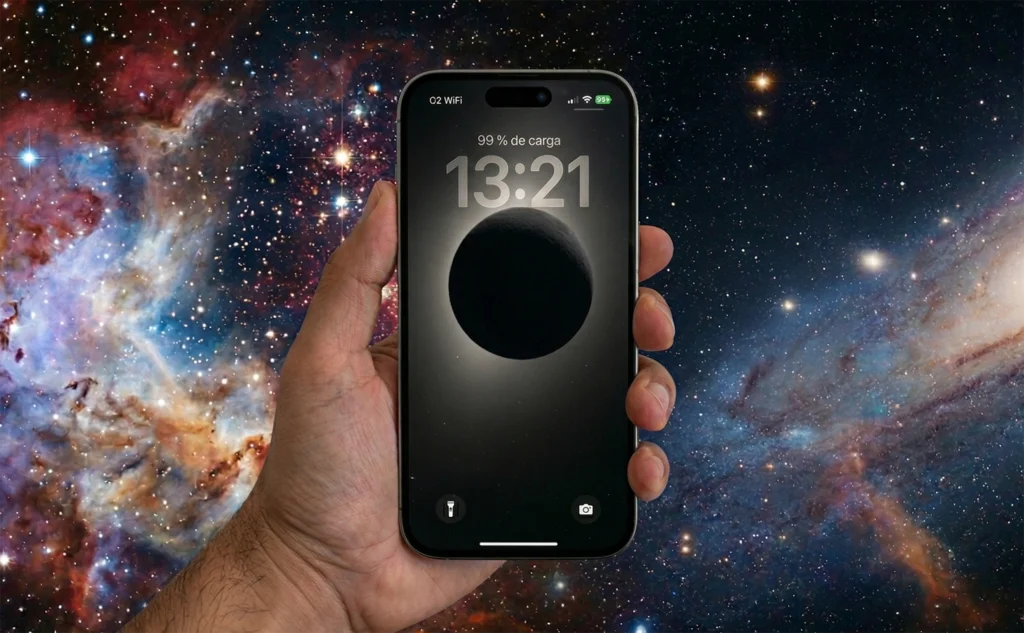
In a further gesture of public engagement, and to commemorate the visual splendor of the Artemis II mission, NASA has released an exclusive collection of free mobile wallpapers. As announced by the agency, "¡Vive la magia de nuestra misión lunar dondequiera que vayas! Descarga fondos de pantalla móviles gratuitos y lleva tu dispositivo a la nueva era de la exploración." This initiative allows anyone with a smartphone to carry a piece of this historic journey in their daily lives. The collection comprises 12 high-resolution photographs, carefully curated to showcase the diverse perspectives captured by the crew. Users can find stunning "Pale Blue Dot" views of Earth, appearing as a vibrant marble against the black expanse of space. Other wallpapers feature intricate details of the lunar surface, revealing craters and ancient seas from Orion’s unique vantage point. Perhaps most dramatic are the images depicting a solar eclipse, as witnessed by the astronauts from their deep-space capsule, offering a celestial alignment rarely seen by human eyes.

Each image in the collection is provided in JPEG format, with file sizes ranging from a manageable 565 KB to 1.24 MB, ensuring quick downloads and compatibility across various mobile devices without compromising visual quality. To access these cosmic marvels, users simply need to visit the dedicated section on the official NASA website (nasa.gov/artemis-ii-mobile-wallpapers). Upon arrival, a clear list of the 12 photographs is presented. A user-friendly interface allows for easy navigation, and a prominent blue download icon located to the right of each image facilitates immediate acquisition. Once downloaded, these captivating images can be effortlessly set as a mobile device’s wallpaper, transforming a mundane screen into a window to the cosmos. The availability of these breathtaking visuals for free exemplifies NASA’s commitment to sharing the wonders of space with the global community, fostering a sense of shared accomplishment and inspiration. The sheer beauty and historical significance of these images make choosing just one a delightful challenge, prompting many to download the entire collection to cycle through, continually refreshing their connection to this extraordinary mission.
Statements from NASA Leadership
Following the successful conclusion of the mission, NASA Administrator Bill Nelson issued a statement commending the crew and the entire Artemis team. "Artemis II has delivered beyond our wildest expectations, demonstrating the resilience of our spacecraft and the unparalleled courage and skill of our astronauts," Nelson stated. "This mission is not just a triumph for NASA, but for all of humanity, setting the stage for our return to the lunar surface and our journey to Mars. The data and experiences gathered are invaluable, and the images shared will inspire generations." Senior mission officials also highlighted the seamless operation of the Orion capsule and the SLS rocket, emphasizing the rigorous testing and meticulous planning that underpinned the mission’s success. The release of the digital assets, including the wallpapers and tracking tools, was described as an integral part of NASA’s public engagement strategy, ensuring that the legacy of Artemis II extends far beyond the scientific community and into the homes of millions globally.
Implications for Future Space Exploration
The success of Artemis II holds profound implications for the future of space exploration. It has validated critical systems and procedures for crewed deep-space travel, significantly de-risking the upcoming Artemis III mission, which will see astronauts land on the Moon. This mission serves as a stepping stone, providing invaluable data on human performance in a deep-space environment, radiation exposure, and the psychological aspects of prolonged isolation far from Earth. Beyond the Moon, the Artemis program is inherently designed as a precursor to human missions to Mars. The technologies developed and tested, the operational experience gained, and the scientific knowledge acquired will be directly applicable to the even greater challenges of interplanetary travel. Furthermore, the collaborative nature of Artemis, involving international partners like Canada and the European Space Agency, signals a growing trend towards global cooperation in space, pooling resources and expertise for ambitious endeavors. The public engagement generated by missions like Artemis II, fueled by accessible content like free wallpapers and real-time trackers, is crucial for maintaining public interest and political support, ensuring the continued funding and development of these transformative projects. By inspiring the next generation of scientists, engineers, and explorers, Artemis II reinforces humanity’s inherent drive to push the boundaries of knowledge and venture into the unknown.
In conclusion, the Artemis II mission stands as a testament to human ingenuity and perseverance. Its successful completion, coupled with the sharing of its incredible visual journey through accessible digital means, marks a significant milestone in humanity’s ongoing quest to explore the cosmos. The breathtaking images now available as free mobile wallpapers are more than just pictures; they are symbols of achievement, beacons of inspiration, and tangible reminders of our renewed commitment to lunar exploration and beyond.
