
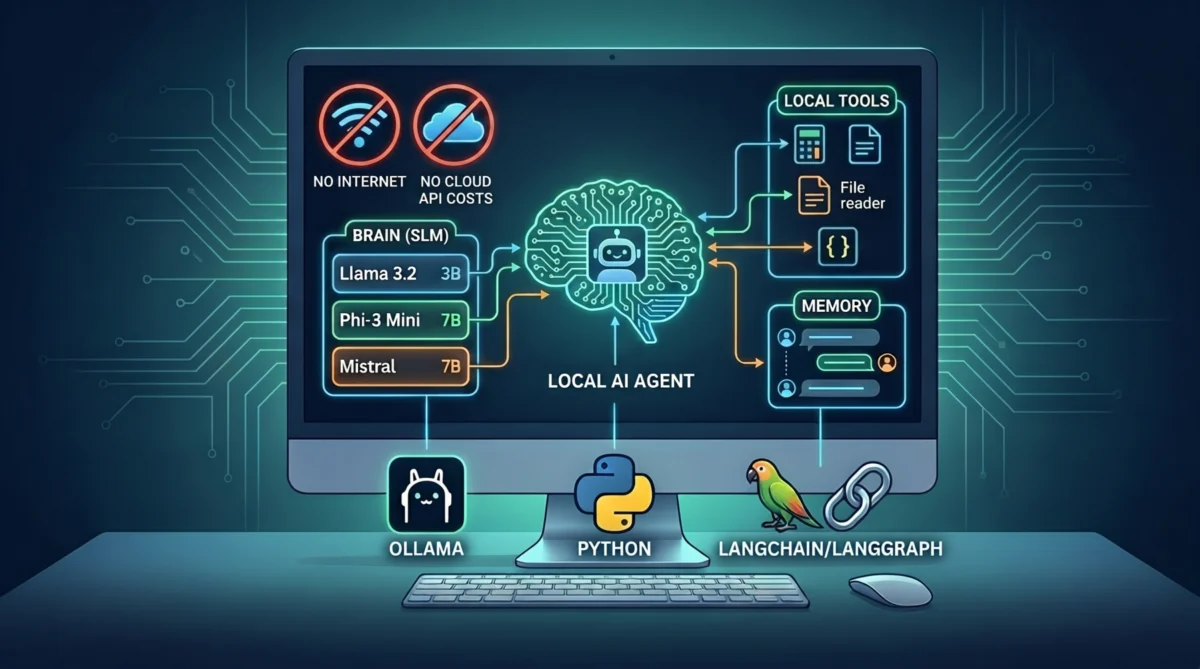

The landscape of artificial intelligence development has undergone a significant transformation, moving beyond the exclusive domain of colossal tech corporations and their vast cloud infrastructures. Today, the power to create and deploy sophisticated AI agents has been democratized, allowing developers, from seasoned professionals to eager beginners, to build fully functional systems that operate entirely on their local machines. This revolutionary shift is fueled by the emergence of Small Language Models (SLMs) and robust open-source tooling, eliminating the traditional barriers of prohibitive API costs and constant internet connectivity.
A New Era of AI Accessibility: From Cloud to Local
For years, the aspiration of crafting an intelligent agent capable of reasoning, planning, and executing tasks felt like a distant dream, accessible only to those with deep pockets for expensive cloud APIs, massive server farms, and specialized expertise. The computational demands of Large Language Models (LLMs) like GPT-4 necessitated powerful, centralized processing, inherently linking AI innovation to cloud providers. However, a new paradigm has rapidly taken hold, driven by advancements in model efficiency and the vibrant open-source community. This paradigm champions local execution, empowering individuals and small teams to harness AI capabilities without relinquishing control over data or incurring recurring costs.
This movement represents a crucial step towards "edge AI," where processing occurs closer to the data source—in this case, the user’s personal computer. It signifies a profound democratization of AI development, making advanced AI capabilities more accessible, private, and customizable. Developers can now architect intelligent systems that, once initially configured, function autonomously, insulated from network outages and external API dependencies.
Demystifying AI Agents: Beyond the Chatbot
At its core, an AI agent is an intelligent program that leverages a language model to understand objectives, make informed decisions, and take sequential actions to achieve a specified goal. Unlike a passive chatbot that merely responds to queries within a predefined conversational scope, an agent possesses a higher degree of autonomy and proactive capability. It can dynamically assess situations, select appropriate tools from its arsenal, and execute complex workflows, often across multiple steps, to reach a desired outcome.
Consider the difference between a simple calculator and a dedicated personal assistant. The calculator awaits specific input to perform a singular operation. The assistant, however, comprehends a broader objective, breaks it down into actionable steps, utilizes various resources (e.g., calendar, email, web search), and iteratively works towards fulfilling the request.
The fundamental architecture of a basic AI agent typically comprises three critical components:
- Brain (LLM/SLM): This serves as the agent’s cognitive core, responsible for understanding natural language input, reasoning about the task, generating plans, and deciding which actions to take or which tools to employ. Its ability to "think" and interpret context is paramount.
- Memory: Essential for maintaining continuity and context across interactions, memory allows the agent to recall past conversations, previously executed steps, or relevant data. This enables more coherent, multi-turn dialogues and complex task execution, preventing the agent from "forgetting" previous instructions or information.
- Tools: These are external functions or APIs that the agent can call upon to interact with the real world or perform specific operations. Examples include a calculator for mathematical computations, a web search engine for information retrieval, a file reader for document analysis, or even custom scripts to interact with other software. The agent’s intelligence is significantly amplified by its ability to intelligently select and utilize these tools.
More advanced agents might also incorporate a Planning and Reasoning Module that allows them to decompose complex tasks into sub-tasks, anticipate outcomes, and adapt their strategy based on intermediate results or environmental feedback.
The Power of Proportionality: Introducing Small Language Models (SLMs)
The linchpin of this local AI revolution is the Small Language Model (SLM). While sharing the foundational principles of their larger counterparts—being trained on vast datasets of text and code—SLMs are meticulously engineered for efficiency and compactness. Where a flagship LLM like GPT-4 might boast hundreds of billions or even trillions of parameters, an SLM typically ranges from 1 billion to 13 billion parameters. This substantial reduction in size makes them viable for deployment on consumer-grade hardware, such as standard laptops or desktop computers equipped with a modern CPU or a mid-range GPU.
The development of SLMs represents a sophisticated balance between model size and capability. Through optimized architectures, targeted training data, and efficient inference techniques, these models can achieve impressive reasoning, planning, and language generation abilities without the massive computational footprint of larger models.
Several prominent SLMs have emerged as frontrunners in this space, each offering distinct advantages:
- Phi-3 Mini (Microsoft): At approximately 3.8 billion parameters, Phi-3 Mini is lauded for its fast reasoning capabilities and minimal memory footprint, making it an excellent choice for resource-constrained environments.
- Mistral 7B (Mistral AI): With 7 billion parameters, Mistral 7B has garnered significant attention for its strong general task performance and instruction-following abilities, often outperforming larger models in certain benchmarks.
- Llama 3.2 (3B) (Meta): A 3-billion-parameter variant from Meta, Llama 3.2 offers a balanced performance profile, showcasing Meta’s commitment to making powerful models accessible.
- Gemma 2B (Google): Google’s 2-billion-parameter model, Gemma 2B, is designed to be lightweight and beginner-friendly, providing an accessible entry point into SLM experimentation.
For developers new to local AI, models like Phi-3 Mini or Llama 3.2 (3B) are often recommended starting points due to their robust documentation, active community support, and proven performance on standard local machines. Techniques like quantization further enhance their local viability by reducing their memory footprint without significant performance degradation.
The Undeniable Advantages of Local AI Execution
The question naturally arises: given the availability and often superior performance of cloud-based APIs like OpenAI’s GPT or Google’s Gemini, why would a developer opt for local SLMs? The answer lies in a compelling suite of advantages that cater to critical needs and burgeoning industry trends:
- Unparalleled Data Privacy and Security: Perhaps the most significant advantage is that no data ever leaves the user’s machine. This is paramount for applications dealing with sensitive personal information, proprietary business data, or classified material where compliance with strict data governance regulations (e.g., GDPR, HIPAA) is essential. Local execution eliminates the risk of data breaches associated with transmitting data to third-party cloud servers.
- Zero API Costs: Cloud API usage typically incurs costs per token, per request, or per hour, which can quickly escalate, especially during development, extensive testing, or high-volume deployment. Local SLMs entirely circumvent these expenses, offering a cost-effective solution for experimentation, learning, and many production scenarios.
- Offline Functionality: Once the model is downloaded and configured, the AI agent can operate without any internet connection. This is invaluable for applications in remote locations, environments with unreliable connectivity, or embedded systems where continuous online access is not feasible or desirable.
- Full Customization and Control: Developers gain complete control over the AI environment, from model selection and versioning to tool integration and security protocols. This allows for deep customization, fine-tuning of models with specific datasets, and the ability to integrate unique, proprietary tools without external limitations.
- Reduced Latency: Processing tasks directly on the local machine eliminates network latency inherent in cloud-based solutions. For applications requiring real-time responses or rapid iterative processing, local execution can provide a snappier, more immediate user experience.
- Enhanced Reliability: Local agents are not subject to cloud service outages, API rate limits, or unexpected changes in API terms, offering a more stable and predictable operational environment.
The Toolchain: Ollama, LangChain, and LangGraph
The practical realization of local AI agents is made possible by a powerful and increasingly user-friendly ecosystem of open-source tools.
- Ollama: This free, open-source platform has emerged as a game-changer for local LLM deployment. Ollama simplifies the complex process of downloading, configuring, and running language models on a local machine. It handles intricate setup details, including dependency management and hardware acceleration, allowing developers to interact with models via a simple command-line interface or a local API. This abstraction significantly lowers the barrier to entry, enabling rapid prototyping and experimentation.
- LangChain: A highly popular framework, LangChain provides a structured and modular approach to building applications powered by language models. It offers abstractions for various components crucial to AI agent development, including different LLM providers (both local and cloud), prompt templates, chains (sequences of LLM calls), agents (which use LLMs to decide what actions to take), memory management, and tool integration. LangChain’s modularity makes it easier to combine these components into sophisticated workflows.
- LangGraph: An extension of LangChain, LangGraph specializes in building stateful, multi-actor applications with LLMs. It allows developers to define complex agent workflows using a graph-based structure, where nodes represent steps or actors, and edges represent transitions. This is particularly powerful for agents that need to engage in multi-step reasoning, iterative problem-solving, or coordination between multiple sub-agents, providing granular control over the agent’s thought and action process.
Building a Local AI Agent: A Conceptual Overview
The process of constructing a local AI agent typically begins with setting up the foundational environment. Developers first install Ollama, then download a desired SLM, such as Phi-3 Mini, using a simple command like ollama pull phi3. This establishes the local inference server. Concurrently, a Python virtual environment is prepared, and essential libraries like langchain, langchain-ollama, and langgraph are installed. Python 3.9 or later is required for compatibility.
With the infrastructure in place, the core agent logic is implemented. This involves:
- Loading the SLM: An
OllamaLLMinstance is initialized, pointing to the locally downloaded model (e.g., "phi3"). - Defining Tools: Custom functions are created and exposed as tools for the agent. For instance, a
calculatortool might use Python’seval()function to compute mathematical expressions (with careful consideration for security in production). Aknowledge_basetool could perform lookups against a local dictionary or a more sophisticated vector database. - Bundling Tools: These tools are then collected into a list that the agent can access.
- Loading a Prompt Template: LangChain facilitates the use of established prompt templates, such as the "ReAct" (Reasoning and Acting) pattern, which guides the language model in its thought process and tool usage. This prompt helps the agent articulate its observations, thoughts, and planned actions.
- Creating the Agent: Using LangChain’s
create_react_agentfunction, the SLM, tools, and prompt are combined to form the agent. - Wrapping in an Executor: An
AgentExecutormanages the agent’s operational loop, handling the execution of thoughts, actions, and tool calls. Theverbose=Truesetting is often used during development to observe the agent’s internal reasoning process. - Adding Memory (for advanced agents): For multi-turn conversations, a memory component, such as
ConversationBufferMemory, is integrated. This memory stores the history of interactions, allowing the agent to maintain context across subsequent prompts, making it behave more like a persistent assistant rather than a stateless query engine.
When the agent is invoked with a query, it leverages its SLM "brain" to analyze the input, potentially consult its memory, and decide whether to directly answer or use one of its available tools. This iterative process of thinking and acting continues until the goal is achieved or a conclusion is reached.
Limitations and Considerations
While the local AI agent paradigm offers compelling advantages, it’s crucial to acknowledge its current limitations:
- Computational Demands: Although SLMs are efficient, running them locally still requires adequate hardware. A modern CPU and sufficient RAM (typically 8GB-16GB for a 7B model) are often necessary. A dedicated GPU (even a consumer-grade one) significantly enhances performance, especially for larger SLMs.
- Model Capabilities: While powerful, SLMs may not possess the same breadth of general knowledge, nuanced understanding, or complex reasoning abilities as the largest, most sophisticated cloud-based LLMs. For highly intricate, open-ended tasks, cloud models might still be superior.
- Setup Complexity: While simplified by tools like Ollama, setting up a local AI environment still requires a degree of technical proficiency, particularly for troubleshooting or integrating custom components.
- Scalability Challenges: Local agents are designed for individual or small-scale use. They are not built to serve thousands of concurrent users, a task for which cloud infrastructure remains indispensable.
- Ongoing Development: The field of SLMs and local AI tools is rapidly evolving. Keeping abreast of updates, model improvements, and framework changes requires continuous engagement.
Local SLMs are ideal for prototyping, educational purposes, privacy-sensitive applications, offline use cases, and scenarios where API costs are a primary concern. For production applications demanding peak accuracy, handling extremely complex tasks, or serving a massive user base, cloud models often remain the go-to solution. The future likely involves a hybrid approach, leveraging the strengths of both local and cloud AI.
The Broader Impact and Future of Decentralized AI
The ability to build AI agents locally with SLMs marks a significant milestone in the journey towards decentralized intelligence. It empowers a new generation of developers, researchers, and innovators to experiment, build, and deploy AI solutions without the traditional gatekeepers or prohibitive costs. This democratization fosters an environment of rapid innovation, where novel applications in areas like personal productivity, local data analysis, creative content generation, and specialized domain expertise can flourish.
Moreover, the emphasis on local execution naturally enhances data sovereignty and privacy, aligning with growing public and regulatory demands for greater control over personal and proprietary information. As SLMs continue to improve in capability and efficiency, and as tools like Ollama and LangChain mature, the barrier to entry for AI development will further diminish, leading to a proliferation of intelligent applications that are integrated more deeply into our personal and professional lives.
This shift is not merely a technical advancement; it’s a philosophical one, redefining who can build AI and how AI interacts with the world. It positions AI as a personal, customizable, and private tool, rather than solely a centralized, cloud-dependent service. The journey has just begun, and the most effective way to truly grasp its potential is to engage directly—to experiment with these tools, swap in different models, and iteratively build agents that solve real-world problems. The future of AI is increasingly in our hands, running right on our desktops.
