

Amazon Web Services (AWS) today announced the general availability of Anthropic’s Claude Opus 4.7 model within Amazon Bedrock, marking a significant advancement in the capabilities offered to enterprise customers for artificial intelligence workloads. This latest iteration of Anthropic’s most intelligent model is specifically designed to boost performance across critical enterprise applications, including sophisticated coding tasks, long-running autonomous agents, and various forms of professional knowledge work, providing businesses with a powerful new tool to enhance productivity and innovation.
The integration of Claude Opus 4.7 into Amazon Bedrock leverages Bedrock’s next-generation inference engine, a robust infrastructure engineered for production-grade workloads. This engine introduces a novel scheduling and scaling logic that dynamically allocates capacity to requests, significantly improving availability, particularly for stable, consistent workloads, while simultaneously ensuring rapid scalability for services experiencing fluctuating demands. A cornerstone feature of this infrastructure is its "zero operator access" guarantee, ensuring that customer prompts and model responses remain strictly confidential, never visible to Anthropic or AWS operators. This commitment to data privacy is paramount for enterprises handling sensitive information, fostering trust and enabling the deployment of AI in highly regulated environments.
Unlocking Advanced Enterprise AI Capabilities
Claude Opus 4.7 represents a substantial leap forward from its predecessor, Claude Opus 4.6, delivering enhanced performance across a spectrum of critical enterprise workflows. According to Anthropic, the model excels in areas such as agentic coding, where AI can autonomously generate, debug, and refactor code; complex knowledge work requiring deep understanding and synthesis of information; visual understanding tasks; and the execution of intricate, long-running processes. The model demonstrates a superior ability to navigate ambiguity, exhibit more thorough problem-solving methodologies, and adhere to instructions with greater precision, making it an invaluable asset for complex, multi-faceted business challenges.

The implications of these advancements are profound for developers and businesses aiming to integrate highly capable AI into their operations. For instance, in software development, agentic coding can drastically accelerate development cycles, allowing engineers to offload routine or complex code generation, testing, and optimization tasks to AI. In customer service, long-running agents can handle multi-step interactions, resolve complex queries, and even proactively manage customer accounts, moving beyond simple chatbot functions. For knowledge workers in fields like legal, finance, or research, Opus 4.7’s improved ability to process and synthesize vast amounts of information, understand nuanced requests, and generate comprehensive reports can significantly enhance efficiency and decision-making quality. Its visual understanding capabilities could also revolutionize tasks like document analysis, quality control in manufacturing, or even medical imaging interpretation, provided appropriate domain-specific fine-tuning and validation.
Amazon Bedrock: A Foundation for Enterprise AI
The strategic partnership between AWS and Anthropic, and the subsequent availability of advanced models like Claude Opus 4.7 on Amazon Bedrock, underscore AWS’s commitment to democratizing access to cutting-edge generative AI. Amazon Bedrock, a fully managed service, provides a streamlined platform for building and scaling generative AI applications with foundation models (FMs). It abstracts away the complexities of managing underlying infrastructure, allowing developers to focus on application logic and innovation.
Since its initial preview and subsequent general availability, Bedrock has rapidly evolved into a pivotal platform in the enterprise AI landscape. It offers a secure and private environment for customizing FMs with proprietary data, a crucial capability for businesses looking to leverage AI without compromising sensitive information or intellectual property. The platform’s commitment to "zero operator access" is a testament to this, ensuring that data processed through the models remains strictly within the customer’s purview. This level of privacy and security is a key differentiator for AWS in the highly competitive cloud AI market, particularly for industries with stringent regulatory compliance requirements such as healthcare, finance, and government.
A Strategic Alliance in the AI Race

The collaboration between AWS and Anthropic has been a cornerstone of the rapidly evolving generative AI ecosystem. Anthropic, founded by former OpenAI researchers, has distinguished itself with its focus on "Constitutional AI" – an approach designed to make AI systems more helpful, harmless, and honest. This philosophy aligns well with AWS’s own responsible AI principles, providing enterprises with not just powerful models, but also those developed with a strong ethical framework.
The integration of Claude Opus 4.7 further solidifies this alliance, offering enterprises a premium model known for its reasoning capabilities and extended context windows. This strategic synergy allows AWS to provide a diverse portfolio of FMs from various providers, giving customers the flexibility to choose the best model for their specific use case, while Anthropic benefits from the vast reach and enterprise-grade infrastructure of AWS. This dynamic mirrors the broader trend in the AI industry, where cloud providers are vying to offer the most comprehensive and secure platforms for deploying and managing a wide array of advanced AI models.
Enhanced Developer Experience and Accessibility
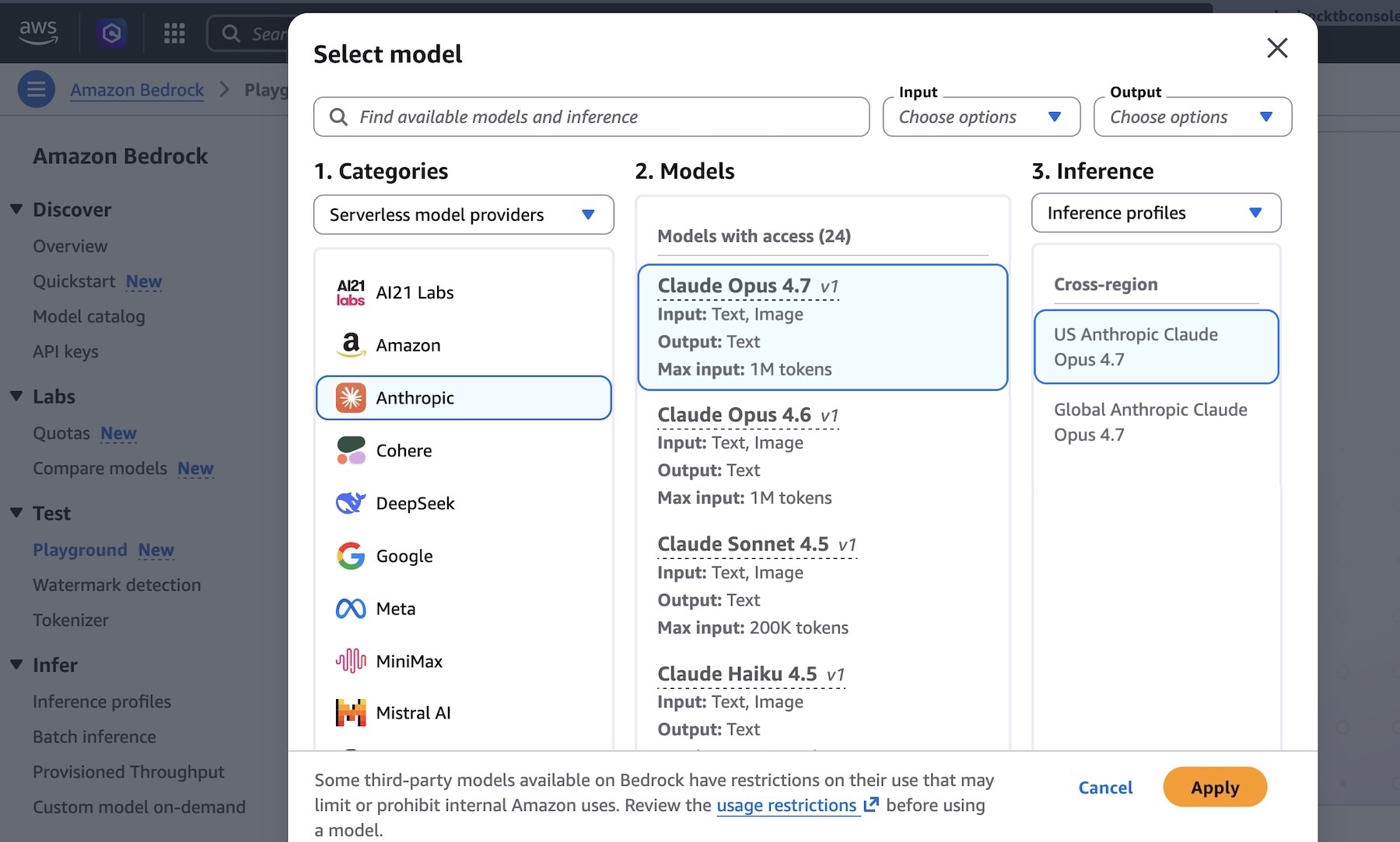
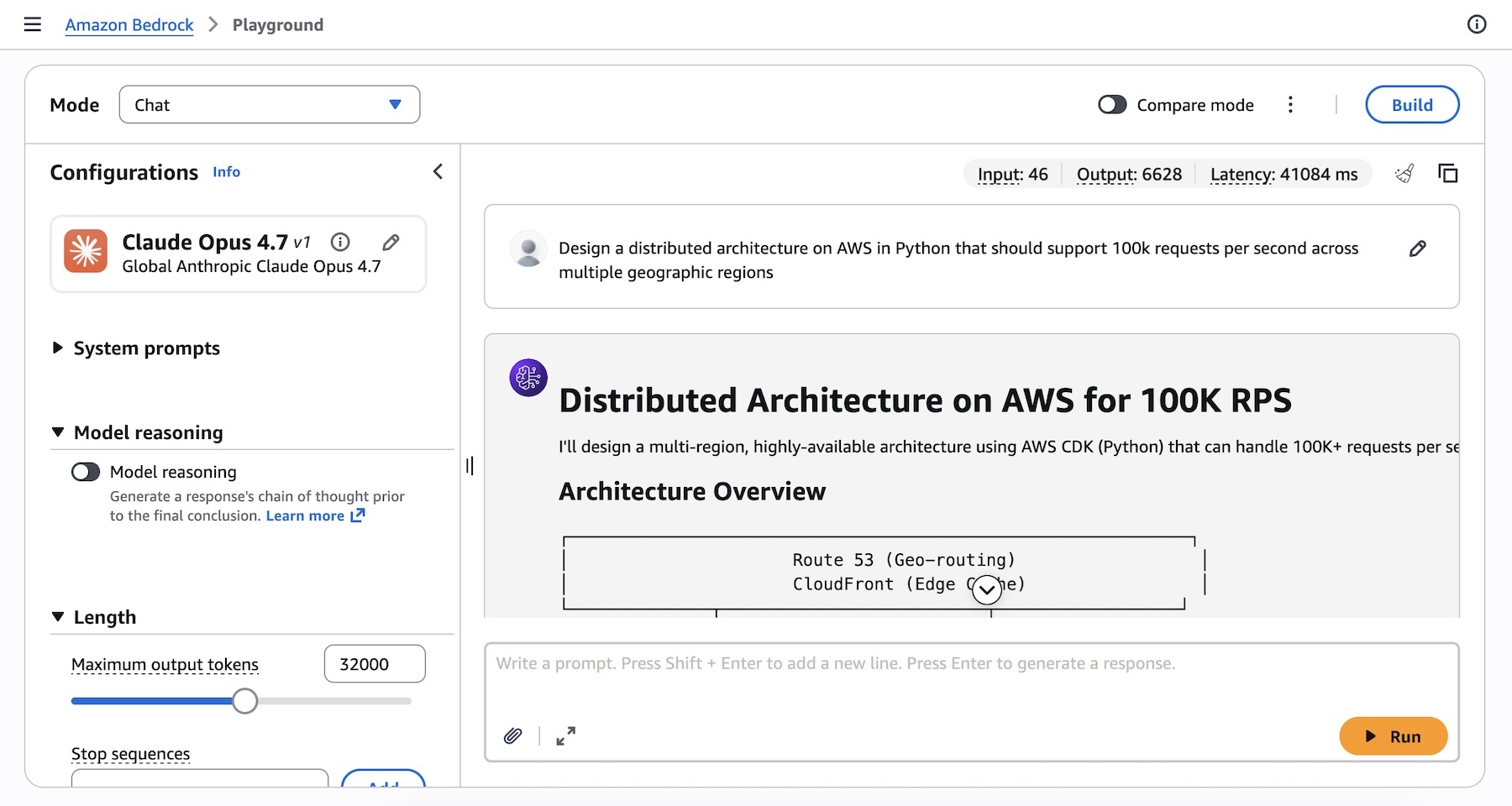
Getting started with Claude Opus 4.7 in Amazon Bedrock is designed to be intuitive and accessible for developers. Users can immediately experiment with the model via the Amazon Bedrock console. Within the console’s Playground environment, developers can select Claude Opus 4.7 and test complex prompts, such as designing a distributed architecture on AWS capable of supporting 100,000 requests per second across multiple geographic regions. This hands-on approach allows for rapid prototyping and evaluation of the model’s capabilities in real-world scenarios.
For programmatic access, developers have multiple options. The Anthropic Messages API, accessible through the bedrock-runtime via the Anthropic SDK or bedrock-mantle endpoints, provides a streamlined interface for interacting with the model. Alternatively, the standard Invoke and Converse API on bedrock-runtime can be utilized via the AWS Command Line Interface (AWS CLI) and AWS SDKs, catering to a wide range of development preferences and existing toolchains.
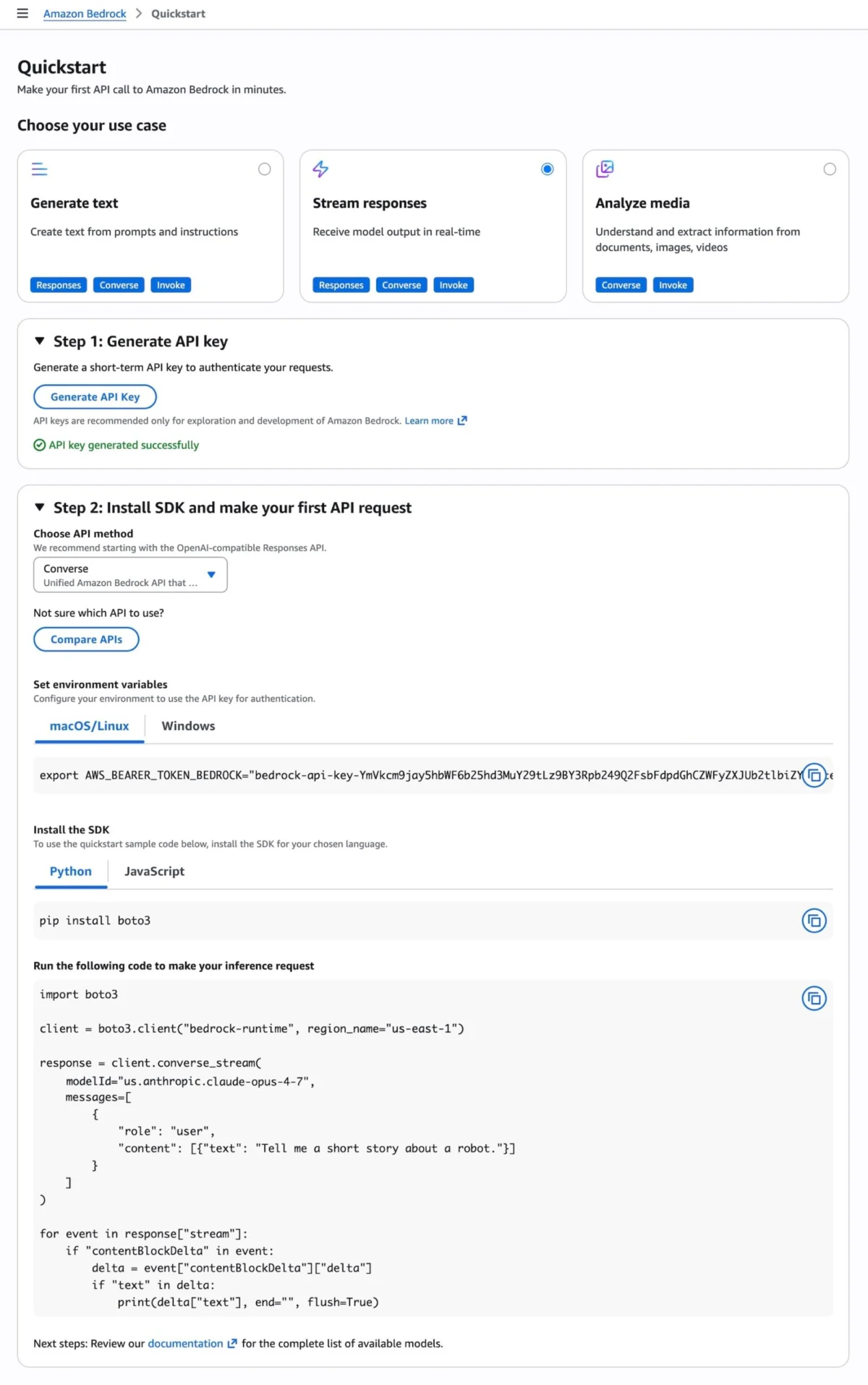
AWS has also simplified the initial setup process through a "Quickstart" option in the console, enabling users to generate a short-term API key for testing purposes. This accelerates the path from exploration to integration, providing sample code snippets for various API methods, including OpenAI-compatible Responses API, to facilitate quick inference requests. For instance, invoking the model using the anthropic[bedrock] SDK package involves a few lines of Python code, initializing the client and creating a message, demonstrating the ease of integration. Similarly, CLI commands allow for direct invocation, providing flexibility for scripting and automation.
A notable advanced feature available with Claude Opus 4.7 is "Adaptive thinking." This capability allows Claude to dynamically allocate thinking token budgets based on the complexity of each request. For simpler queries, it uses fewer resources, while for more intricate problems, it can allocate more computational "thought" cycles, optimizing both performance and cost. This intelligent resource management is crucial for enterprises managing large-scale AI deployments, ensuring efficiency without compromising on the quality of output for complex tasks.
Global Reach and Future Implications
Anthropic’s Claude Opus 4.7 model is immediately available in key AWS Regions, including US East (N. Virginia), Asia Pacific (Tokyo), Europe (Ireland), and Europe (Stockholm). This multi-regional availability is critical for global enterprises that require low-latency access to AI services, data residency compliance across different jurisdictions, and robust disaster recovery strategies. AWS continuously updates its list of available regions, indicating a commitment to expanding the model’s global footprint in response to customer demand.
The introduction of Claude Opus 4.7 on Amazon Bedrock is poised to have several far-reaching implications. For enterprises, it signifies an enhanced ability to leverage generative AI for strategic advantage. The model’s improvements in coding, agentic behavior, and complex problem-solving mean that businesses can automate more sophisticated processes, develop more intelligent applications, and derive deeper insights from their data. This translates into potential gains in operational efficiency, faster time-to-market for new products and services, and a more personalized customer experience.
From a competitive standpoint, this release intensifies the "AI arms race" among cloud providers and foundation model developers. AWS continues to solidify its position as a leading platform for enterprise AI, offering a diverse and high-performing portfolio of models. By integrating Anthropic’s most advanced model, AWS strengthens its appeal to developers and businesses seeking both cutting-edge AI capabilities and the robust security and scalability of a major cloud provider. This trend suggests a future where enterprises will increasingly rely on cloud-agnostic strategies, leveraging multiple FMs from different providers through unified platforms like Bedrock to optimize for specific use cases and maintain flexibility.
Moreover, the emphasis on "zero operator access" and the secure, private environment of Amazon Bedrock is likely to accelerate AI adoption in highly sensitive sectors. Industries like finance, healthcare, and government, which have traditionally been cautious about cloud adoption due to data security and compliance concerns, can now deploy powerful generative AI models with greater confidence, unlocking new possibilities for innovation within their stringent regulatory frameworks.
As the generative AI landscape continues its rapid evolution, the availability of models like Claude Opus 4.7 on platforms like Amazon Bedrock underscores a clear trajectory: the continuous drive towards more intelligent, more secure, and more accessible AI solutions designed to meet the complex demands of the modern enterprise. The combination of Anthropic’s cutting-edge AI research and AWS’s global infrastructure and enterprise focus creates a compelling offering for organizations ready to transform their operations with advanced artificial intelligence.
For developers and businesses eager to explore these capabilities, Amazon Bedrock provides the necessary tools and environment. Feedback channels, such as AWS re:Post for Amazon Bedrock and direct AWS Support contacts, remain open for users to share their experiences and contribute to the ongoing evolution of these services.
(Updated on April 17, 2026 – Code samples and CLI commands have been updated to align with the latest version specifications, ensuring developers have access to the most current and functional implementation guidelines.)
