
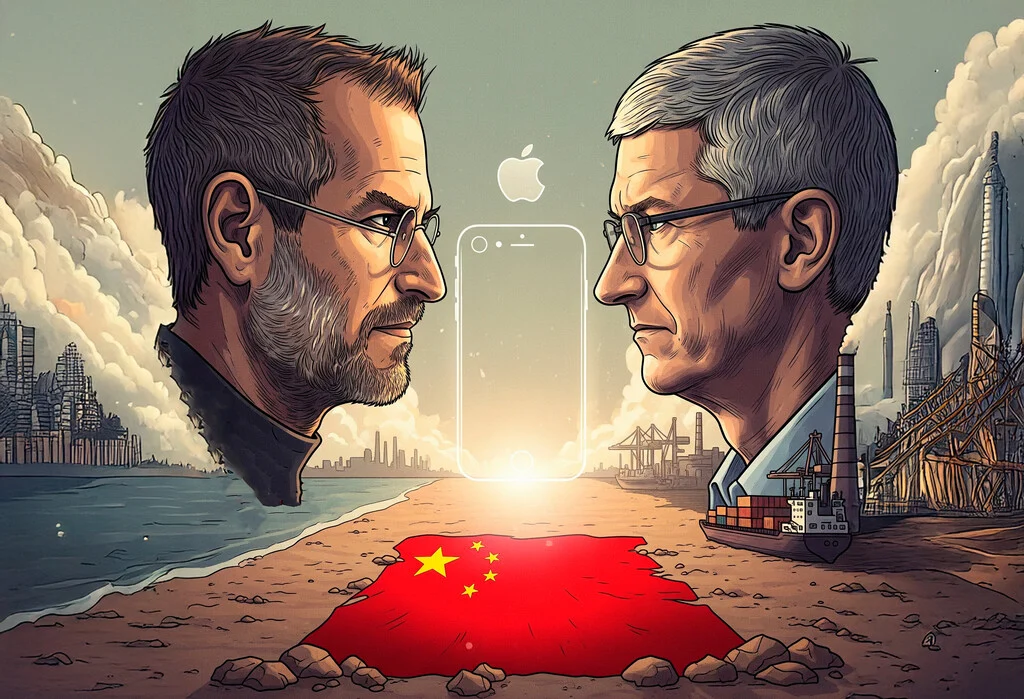

The intricate history between Apple and China is, at minimum, a peculiar tapestry woven from threads of necessity, ambition, and unforeseen consequences. While current geopolitical tensions are prompting a gradual pivot away from China towards other manufacturing hubs, the deep foundations of this dependency were laid decades ago, shaping the very identity of the Cupertino giant. China, a vast and often enigmatic market, presented both an irresistible opportunity for expansion and a formidable challenge, ultimately defining much of what Apple is today, a stark contrast to the initial vision of its founder, Steve Jobs.
From "Made in California" to Global Pragmatism: Jobs’ Vision vs. Reality
Steve Jobs’ original philosophy for Apple was rooted in an almost purist desire for absolute control over every facet of hardware manufacturing. "He didn’t trust any supplier to have the necessary expertise to build it," recounted former employees, who affirmed his steadfast belief that "controlling the hardware meant building it" in-house, ideally in California. This vision was deeply embedded in the company’s ethos, reflecting a commitment to vertical integration and meticulous quality control that Jobs believed was paramount to Apple’s unique product experience.
However, even under Jobs’ early leadership, the harsh realities of mass production and market demands occasionally necessitated tactical outsourcing. During his hiatus from Apple at NeXT, Jobs famously declared his preference for computers "not made in Osaka," underscoring his resistance to foreign manufacturing. Yet, pragmatism sometimes prevailed. Robert Brunner, Apple’s then-head of design, conceded that the PowerBook 100, manufactured by Japan’s Sony, was a "better product" than its domestically produced counterparts, the 140 and 160 models. These early concessions, though limited, hinted at the future trajectory, demonstrating that even Jobs’ staunch idealism could bend to superior operational efficiency and expertise found abroad.

The Crucible of Crisis: Apple’s Near Collapse and Tim Cook’s Arrival
The late 1990s marked a critical juncture for Apple, a period often described as a "perfect storm" that threatened the company’s very existence. In March 1996, Apple reported a staggering $700 million in losses, a figure so dire that then-CFO Fred Anderson reportedly termed it a "death spiral." The company, once a pioneer, was adrift, struggling with an unwieldy product line and dwindling market share. Its internal manufacturing processes were inefficient, slow, and increasingly costly, draining vital resources.
It was into this maelstrom that Tim Cook arrived in 1998, recruited by Jobs who, according to biographers, sought a figure who "embodied all the things he wasn’t good at and didn’t care to think about"—namely, operational logistics and supply chain management. Cook, a supply chain maestro with a background at Compaq and IBM, quickly identified the urgent need for a radical overhaul. He streamlined operations, drastically cut inventory, and began dismantling Apple’s disparate manufacturing facilities. His strategic brilliance was in recognizing that Apple’s survival depended on leveraging global manufacturing capabilities, even if it meant sacrificing some of Jobs’ original "Made in California" ideal. This pragmatic shift was not just about cost-cutting; it was about transforming Apple into an agile, globally competitive enterprise.
China Emerges: The Promise of Unprecedented Scale and Efficiency
As Apple grappled with its internal inefficiencies, China was rapidly transforming into the world’s factory floor. Decades of economic reforms and significant investment in infrastructure had created an unparalleled manufacturing ecosystem, characterized by a vast, rapidly industrializing workforce, robust logistical networks, and government policies supportive of foreign investment and export-oriented production. The appeal for multinational corporations was immense: the ability to scale production rapidly, access a deep pool of labor, and benefit from competitive costs.

The shortcomings of Apple’s existing, complex supply chain became glaringly apparent with products like the iMac G4, which sourced components from up to six different Asian countries. This fragmented approach proved "inefficient, slow, and costly," as detailed in Patrick McGee’s book Apple in China. Apple needed consolidation, and the choice became clear: "There was only one place to go," McGee observed. Even before the iMac G4 hit the market, Apple was actively pressuring its partners, from Singapore to Japan, to establish operations in China, signaling a definitive shift in its global strategy.
Foxconn and the "China Speed": A Partnership Forged in Necessity
The pivotal moment arrived with the emergence of Terry Gou, the founder of Foxconn (Hon Hai Precision Industry). Gou, known for his relentless drive and aggressive business tactics, directly approached Tim Cook with a bold promise: "I can fix this." Gou’s unwavering commitment to Apple’s success was legendary, often at significant personal and corporate cost. His willingness to sacrifice profit margins, push his workforce to extreme limits, and adapt with unparalleled speed would become the cornerstone of Apple’s manufacturing prowess.
Apple engineers were astonished by what they termed "China speed"—the ability to execute complex manufacturing tasks at a pace incomprehensible to Western visitors. Gou famously promised the tooling for the iMac in just 25 days, a radical departure from the typical 12 weeks. Jon Rubinstein, a key figure in the iPod’s design, recounted Gou pointing to an empty plot of land and declaring, "Here’s your factory." Months later, that factory was fully operational. This rapid deployment, coupled with Foxconn’s immense capacity and flexibility, offered Apple an "army of affordable and available labor" that enabled an unrestricted, intricate, and complex design philosophy previously unattainable.
This partnership allowed Apple to push the boundaries of product design, knowing that Foxconn could translate even the most ambitious concepts into mass-produced reality. The concentration of suppliers, engineers, and workers in mega-factories like Foxconn City (Zhengzhou) created an industrial synergy that no other region could match, offering unmatched speed, efficiency, and scalability.

The Human Cost and Unforeseen Social Implications
The relentless pursuit of "China speed" and Apple’s increasing reliance on Asia’s manufacturing might came with a significant human cost. The intense pressure to deliver products on impossibly tight deadlines often resulted in engineers working eighty-hour weeks, leading to severe mental health strain and marital issues among Apple’s expatriate staff. This phenomenon gave rise to the poignant term "Apple widows," referring to the spouses left behind in California while engineers toiled for extended periods in China.
Apple, recognizing the severity of the problem, eventually implemented the "Divorce Avoidance Program" (DAP) to support its employees and mitigate the personal toll of their demanding work schedules. While an admirable effort, it underscored the extreme measures and sacrifices inherent in maintaining the pace of innovation and production Apple had come to expect from its Chinese partners. Similarly, Foxconn faced intense scrutiny over its labor practices, including reports of excessive working hours, low wages, and harsh conditions, leading to public debate and calls for improved corporate responsibility within the global supply chain.
The iPhone Era: Cementing an Indispensable Bond
The launch of the iPhone in 2007, initially codenamed the "Purple Project," marked the ultimate point of no return for Apple’s deep integration with China. Chip Hills, Apple’s operations executive, made the crucial and irreversible decision to select Foxconn as the primary manufacturing partner for its revolutionary mobile device. The iPhone, with its intricate design, multiple components, and unprecedented demand, required a manufacturing scale and precision that only Foxconn and its Chinese ecosystem could reliably provide.

The success of the iPhone cemented this symbiotic relationship. China became not just a manufacturing hub but also a crucial market for Apple, evolving into its third-largest revenue source. This dual role—as both producer and consumer—deepened the ties to an almost unbreakable degree. The specialized skills of millions of workers, the vast network of component suppliers, and the sophisticated logistical infrastructure built around Apple’s needs in China became indispensable.
The Geopolitical Pivot: Diversification and the Challenge of Decoupling
In recent years, the landscape has shifted dramatically. Escalating US-China trade tensions, concerns over supply chain resilience (highlighted by the COVID-19 pandemic), and geopolitical pressures have compelled Apple to re-evaluate its singular reliance on China. The company has initiated significant efforts to diversify its manufacturing footprint, notably expanding production in India and Vietnam. Reports indicate that Apple aims to produce a substantial portion, potentially 25% or more, of its iPhones in India, and shift significant AirPods and Mac production to Vietnam.
This strategic diversification is driven by a desire to mitigate risks associated with a concentrated supply chain, including potential tariffs, production disruptions, and political instability. The "Made in China" label, once a hallmark of efficiency, is slowly being augmented by "Made in India" and "Made in Vietnam."
The Enduring Challenge: Can Apple Truly Decouple?

Despite these aggressive diversification efforts, the prospect of a complete and definitive separation from China remains a distant utopia. The roots of Apple’s dependence run exceptionally deep, far beyond mere labor costs. China offers an unparalleled ecosystem of skilled labor, from highly specialized engineers to assembly line workers, along with an entire network of component suppliers clustered geographically, enabling rapid iteration and seamless integration. This "supply chain density" is incredibly difficult, if not impossible, to replicate elsewhere in the short to medium term.
As Patrick McGee suggests, an iPhone without Foxconn or the broader Chinese manufacturing infrastructure seems more like "fantasy than reality." The costs associated with fully re-shoring production to Western countries, or even rapidly building equivalent ecosystems in new developing nations, are astronomical. Analysts predict that tariffs and the expense of domestic production could drive the cost of an iPhone to well over $2,000, rendering it inaccessible to a significant portion of its global market.
Steve Jobs, in his time, harbored skepticism about manufacturing in China, just as he did about a hypothetical "Made in USA" iPhone. He turned out to be wrong about China’s potential. Today, Tim Cook and other industry leaders echo these sentiments regarding a fully Westernized production, citing the insurmountable challenges. The journey from Jobs’ ideal of localized control to Cook’s pragmatic embrace of globalized efficiency has forged a bond with China that, despite geopolitical headwinds, remains profoundly entrenched. The peculiar story of Apple and China is far from over, continuing to evolve as the tech giant navigates the complex interplay of global economics, innovation, and international relations.
