

The digital landscape of enterprise technology witnessed a significant convergence of innovation and strategic collaboration at the recent "What’s Next with AWS" event, where Amazon Web Services (AWS) revealed a series of advancements poised to redefine business operations through the power of agentic artificial intelligence. Industry leaders, including Matt Garman, CEO of AWS; Colleen Aubrey, SVP Amazon Applied AI Solutions; Julia White, CMO of AWS; and prominent figures from OpenAI, convened to articulate a shared vision for how autonomous AI agents are not merely augmenting human capabilities but fundamentally transforming the fabric of enterprise productivity and decision-making. This pivotal gathering underscored AWS’s aggressive push into the rapidly evolving AI sector, cementing its role not just as a foundational cloud provider but as a frontrunner in delivering sophisticated, action-oriented AI solutions directly to the enterprise.
The Rise of Agentic AI: A Strategic Pivot for AWS
The "What’s Next with AWS" event, known for showcasing the latest innovations and strategic directions of the cloud giant, served as the primary platform for these groundbreaking announcements. The central theme resonated around "agentic AI" – a paradigm shift from reactive AI tools to proactive, autonomous systems capable of understanding context, making decisions, and executing multi-step tasks on behalf of users or organizations. This represents a significant leap beyond traditional chatbots or analytical AI, moving towards intelligent entities that can truly act as digital assistants or specialized operatives within complex business environments.
Matt Garman, CEO of AWS, reportedly emphasized the strategic imperative behind this shift, stating, "We are at an inflection point where AI is moving beyond predictive analytics to become an active participant in daily business operations. Agentic AI is about empowering our customers to unlock unprecedented levels of efficiency and innovation, enabling their teams to focus on higher-value, creative work." This sentiment was echoed by Colleen Aubrey, SVP Amazon Applied AI Solutions, who highlighted the practical applications: "Our goal is to integrate AI agents seamlessly into existing workflows, making them indispensable tools that learn, adapt, and act intelligently, transforming how work gets done across every sector." Julia White, CMO of AWS, further elaborated on the market readiness and customer demand, noting, "Businesses are actively seeking AI solutions that deliver tangible, measurable impact. Our latest offerings are designed to meet this demand, providing robust, secure, and scalable agentic capabilities that can be rapidly deployed." The collective message from AWS leadership was clear: agentic AI is not just a technological advancement; it’s a core component of their future strategy to drive enterprise transformation.
Amazon Quick: Your Autonomous AI Work Assistant
Leading the charge in individual productivity is Amazon Quick, a newly introduced AI assistant designed to integrate deeply into the professional workflow, connecting to a multitude of applications, learning user preferences, and executing tasks autonomously. Launched with immediate availability via a new desktop application, Amazon Quick aims to be the central nervous system for digital work, going beyond mere information retrieval to become an active participant in daily operations.
Amazon Quick’s capabilities are extensive and designed for seamless integration. It connects to an ever-expanding ecosystem of enterprise applications, from communication platforms and project management tools to CRM systems and document repositories. This broad connectivity allows Quick to gather context from various sources, understand the user’s intent, and take proactive actions. For instance, Quick can summarize lengthy email threads, draft responses, schedule meetings, create project tasks, or even initiate complex workflows across different software tools, all based on natural language commands or inferred needs.
A significant enhancement announced for Amazon Quick includes the ability to generate visual assets directly within the chat interface. This feature empowers users to quickly create presentations, infographics, or marketing materials without leaving their primary workspace, drastically reducing the time spent toggling between applications and enhancing creative output. Furthermore, the update on April 29th revealed an exciting new feature: the capacity to build custom applications using natural language. This democratizes app development, allowing non-technical users to design and deploy specialized tools tailored to their specific needs, further extending Quick’s utility and adaptability within diverse organizational structures.
Amazon Quick is available through flexible Free and Plus pricing plans, making advanced AI assistance accessible to a broad spectrum of users and businesses, from individual professionals to large enterprises. The introduction of Quick directly positions AWS in the competitive landscape of AI-powered work assistants, challenging existing solutions by offering deeper integration with AWS services and a broader ecosystem of connected applications. Industry analysts project that the market for intelligent workplace assistants will expand significantly, driven by the increasing complexity of digital work and the demand for tools that enhance cognitive load management and operational efficiency. Amazon Quick’s ability to learn user preferences and take action on their behalf marks a critical step towards truly personalized and proactive AI assistance.
Transforming Enterprise Workflows with Amazon Connect’s Agentic Solutions
Beyond individual productivity, AWS is also making significant strides in transforming core enterprise functions through the expansion of Amazon Connect. What was once a singular contact center service has evolved into a comprehensive suite of four specialized agentic AI solutions, each meticulously crafted to address distinct business challenges within existing workflows. This strategic diversification underscores AWS’s commitment to delivering targeted, domain-specific AI intelligence.
The four new agentic AI solutions under the Amazon Connect umbrella are:
- Amazon Connect Decisions (for Supply Chains): This solution leverages AI agents to optimize complex supply chain operations. It can analyze vast datasets from logistics, inventory, demand forecasting, and supplier networks to identify bottlenecks, predict disruptions, and recommend optimal routes or inventory adjustments. For instance, an agent could proactively alert a logistics manager to a potential delay in a shipment, propose alternative carriers, and even initiate communication with affected parties, thereby minimizing operational disruptions and improving overall supply chain resilience.
- Amazon Connect Talent (for Hiring): Designed to revolutionize recruitment and talent management, Connect Talent streamlines the hiring process through intelligent automation. AI agents can assist with candidate sourcing, screening resumes, scheduling interviews, and even providing personalized feedback. This not only accelerates the recruitment cycle but also helps identify best-fit candidates by analyzing a broader range of data points than traditional methods, ultimately enhancing the quality of hires and reducing time-to-fill for critical roles.
- Amazon Connect Customer (for Customer Experience): Building on the foundational strengths of Amazon Connect, this solution supercharges customer service operations. Agentic AI can handle routine inquiries, provide instant support, personalize customer interactions, and intelligently route complex issues to human agents with all necessary context. It aims to deliver a seamless, efficient, and highly personalized customer experience, reducing wait times and improving resolution rates while empowering human agents to focus on more intricate customer needs.
- Amazon Connect Health (for Health Care): Addressing the unique demands of the healthcare sector, Connect Health offers specialized AI agents for managing patient interactions, administrative tasks, and operational efficiencies. This could include scheduling appointments, providing information on services, processing insurance inquiries, or even assisting healthcare professionals with administrative burdens, freeing them to concentrate on patient care. The solution emphasizes compliance with stringent healthcare regulations and data privacy standards.
The expansion of Amazon Connect into these specialized, agentic solutions highlights AWS’s strategy of verticalizing AI capabilities to meet the specific pain points of different industries. Each solution is engineered to integrate deeply into existing enterprise systems, allowing businesses to leverage AI without overhauling their entire IT infrastructure. The potential impact on operational efficiency, cost reduction, and enhanced service delivery across these critical functions is substantial, as these agents can operate 24/7, process vast amounts of data, and execute tasks with consistent accuracy. This move positions AWS as a key enabler for enterprises looking to infuse intelligent automation into their core business processes.
A Deepened Alliance: AWS and OpenAI Forge New Frontiers in Enterprise AI
Perhaps one of the most impactful announcements from "What’s Next with AWS" was the significant expansion of the partnership between AWS and OpenAI. This collaboration is set to bring the latest frontier AI intelligence directly into the secure and scalable infrastructure of AWS, offering enterprises unparalleled capabilities for building and deploying advanced AI applications. This strategic alliance underscores a shared commitment to democratizing access to cutting-edge AI models while prioritizing enterprise-grade security and reliability.
The expanded partnership introduces several key initiatives, all currently in limited preview:
- Bringing the Latest OpenAI Models to Amazon Bedrock: Amazon Bedrock, AWS’s fully managed service that makes foundation models from leading AI companies and Amazon accessible via an API, will now host the very latest OpenAI models. This means AWS customers will have direct, secure access to OpenAI’s most advanced large language models (LLMs) and generative AI capabilities, allowing them to experiment with and integrate state-of-the-art AI into their applications without managing complex infrastructure. This integration significantly enhances Bedrock’s offering, making it an even more comprehensive hub for diverse foundation models.
- Launching Codex on Amazon Bedrock: Codex, OpenAI’s powerful AI model specifically designed for code generation, is also making its debut on Amazon Bedrock. This is a game-changer for developers and engineering teams. Codex can translate natural language into code, assist with code completion, debug, and even generate entire functions or scripts across various programming languages. Its availability on Bedrock means developers can securely leverage this capability within the AWS ecosystem, accelerating software development cycles, reducing manual coding efforts, and enhancing developer productivity. This integration is particularly valuable for enterprises looking to innovate faster and bring new products to market with greater agility.
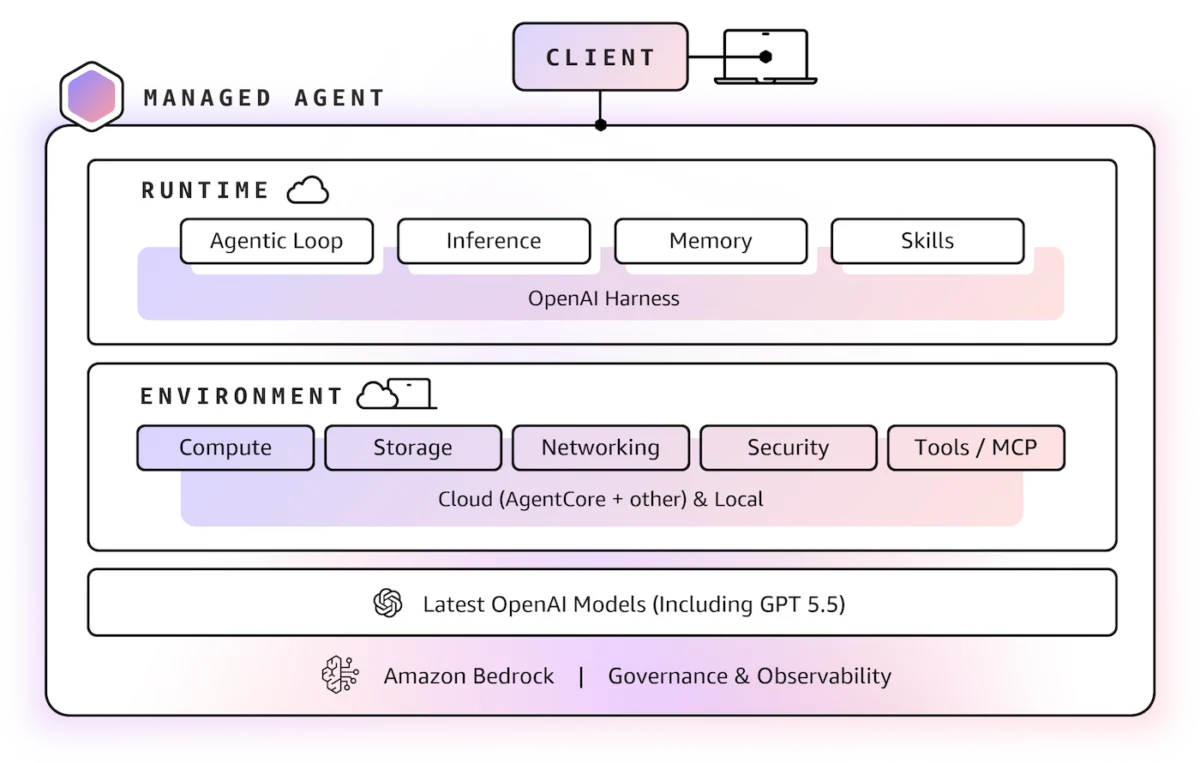
- Launching Amazon Bedrock Managed Agents, Powered by OpenAI: This is perhaps the most significant announcement regarding the partnership, directly tying into the event’s theme of agentic AI. Amazon Bedrock Managed Agents, powered by OpenAI, provides enterprises with a robust framework to build, deploy, and manage sophisticated AI agents that leverage OpenAI’s models. These managed agents can be designed to perform complex, multi-step tasks across enterprise systems, interacting with various data sources and applications securely within the AWS environment. This offering addresses a critical need for businesses that want to build custom agentic solutions but lack the deep AI expertise or infrastructure to do so from scratch. By providing managed agents powered by OpenAI, AWS is offering enterprises "frontier intelligence on the infrastructure they trust," combining the power of OpenAI’s models with AWS’s renowned security, scalability, and operational excellence.
This deepened partnership is a powerful signal to the market. For AWS, it reinforces Bedrock’s position as a leading platform for enterprise AI development, offering a diverse choice of top-tier models. For OpenAI, it provides expanded reach into the vast enterprise customer base of AWS, accelerating the adoption of their advanced models within a secure and compliant cloud environment. The collaboration is expected to spur innovation across industries, enabling enterprises to build more intelligent applications, automate more complex processes, and unlock new business opportunities with confidence.
Market Dynamics and Broader Implications
The announcements from "What’s Next with AWS" arrive at a time of intense competition and rapid innovation in the global artificial intelligence market. The market for enterprise AI solutions is projected to grow significantly, with some estimates placing it at hundreds of billions of dollars within the next few years. Companies are increasingly recognizing AI not as an optional add-on but as a strategic imperative for maintaining competitiveness, driving efficiency, and fostering innovation.

AWS’s comprehensive push into agentic AI with Amazon Quick and the expanded Amazon Connect solutions directly addresses this burgeoning demand for practical, deployable AI tools. By offering solutions that integrate into existing workflows and cater to specific enterprise functions (like supply chain, HR, customer service, and healthcare), AWS is positioning itself as a holistic AI partner, moving beyond raw infrastructure provision. This strategy allows businesses to adopt AI incrementally, focusing on areas where intelligent automation can yield the most immediate and tangible benefits.
The expanded partnership with OpenAI is particularly noteworthy in the context of the broader AI ecosystem. It signifies a mature approach to AI strategy, where cloud providers are not just developing their own models but also collaborating with leading AI research labs to offer customers the best-of-breed. This collaboration allows AWS to provide access to OpenAI’s cutting-edge models while ensuring they run on AWS’s robust, secure, and compliant infrastructure. This addresses a key concern for many enterprises: how to leverage advanced AI models without compromising data security, privacy, and regulatory adherence. AWS’s commitment to responsible AI development, data governance, and enterprise-grade security within Bedrock provides a trusted environment for deploying OpenAI’s powerful capabilities.
For businesses, the implications are profound. Enhanced automation through agentic AI promises not only cost reductions but also a significant boost in productivity, allowing human capital to be reallocated to more creative, strategic, and empathetic tasks. Intelligent decision-making, powered by AI agents analyzing vast datasets, can lead to optimized operations, better customer experiences, and more agile responses to market changes. The ability to build custom AI applications with natural language (via Amazon Quick) or deploy managed agents powered by frontier models (via Bedrock and OpenAI) democratizes AI development, empowering a wider range of employees to innovate.
The competitive landscape, particularly with Microsoft’s strong Copilot offerings and Google’s Gemini for Workspace, emphasizes the strategic importance of these announcements. AWS is clearly demonstrating its commitment to not just keep pace but to lead in delivering enterprise-ready AI solutions that combine powerful models with practical application and robust infrastructure.
Looking Ahead: The Future of Autonomous AI in the Enterprise
The "What’s Next with AWS" event has painted a clear picture of the immediate future of enterprise AI: one dominated by agentic, autonomous systems designed to integrate deeply and proactively into every facet of business. The launch of Amazon Quick, the strategic expansion of Amazon Connect into specialized agentic solutions, and the deepened, high-stakes partnership with OpenAI collectively mark a pivotal moment for AWS and the broader enterprise technology landscape.
These developments signal a shift from AI as a supplementary tool to AI as an embedded, intelligent partner in daily operations. As AI agents become more sophisticated, capable of understanding complex contexts, learning from interactions, and executing multi-step tasks with minimal human intervention, they will increasingly become indispensable for businesses striving for efficiency, innovation, and competitive advantage. AWS’s long-term vision appears to be centered on providing a comprehensive, secure, and scalable ecosystem where businesses can seamlessly leverage the most advanced AI capabilities, whether developed in-house, by AWS, or through strategic partnerships.
The transformative potential of agentic AI across industries is immense. From optimizing global supply chains and revolutionizing talent acquisition to personalizing customer experiences and streamlining healthcare administration, the applications are boundless. As these solutions mature and become more widely adopted, they are set to redefine job roles, reshape organizational structures, and ultimately, drive a new era of intelligent enterprise productivity and innovation, with AWS positioned firmly at the helm of this evolution.
