

In a significant leap forward for its AI agent platform, Anthropic announced substantial enhancements to its Managed Agents service, building upon its initial public beta launch in April. The latest updates introduce "dreaming," a novel self-improvement mechanism, a refined focus on defining and achieving "outcomes," and a more robust multi-agent orchestration system. These advancements aim to empower AI agents to tackle increasingly complex tasks with greater autonomy and minimal human intervention, marking a pivotal step in the evolution of AI agent capabilities.
The core of these new features lies in Anthropic’s commitment to developing AI agents that are not only more capable but also more self-sufficient and aligned with user intent. The company states that these upgrades will make agents "more capable at handling complex tasks with minimal steering," a crucial development for enterprise adoption and advanced AI workflows.
What Do AI Agents Dream About? The Dawn of "Dreaming"
The most intriguing and potentially transformative addition is the "dreaming" capability, currently in a research preview. This feature draws an analogy to human sleep, where the brain consolidates memories and processes information. For Anthropic’s Managed Agents, "dreaming" translates into a scheduled, introspective process. After completing tasks, agents will engage in a review of their recent work sessions. This includes analyzing patterns, identifying potential errors or inefficiencies, and then updating their internal memory with these synthesized observations.
This "dreaming" process is designed to foster continuous learning and self-improvement. By reflecting on past actions and outcomes, agents can refine their strategies and enhance their performance over time. Anthropic has provided users with granular control over this feature, allowing it to operate as a fully automated background process or to require explicit user review of any proposed memory updates before they are permanently integrated. This dual approach ensures both efficiency and user oversight, crucial for maintaining trust and control in AI deployments.

The practical implication of "dreaming" is profound. While a single agent might struggle to identify subtle, recurring issues across its operations, the holistic review facilitated by this feature allows for the detection of patterns that might otherwise go unnoticed. This is particularly valuable for agents involved in iterative tasks or those that encounter a wide variety of scenarios. As Anthropic puts it, "Together, memory and dreaming form a robust memory system for self-improving agents." This system allows each agent to not only capture what it learns during active work but also to consolidate and integrate that learning in a more profound, reflective manner, leading to a more sophisticated and adaptable AI.
Focusing on Outcomes: Defining and Achieving Success
Another significant enhancement is the introduction of "outcomes," a feature designed to align agent actions with defined success criteria. Anthropic posits that AI agents perform optimally when they have a clear understanding of what constitutes "good" performance for a given task. To achieve this, users can now define specific metrics and benchmarks that an agent must meet.
A separate, specialized "grader agent" is then employed to evaluate the output of the primary agent against these pre-defined outcomes. This grader agent operates with its own context window, ensuring that it provides an objective assessment without being influenced by the primary agent’s operational context, thereby preventing any form of "cheating" or manipulation.
This "outcomes" framework is particularly beneficial for tasks that demand meticulous attention to detail, comprehensive coverage, or subjective quality assessments. Examples include generating marketing copy that adheres to a specific brand voice or producing reports that meet rigorous factual accuracy standards. Anthropic’s internal testing has demonstrated the efficacy of this approach, reporting up to a 10-point improvement in task success rates when compared to traditional prompting methodologies. This data underscores the value of clearly defined objectives in maximizing AI performance and ensuring that AI outputs consistently meet user expectations.
Multi-Agent Orchestration: Coordinating Complex Workflows
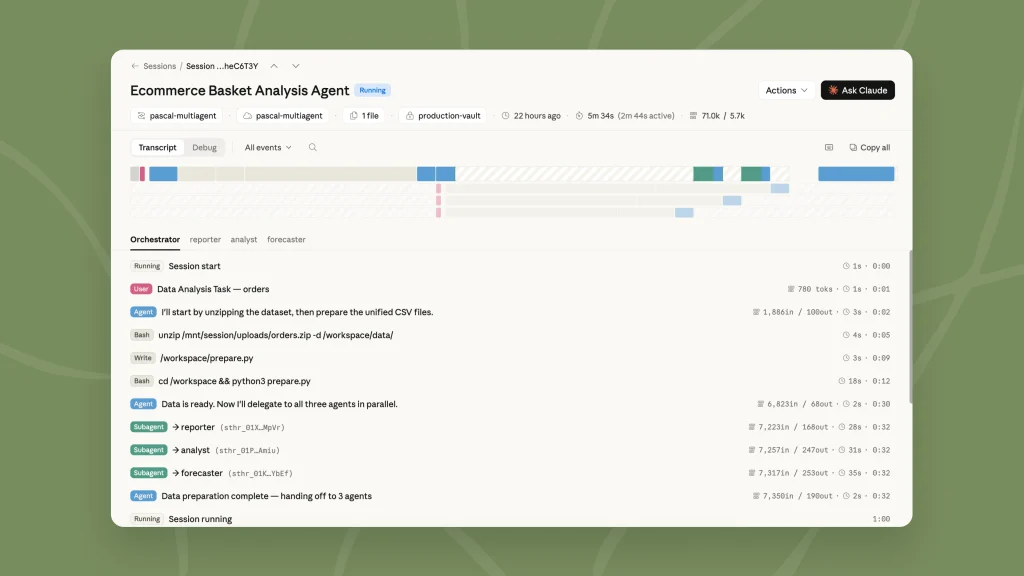
The ability to orchestrate multiple AI agents working in concert is rapidly becoming a critical area of development in the AI landscape, and Anthropic is at the forefront of this trend with its Managed Agents platform. The updated service now allows for sophisticated multi-agent orchestration, enabling agents to break down complex tasks and delegate sub-tasks to specialized agents.

A lead agent can now intelligently distribute work among a team of sub-agents, fostering parallel processing and optimizing workflow efficiency. While capabilities like those seen in Claude Code and Cowork often involve multiple agents, the Managed Agents platform provides a more structured and transparent environment for managing these collaborations. Users can access a dedicated area within the Claude Console to meticulously track the actions of each agent, step by step, gaining full visibility into the entire process. This level of transparency is essential for debugging, auditing, and understanding the intricate workings of complex AI systems.
Availability and Future Implications
The "outcomes" feature and the enhanced multi-agent orchestration capabilities are now fully integrated into the public beta of Anthropic’s Managed Agents platform, making them readily accessible to users. For those interested in exploring the "dreaming" feature, Anthropic has opened a request process, indicating its ongoing development and refinement before a broader release.
The expansion of Managed Agents signals a maturing of Anthropic’s approach to AI agent development, moving beyond simple task execution to more sophisticated, self-improving, and collaboratively oriented systems. The emphasis on "dreaming" and "outcomes" suggests a future where AI agents can learn and adapt with less direct human supervision, while still remaining aligned with human-defined goals. This could dramatically accelerate the pace of innovation in various sectors, from scientific research and software development to creative industries and customer service.
The ability to orchestrate multiple agents, coupled with their enhanced learning and objective-driven capabilities, positions Managed Agents as a powerful tool for enterprises seeking to leverage AI for complex, mission-critical operations. As AI continues to evolve, platforms like Anthropic’s Managed Agents will play a crucial role in bridging the gap between theoretical AI potential and practical, real-world applications. The ongoing research preview of "dreaming" is particularly noteworthy, hinting at a future where AI agents possess a form of "reflective intelligence," capable of learning not just from direct instruction but from introspection and self-analysis, much like their human counterparts. This development is not merely an incremental improvement; it represents a fundamental shift in how we conceive of and interact with artificial intelligence.
