

Seattle, WA & San Francisco, CA – [Insert Current Date] – Amazon Web Services (AWS) and Anthropic today announced the general availability of Claude Opus 4.7, Anthropic’s most advanced large language model (LLM), on Amazon Bedrock. This strategic integration marks a significant leap forward in enterprise-grade artificial intelligence, offering businesses unparalleled performance across complex tasks such as agentic coding, long-running processes, and sophisticated professional workflows. The rollout leverages Amazon Bedrock’s next-generation inference engine, designed to provide robust, scalable, and highly secure infrastructure for demanding production environments.
The introduction of Claude Opus 4.7 to the Bedrock platform underscores the deepening collaboration between AWS and Anthropic, aiming to democratize access to cutting-edge AI for a broad spectrum of industries. This latest iteration of the Opus model family promises enhanced problem-solving capabilities, greater precision in following instructions, and superior handling of ambiguous inputs, critical for real-world business applications.
Deep Dive into Claude Opus 4.7: A New Era for Enterprise AI
Claude Opus 4.7 represents the pinnacle of Anthropic’s foundational model development, specifically engineered to tackle the most challenging computational and cognitive tasks faced by enterprises today. Building upon the strengths of its predecessors, particularly Opus 4.6, this new model introduces significant architectural and algorithmic improvements that translate directly into tangible business benefits.

According to Anthropic, Claude Opus 4.7 delivers substantial advancements across several key domains crucial for modern enterprise operations. These include:
- Agentic Coding: The model exhibits a heightened ability to understand, generate, and debug complex code, facilitating the development of sophisticated software agents. This is particularly valuable for automating intricate programming tasks, accelerating development cycles, and enabling rapid prototyping in environments like DevOps or specialized application development. Its capacity to reason through code logic more effectively allows it to handle multi-step coding challenges with greater autonomy and accuracy.
- Knowledge Work and Reasoning: Opus 4.7 shows marked improvement in its ability to process and synthesize vast amounts of information, making it an invaluable tool for legal research, financial analysis, scientific discovery, and strategic planning. Its enhanced reasoning capabilities allow it to identify nuanced relationships within data, extract relevant insights, and generate comprehensive reports with greater fidelity.
- Visual Understanding: While primarily a text-based model, improvements in its underlying architecture often translate to better multimodal capabilities or the ability to process and interpret descriptions of visual information more effectively, enabling applications in content creation, image analysis interpretation, and even industrial inspection scenarios where textual descriptions are used.
- Long-Running Tasks: Enterprises frequently grapple with processes that span multiple steps, require memory of previous interactions, and demand consistent performance over extended periods. Claude Opus 4.7 is designed to excel in these long-running tasks, maintaining coherence and context, which is vital for applications like customer service chatbots handling complex inquiries, project management assistants, or automated research pipelines.
- Problem Solving with Ambiguity: Real-world data is rarely pristine or perfectly unambiguous. Opus 4.7 demonstrates a superior capacity to navigate and resolve ambiguities in prompts and data, leading to more robust and reliable outputs in scenarios where human-like inference is required. Its thoroughness in problem-solving means it considers a wider range of possibilities and implications before arriving at a solution, reducing the likelihood of errors.
- Instruction Following Precision: For enterprise applications, strict adherence to instructions is paramount. Whether it’s generating code conforming to specific style guides, summarizing documents according to predefined templates, or executing complex workflows, Opus 4.7’s enhanced instruction following ensures outputs are consistently aligned with user requirements, minimizing the need for manual corrections.
While Claude Opus 4.7 is an undeniable upgrade, Anthropic advises that users may need to implement minor prompting changes and harness tweaks to fully leverage the model’s advanced capabilities. The company has released updated prompting guides to assist developers in optimizing their interactions with the new model, ensuring they extract maximum value from its intelligence.
The Backbone: Amazon Bedrock’s Next-Generation Inference Engine
A critical enabler for Claude Opus 4.7’s enterprise readiness is Amazon Bedrock’s newly enhanced inference engine. This engine is not merely a hosting platform; it is a meticulously engineered infrastructure designed from the ground up to meet the rigorous demands of production-grade AI workloads. Its advancements are pivotal for businesses seeking reliable, scalable, and secure deployment of foundational models.
Key innovations in Bedrock’s inference engine include:

- Dynamic Scheduling and Scaling Logic: The engine features sophisticated algorithms that dynamically allocate capacity to incoming requests. This intelligent resource management significantly improves availability, particularly for steady-state workloads that require consistent performance. Concurrently, it efficiently makes room for rapidly scaling services, ensuring that applications can handle sudden spikes in demand without degradation in performance or service interruptions. This elasticity is crucial for businesses with fluctuating AI usage patterns.
- Enterprise-Grade Infrastructure: Bedrock offers the underlying compute, storage, and networking resources necessary to run large, complex AI models at scale. This abstracts away the operational overhead for enterprises, allowing them to focus on application development rather than infrastructure management.
- Enhanced Data Privacy: Zero Operator Access: A cornerstone of Bedrock’s security posture, and a critical requirement for many enterprises, is its "zero operator access" policy. This means that customer prompts and responses processed through Bedrock are never visible to Anthropic or AWS operators. This stringent privacy measure ensures that sensitive corporate data, proprietary algorithms, and confidential communications remain private and isolated, addressing major concerns for industries such such as healthcare, finance, and legal sectors. This architectural design is a significant differentiator in the competitive cloud AI landscape, where data privacy is paramount.
The combination of Claude Opus 4.7’s advanced intelligence and Bedrock’s robust inference engine creates a powerful synergy, providing enterprises with a reliable, high-performance, and secure foundation for deploying cutting-edge generative AI applications.
Strategic Partnership: AWS and Anthropic’s Shared Vision
The collaboration between AWS and Anthropic has been a strategic alliance aimed at accelerating the adoption of safe and reliable AI. This partnership gained significant momentum with AWS’s substantial investment in Anthropic, solidifying a long-term commitment to advancing generative AI.
Timeline of Collaboration:
- September 2023: AWS announces a strategic collaboration and investment in Anthropic, making AWS the primary cloud provider for Anthropic’s mission-critical workloads, including research and development, and providing Anthropic developers access to AWS Trainium and Inferentia chips. This agreement positioned AWS as a key partner in Anthropic’s journey to build safe and steerable AI.
- November 2023: Anthropic’s Claude 2.1 model becomes generally available on Amazon Bedrock, offering a 200K token context window and improved accuracy.
- March 2024: AWS announces an additional investment of up to $2.75 billion in Anthropic, bringing its total investment to $4 billion. This deepens the collaboration, emphasizing AWS’s commitment to supporting Anthropic’s future innovations and expanding the availability of its models on Amazon Bedrock.
- April 2024: Claude 3 Opus, the most intelligent of Anthropic’s Claude 3 family, is made available on Amazon Bedrock, followed by the general availability of Claude Opus 4.7.
This chronology highlights a deliberate and accelerating partnership, focused not just on financial investment but on deep technical integration and shared development goals. AWS’s commitment to providing Anthropic with access to its powerful custom silicon, such as AWS Trainium for training and AWS Inferentia for inference, further strengthens this alliance, enabling Anthropic to optimize its models for performance and efficiency on the AWS infrastructure.
Broader Market Impact and Implications
The availability of Claude Opus 4.7 on Amazon Bedrock is set to have significant implications across the enterprise AI landscape.
- Accelerated Enterprise AI Adoption: By offering a top-tier LLM within a managed, secure, and scalable cloud environment, AWS significantly lowers the barrier to entry for enterprises looking to integrate advanced generative AI. This move is expected to accelerate the adoption of AI across various business functions, from customer service and marketing to product development and back-office operations. The global generative AI market is projected to grow from an estimated $67 billion in 2023 to over $667 billion by 2030, according to some market analyses, and robust platforms like Bedrock are key drivers of this expansion.
- Competitive Landscape Shift: This release intensifies competition among cloud providers and AI model developers. AWS, with its deep enterprise customer base, can now offer a compelling alternative to other leading models and platforms. This pushes other players to innovate further in terms of model capabilities, inference efficiency, and security features.
- Developer Empowerment: Developers gain access to a powerful tool that can dramatically improve their productivity and enable the creation of new, innovative applications. The ability to integrate Claude Opus 4.7 programmatically via familiar SDKs (like
anthropic[bedrock]SDK package) or through AWS CLI makes it accessible to a wide developer audience. Examples provided, such as designing a distributed architecture on AWS, illustrate the immediate practical applications for engineers and architects. - Focus on Responsible AI: Anthropic’s strong emphasis on "safe and steerable AI" aligns with growing industry and regulatory concerns around ethical AI development. By partnering with Anthropic, AWS reinforces its commitment to providing customers with AI solutions that are not only powerful but also designed with safety and responsibility in mind. The "Adaptive thinking" feature for Claude Opus 4.7, which dynamically allocates token budgets based on request complexity, is another example of intelligent design aimed at optimizing resource use and potentially improving the quality of complex outputs.
Accessibility and Practical Implementation
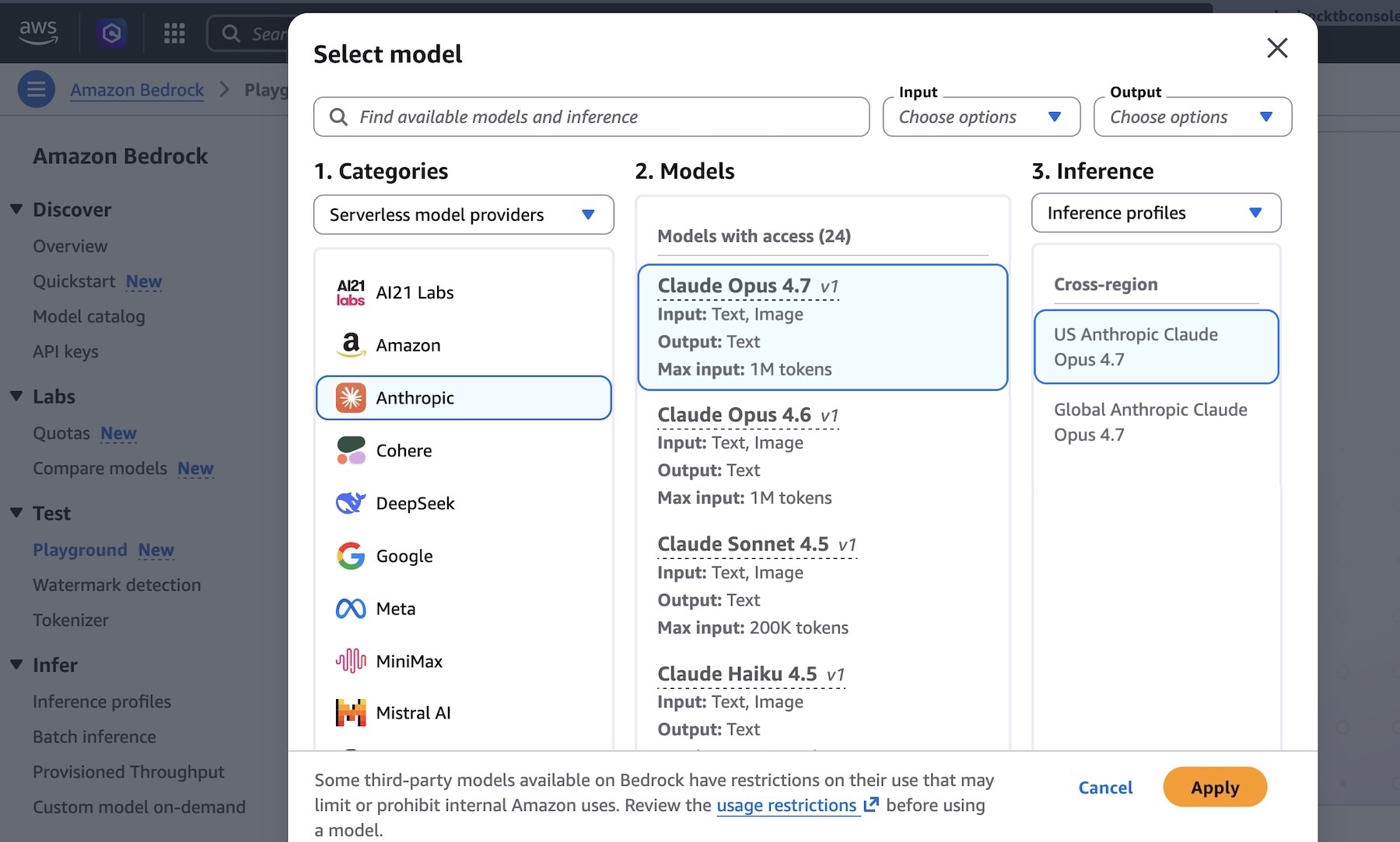
Claude Opus 4.7 is now available in several AWS Regions, including US East (N. Virginia), Asia Pacific (Tokyo), Europe (Ireland), and Europe (Stockholm), with plans for expansion to additional regions in the future. This geographical distribution ensures that enterprises can deploy and utilize the model with low latency and in compliance with regional data residency requirements.
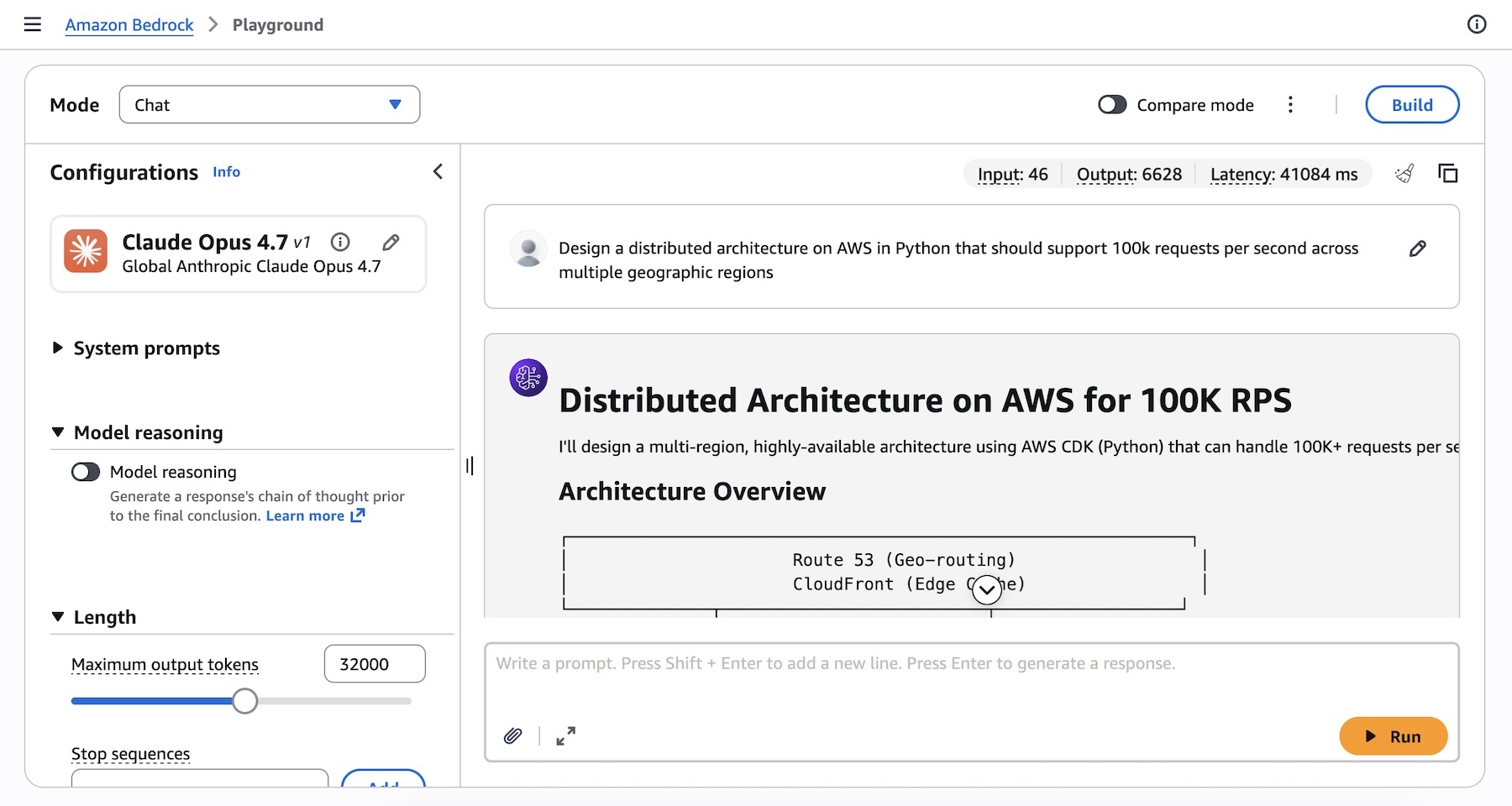
Developers and businesses can immediately begin experimenting with Claude Opus 4.7 through the Amazon Bedrock console. The "Playground" feature offers a user-friendly interface to test complex prompts and observe the model’s responses, as demonstrated by the example of designing a highly scalable distributed architecture on AWS.
For programmatic access, AWS provides multiple avenues:
- Anthropic Messages API via
anthropic[bedrock]SDK: A streamlined experience using a dedicated SDK package. - AWS CLI and AWS SDKs: Traditional AWS tools for invoking models directly through the
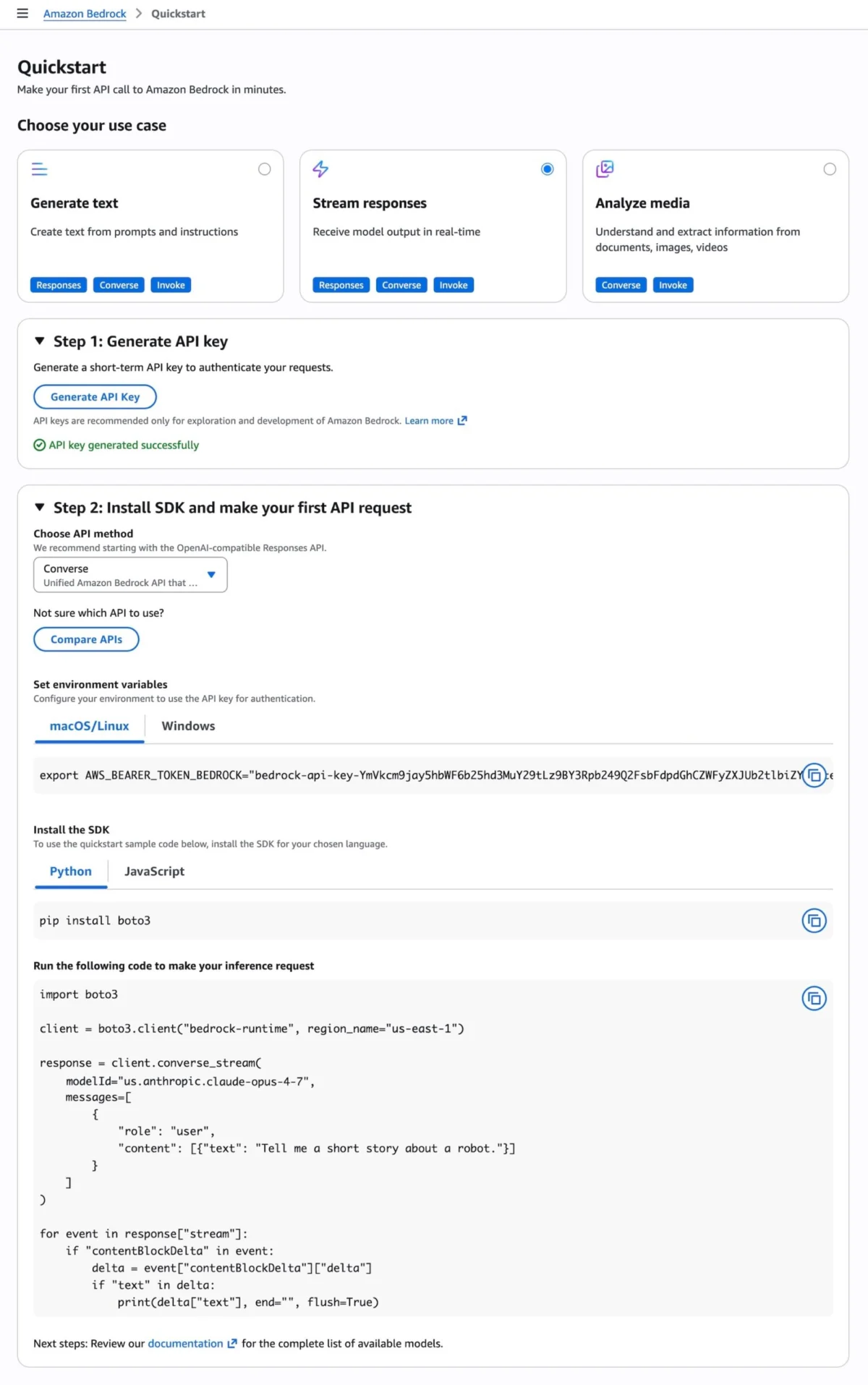
bedrock-runtimeendpoint, supporting theInvokeandConverseAPIs. - Quickstart Guide: The Bedrock console includes a Quickstart section to help users generate temporary API keys and sample code for making their first API calls within minutes, facilitating rapid prototyping and integration.
The integration supports advanced features such as Adaptive thinking, which allows Claude Opus 4.7 to dynamically allocate computational resources based on the complexity of each request, optimizing for both performance and cost. Comprehensive documentation, including code examples for various programming languages and use cases, is available to guide developers in harnessing the full potential of the model.
Conclusion
The general availability of Anthropic’s Claude Opus 4.7 on Amazon Bedrock marks a pivotal moment in the evolution of enterprise AI. By combining Anthropic’s cutting-edge intelligence with AWS’s robust, secure, and scalable cloud infrastructure, businesses are empowered to innovate faster, automate more complex tasks, and unlock new levels of productivity. The emphasis on advanced inference capabilities, stringent data privacy, and a seamless developer experience positions this offering as a leading solution for organizations navigating the complexities of the generative AI revolution. AWS encourages customers to explore Claude Opus 4.7 in the Amazon Bedrock console and provide feedback to further refine and expand its capabilities for diverse enterprise needs.
