

The global data center landscape is currently undergoing its most significant architectural shift in decades, driven by the insatiable bandwidth requirements of generative artificial intelligence and large language models. As traditional copper interconnects reach their physical limits in terms of distance and power efficiency, the industry is pivoting toward an all-optical future. While much of the public discourse focuses on the silicon chips themselves—the GPUs and XPUs that process data—the fundamental enabler of this transition is the laser. Every optical interconnect requires a light source to serve as the data carrier, and the demand for these high-performance components has transformed the laser industry into a critical pillar of the global technology supply chain.
The Physics of Data: The Role of the Laser in Modern Interconnects
In an optical communication system, the laser provides the continuous wave of light that serves as the carrier. This light is modulated and manipulated by a transmitter optical engine, which converts electrical data into optical pulses. These pulses travel through a complex network of fibers and connectors to a receiver optical engine, where they are converted back into electrical signals. However, this journey is not without loss. Every fiber splice, connector interface, and photonic component the light encounters results in signal attenuation.
This loss is managed through what engineers call the "link budget"—the maximum amount of signal degradation that can be tolerated while still ensuring the receiver can accurately interpret the data. A leaner, more efficient link budget is highly desirable, as it allows for lower laser power, reduced operating costs, and lower bit-error rates. As data centers scale up to meet AI demands, the pressure to optimize these budgets has turned the spotlight on a specific class of high-power, high-reliability lasers capable of driving multiple fibers simultaneously.

A Sixty-Year Chronology: From Laboratory Curiosity to Industrial Workhorse
The current dominance of laser technology is the result of six decades of evolution. The laser was independently pioneered in 1962 by researchers at General Electric, IBM, and MIT Lincoln Labs. The underlying principle remains elegantly simple: a forward-biased PN junction brings holes and photons together to release light, while reflectors provide the optical amplification necessary to produce a focused, coherent beam. However, the modern lasers used in AI clusters are vastly more sophisticated than their early ancestors.
For the first thirty years of their existence, lasers were primarily laboratory tools or used in niche industrial applications. Their entry into telecommunications three decades ago revolutionized the internet, enabling trans-oceanic and trans-continental data transmission. More recently, "fiber to the home" (FTTH) technology brought optical speeds to the consumer level.
Within the data center, lasers first appeared over thirty years ago in the form of pluggable transceivers. These devices allowed operators to convert electrical signals to optical signals for long-reach "scale-out" networking. Today, virtually all scale-out data—the traffic moving between different rows of servers or across a campus—is transmitted via laser-powered pluggable transceivers. The industry is now entering a new phase: the "scale-up" era, where lasers are used for short-reach connections between GPUs within the same rack. This shift is being realized through Co-packaged Optics (CPO) and Near-packaged Optics (NPO), which replace traditional copper traces with high-density fiber paths.
Market Dynamics: The $20 Billion AI Windfall
The economic impact of this transition is profound. As of 2024, the global laser technology market has surpassed $20 billion annually. Market analysts project this figure will exceed $30 billion by 2030, though many industry insiders believe this estimate is conservative. The primary engine for this growth is the AI data center, which already accounts for more than 50% of total market demand.

The financial markets have reacted accordingly. Leading laser manufacturers such as Coherent and Lumentum have seen their market capitalizations soar to over $60 billion each—a tenfold increase compared to their valuations just a year ago. This surge reflects the strategic importance of laser supply; in March 2024, Nvidia announced a landmark $2 billion investment in both Lumentum and Coherent. This $4 billion total commitment was designed to secure supply chain capacity ahead of Nvidia’s 2028 roadmap, which heavily features CPO technology.
Currently, the market is characterized by a significant supply-demand imbalance. Both Coherent and Lumentum are reportedly sold out of high-end capacity, often requiring up-front cash payments from customers to secure future production slots. While the "Big Three"—Coherent, Lumentum, and Sumitomo—control approximately 68% of the market, a secondary tier of suppliers including Broadcom, Mitsubishi, MACOM, and Applied Opto is racing to expand production.
Indium Phosphide: The Material of Choice for AI Scale-Up
While various laser types exist, Indium Phosphide (InP) has emerged as the definitive material for high-speed AI interconnects. Specifically, the industry is moving toward Continuous Wave (CW) Ultra-High Power (UHP) lasers. These are typically Distributed Feedback (DFB) lasers, which utilize a lateral periodic grating structure to form a resonant cavity, ensuring a very stable and narrow wavelength.
InP lasers generate light in the O-band (1,260nm to 1,360nm), with 1,310nm being the standard center point. The O-band is favored for CPO applications because it offers the lowest chromatic dispersion—a phenomenon where different wavelengths travel at different speeds, causing pulses to spread out and blur over distance. By minimizing dispersion, engineers can maintain signal integrity at much higher data rates.

The definition of "high power" in the laser world is also shifting. Until recently, a 50mW laser was considered standard. Today’s InP CW UHP lasers are reaching 300mW to 400mW, with some cutting-edge units hitting 600mW. This high output is necessary because a single laser is now often split to power 4, 8, or even 16 individual fibers. However, this power comes at a thermal cost: for every watt of light produced, the laser generates three to four watts of waste heat.
ELSFP: Solving the Packaging Challenge
One of the most significant hurdles in adopting CPO is managing the heat and reliability of the laser. Because lasers are highly sensitive to temperature—wavelength drifts by approximately 0.1nm for every degree Celsius—placing them directly on a 1,000-watt GPU package is problematic. To solve this, the industry has developed the External Laser Small Form-factor Pluggable (ELSFP).
By keeping the laser in an external, pluggable module, operators can cool the laser independently using Thermoelectric Cooling (TEC) devices, which maintain the junction temperature within a narrow +/- 20°C range. Furthermore, if a laser fails, the ELSFP can be replaced without discarding the expensive GPU or switch silicon it supports.
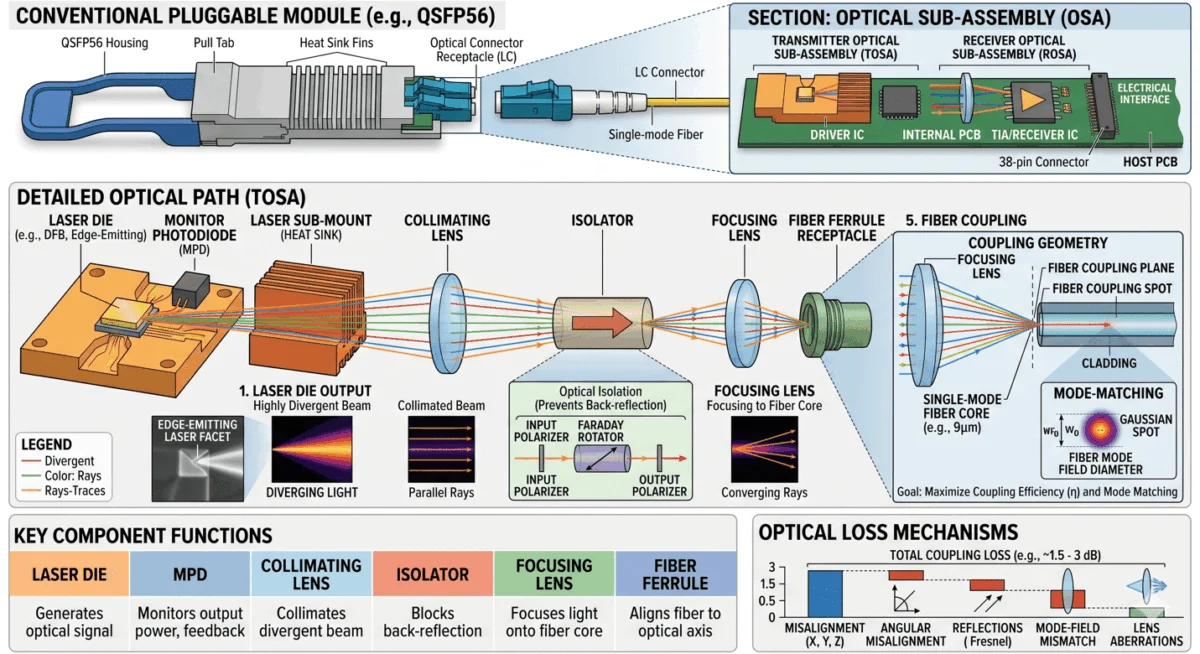
The internal architecture of an ELSFP is a masterpiece of micro-optics. Because InP laser die typically output an oval-shaped beam from a horizontal slit, they do not naturally align with round optical fibers. An ELSFP contains a series of collimating lenses to reshape the beam, followed by an isolator made of yttrium iron garnet to prevent back-reflections from damaging the laser. Finally, a second lens focuses the light into the fiber. Due to these complex optical paths, the "wall-plug efficiency" of an ELSFP is generally between 10% and 15%, meaning the vast majority of the electricity consumed is converted into heat rather than light.

Multiplexing and the Path to Terabit Speeds
As bandwidth requirements continue to double every two years, the industry is moving beyond single-wavelength transmission toward Wavelength Division Multiplexing (WDM). By sending multiple "colors" of light down the same fiber, data capacity can be multiplied without adding more cables.
The OCI-MSA (Optical Computer Interconnect Multi-Source Agreement), backed by titans such as Meta, Microsoft, Nvidia, AMD, and Broadcom, has proposed a standard utilizing eight wavelengths (four in each direction). This requires an ELSFP to house eight individual InP lasers, each tuned to a specific frequency with roughly 2nm of spacing.
At the 2026 Optical Fiber Communication (OFC) conference, the boundaries of this technology were pushed even further. Lumentum demonstrated 16-channel Dense Wavelength Division Multiplexing (DWDM) with 200GHz spacing. Meanwhile, startups like Scintil Photonics are exploring hybrid approaches, bonding InP die onto silicon photonics wafers to achieve even tighter wavelength control (100GHz spacing). These advancements suggest that the 100nm-wide O-band will eventually be packed with dozens of channels, enabling terabit-per-second speeds on a single strand of glass.
Strategic Implications and Future Outlook
The transition to optical interconnects is no longer a matter of "if" but "when." The limitations of copper—specifically its inability to carry high-frequency signals over distances longer than a few meters without massive power consumption—have made optical technology the only viable path forward for the AI era.

The implications for the semiconductor industry are twofold. First, there is a massive infrastructure build-out underway. Coherent has announced it will double its InP wafer capacity by 2026 and move to six-inch wafer production to improve yields and lower costs. Second, the "link budget" has become the new metric of merit. Companies that can minimize end-to-end signal loss will be able to use lower-power lasers, giving them a competitive edge in "performance per watt"—the most critical metric in the modern data center.
As we look toward 2030, the laser will cease to be a peripheral component and will instead be recognized as the heartbeat of the AI cluster. The ongoing investments by hyperscalers and chip designers ensure that the next five years will be defined by a rapid migration from copper to CPO. For the $20 billion laser industry, the AI revolution is not just a growth opportunity; it is a fundamental transformation of its role in the global economy.
