
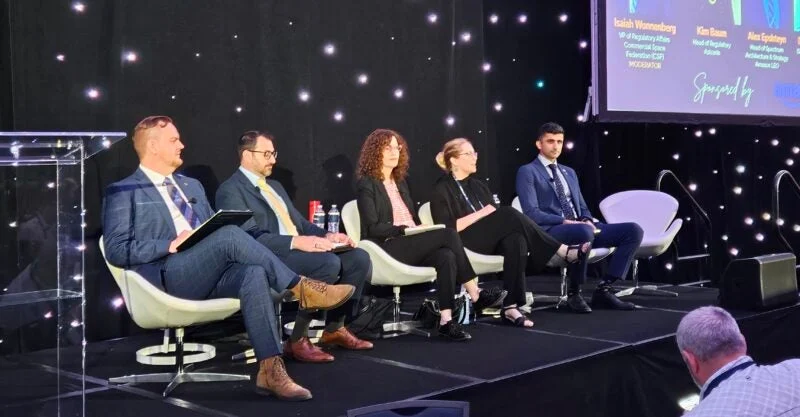

The global race for orbital dominance and spectrum priority is entering a critical phase as the international community prepares for the 2027 World Radiocommunication Conference (WRC-27). Set to be hosted by the Chinese government in Shanghai, the quadrennial summit is already drawing intense scrutiny from United States space executives and policy experts. During the recent ASCEND conference in Washington, industry leaders warned that the "satellite-heavy" nature of the upcoming agenda, combined with China’s role as the host nation, presents significant strategic and security challenges for the U.S. space economy. As the International Telecommunication Union (ITU) prepares to adjudicate the rules governing the next generation of satellite constellations, the U.S. delegation faces a complex battle to modernize outdated regulations while navigating a geopolitical landscape fraught with tension.
The Strategic Importance of WRC-27
The World Radiocommunication Conference is the premier global forum for reviewing and revising the Radio Regulations, the international treaty governing the use of the radio-frequency spectrum and satellite orbits. Held every four years, the decisions made at these summits dictate the technical and operational landscape for telecommunications, maritime navigation, aviation, and, increasingly, the burgeoning commercial space sector.
According to Alex Epshteyn, Head of Spectrum Architecture and Strategy at Amazon Leo, WRC-27 will be unprecedented in its focus on non-geostationary orbit (NGSO) systems. Epshteyn noted that over 80% of the conference agenda is directly or indirectly related to NGSO systems, which include low-Earth orbit (LEO) megaconstellations like SpaceX’s Starlink and Amazon’s Project Kuiper, as well as medium-Earth orbit (MEO) constellations utilized by Earth observation and connectivity providers.
The high stakes for the 2027 summit stem from the sheer volume of satellite deployments planned for the coming decade. With thousands of new satellites expected to launch, the competition for spectrum—the invisible "highways" of the airwaves—has reached a fever pitch. Danielle Pineres, Deputy General Counsel and Vice President of Planet Labs, emphasized that the 2027 conference represents a "wonderful opportunity to consensus-build with other like-minded nations" to support the technological requirements of modern constellations. However, achieving that consensus requires overcoming significant regulatory inertia and geopolitical friction.
The Debate Over Outdated Technical Standards
A central point of contention heading into WRC-27 is the reform of Equivalent Power Flux Density (EPFD) limits. These regulatory metrics were established by the ITU in the late 1990s to prevent interference between the then-emerging LEO satellites and the established geosynchronous orbit (GEO) satellites that sit much higher in space.
Industry advocates argue that these 25-year-old limits are based on obsolete technology and do not reflect the sophisticated beam-forming and interference-mitigation capabilities of contemporary NGSO constellations. "The ITU does struggle to keep pace with technology," Epshteyn remarked during the ASCEND panel. He argued that the current quadrennial cadence of the WRC process fails to account for breakthrough innovations that occur between conferences.
The push for EPFD reform is not without opposition. Many traditional GEO satellite operators, who provide critical services for broadcasting and national security, fear that relaxing these limits could lead to signal degradation and service interruptions. This divide was a "hot-button issue" during WRC-23, and despite intense lobbying from LEO proponents, the reform of EPFD limits was not formally adopted for the WRC-27 agenda.
In a notable move to bypass the slow-moving international process, the U.S. Federal Communications Commission (FCC) recently approved an update to domestic EPFD frameworks. While this move was cheered by LEO operators like SpaceX and Amazon, it has created a regulatory divergence between U.S. national policy and international standards, adding another layer of complexity to the U.S. delegation’s mission in Shanghai.
Geopolitical Friction and the "Home Field Advantage"
The selection of Shanghai as the host city for WRC-27 has introduced significant logistical and security concerns for the U.S. private sector and government agencies. In the world of international diplomacy, the host nation of a WRC often enjoys a "home field advantage," wielding influence over the conference’s leadership, committee assignments, and the general flow of negotiations.
"Generally, whoever hosts the WRC has home field advantage," Epshteyn stated. The concern among U.S. executives is that China could leverage this position to shape regulations that favor its own rapidly expanding satellite sector, such as the "Guowang" (State Network) constellation, while potentially disadvantaging U.S. systems.
Beyond the regulatory influence, security concerns are a primary deterrent for U.S. participation. Kim Baum, Head of Regulatory Affairs at Astranis, highlighted the risks of American delegates falling victim to sophisticated hacking or industrial espionage while in China. She noted that participation in recent regional preparatory meetings has already been "incredibly limited" due to these security anxieties.
"We’re going to have to figure out a way to protect our information security and whatever else is needed, but we can’t go with a skeleton delegation and hope to really win the day for the United States," Baum warned. The dilemma for the U.S. is clear: staying home to protect information security risks ceding the regulatory floor to China, but attending in force requires a robust and expensive counter-intelligence effort.
The Fractured U.S. Proposal Process
Internal procedural hurdles further complicate the U.S. position. The process for developing the American national position for a WRC is bifurcated between the private sector and the federal government.
- The Private Sector Path: Commercial entities work through the FCC’s WRC Advisory Committee. This process is generally transparent and allows for public debate among industry stakeholders.
- The Government Path: Federal agencies, including the Department of Defense and NASA, develop their positions through an interagency process managed by the National Telecommunications and Information Administration (NTIA). This process occurs largely behind closed doors.
Baum described the final reconciliation of these two paths as "murky," noting that the divergence between commercial interests and government priorities can weaken the U.S. position when it finally reaches the international stage. For the U.S. to be successful at WRC-27, industry leaders argue that a more unified and streamlined approach is necessary to present a cohesive front against well-coordinated international rivals.
A Chronology of Spectrum Regulation and the Road to 2027
To understand the weight of WRC-27, it is helpful to look at the timeline of events that have shaped the current regulatory environment:
- 1990s: The ITU establishes initial EPFD limits to protect GEO satellites from early LEO projects like Iridium and Globalstar.
- 2019 (WRC-19): Significant spectrum was allocated for 5G services, but satellite operators began sounding the alarm about the need for more NGSO-specific rules.
- 2020-2023: The rapid deployment of SpaceX’s Starlink constellation transforms the LEO landscape, making spectrum sharing a top-tier global issue.
- Late 2023 (WRC-23): Held in Dubai, this conference saw intense debate over EPFD. While some progress was made on satellite-to-device connectivity, the major LEO operators failed to get EPFD reform on the official 2027 agenda.
- April 2024: The FCC votes to update U.S. EPFD frameworks, signaling a "go-it-alone" approach to force the international community’s hand.
- 2024-2026: Preparatory meetings (CPM) and regional group meetings (such as CITEL in the Americas) will take place to draft the technical foundations for WRC-27.
- November 2027: WRC-27 convenes in Shanghai for four weeks of final negotiations.
Broader Implications: The $1.8 Trillion Space Economy
The outcome of WRC-27 will have ripple effects far beyond the technical specifications of radio waves. According to a 2024 report by the World Economic Forum and McKinsey & Company, the global space economy is projected to reach $1.8 trillion by 2035. This growth is driven largely by satellite-enabled services, including high-speed internet, climate monitoring, and precision agriculture.
If the U.S. fails to secure favorable spectrum rules, it could hamper the commercial viability of multi-billion dollar projects like Amazon’s Kuiper or future LEO-based Earth observation fleets. Furthermore, the "balkanization" of spectrum—where different countries follow different rules—could lead to a fragmented global market, increasing costs for consumers and slowing the rollout of life-saving technologies in developing regions.
The U.S. space sector is at a crossroads. The upcoming 2027 conference in Shanghai represents a test of American diplomatic agility and technical leadership. To maintain its edge, the U.S. must navigate the dual challenges of a host nation that is also its primary strategic competitor and a regulatory body that is struggling to remain relevant in an era of exponential technological growth. As Danielle Pineres of Planet Labs noted, "This year is an important time for the United States to show up in force." The decisions made in the lead-up to 2027 will define the orbital landscape for decades to come.
