

Amazon Web Services (AWS) has announced the launch of Amazon Bedrock Advanced Prompt Optimization, a sophisticated new tool designed to significantly enhance the performance and efficiency of large language models (LLMs) deployed on its Bedrock platform. This innovative feature empowers developers and enterprises to systematically optimize prompts for any model available on Amazon Bedrock, facilitating seamless migration between models and substantial improvements in existing model performance. By enabling simultaneous comparison of original and optimized prompts across up to five different models, AWS is addressing a critical bottleneck in generative AI development: the complex and often iterative process of prompt engineering.
The introduction of Advanced Prompt Optimization marks a pivotal step in democratizing access to high-performing generative AI applications, allowing organizations to achieve superior outcomes while mitigating common challenges like performance regressions and underperforming tasks. This metric-driven approach streamlines the development lifecycle, moving away from the laborious trial-and-error methods that have historically characterized prompt engineering.
The Evolving Landscape of Large Language Models and Prompt Engineering
The rapid proliferation of Large Language Models (LLMs) has fundamentally transformed the technological landscape, offering unprecedented capabilities in natural language understanding, generation, and complex problem-solving. From customer service chatbots to sophisticated content creation tools, LLMs are now at the forefront of enterprise innovation. However, harnessing the full potential of these powerful models is not without its challenges. One of the most significant hurdles lies in "prompt engineering" – the art and science of crafting effective inputs (prompts) to guide an LLM toward producing desired outputs.
Effective prompt engineering is crucial because the quality, relevance, and accuracy of an LLM’s response are highly dependent on the prompt it receives. A poorly constructed prompt can lead to irrelevant, inaccurate, or even harmful outputs, diminishing the utility of the underlying model. Conversely, a well-engineered prompt can unlock extraordinary levels of performance, precision, and creativity. The complexity arises from the fact that optimal prompts are often highly specific to the task, the model, and even the nuances of the desired output. This often translates into a labor-intensive, iterative process involving extensive experimentation, manual tuning, and subjective evaluation.
Enterprises grappling with the deployment of LLMs have long sought more robust, systematic methods for prompt optimization. Developers spend considerable time fine-tuning prompts, often resorting to guesswork or anecdotal evidence to achieve incremental improvements. This manual approach is not only time-consuming and expensive but also prone to inconsistencies, making it difficult to scale and maintain high-quality AI applications across diverse use cases and evolving model landscapes. Furthermore, the sheer variety of LLMs, each with its own architectural nuances and training data biases, means that a prompt optimized for one model may not perform optimally, or even adequately, on another. This presents a significant challenge for organizations looking to migrate between models for cost efficiency, performance gains, or access to new capabilities.
Amazon Bedrock: A Platform for Generative AI Innovation
Amazon Bedrock, launched in general availability in September 2023, has rapidly established itself as a cornerstone of AWS’s generative AI strategy. As a fully managed service, Bedrock offers a simplified pathway for developers to build and scale generative AI applications using a variety of foundation models (FMs) from Amazon and leading AI companies like AI21 Labs, Anthropic, Cohere, Meta, Mistral AI, and Stability AI. The platform abstracts away much of the underlying infrastructure complexity, allowing users to focus on application development rather than managing servers or model deployments.
Bedrock’s initial offerings included access to a diverse array of FMs, tools for fine-tuning models with proprietary data, and capabilities like Agents for Amazon Bedrock to orchestrate complex tasks, and Knowledge Bases for Amazon Bedrock to connect FMs to organizational data sources. These features collectively aim to lower the barrier to entry for generative AI development, enabling a broader spectrum of businesses to integrate AI into their operations. The service has been widely adopted by enterprises across various sectors, from finance and healthcare to media and retail, seeking to leverage generative AI for tasks ranging from content generation and summarization to code assistance and intelligent search.
The introduction of Advanced Prompt Optimization represents a natural and essential evolution of the Bedrock platform. It directly addresses one of the most pressing operational challenges faced by developers working with LLMs today. By providing a structured, automated, and metric-driven approach to prompt engineering, AWS is not only enhancing the efficiency of its platform but also empowering its customers to extract maximum value from their generative AI investments. This new feature solidifies Bedrock’s position as a comprehensive ecosystem for end-to-end generative AI development, from model selection and customization to deployment and continuous optimization.
Unpacking Advanced Prompt Optimization: Features and Functionality
At its core, Amazon Bedrock Advanced Prompt Optimization is designed to automate and objectify the process of creating highly effective prompts. The tool takes a systematic approach, moving beyond manual guesswork to leverage a metric-driven feedback loop that iteratively refines prompt templates.

Core Inputs and Process:
Users initiate the optimization process by providing several key inputs:
- Prompt Template: The initial, unoptimized prompt structure that includes variables for user inputs.
- Example User Inputs: A dataset of real-world or representative examples for the variable values within the prompt template.
- Ground Truth Answers: For supervised optimization, corresponding correct or ideal answers for each example user input. This serves as the benchmark for evaluation.
- Evaluation Metric/Guidance: A clear criterion or method by which the quality of the LLM’s response will be assessed. This is crucial for guiding the optimization process.
Once these inputs are provided, the prompt optimizer engages in a feedback loop. It sends the prompt template with example inputs to the selected inference models, evaluates the resulting responses against the defined metric or ground truth, and then intelligently rewrites or refines the prompt template. This iterative process continues until the prompt achieves the desired performance level according to the specified evaluation metric. The final output includes both the original and optimized prompt templates, alongside detailed evaluation scores, estimated costs, and latency metrics for each.
Multi-Model Comparison and Migration:
A standout feature is the ability to compare prompt performance across up to five inference models simultaneously. This is particularly beneficial for:
- Model Migration: Organizations can select their current model as a baseline and compare its performance against several candidate new models (e.g., Anthropic’s Claude 3 Opus vs. Meta’s Llama 3) using an optimized prompt. This allows for data-driven decisions on model switching, ensuring that performance is maintained or improved without introducing regressions.
- Performance Benchmarking: Even if not migrating, developers can use this feature to benchmark the efficacy of a single optimized prompt across different models, understanding which models respond best to specific prompting strategies for particular tasks.
- Continuous Improvement: For existing deployments, users can select their current model and observe the "before and after" impact of the optimization process, validating the gains in performance.
Multimodal Capabilities:
Recognizing the growing importance of multimodal AI applications, the Advanced Prompt Optimization tool supports multimodal user inputs. This means users can include png, jpg, and pdf files as inputs to their prompt templates. This capability is invaluable for tasks such as:
- Document Analysis: Extracting information from invoices, reports, or legal documents.
- Image Interpretation: Describing image content, answering questions about visual data, or generating captions.
- Content Generation from Diverse Sources: Creating summaries or reports based on a combination of text and visual information.
This feature significantly broadens the scope of problems that can be addressed effectively with optimized prompts on Bedrock.
Flexible Evaluation Methods:
The tool offers three distinct and flexible methods for guiding the optimization process and evaluating prompt quality:
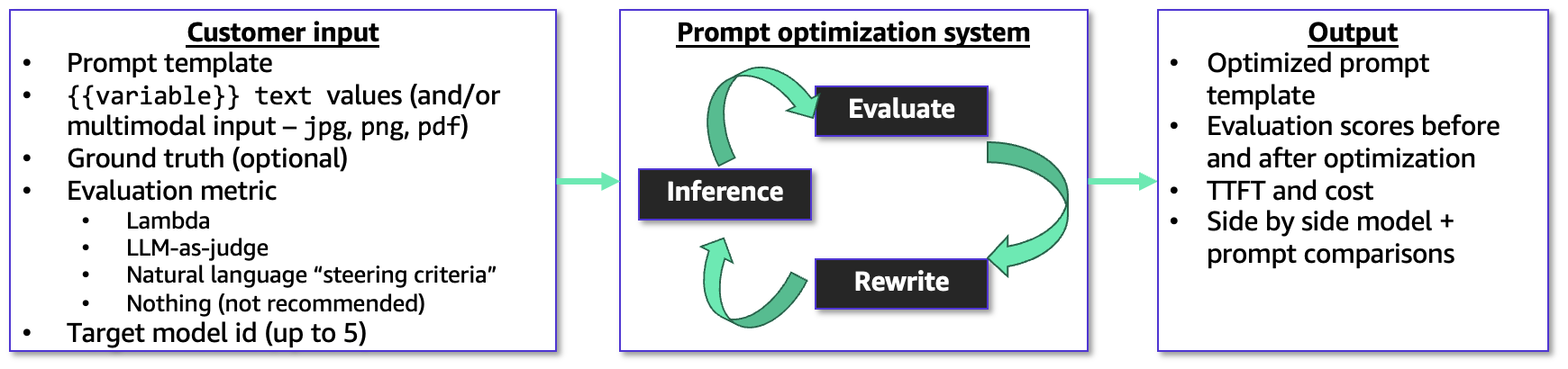
- AWS Lambda Function: For highly customized scoring logic, users can provide an AWS Lambda function. This allows developers to implement their own Python-based scoring algorithms, catering to unique business rules or complex evaluation criteria that might not be covered by standard metrics.
- LLM-as-a-Judge Rubric: This innovative approach leverages another LLM to act as a judge, evaluating the responses generated by the primary model against a custom natural language rubric. This is particularly useful for subjective tasks where traditional metrics (like ROUGE or BLEU) might fall short, such as assessing creativity, coherence, or tone.
- Natural Language Steering Criteria: For simpler or more intuitive guidance, users can provide a short natural language description that outlines the desired characteristics of the model’s response. This method offers a low-code entry point for optimization, making it accessible to a wider range of users.
Users can apply different evaluation methods to different prompt templates within a single optimization job, providing unparalleled flexibility.
Streamlined Workflow and Integration
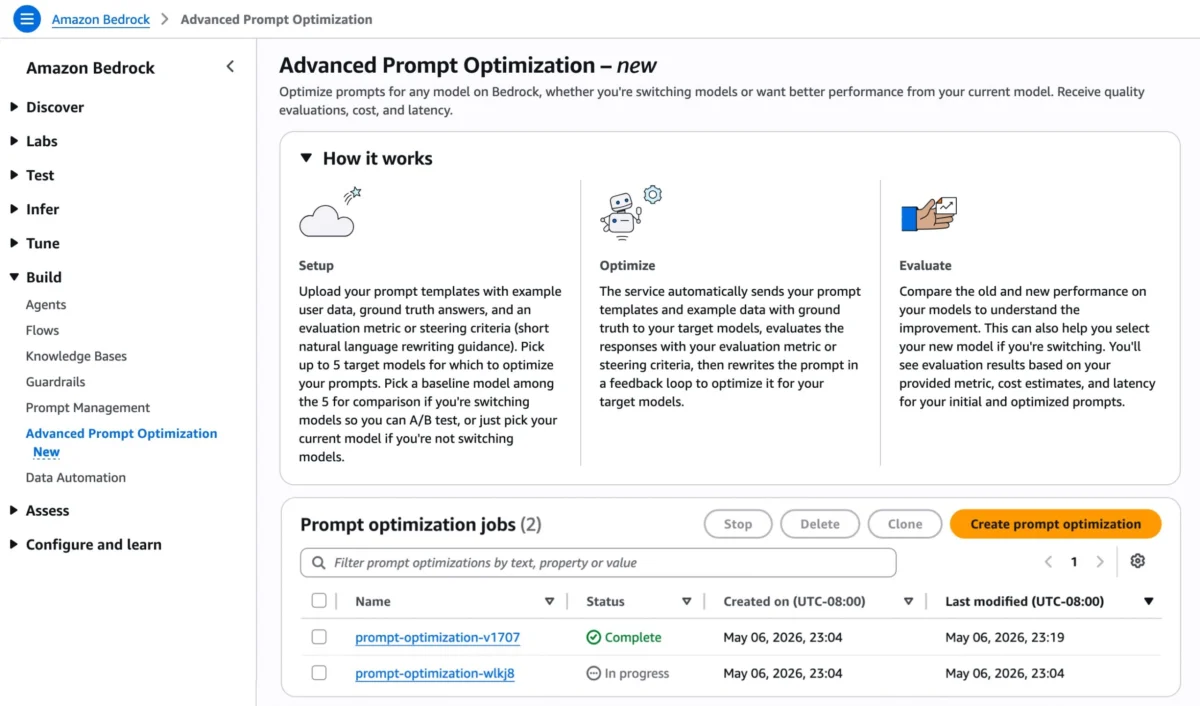
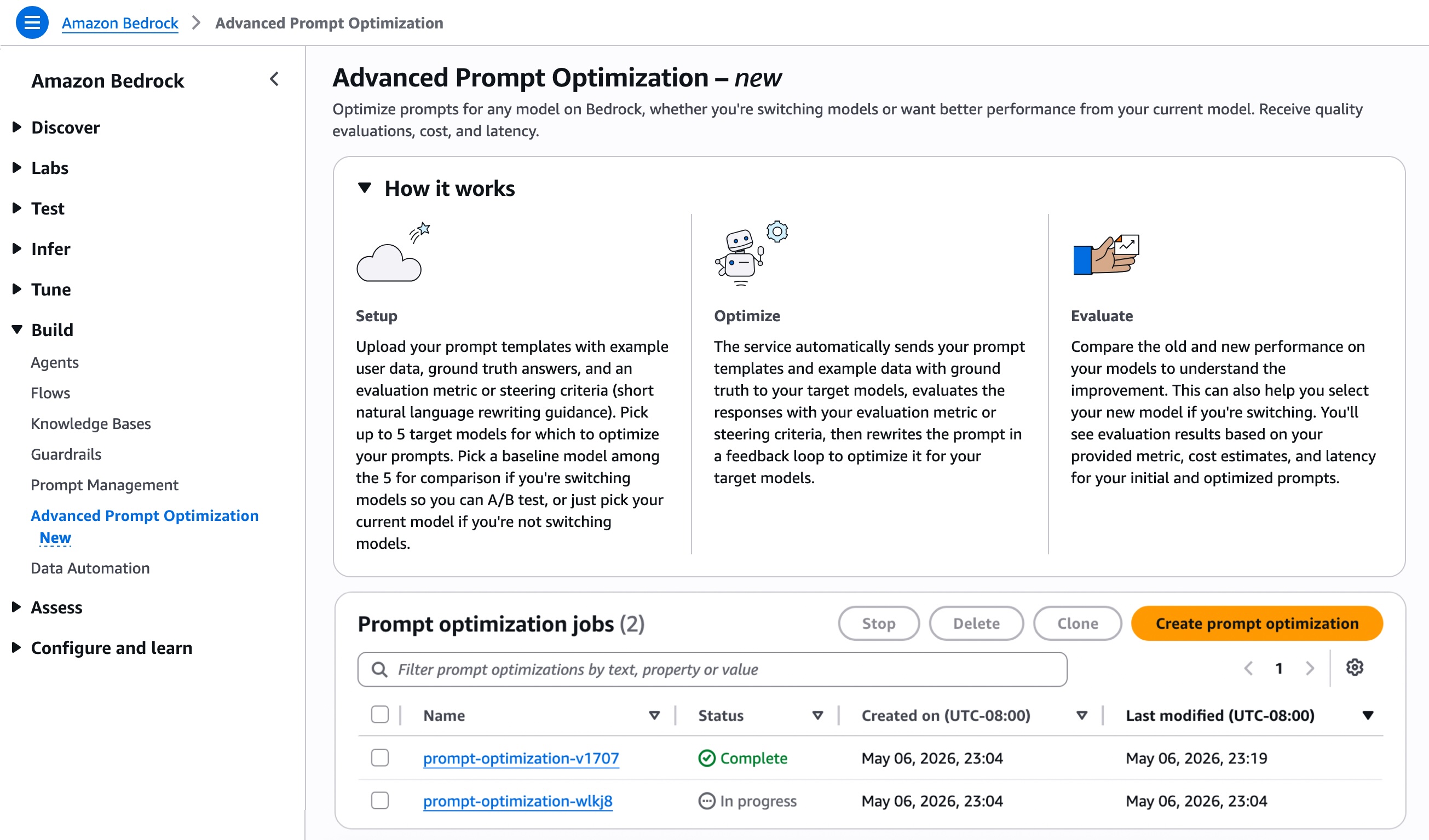
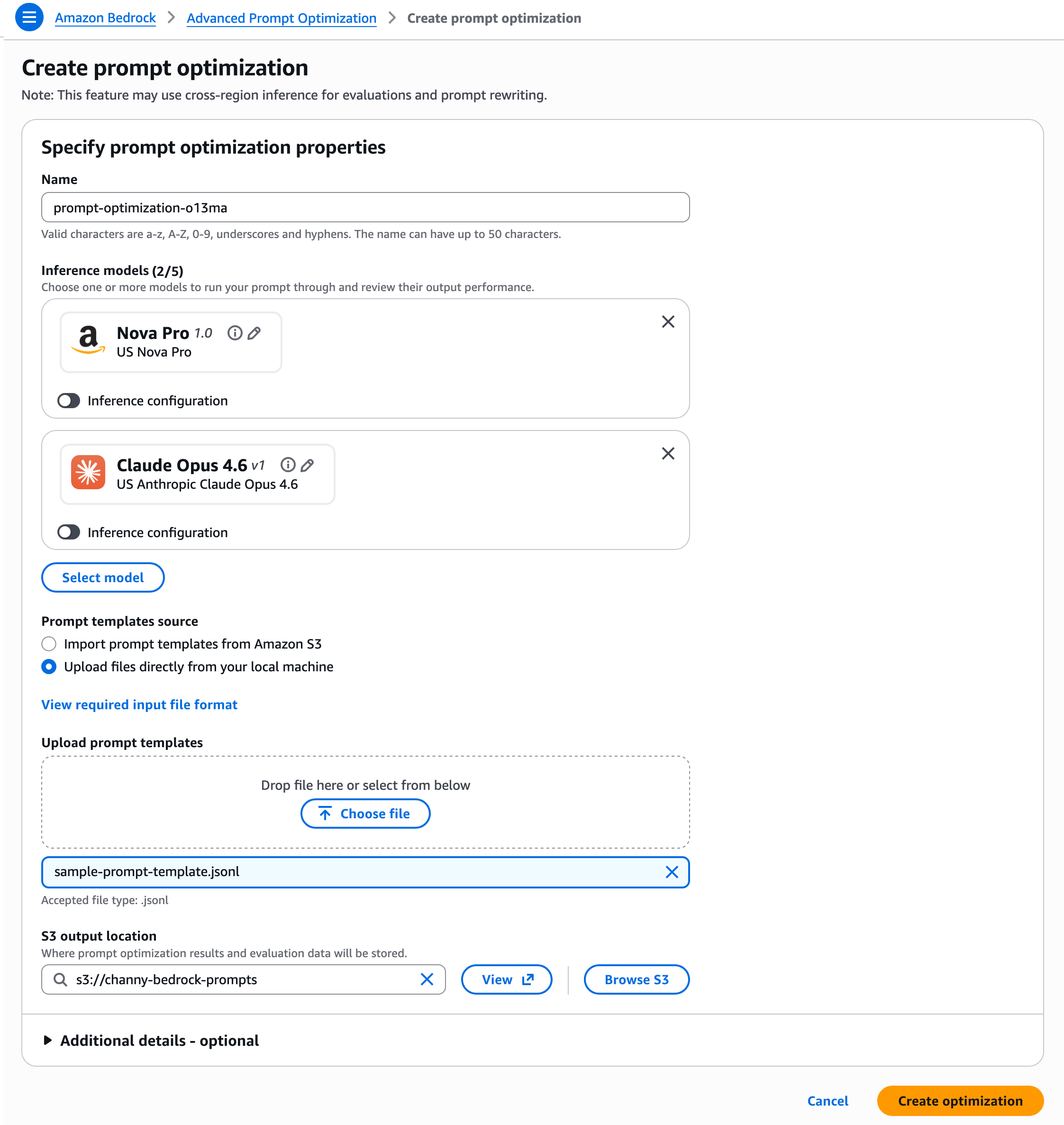
Accessing Amazon Bedrock Advanced Prompt Optimization is designed to be intuitive and integrated within the existing Bedrock console. Users navigate to the "Advanced Prompt Optimization" page and select "Create prompt optimization." The workflow then guides them through selecting up to five inference models and uploading their prompt templates and example data.
Prompt templates are expected in JSONL format, which allows for structured definitions including the prompt itself, steering criteria, custom evaluation metric labels, and evaluationSamples. The evaluationSamples array supports inputVariables for textual data and inputVariablesMultimodal for integrating png, jpg, or pdf files stored in Amazon S3, along with optional referenceResponse (ground truth). This structured input ensures consistency and facilitates automated processing.
Once submitted, Amazon Bedrock takes over, automatically executing the optimization loop. The results, including the final optimized prompts and comprehensive evaluation data, are then stored in a user-specified Amazon S3 output location. This seamless integration with S3 ensures data persistence and easy access for further analysis or deployment. The console then presents evaluation results based on the chosen metric, along with the rewritten, optimized prompt templates, providing clear insights into the improvements achieved.
Broader Implications and Impact
The launch of Amazon Bedrock Advanced Prompt Optimization carries significant implications for the wider adoption and effective utilization of generative AI within enterprises.
Democratizing Advanced AI Development: By automating a traditionally complex and specialized task like prompt engineering, AWS is effectively lowering the barrier to entry for effective LLM utilization. Developers who may not have deep expertise in prompt engineering can now leverage sophisticated tools to achieve high-quality results, accelerating the pace of AI innovation across a broader developer base. This democratization means that more teams within an organization can build and deploy generative AI applications, rather than relying solely on a small group of prompt engineering specialists.
Enhanced Cost Efficiency: Optimized prompts are inherently more efficient. They guide LLMs more precisely, reducing the likelihood of irrelevant outputs that require re-generation or excessive token consumption. In a usage-based pricing model like Bedrock’s, where costs are often tied to the number of tokens processed, more efficient prompts directly translate into lower operational expenses. The inclusion of cost estimates in the optimization output provides direct visibility into this benefit, allowing enterprises to manage their generative AI budgets more effectively, especially as they scale their applications. This is critical for moving AI projects from pilot to production, where cost-effectiveness becomes a major factor.
Improved AI Application Quality and Reliability: Better prompts lead to better LLM responses. This directly impacts the quality, accuracy, and consistency of AI applications, whether they are generating marketing copy, answering customer queries, or summarizing complex documents. Consistent and reliable outputs build trust in AI systems, which is essential for enterprise adoption and for critical applications where errors can have significant consequences. The ability to test for regressions and improve underperforming tasks ensures that AI applications not only perform well initially but also maintain their performance over time and across model updates.
Accelerated Time-to-Market: The manual iteration cycle of prompt engineering can be a significant drag on development timelines. By automating this process, Bedrock Advanced Prompt Optimization dramatically reduces the time required to develop, test, and deploy generative AI applications. This allows businesses to iterate faster, experiment with new use cases more readily, and bring AI-powered products and services to market more quickly, gaining a competitive edge.
Strengthening the Bedrock Ecosystem: This new feature significantly enhances the value proposition of Amazon Bedrock as an end-to-end platform for generative AI. It positions Bedrock not just as a gateway to FMs but as a comprehensive toolkit that supports the entire lifecycle of AI application development, from foundational model access to sophisticated optimization and deployment. This makes Bedrock a more compelling choice for enterprises seeking a robust, scalable, and efficient platform for their AI initiatives.
While AWS has not released official statements from specific executives on this particular launch at the time of reporting, the introduction of such a feature aligns perfectly with Amazon’s stated commitment to making advanced AI technologies accessible and practical for enterprises. Industry analysts are likely to view this as a crucial step in maturing the generative AI ecosystem, addressing real-world pain points that have hindered widespread enterprise adoption. For example, an analyst from a prominent tech research firm might comment, "The Bedrock Advanced Prompt Optimization tool is a game-changer for enterprises struggling with the complexities of prompt engineering. By automating this critical step and offering multi-model comparison, AWS is not just simplifying development but also enabling businesses to unlock greater ROI from their generative AI investments, particularly in environments where model performance and cost efficiency are paramount." Developers, too, are expected to welcome a tool that promises to reduce the toil of manual prompt tuning, allowing them to focus on higher-value tasks and creative problem-solving.
Availability and Pricing
Amazon Bedrock Advanced Prompt Optimization is now generally available across several key AWS regions. These include US East (N. Virginia, Ohio), US West (Oregon), Asia Pacific (Mumbai, Seoul, Singapore, Sydney, Tokyo), Canada (Central), Europe (Frankfurt, Ireland, London, Zurich), and South America (São Paulo) Regions. This widespread availability ensures that a broad global customer base can immediately leverage the new capabilities.
In terms of pricing, customers will be charged based on the Bedrock model-inference tokens consumed during the optimization process. This follows the same per-token rates as regular Bedrock inference. This transparent and integrated pricing model means that the costs associated with prompt optimization are directly tied to the underlying model usage, making it predictable and consistent with existing Bedrock cost structures. Organizations are encouraged to review the Amazon Bedrock pricing page for detailed information on token rates.
AWS encourages users to explore the advanced prompt optimization feature through the Amazon Bedrock console or via the CreateAdvancedPromptOptimizationJob API. Feedback channels, including AWS re:Post for Amazon Bedrock and usual AWS Support contacts, are open for users to share their experiences and suggestions, contributing to the continuous improvement of the service. This ongoing engagement with the developer community underscores AWS’s commitment to evolving its generative AI offerings in response to customer needs.
In conclusion, Amazon Bedrock Advanced Prompt Optimization represents a significant leap forward in making generative AI more practical, efficient, and accessible for enterprises worldwide. By automating and refining the critical process of prompt engineering, AWS is empowering organizations to build more effective, cost-efficient, and high-quality AI applications, further solidifying Bedrock’s position as a leading platform in the rapidly expanding generative AI market.
