
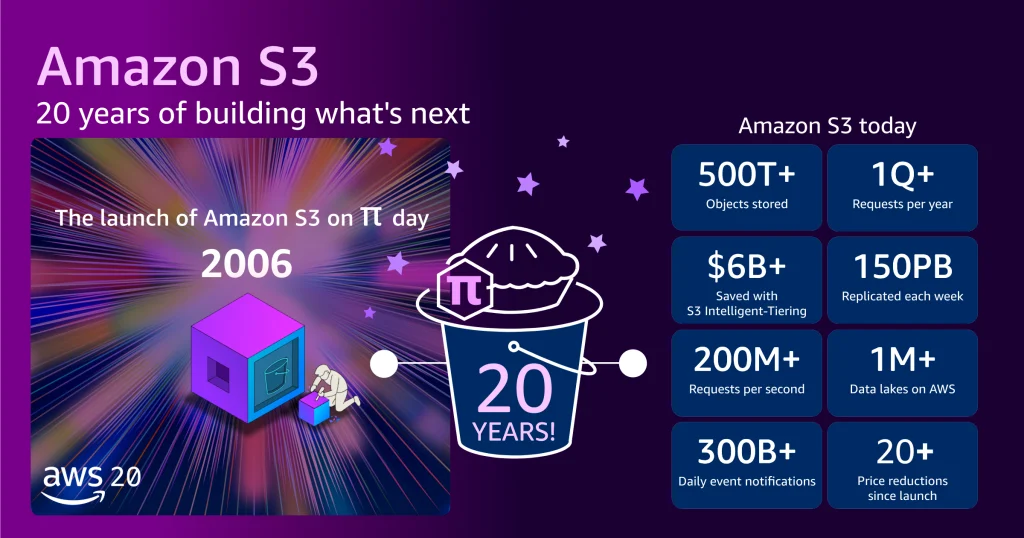

On March 14, 2006, Amazon Web Services (AWS) quietly unveiled Amazon Simple Storage Service (Amazon S3), a seemingly modest offering that would, over the next two decades, fundamentally transform the landscape of internet infrastructure and pave the way for the modern cloud computing era. What began with a brief, one-paragraph announcement on the AWS "What’s New" page and a few sentences on Jeff Barr’s blog, written before he boarded a flight to a developer event, evolved into a ubiquitous, indispensable backbone for countless applications and services worldwide. This unheralded launch marked a pivotal moment, introducing a paradigm shift in how developers and businesses approach data storage, setting a new standard for scalability, reliability, and cost-efficiency.
The Genesis of a Cloud Giant: A Quiet Revolution
In the mid-2000s, the digital infrastructure landscape was vastly different. Developers and businesses typically managed their own hardware, data centers, and storage solutions. Scaling applications meant significant upfront capital expenditure, complex provisioning, and ongoing maintenance—a burden known as "undifferentiated heavy lifting." The process of acquiring, installing, and maintaining physical storage was a significant barrier to innovation, particularly for startups and rapidly growing enterprises. It was against this backdrop that S3 emerged with a deceptively simple proposition: "storage for the Internet." Its initial description promised a "simple web services interface that can be used to store and retrieve any amount of data, at any time, from anywhere on the web," offering developers access to "the same highly scalable, reliable, fast, inexpensive data storage infrastructure that Amazon uses to run its own global network of web sites." This vision, though understated at the time, was nothing short of revolutionary. It democratized access to enterprise-grade storage, abstracting away the complexities of hardware management and empowering developers to focus on building higher-value applications. The core primitives, PUT to store an object and GET to retrieve it, embodied a philosophy of simplicity that belied the profound engineering complexity beneath.
Foundational Pillars: The Unchanging Principles of S3
From its inception, S3 was guided by five immutable principles that have remained the bedrock of its design and operation:
- Security: Data protection by default was paramount. S3 was engineered with robust security features, ensuring that customer data remained private and secure, adhering to strict access controls and encryption standards.
- Durability: Designed for an astounding "11 nines" (99.999999999%) of durability, S3 was built to be lossless. This level of durability means that, on average, a customer could store 10,000,000 objects and expect to lose only one object once every 10,000,000 years. This extreme resilience is achieved through sophisticated data replication and integrity checks across multiple devices and facilities.
- Availability: Recognizing that failures are an inherent part of any large-scale system, S3 was designed with availability woven into every layer. It anticipates and handles failures seamlessly, ensuring that data is always accessible when needed, even in the face of underlying infrastructure issues.
- Performance: The service was optimized to handle virtually any amount of data without degradation in retrieval or storage speed. This consistent, high-speed access is crucial for demanding applications, from content delivery to data analytics.
- Elasticity: Perhaps one of S3’s most transformative features, elasticity meant the system automatically scaled up or down in response to user data needs. Developers no longer had to provision storage in advance, eliminating guesswork, waste, and manual intervention, allowing for unprecedented agility.
These five fundamentals collectively enabled S3 to offer a service that simply "just works," abstracting away the immense complexity of distributed storage systems and freeing developers to innovate at an unprecedented pace. Industry analysts frequently cite S3 as a prime example of how well-defined, robust foundational services can catalyze an entire industry.
Two Decades of Unprecedented Growth and Scale
The journey from its modest launch to its current colossal scale is a testament to S3’s enduring design and continuous innovation. The initial S3 offering provided approximately one petabyte (PB) of total storage capacity across about 400 storage nodes in 15 racks, spanning three data centers, with 15 Gigabits per second (Gbps) of total bandwidth. It was designed to store tens of billions of objects, with a maximum object size of 5 GB. The initial price point was 15 cents per gigabyte per month.
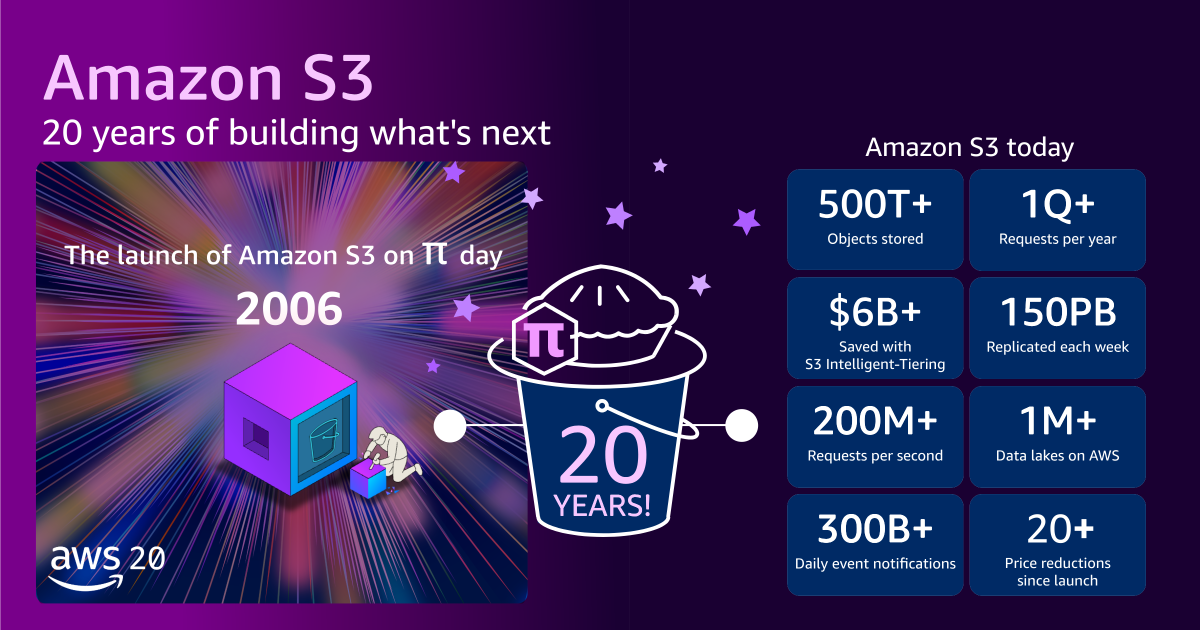
Fast forward 20 years, and S3’s metrics paint a picture of exponential growth that is challenging to comprehend. Today, S3 stores more than 500 trillion objects and serves over 200 million requests per second globally. This vast ocean of data, spanning hundreds of exabytes, is distributed across 123 Availability Zones in 39 AWS Regions, serving millions of customers worldwide. The maximum object size has expanded dramatically from 5 GB to a staggering 50 TB, representing a 10,000-fold increase in individual file capacity. To put its physical scale into perspective, if one were to stack all the tens of millions of S3 hard drives on top of each other, they would reach the International Space Station and almost back.
Alongside this phenomenal growth in capacity and performance, AWS has also delivered significant cost reductions. The price of S3 storage has plummeted by approximately 85% since its launch, now costing slightly over 2 cents per gigabyte. Beyond this direct price reduction, AWS has introduced various storage classes and features like Amazon S3 Intelligent-Tiering, which automatically moves data between access tiers to optimize costs. This innovation has led to substantial savings for customers, with over $6 billion saved collectively by using Intelligent-Tiering compared to Amazon S3 Standard. This relentless focus on cost-effectiveness has democratized access to powerful storage solutions, making advanced data management accessible to businesses of all sizes.
Industry Standard and Unwavering Backward Compatibility
One of S3’s most remarkable achievements is its pervasive influence on the broader storage industry. The S3 API has been widely adopted as a de facto standard, with numerous vendors now offering S3-compatible storage tools and systems. This standardization means that skills, tools, and applications developed for S3 are often transferable to other storage platforms, fostering an ecosystem of interoperability and reducing vendor lock-in concerns. This widespread adoption underscores the elegance and effectiveness of S3’s original design.
Perhaps even more impressive is AWS’s unwavering commitment to backward compatibility. The code written for S3 in 2006 remains functional today, completely unchanged. This means that data stored two decades ago is still accessible, having seamlessly transitioned through multiple generations of underlying infrastructure, disks, and storage systems. While the internal code handling requests has been entirely rewritten over time, the external API contract has been meticulously maintained. This commitment ensures that customer investments in S3 are protected, allowing them to benefit from continuous innovation without needing to re-architect existing applications—a rare feat in the rapidly evolving tech world. An AWS spokesperson emphasized this point, stating, "Our commitment to delivering a service that continually ‘just works’ extends to preserving the integrity of our customers’ original implementations, ensuring their data and applications evolve effortlessly with S3."
The Engineering Marvel: Powering Scale Through Innovation
The ability to sustain such exponential growth and maintain stringent performance and durability targets is a testament to continuous, cutting-edge engineering innovation within AWS. Insights from leaders like Mai-Lan Tomsen Bukovec, VP of Data and Analytics at AWS, highlight several key engineering philosophies and practices:
- Lossless Durability via Microservices: At the heart of S3’s 11 nines durability is an intricate system of microservices that relentlessly inspect every byte across the entire fleet. These "auditor" services continuously monitor data integrity, automatically triggering repair systems the moment any signs of degradation are detected. This proactive, self-healing architecture ensures that objects are not merely replicated but are actively protected against loss. The sizing of replication factors and re-replication fleets is meticulously designed to meet the lossless objective.
- Formal Methods and Automated Reasoning: To guarantee correctness at scale, S3 engineers employ advanced formal methods and automated reasoning in production environments. This involves mathematically proving the correctness of critical system components. For instance, when engineers check in code to the index subsystem, automated proofs verify that consistency properties haven’t regressed. This rigorous approach is also applied to validate complex features like cross-Region replication and sophisticated access policies, ensuring their behavior is predictable and correct under all conditions.
- Rust for Performance and Safety: Over the past eight years, AWS has progressively rewritten performance-critical code in the S3 request path using Rust. Components responsible for blob movement and disk storage have been re-engineered, with active work continuing across other areas. Rust’s advantages extend beyond raw performance; its robust type system and memory safety guarantees eliminate entire classes of bugs at compile time. This is an indispensable property for operating a service with S3’s scale, correctness requirements, and reliability demands, significantly reducing the likelihood of runtime errors.
- "Scale is to your advantage" Philosophy: A core design philosophy within S3 engineering is that increased scale should inherently improve attributes for all users. Engineers design systems in a way that the larger S3 becomes, the more de-correlated workloads become. This de-correlation enhances overall reliability and stability for every user, as localized issues are less likely to impact the broader system.
Looking Forward: The Universal Foundation for Data and AI
S3’s vision extends far beyond being a mere storage service; it aims to be the universal foundation for all data and AI workloads. This ambitious vision posits that users should be able to store any type of data once in S3 and work with it directly, eliminating the need to move data between specialized systems. This approach significantly reduces costs, minimizes operational complexity, and removes the necessity for maintaining multiple copies of the same data across different platforms.
Recent innovations exemplify this forward-looking strategy, transforming S3 into a powerful hub for advanced analytics, machine learning, and data processing:
- S3 Select and S3 Glacier Select: These capabilities allow users to run SQL queries directly on data stored in S3, reducing the need to extract entire datasets for analysis. This on-demand querying saves time and costs by only retrieving the necessary data.
- Integration with AWS Data Lakes and Analytics Services: S3 serves as the primary storage layer for AWS data lakes, seamlessly integrating with services like Amazon Athena for interactive query, Amazon Redshift Spectrum for exabyte-scale analytics, and AWS Glue for data cataloging and ETL. This makes S3 the central repository for enterprise data strategy.
- Machine Learning Integration: S3 is a critical component of machine learning workflows, serving as the storage for training datasets, model artifacts, and inference results for services like Amazon SageMaker. Its scalability and performance are vital for the large datasets typical of AI workloads.
- Serverless Computing with AWS Lambda: The deep integration of S3 with AWS Lambda allows developers to trigger serverless functions in response to S3 events, such as new object uploads. This enables powerful, event-driven architectures for data processing, image resizing, and file conversions without managing any servers.
- S3 Object Lambda: This capability allows developers to add their own code to process data as it is being retrieved from S3. It provides a simple way to modify data returned by S3 requests, such as redacting sensitive information, resizing images, or watermarking, without altering the original object.
Each of these capabilities operates within the inherent cost structure of S3, making it economically feasible to handle diverse data types and complex workloads that traditionally required expensive databases or specialized systems. From a foundational object store to an intelligent data platform, S3 continues to evolve, pushing the boundaries of what cloud storage can achieve.
Broader Impact and Enduring Legacy
The profound impact of Amazon S3 extends far beyond its technical specifications and impressive scale. It played a crucial role in democratizing access to computing resources, enabling countless startups to launch and scale without the prohibitive costs of traditional infrastructure. By abstracting away the complexities of storage, S3 empowered developers to focus on innovation, accelerating the pace of digital transformation across industries. It laid the groundwork for the broader adoption of cloud computing, proving the viability and advantages of utility-based, on-demand infrastructure.
S3’s consistent evolution, marked by drastic price reductions and continuous feature enhancements, has ensured its relevance in a rapidly changing technological landscape. Its role as the universal foundation for data and AI workloads signifies its continued importance as enterprises increasingly leverage vast datasets for insights and innovation.
From a humble one petabyte to hundreds of exabytes, from 15 cents to 2 cents per gigabyte, and from simple object storage to the bedrock of AI and analytics, Amazon S3’s journey over two decades has been nothing short of transformative. Throughout this remarkable evolution, its five core fundamentals—security, durability, availability, performance, and elasticity—have remained steadfast, a testament to a visionary design. And perhaps most importantly, the code written for S3 in 2006 still functions perfectly today, a symbol of AWS’s unwavering commitment to its customers. Here’s to the next 20 years of innovation on Amazon S3.