

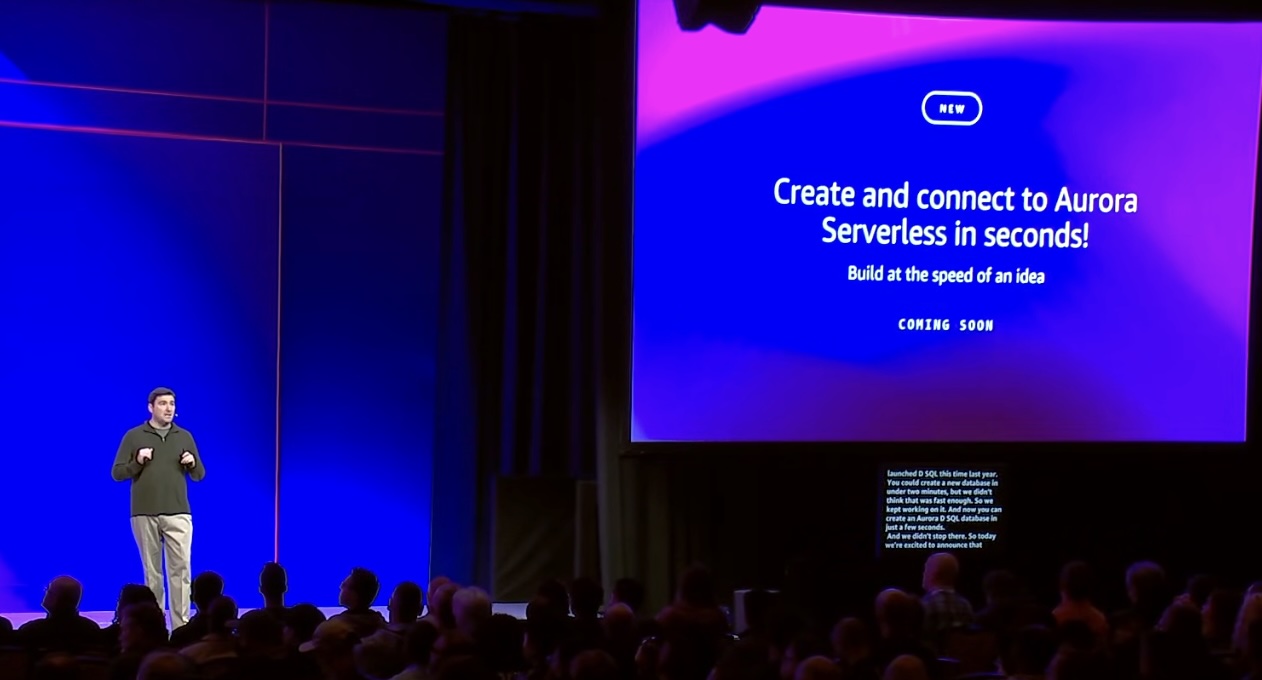
Seattle, Washington – Amazon Web Services (AWS) today announced the general availability of a new express configuration for Amazon Aurora PostgreSQL, a significant development designed to drastically reduce the time and complexity involved in setting up production-ready relational databases. This streamlined database creation experience, featuring preconfigured defaults, allows users to launch an Amazon Aurora PostgreSQL serverless database in mere seconds, fundamentally accelerating the journey from a conceptual idea to a functional application. This announcement builds upon a strategic vision articulated at re:Invent 2025, where Colin Lazier, Vice President of Databases at AWS, underscored the critical importance of "building at the speed of an idea."
The Vision: Building at the Speed of an Idea

The core philosophy driving this innovation at AWS is the elimination of friction in the development process, enabling rapid iteration and deployment. At the annual re:Invent conference in 2025, Colin Lazier highlighted this imperative, emphasizing that the ability to quickly translate an idea into a running application is paramount for modern innovation. This vision had already materialized with existing AWS database services such as Amazon DynamoDB, a fully managed NoSQL database, and Amazon Aurora DSQL, which allowed customers to create production-ready tables and databases in seconds. The preview of a similar rapid creation capability for Amazon Aurora serverless databases at the same event generated considerable interest and customer demand, setting the stage for today’s general availability.
The introduction of the express configuration for Aurora PostgreSQL is a direct response to this demand, reflecting a broader industry trend towards serverless architectures and developer-centric tools that abstract away infrastructure complexities. Traditional database provisioning, even in cloud environments, often involves multiple steps, network configuration, security group setup, and credential management, which can collectively consume minutes to hours, slowing down initial development and prototyping phases. By compressing this timeline to a matter of seconds, AWS aims to democratize access to high-performance, scalable databases for developers of all skill levels, from individual innovators to large enterprise teams.
Unpacking the Aurora PostgreSQL Express Configuration

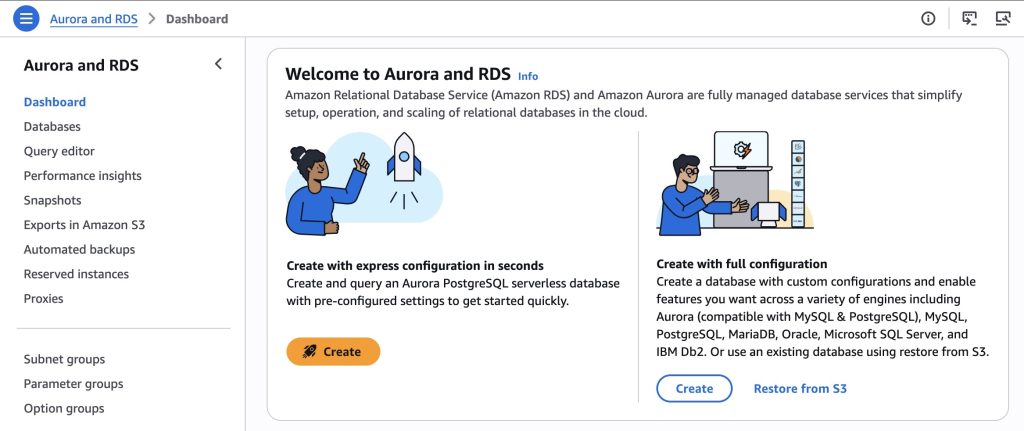
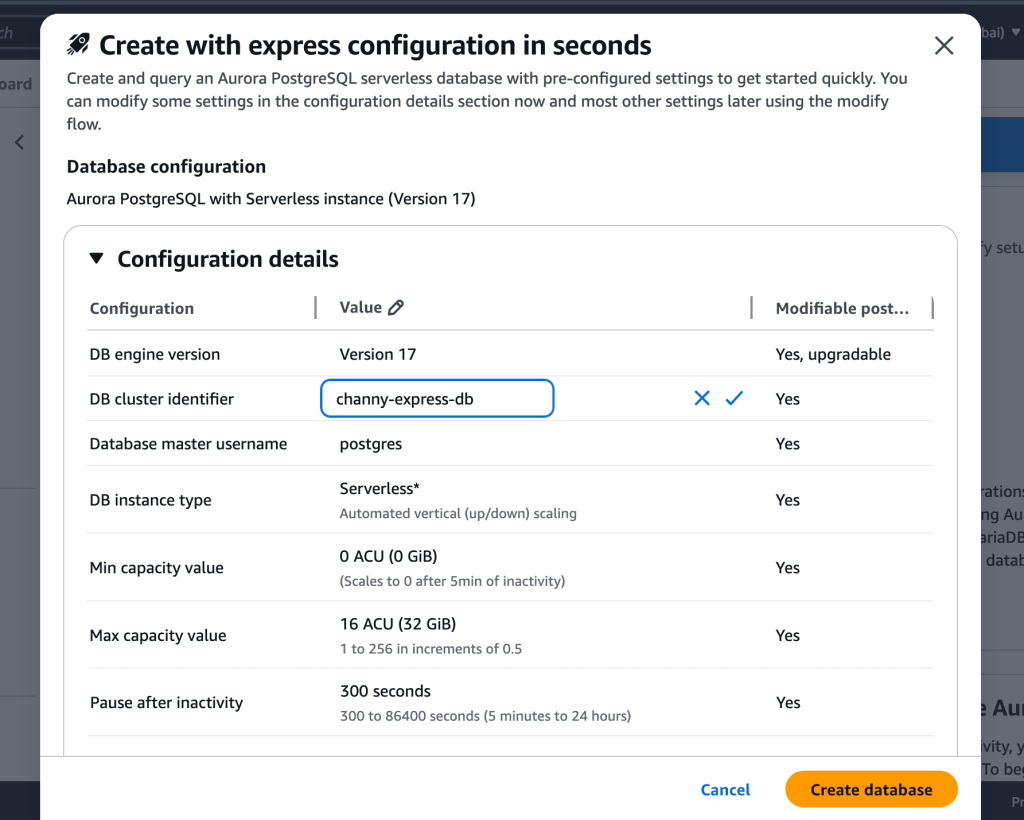
The express configuration for Amazon Aurora PostgreSQL is engineered for simplicity and speed. With as few as two clicks within the AWS console, users can provision a fully functional Aurora PostgreSQL serverless database. This process leverages intelligent preconfigured defaults, ensuring that the database is immediately ready for use without requiring extensive manual setup. While optimized for rapid deployment, the express configuration retains a degree of flexibility, allowing users to modify critical settings both during and after the initial creation. For instance, developers can adjust the capacity range for the serverless instance at creation time or later add read replicas and modify parameter groups to fine-tune performance and availability characteristics.
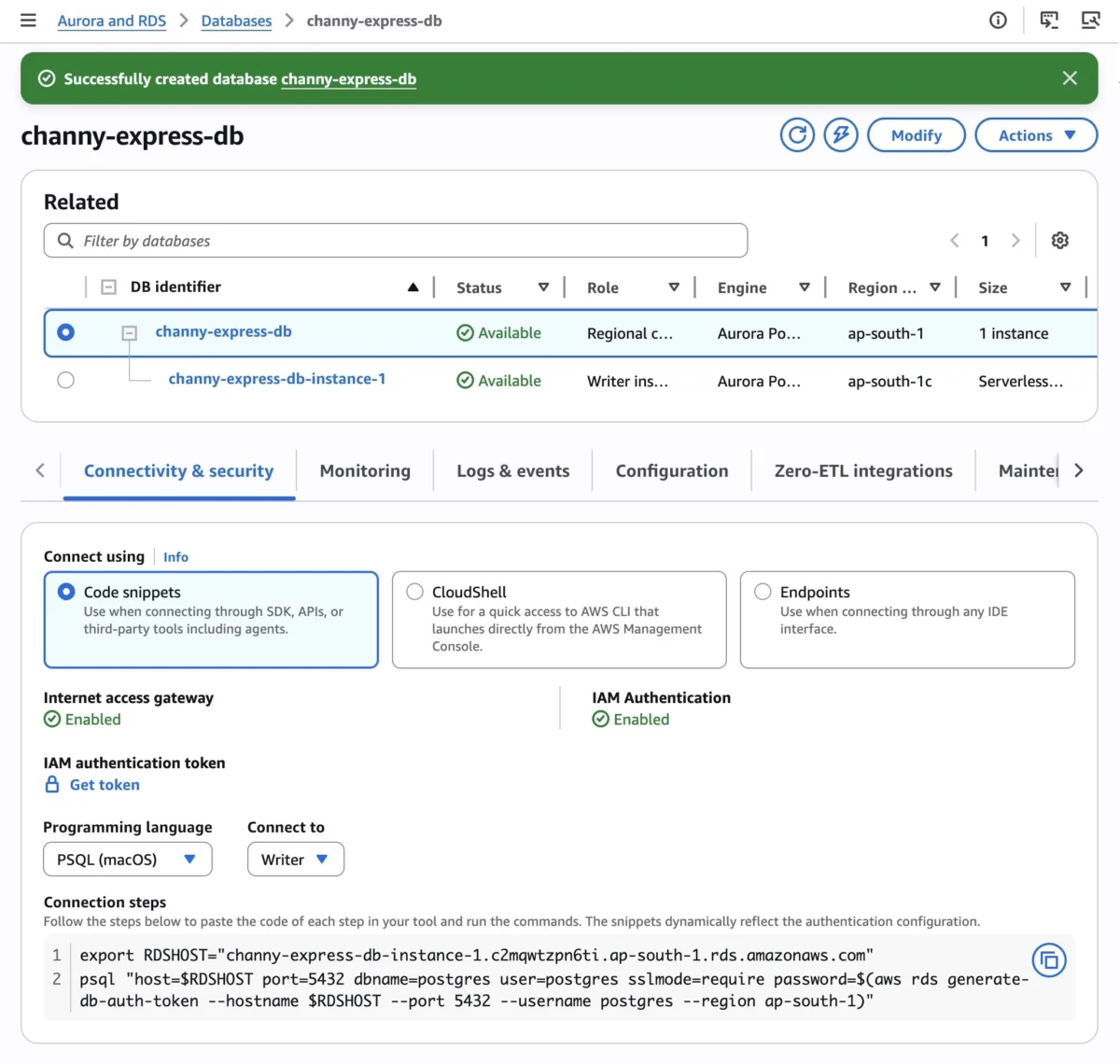
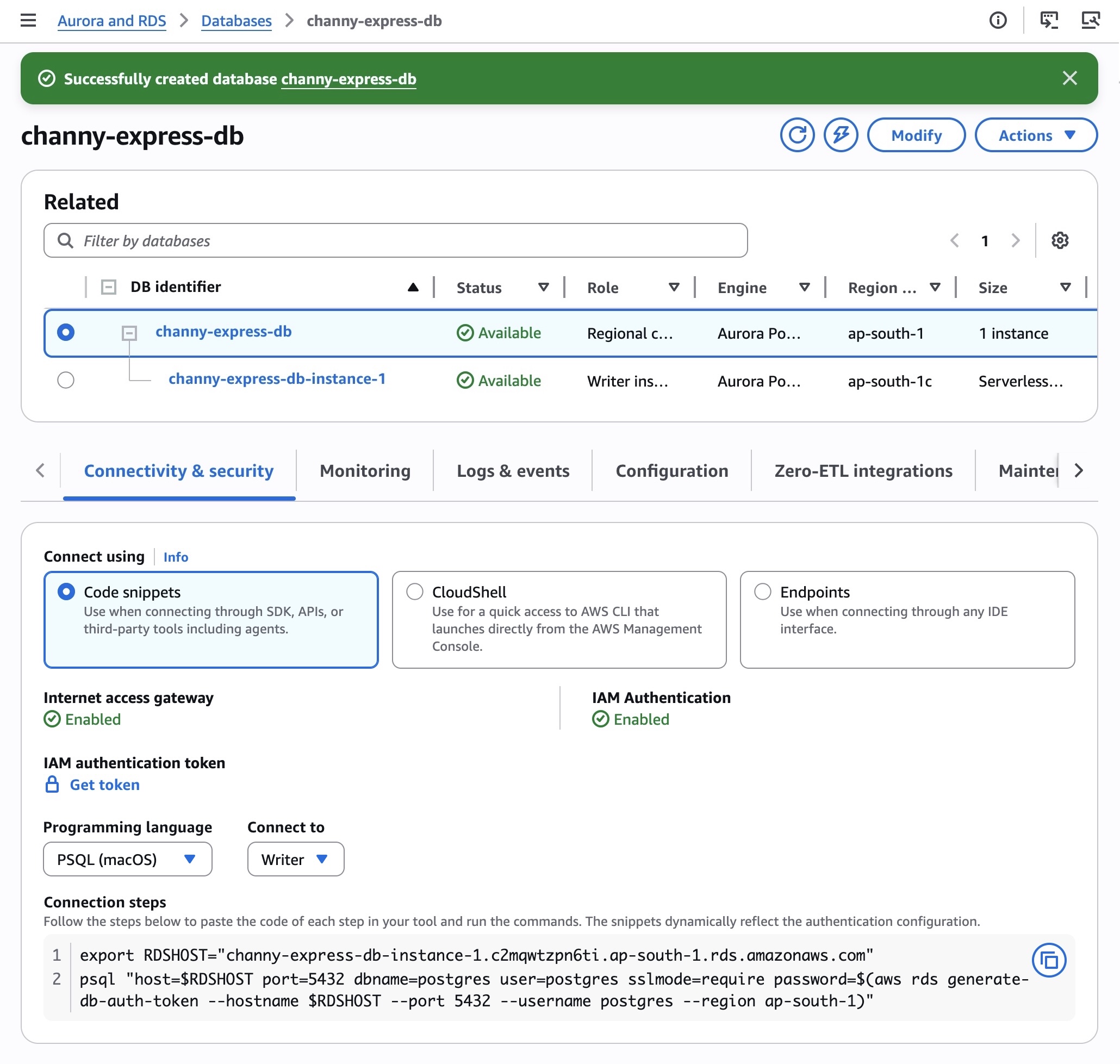
A notable feature of this express configuration is its simplified networking model. Unlike conventional Aurora cluster setups that typically require intricate Amazon Virtual Private Cloud (Amazon VPC) network configurations, express configuration clusters are created without an explicit VPC. Instead, they include an internet access gateway, facilitating secure connections from a wide array of development tools. This eliminates the need for complex VPN setups or AWS Direct Connect, significantly lowering the barrier to entry for developers who might be less familiar with advanced networking concepts or who require quick external access for development and testing.
Security is also a central tenet of the express configuration, with AWS Identity and Access Management (IAM) authentication enabled by default for the administrator user. This provides passwordless database authentication from the outset, enhancing security posture and simplifying credential management, as developers can leverage existing IAM roles and policies for granular access control. This default setting aligns with best practices for secure cloud deployments, minimizing the risk associated with static passwords.
Technical Deep Dive: Connectivity and Scalability
Once an Aurora PostgreSQL serverless database is created via the express configuration, it immediately gains access to the full suite of features available for Aurora PostgreSQL serverless. This includes crucial capabilities such as deploying additional read replicas for enhanced high availability and automated failover, ensuring business continuity and data resilience. Aurora’s serverless architecture inherently provides automatic scaling of compute and storage resources, allowing the database to dynamically adjust capacity based on application demand, and even scale down to zero when idle, optimizing cost efficiency.
A key technical innovation introduced with this launch is a new internet access gateway routing layer specifically designed for Aurora. This gateway, enabled by default for new serverless instances, empowers applications to establish secure connections from virtually anywhere in the world over the internet using the standard PostgreSQL wire protocol. Crucially, this gateway is distributed across multiple Availability Zones (AZs), offering the same level of high availability and fault tolerance as the underlying Aurora cluster itself. This multi-AZ deployment ensures that connectivity remains robust even in the event of an outage in a single Availability Zone, providing a highly resilient pathway for global access.
For developers, connecting to their newly provisioned Aurora database is made straightforward through various options available in the AWS console’s "Connectivity & security" tab. These options include:
- Code snippets: Dynamically generated code examples in multiple programming languages (e.g., Python, Node.js, Java, .NET, Go, PHP, TypeScript, PSQL) simplify integration with application code. These snippets often reflect the IAM authentication configuration, making secure, passwordless connections seamless.
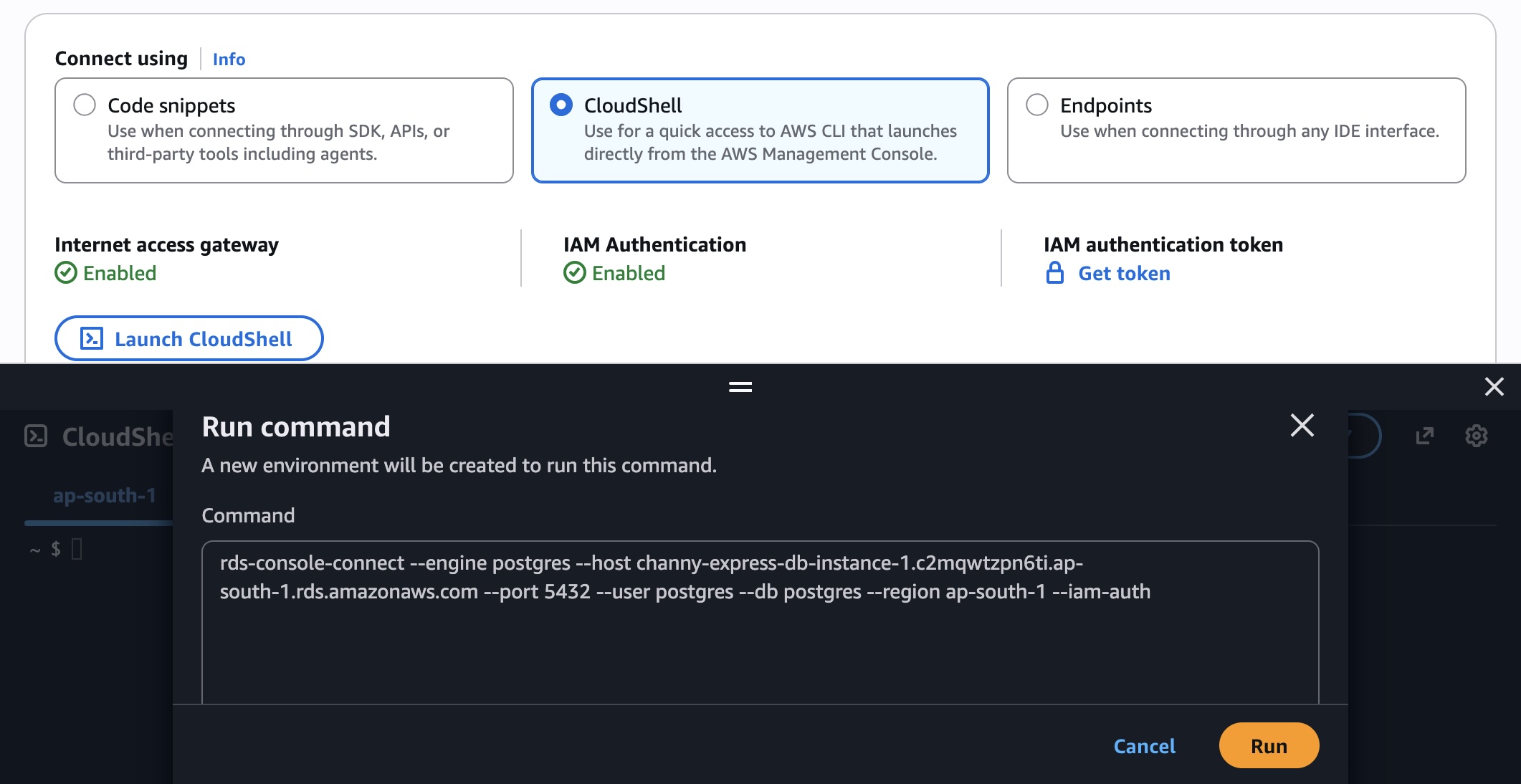
- AWS CloudShell: For immediate command-line interaction, users can launch AWS CloudShell directly from the console. The command line interface is pre-populated with the necessary connection information, allowing developers to quickly access the
psqlprompt and execute SQL commands. - Endpoints: For tools that traditionally rely on username and password credentials, such as pgAdmin, the console provides an option to generate an IAM authentication token. This token, valid for 15 minutes, can be used as a password, allowing secure connections without compromising master credentials.
Empowering the Developer Ecosystem
The express configuration is part of a broader AWS strategy to foster a more accessible and integrated development environment. AWS has simultaneously enhanced its developer programs and expanded partnerships to maximize the utility of services like Aurora PostgreSQL.
One significant update, announced at re:Invent 2025, was the enhancement of the AWS Free Tier program. New customers now receive up to $200 in AWS credits ($100 upon sign-up, and an additional $100 for using services like Amazon Relational Database Service (Amazon RDS), AWS Lambda, and Amazon Bedrock). Crucially, Amazon Aurora is now available across a broad set of eligible Free Tier database services, allowing developers to gain hands-on experience with Aurora at no upfront cost. This significantly lowers the financial barrier for experimentation and learning, aligning perfectly with the "speed of an idea" ethos by enabling developers to build and test without immediate budgetary concerns.
Beyond cost, AWS is deeply integrating its database services into popular developer platforms and AI-powered tools. A prime example is the collaboration with Vercel, a leading platform for front-end developers. AWS announced integrations with the Vercel Marketplace, allowing users to create and connect to AWS databases directly from the Vercel interface in seconds. Furthermore, the integration with v0 by Vercel, an AI-powered tool that transforms natural language ideas into production-ready, full-stack web applications, extends this capability. v0 now includes support for Aurora PostgreSQL, Aurora DSQL, and DynamoDB, empowering developers to leverage AI to scaffold applications with robust AWS database backends. Existing databases created via express configuration can also be seamlessly connected to Vercel projects, ensuring flexibility for various workflows. This partnership underscores AWS’s commitment to meeting developers where they are, embedding its powerful infrastructure within widely adopted development ecosystems.
Similarly, AWS has introduced an Aurora PostgreSQL integration with Kiro powers. Kiro is an AI agent-assisted development platform that helps developers build applications faster. By utilizing Kiro power for Aurora PostgreSQL within the Kiro IDE or through one-click installation from the Kiro powers webpage, developers can leverage AI to accelerate the creation of Aurora PostgreSQL-backed applications. This integration, along with others, reflects a strategic move by AWS to weave its database offerings into the fabric of modern development workflows, including those powered by artificial intelligence, thereby unlocking unprecedented levels of productivity and innovation.
Broader Implications for Innovation and Business
The general availability of Aurora PostgreSQL express configuration has far-reaching implications for both individual developers and enterprises.
- For Developers: The dramatically reduced setup time translates to faster prototyping, increased experimentation, and a lower cognitive load. Developers can focus more on writing application logic and less on infrastructure provisioning, fostering greater creativity and agility. The simplified networking and IAM authentication also make it easier for new developers to get started with cloud databases, expanding the talent pool capable of building cloud-native applications.
- For Startups and Small Businesses: The combination of rapid deployment, serverless cost efficiency (pay-per-second, scales to zero), and Free Tier availability makes Aurora PostgreSQL highly attractive. Startups can iterate quickly, launch products faster, and scale their database infrastructure seamlessly as their user base grows, all while managing costs effectively.
- For Enterprises: While enterprises often have more complex provisioning requirements, the express configuration can still serve as an invaluable tool for proof-of-concept development, internal hackathons, and non-production environments. It can also accelerate the onboarding of new teams or projects, providing a quick way to get started before migrating to more customized, enterprise-grade configurations if needed. The new internet access gateway also offers a simplified, secure pathway for connecting developer tools, potentially streamlining development pipelines.
- For the Cloud Database Market: This move intensifies competition in the cloud database space, pushing other providers to enhance their ease-of-use and rapid deployment capabilities. AWS continues to solidify its position as a leader by addressing one of the persistent pain points in cloud development: the initial setup time.
Availability and Pricing
The express configuration for Amazon Aurora PostgreSQL is now generally available across all AWS commercial Regions, ensuring broad accessibility for developers and organizations worldwide.
Regarding pricing, Amazon Aurora PostgreSQL serverless operates on a pay-per-capacity model. Users are billed for Aurora Capacity Units (ACUs) consumed, with billing occurring per second from zero capacity. This elastic pricing model automatically starts up, shuts down, and scales capacity up or down based on the application’s real-time needs, ensuring cost optimization by only paying for the resources actively utilized. Further details on pricing can be found on the Amazon Aurora Pricing page, while information on regional availability and future roadmap can be accessed via the AWS Capabilities by Region portal.
AWS encourages users to try out the new express configuration via the Aurora and RDS console and provide feedback through AWS re:Post for Aurora PostgreSQL or their standard AWS Support channels. This iterative approach, driven by customer input, remains a cornerstone of AWS’s product development philosophy, promising continued enhancements to the developer experience and further innovations in cloud database technology.