
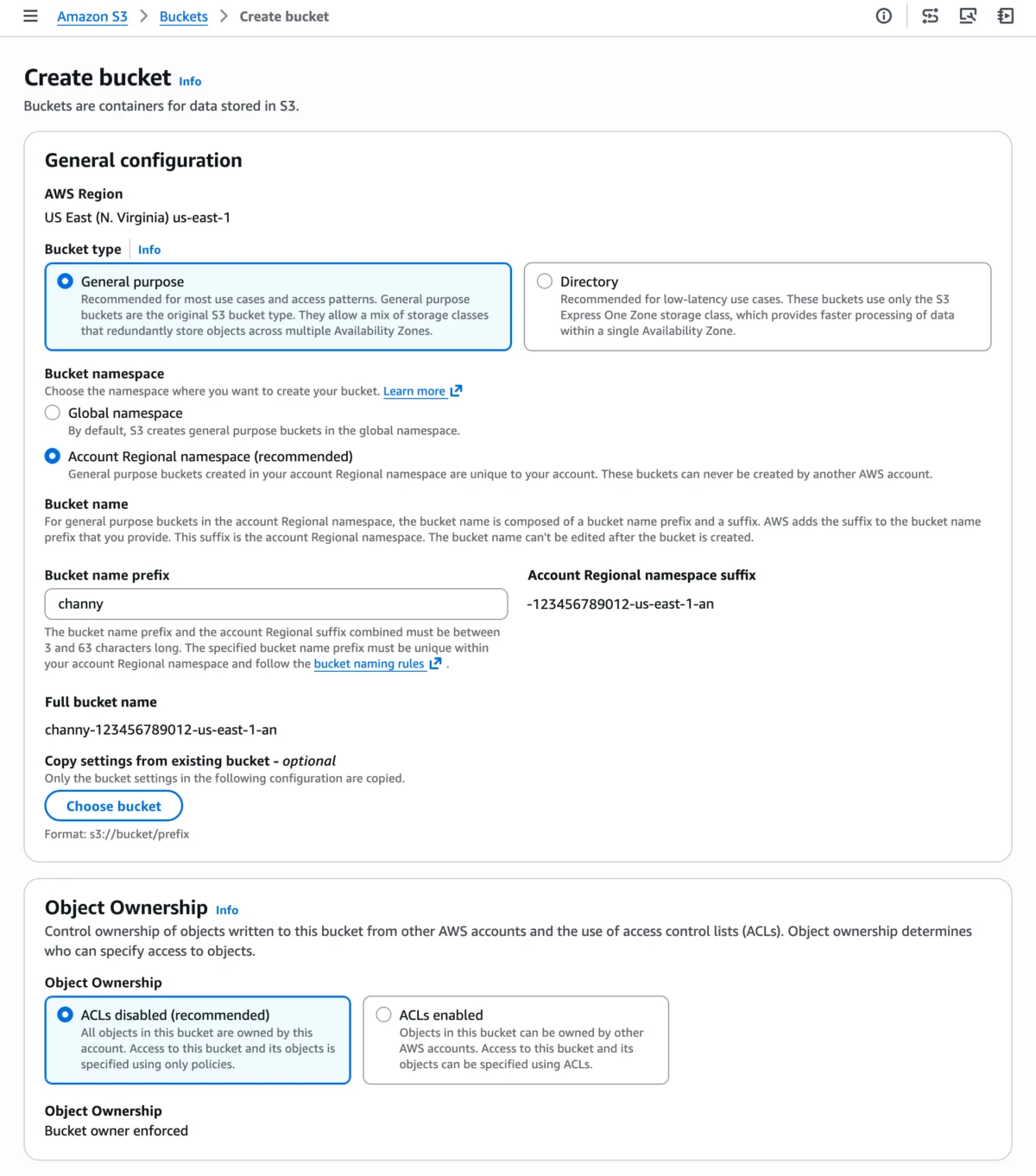

Amazon Web Services (AWS) today announced a significant new feature for its foundational object storage service, Amazon Simple Storage Service (Amazon S3), enabling customers to create general purpose buckets within their own account regional namespace. This enhancement is designed to simplify bucket creation and management, ensuring that desired bucket names remain consistently available for individual AWS accounts as data storage needs escalate in size and complexity across various AWS Regions. The introduction of this feature marks a pivotal evolution in S3’s naming convention, directly addressing a long-standing operational challenge for developers and large enterprises alike.
A New Era for S3 Naming: Enhancing Predictability and Management
The core of this innovation lies in its ability to provide a predictable naming scheme for S3 general purpose buckets. Previously, all S3 general purpose bucket names had to be globally unique across every AWS account worldwide, a design choice that, while foundational to S3’s initial architecture, presented growing challenges as AWS adoption surged. With the new account regional namespace, users can now reliably name and create buckets by appending their account’s unique suffix to their chosen bucket name prefix. For instance, a bucket might be named mybucket-123456789012-us-east-1-an, where mybucket is the user-defined prefix, and -123456789012-us-east-1-an is the system-generated account regional suffix. This suffix uniquely identifies the AWS account (via its ID), the AWS Region, and the "account-regional" namespace designation. A critical security measure embedded in this design ensures that if another AWS account attempts to create a bucket using a suffix belonging to a different account, the request will be automatically rejected, preserving the integrity and uniqueness of each account’s namespace.
This architectural shift is more than a convenience; it represents a strategic response to the increasing demand for streamlined cloud resource management. For organizations operating at scale, often with hundreds or thousands of AWS accounts and a global footprint, managing a multitude of S3 buckets under a globally unique naming constraint became an increasingly complex and time-consuming task. The new feature alleviates the need for elaborate internal naming conventions or the frustration of encountering "BucketAlreadyExists" errors, thereby fostering greater agility and operational efficiency.
The Evolution of S3: Addressing a Long-Standing Challenge
When Amazon S3 first launched in 2006, it revolutionized cloud storage, offering seemingly infinite scalability and durability. Its initial design mandated that all S3 bucket names be globally unique across the entire AWS platform. At the time, with a nascent cloud ecosystem, this approach was manageable. However, as AWS grew exponentially, attracting millions of customers and hosting trillions of objects, the global namespace became a bottleneck. Developers frequently found themselves in a race to claim desirable, short, or mnemonic bucket names, often resorting to appending random strings, project IDs, or complex hashes to achieve uniqueness. This led to:
- Naming Collisions: Frequent errors during automated deployments or manual bucket creation due to a desired name already being taken by another AWS customer, anywhere in the world.
- Cognitive Load: Developers and architects had to spend considerable effort devising and managing complex naming strategies to ensure uniqueness, detracting from core development tasks.
- Operational Friction: Large enterprises with numerous development teams and accounts struggled to enforce consistent naming conventions across their diverse environments without running into conflicts.
- "Name Squatting": While not a widespread security threat, the global nature of S3 bucket names sometimes led to situations where a preferred name was taken, potentially by an inactive account, making it unavailable indefinitely.
For years, the global namespace constraint was a frequently discussed topic within the AWS developer community. While AWS introduced features like S3 Object Lambda and S3 Storage Lens to enhance data processing and observability, the fundamental naming challenge persisted for general purpose buckets. The introduction of account regional namespaces for S3 general purpose buckets signifies a direct and robust answer to this enduring feedback, aligning S3’s naming strategy more closely with the account-scoped uniqueness commonly found in other AWS services and cloud platforms. This move is a testament to AWS’s commitment to continuous innovation, even for its most mature and widely adopted services, by adapting them to the evolving needs of its global customer base.
Deeper Dive into the Account Regional Namespace Mechanism
The technical implementation of the account regional namespace feature is designed for seamless integration and enhanced security. When a user opts for this new naming convention, the system automatically constructs the full bucket name using a defined structure: [user-defined-prefix]-[AWS-Account-ID]-[AWS-Region]-an. The "-an" suffix explicitly denotes the "account-regional" namespace. This design ensures that:
- Guaranteed Uniqueness: Within a given AWS account and AWS Region, any chosen prefix will result in a unique bucket name, as the account ID and region are integral to the suffix. This eliminates the uncertainty associated with global uniqueness checks.
- Simplified Automation: Infrastructure as Code (IaC) tools and automated deployment pipelines can now create buckets with predictable names, greatly reducing the complexity of scripts that previously had to handle potential naming conflicts.
- Enhanced Governance and Security: AWS Identity and Access Management (IAM) policies and AWS Organizations Service Control Policies (SCPs) can leverage a new condition key,
s3:x-amz-bucket-namespace, to enforce the adoption of this naming convention across an entire organization. This allows security teams to mandate that all new general purpose buckets adhere to the account regional namespace model, improving compliance, reducing misconfigurations, and standardizing resource provisioning. For instance, an SCP could be configured to reject any S3 bucket creation request that does not specifyaccount-regionalfor thes3:x-amz-bucket-namespacecondition key, thereby institutionalizing the new naming paradigm.
It is important to note that the combined length of the bucket name prefix and the account regional suffix must adhere to S3’s existing length constraints, falling between 3 and 63 characters. This ensures compatibility with existing S3 APIs and tools while providing ample flexibility for meaningful prefixes. Furthermore, this feature maintains full parity with all existing capabilities of general purpose buckets in the global namespace, meaning all S3 features such as versioning, replication, lifecycle policies, and access control mechanisms continue to function identically. The only architectural difference lies in the scope of the bucket name’s uniqueness.
Seamless Integration Across AWS Tooling
AWS has ensured that the new account regional namespace feature is readily accessible and manageable through all standard AWS interfaces, making adoption straightforward for various user preferences and automation needs.
- AWS Management Console: Users can easily create a new bucket by navigating to the Amazon S3 console, selecting "Create bucket," and then choosing the "Account regional namespace" option. This intuitive graphical interface simplifies the process for manual operations, allowing users to define their desired prefix with confidence.
- AWS Command Line Interface (AWS CLI): For those who prefer command-line interaction or scripting, the AWS CLI supports the new feature. A simple command using the
s3api create-bucketoperation now includes the--bucket-namespace account-regionalparameter, alongside the compatible bucket name (which would include the full account-regional suffix). This integration facilitates quick programmatic creation and management. - AWS SDKs: Developers utilizing AWS SDKs, such as the AWS SDK for Python (Boto3), can integrate account regional bucket creation directly into their applications. The
CreateBucketAPI request can now accept aBucketNamespaceparameter set to "account-regional." The provided Boto3 example demonstrates how anAccountRegionalBucketCreatorclass can dynamically resolve the caller’s AWS account ID and region using the AWS Security Token Service (STS)GetCallerIdentityAPI, then construct the appropriate bucket name before making thecreate_bucketcall. This allows for robust and dynamic bucket provisioning within custom applications. - AWS CloudFormation: Infrastructure as Code (IaC) is central to modern cloud operations, and AWS CloudFormation templates have been updated to support the account regional namespace. Users can leverage CloudFormation’s pseudo parameters,
AWS::AccountIdandAWS::Region, to construct the full bucket name dynamically within their templates. For even greater simplicity, CloudFormation introduces aBucketNamePrefixproperty. WhenBucketNamespaceis set to "account-regional" andBucketNamePrefixis used, CloudFormation automatically appends the correct account regional suffix based on the deploying AWS account and Region. This significantly reduces template verbosity and potential for configuration errors, promoting cleaner and more reusable IaC.
These diverse integration options underscore AWS’s commitment to making the new feature accessible to all users, from individual developers to large enterprises managing complex cloud environments through highly automated pipelines.

Strategic Implications and Future Outlook
The introduction of account regional namespaces for S3 general purpose buckets carries significant strategic implications across the AWS ecosystem.
- For Developers: This change will profoundly improve the developer experience by eliminating a frequent source of frustration. No longer will developers need to spend precious time troubleshooting naming conflicts or devising convoluted naming schemes. This frees them to focus on application logic and innovation, accelerating development cycles.
- For Enterprises: Large organizations, which often manage vast numbers of S3 buckets across multiple AWS accounts and regions, stand to gain immense operational benefits. The ability to enforce consistent, predictable naming conventions through IAM and AWS Organizations will bolster governance, simplify auditing, and streamline resource provisioning. This translates into reduced operational overhead, fewer deployment failures related to naming, and better adherence to internal compliance standards. It also facilitates easier migration and replication strategies where consistent naming across environments is crucial.
- For the AWS S3 Ecosystem: This update represents a sophisticated evolution of one of AWS’s most venerable services. It demonstrates AWS’s responsiveness to customer feedback and its willingness to re-architect core components to meet the demands of an ever-expanding cloud landscape. By providing an account-level namespace option, S3 becomes even more flexible and developer-friendly, reinforcing its position as the industry-leading object storage solution. While S3 directory buckets and S3 table/vector buckets already operate within account-level or zonal namespaces, extending this concept to general purpose buckets addresses the most common and widespread naming challenge.
- Competitive Landscape: In the broader cloud storage market, other providers like Google Cloud Storage also operate with a global namespace but often offer project-level uniqueness for certain resource types. Azure Blob Storage utilizes storage account-level uniqueness. This move by AWS brings S3’s general purpose bucket naming more in line with account-level scoping, a common and often preferred model for cloud resources, providing a competitive edge in ease of use and manageability.
Looking ahead, this strategic update could potentially pave the way for similar namespace enhancements in other AWS services where global naming constraints might still present challenges. It signifies a continued maturation of cloud architecture, prioritizing developer experience and enterprise-scale management alongside foundational scalability and reliability.
Availability and Next Steps
The ability to create general purpose buckets in your account regional namespace is now broadly available across 37 AWS Regions globally. This extensive rollout includes key geographical areas such as the AWS China Regions and AWS GovCloud (US) Regions, ensuring that a wide array of customers, including those with stringent compliance and data residency requirements, can immediately benefit from this feature. Crucially, AWS has confirmed that there is no additional cost associated with creating general purpose buckets in your account regional namespace, making it an accessible enhancement for all S3 users.
It is important for users to understand a few key considerations:
- New Buckets Only: This feature applies only to the creation of new general purpose buckets. Existing S3 buckets operating under the global namespace cannot be renamed to adopt the account regional namespace suffix. Customers wishing to migrate existing data to buckets with this new naming convention would need to create new account regional namespace buckets and transfer their data.
- Specific Bucket Types: The account regional namespace is specifically for general purpose buckets. Other specialized S3 bucket types, such as S3 table buckets and vector buckets, already operate within an account-level namespace, and S3 directory buckets exist in a zonal namespace, so this new feature does not apply to them.
AWS encourages users to explore this new capability today via the Amazon S3 console. Feedback on the feature can be submitted through AWS re:Post for Amazon S3 or via established AWS Support channels. This proactive approach to customer feedback and continuous service improvement solidifies S3’s standing as a dynamic and evolving cloud storage solution. The introduction of account regional namespaces for general purpose buckets represents a substantial leap forward in simplifying cloud operations and enhancing the developer experience for millions of AWS users worldwide.