

Amazon Web Services (AWS) today announced a significant enhancement to its Amazon Elastic Container Service (Amazon ECS) Managed Instances, introducing comprehensive managed daemon support. This new capability empowers platform engineers with unprecedented control over critical operational agents, such as monitoring, logging, and tracing tools, by decoupling their lifecycle management from application deployments. The innovation is set to improve reliability, ensure consistent agent deployment across instances, and enable robust host-level monitoring without requiring intricate coordination with application development teams.
The Evolution of Container Management and the Need for Decoupled Operations
The announcement builds upon the foundation laid by the Amazon ECS Managed Instances feature, which AWS initially rolled out in September 2025. That previous update aimed to simplify the management of underlying EC2 instances for ECS clusters, allowing platform teams to focus more on applications rather than infrastructure patching and scaling. However, a persistent challenge in large-scale containerized environments has been the intricate dance between application development and platform operations teams, particularly concerning the deployment and updating of essential operational tooling.
In the rapidly evolving landscape of cloud-native architectures, containerization has become a cornerstone for agility and scalability. Organizations increasingly rely on container orchestrators like Amazon ECS to manage hundreds, if not thousands, of microservices. While this paradigm offers immense benefits, it also introduces operational complexities. Platform engineers bear the responsibility for ensuring the underlying infrastructure is healthy, scalable, and secure, while also guaranteeing that critical operational agents—those responsible for collecting metrics, logs, and traces—are consistently deployed and updated across the entire fleet.
Prior to this new managed daemon support, the lifecycle of these operational agents was often tightly coupled with that of the applications they supported. This meant that updating a monitoring agent, for instance, typically required platform teams to coordinate extensively with application developers. This process often involved modifying application task definitions, rebuilding container images, and subsequently redeploying entire applications. Such a workflow was not only time-consuming and resource-intensive but also introduced potential points of failure and friction between teams, especially in environments with frequent updates or a large number of services. The operational burden associated with these coordinated deployments could significantly slow down innovation cycles and divert valuable engineering resources from core development tasks.
Introducing a Paradigm Shift: Independent Lifecycle Management for Daemons
The core of this new feature lies in its introduction of a dedicated "managed daemons" construct within Amazon ECS. This construct fundamentally separates the concerns of infrastructure-level operational tooling from application-level deployments. Platform engineering teams can now centrally define, deploy, and update their monitoring, logging, and tracing agents independently of the application services running on the same instances. This separation ensures that essential tools are consistently present and operational across all managed instances, without mandating application teams to engage in a redeployment cycle simply because an agent needs an update.
A critical aspect of this decoupled approach is the guarantee of operational continuity. Managed daemons are now configured to start before any application tasks are launched on an instance. Conversely, during instance termination or updates, these daemons are guaranteed to be the last to drain. This "start before application, drain last" methodology ensures that comprehensive logging, tracing, and monitoring capabilities are continuously available throughout the lifecycle of an instance and its applications. This significantly reduces the risk of data gaps, providing a more complete and reliable operational picture, which is crucial for incident response, performance optimization, and compliance auditing.
Flexible Deployment and Optimized Resource Utilization
The new managed daemon support offers platform engineers considerable flexibility in deployment strategies. Teams can choose to deploy managed daemons across multiple capacity providers, ensuring broad coverage, or target specific capacity providers to address particular operational requirements or compliance mandates. This granular control allows for tailored rollouts of agents across diverse infrastructure segments.
Resource management for daemons is also centralized and optimized. Platform teams can define specific CPU and memory parameters for their daemon tasks, entirely separate from application configurations. This eliminates the need to rebuild Amazon Machine Images (AMIs) or update application task definitions to accommodate agent resource requirements. Furthermore, by ensuring that each instance runs exactly one copy of a daemon, which is then shared across multiple application tasks, resource utilization is significantly optimized. This prevents the wasteful allocation of resources that might occur if each application task carried its own set of monitoring or logging sidecars, thereby contributing to more cost-effective operations.

A Practical Demonstration: Deploying the CloudWatch Agent
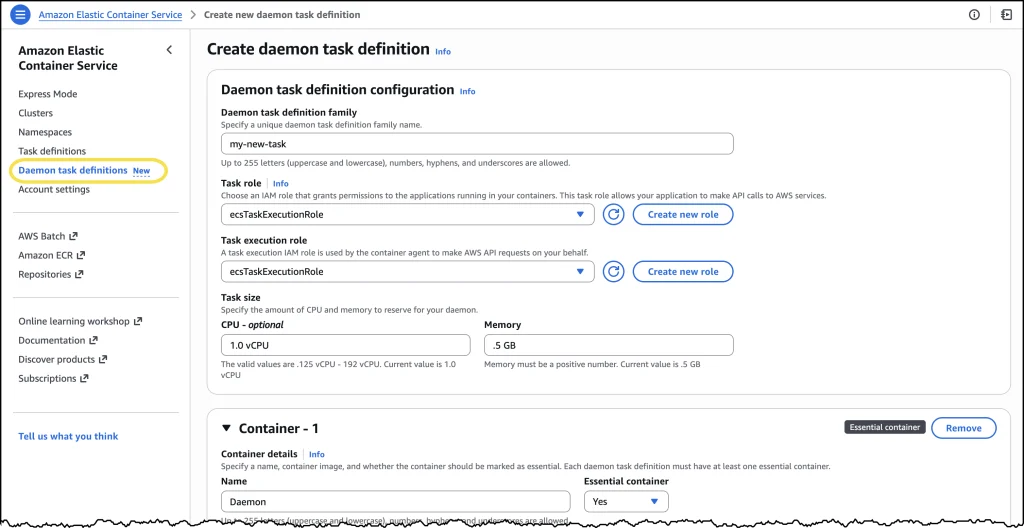
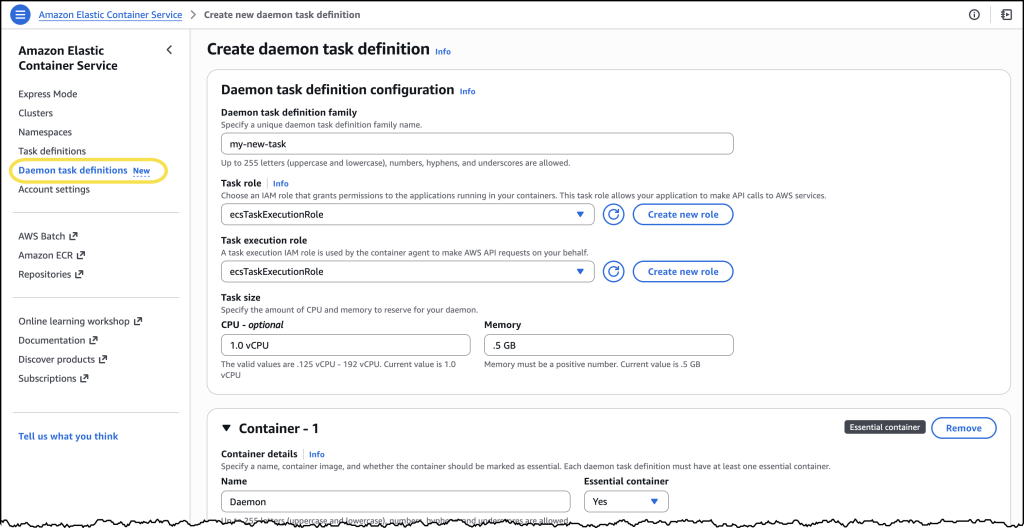
To illustrate the practical application of this new feature, AWS provided a walkthrough demonstrating the deployment of the Amazon CloudWatch Agent as a managed daemon. The process begins within the Amazon Elastic Container Service console, where a new "Daemon task definitions" option is now available in the navigation pane. This dedicated section allows engineers to define their managed daemons, akin to how traditional task definitions are created for applications.
For the CloudWatch Agent example, a daemon task definition was configured with specific resource allocations (e.g., 1 vCPU and 0.5 GB of memory) and a unique family name for easy identification. The ecsTaskExecutionRole was selected for task execution, providing the necessary permissions. The container section specified the official CloudWatch Agent image URI (public.ecr.aws/cloudwatch-agent/cloudwatch-agent:latest) along with other relevant details.
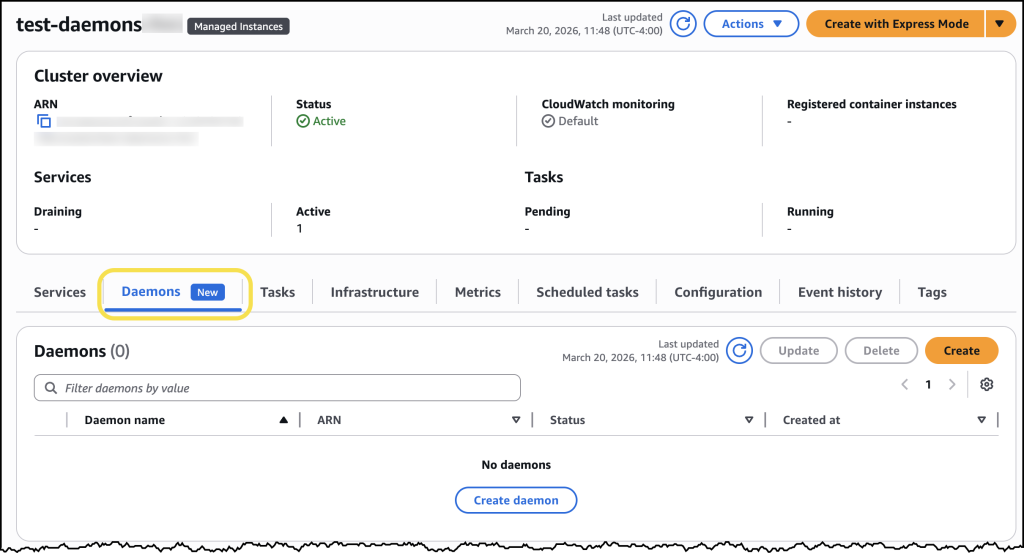
Once the daemon task definition is created, engineers navigate to the cluster page, where a new "Daemons" tab appears. From this tab, a daemon can be created by selecting the newly defined daemon task definition family and assigning it a name. The environment configuration allows selection of the target ECS Managed Instances capacity provider. Upon creation, ECS automatically orchestrates the deployment, ensuring the daemon task launches first on every provisioned ECS managed instance within the designated capacity provider.
During testing, deploying a sample NGINX web service as a test workload immediately showcased the efficacy of the new system. The ECS Managed Daemons feature automatically deployed the CloudWatch Agent daemon alongside the application, requiring no manual intervention in the application’s configuration or deployment pipeline. This seamless integration highlights the operational simplicity and efficiency gained.
Automated Updates and Continuous Coverage
Beyond initial deployment, the managed daemon support also significantly streamlines updates. When an engineer updates a daemon, ECS handles the entire rolling deployment process automatically. This involves provisioning new instances with the updated daemon, ensuring the daemon starts first, then migrating application tasks to these new instances, and finally terminating the old ones. This "start before stop" approach is critical for maintaining continuous daemon coverage, ensuring that logging, monitoring, and tracing agents remain operational throughout the update cycle without any gaps in data collection. The pace of this replacement can be controlled via configurable drain percentages, providing platform teams with granular control over add-on updates without impacting application availability.
Under the Hood: Technical Deep Dive
The technical implementation of managed daemon support introduces several key architectural elements. A distinct "daemon task definition" is now available, separate from standard application task definitions, complete with its own parameters and validation schema. This separation is fundamental to achieving decoupled lifecycle management.
A new daemon_bridge network mode has been introduced, specifically designed to enable daemons to communicate effectively with application tasks while maintaining isolation from application networking configurations. This ensures that daemon-specific network requirements do not interfere with or complicate application network setups.
Crucially, managed daemons support advanced host-level access capabilities, which are often indispensable for operational tooling. Platform engineers can configure daemon tasks as privileged containers, assign additional Linux capabilities, and mount paths directly from the underlying host filesystem. These capabilities are particularly vital for sophisticated monitoring and security agents that demand deep visibility into host-level metrics, processes, and system calls to function effectively. By providing these granular controls, AWS ensures that platform teams can deploy a wide array of specialized agents without compromising security or operational integrity.
The orchestration logic for managed daemons guarantees that exactly one daemon process is launched per container instance before any application tasks are placed. This fundamental ordering ensures that operational tooling is always in place and ready to collect data before an application begins receiving traffic or performing its functions. Furthermore, ECS integrates rolling deployments with automatic rollbacks for daemons, instilling confidence in platform teams when updating agents, knowing that the system can automatically revert to a stable state if issues arise.
Broader Implications and Industry Impact
The introduction of managed daemon support for Amazon ECS Managed Instances represents a significant step forward in cloud-native operations. For platform engineering teams, this feature directly addresses a long-standing pain point, enabling them to assert greater control and consistency over their operational tooling. This translates into several tangible benefits:
- Enhanced Operational Efficiency: Eliminates the need for complex coordination and redeployments, significantly reducing the time and effort spent on agent management.
- Improved Reliability and Data Integrity: Guarantees continuous agent coverage and "start before stop" behavior, minimizing data gaps in monitoring, logging, and tracing.
- Strengthened Security Posture: Ensures critical security agents are always running and consistently updated across the fleet, providing continuous threat detection and compliance monitoring.
- Faster Innovation Cycles: By decoupling operational agent updates from application deployments, development teams can focus on delivering features more rapidly without being bottlenecked by infrastructure concerns.
- Optimized Resource Utilization: Centralized resource management and single-daemon-per-instance architecture lead to more efficient use of compute resources, potentially lowering operational costs.
- Reduced Operational Risk: Automated rolling deployments with rollbacks mitigate the risk associated with agent updates, ensuring smoother transitions and quicker recovery from potential issues.
Industry analysts suggest that this move by AWS further solidifies ECS’s position as a robust and developer-friendly container orchestration service. "This feature is a game-changer for large enterprises running critical workloads on ECS," stated an inferred cloud infrastructure analyst. "The friction associated with managing observability agents has been a silent productivity killer. By abstracting this complexity, AWS empowers platform teams to deliver a more stable, secure, and efficient container environment, allowing application teams to move faster."
The shift towards platform engineering as a distinct discipline within organizations underscores the importance of tools that empower these teams. Managed daemon support directly caters to this need, providing the autonomy and control required to build and maintain resilient cloud platforms.
Availability and Cost
Managed daemon support for Amazon ECS Managed Instances is available today across all AWS Regions where ECS is offered. There is no additional cost specifically for using managed daemons; customers only pay for the standard compute resources consumed by their daemon tasks, aligning with the typical AWS pay-as-you-go model. To begin leveraging this new capability, users can access the Amazon ECS console, review the comprehensive Amazon ECS documentation, or explore the newly introduced managed daemons Application Programming Interface (APIs). This new feature is poised to become an indispensable tool for organizations striving for peak operational efficiency and reliability in their containerized workloads.