
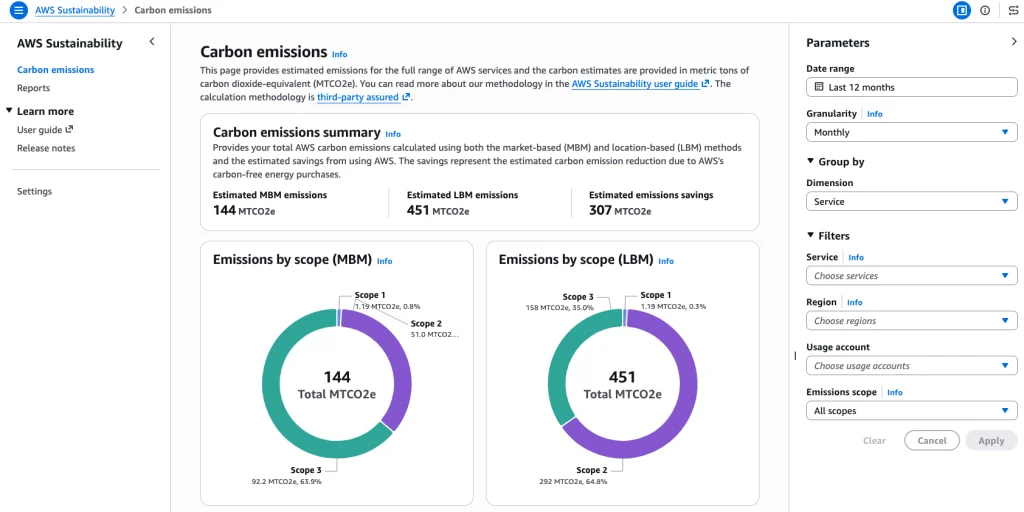

Amazon Web Services (AWS) has announced the launch of its dedicated Sustainability Console, a new standalone service designed to consolidate all AWS sustainability reporting and resources into a single, easily accessible platform. This development marks a significant step in AWS’s ongoing commitment to helping its customers measure and reduce the environmental footprint of their cloud workloads, providing critical data for increasingly stringent corporate sustainability reporting. The console builds upon the existing Customer Carbon Footprint Tool (CCFT) but introduces enhanced accessibility, granular reporting, and integration capabilities, addressing a long-standing need for sustainability professionals.
The Growing Imperative for Corporate Sustainability and Cloud Transparency
In an era defined by climate change concerns and increasing stakeholder demands, corporate sustainability has moved from a niche concern to a central pillar of business strategy. Companies worldwide face escalating pressure from investors, regulators, customers, and employees to demonstrate tangible progress on environmental, social, and governance (ESG) metrics. This global shift is underscored by a proliferation of new regulations, such as the European Union’s Corporate Sustainability Reporting Directive (CSRD) and proposed rules from the U.S. Securities and Exchange Commission (SEC), which mandate comprehensive and auditable disclosures of environmental impacts, including greenhouse gas emissions.
For businesses leveraging cloud computing, accurately measuring their environmental footprint has presented a unique challenge. While cloud providers like AWS offer inherent efficiency advantages over on-premises data centers due to economies of scale, optimized hardware, and higher utilization rates, understanding the specific carbon impact of individual cloud workloads can be complex. This complexity stems from shared infrastructure, dynamic resource allocation, and the varying energy mixes of global data center regions. Until now, gaining access to this critical data often required navigating financial reporting systems, creating an unnecessary barrier for sustainability teams whose primary focus is environmental performance rather than billing.
Amazon’s Climate Pledge and AWS’s Foundational Role

The launch of the AWS Sustainability Console is inextricably linked to Amazon’s ambitious "The Climate Pledge," a commitment made in 2019 to achieve net-zero carbon across its operations by 2040 – a decade ahead of the Paris Agreement’s target. A core component of this pledge involves powering Amazon’s operations with 100% renewable energy, a goal AWS has been instrumental in pursuing. AWS has already reached 90% renewable energy across its global operations in 2023, well on its way to achieving 100% by 2025, five years earlier than initially projected. This commitment shapes every aspect of how AWS designs, builds, and operates its global data center infrastructure, ensuring that the foundational layers of its cloud services are as sustainable as possible.
However, Amazon recognizes that its responsibility extends beyond its own operations. As a leading cloud provider, AWS plays a crucial role in enabling its customers to reduce their own environmental impact. The shared responsibility model in the cloud extends to sustainability; while AWS optimizes the underlying infrastructure, customers are responsible for optimizing their applications and resource usage on top of that infrastructure. Providing transparent and actionable data on carbon emissions is therefore a vital service, allowing customers to make informed decisions that align with their own sustainability objectives and regulatory obligations.
Evolution of Carbon Footprint Measurement: From CCFT to a Dedicated Platform
Prior to the new console, AWS offered the Customer Carbon Footprint Tool (CCFT) within the AWS Billing Console. While revolutionary at its inception, providing initial insights into the carbon emissions attributed to AWS usage, the CCFT had practical limitations. A primary challenge was its integration within the billing system, which meant that accessing carbon footprint data required billing-level permissions. This created an operational bottleneck: sustainability professionals, reporting teams, and environmental managers typically do not, and often should not, possess access to sensitive cost and billing information. Consequently, organizations often had to devise convoluted internal processes or rely on intermediaries to extract the necessary sustainability data, hindering efficiency and real-time analysis.
The AWS Sustainability Console directly addresses this pain point by introducing its own independent permissions model. This separation ensures that sustainability professionals can gain direct, secure access to emissions data without needing extraneous billing permissions. This streamlined access is expected to significantly improve workflow efficiency for teams tasked with environmental reporting and compliance, fostering greater collaboration between sustainability, finance, and IT departments. The underlying data and methodology for calculating emissions, which cover Scope 1, 2, and 3 emissions attributed to AWS usage, remain consistent with the CCFT, ensuring continuity and reliability. This methodology has also been independently verified by Apex, a third-party consultant, underscoring AWS’s commitment to accuracy and transparency.
Key Features and Capabilities of the AWS Sustainability Console

The new console is designed to be a comprehensive hub for all things related to AWS sustainability reporting, offering a suite of capabilities that enhance data accessibility, granularity, and reporting flexibility:
-
Granular Emissions Data: The console provides a detailed breakdown of carbon emissions (expressed in metric tons of carbon dioxide equivalent – MTCO2e) by AWS Region and by specific AWS service. This includes prominent services such as Amazon CloudFront, Amazon Elastic Compute Cloud (Amazon EC2), and Amazon Simple Storage Service (Amazon S3). This level of granularity is crucial for identifying "hotspots" within an organization’s cloud architecture, allowing businesses to pinpoint which services or regions contribute most to their carbon footprint and strategize optimization efforts accordingly. The console visually presents emissions by scope:
- Scope 1: Direct emissions from owned or controlled sources (e.g., fuel combustion in AWS-owned vehicles or on-site backup generators, though AWS primarily focuses on indirect emissions for customers).
- Scope 2: Indirect emissions from the generation of purchased energy. The console offers both Market-Based Method (MBM) data, which accounts for energy attribute certificates like Renewable Energy Certificates (RECs), and Location-Based Method (LBM) data, which uses average local grid emissions.
- **Scope 3: Other indirect emissions that occur in the value chain of the reporting company, including manufacturing of servers, data center construction, and business travel. For cloud users, this primarily covers the embodied emissions of hardware used in AWS data centers.
-
Flexible Reporting Options: Recognizing the diverse reporting needs of organizations, the console offers robust reporting functionalities:
- Preset Reports: Users can download standardized monthly and annual carbon emissions reports covering both MBM and LBM data, simplifying routine reporting tasks.
- Custom CSV Reports: For organizations with unique reporting requirements, the console allows users to build custom comma-separated values (CSV) reports. Users can select specific fields to include, define time granularity (e.g., daily, monthly, quarterly), and apply various filters, providing unparalleled flexibility in data extraction.
- Fiscal Year Alignment: A critical enhancement for finance and sustainability teams, the console can now be configured to match an organization’s specific fiscal year. This ensures that all data views and exports reflect the company’s established reporting periods, eliminating a common friction point in financial and sustainability reporting alignment.
-
Programmatic Access through API and SDKs: Beyond the visual console, AWS has introduced a new API and made the functionality available through AWS SDKs (Software Development Kits) and the AWS Command Line Interface (CLI). This programmatic access is a game-changer for large enterprises and those with sophisticated data integration needs. It enables teams to:
- Integrate Emissions Data: Seamlessly pull emissions data into existing internal reporting pipelines, business intelligence dashboards, or compliance management systems.
- Automate Workflows: Automate the collection of data for specific months across numerous AWS accounts without manual data exports.
- Custom Account Groupings: Establish custom account groupings for emissions reporting that may not align with existing AWS Organizations structures, providing greater flexibility for complex corporate hierarchies.
Strategic Implications for Businesses and the Cloud Industry
The launch of the AWS Sustainability Console carries significant implications for businesses leveraging AWS and for the broader cloud computing industry:
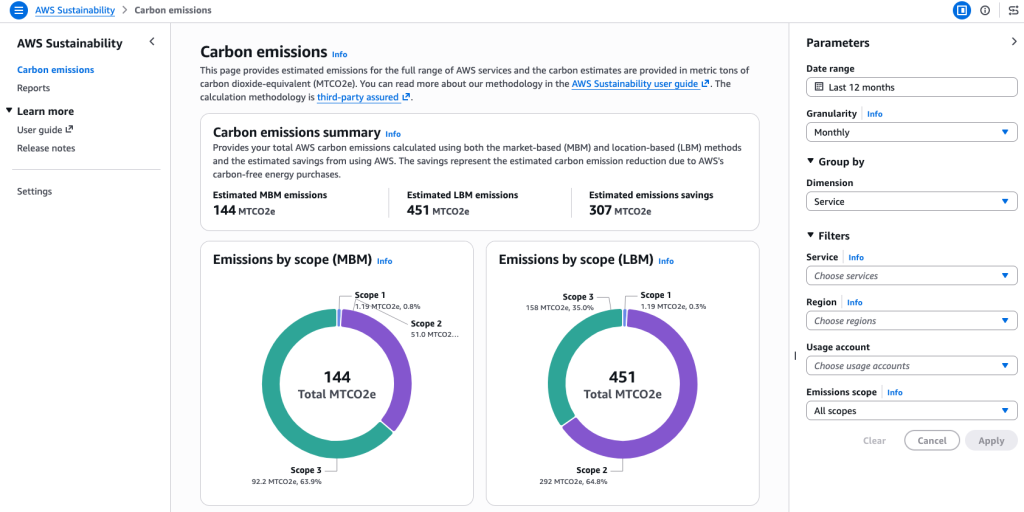
- Empowering Informed Decision-Making: By providing granular, easily accessible, and accurate carbon footprint data, the console empowers businesses to make data-driven decisions regarding their cloud architecture. Organizations can identify high-emission workloads, experiment with different AWS regions that rely more heavily on renewable energy, and optimize resource usage to actively reduce their environmental impact. This moves beyond mere reporting to enabling active carbon reduction strategies.
- Streamlined Compliance and ESG Reporting: The console significantly eases the burden of meeting growing ESG reporting requirements. With preset and custom report generation, fiscal year alignment, and programmatic access, companies can more efficiently prepare disclosures for regulators, investors, and other stakeholders, reducing manual effort and increasing the reliability of their reports.
- Enhanced Transparency and Accountability: The availability of detailed Scope 1, 2, and 3 emissions data, along with independently verified methodologies, enhances transparency around cloud usage. This allows companies to demonstrate genuine accountability for their environmental impact, strengthening their reputation and fostering trust with environmentally conscious consumers and investors.
- Driving Cloud Optimization and Cost Savings: Often, optimizing cloud resources for lower carbon emissions also leads to cost savings. By identifying inefficient workloads or underutilized resources through the console’s data, businesses can streamline their operations, reduce waste, and achieve both environmental and financial benefits.
- Setting an Industry Standard: As a major cloud provider, AWS’s commitment to providing such a comprehensive and accessible sustainability tool can set a precedent for the entire industry. It highlights the growing expectation for cloud providers to not only offer efficient services but also to enable their customers to be more sustainable.
Looking Ahead: A Console Designed for Growth
AWS has stated that the Sustainability Console is designed to evolve. The company plans to continuously release new features and capabilities, responding to customer feedback and the dynamic landscape of sustainability reporting. This commitment suggests that the console will grow into an even more powerful tool, potentially incorporating additional metrics, predictive analytics for emissions, or deeper integration with other environmental management systems.
Availability and Getting Started Today
The AWS Sustainability Console is available immediately to all AWS customers at no additional cost. Users can access it directly from the AWS Management Console by searching for "sustainability." For organizations eager to understand their past environmental impact, historical data is available going back to January 2022, allowing businesses to analyze trends and establish baselines for their emissions reduction targets right away. This immediate access to historical data ensures that companies can quickly integrate the console into their ongoing sustainability initiatives.
The launch of the AWS Sustainability Console represents a pivotal moment for businesses seeking to align their cloud strategies with their environmental goals. By demystifying cloud carbon footprints and providing powerful tools for measurement and reporting, AWS is not only supporting its customers’ sustainability journeys but also contributing to the broader global effort to address climate change.