
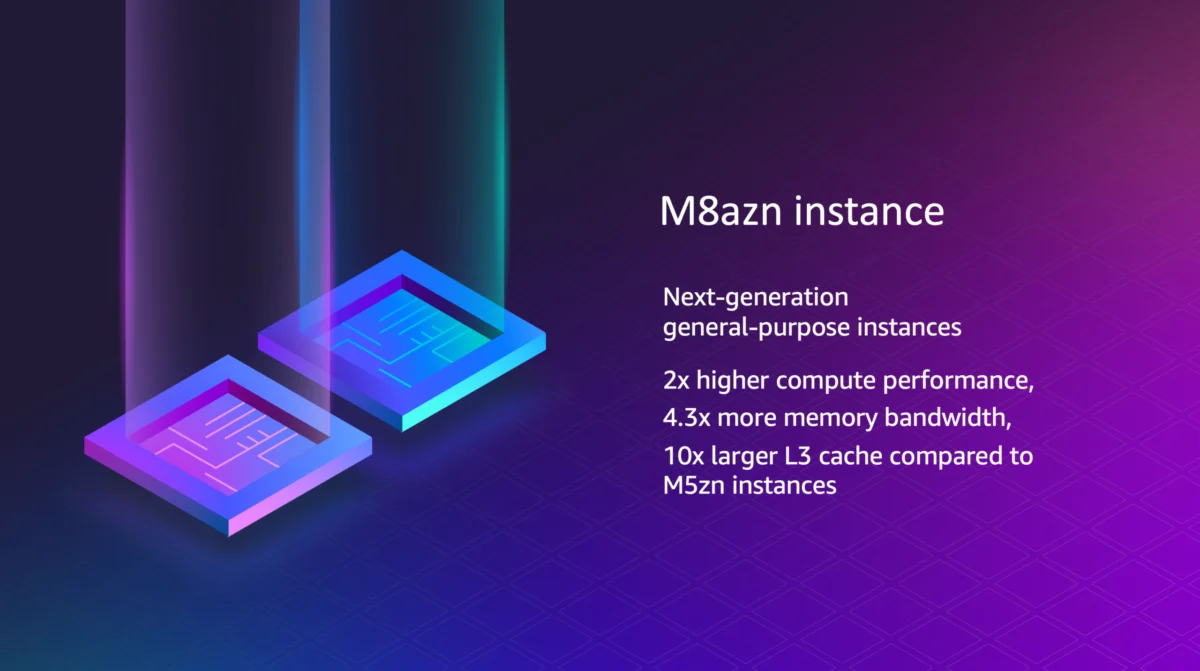

Amazon Web Services (AWS) has announced the general availability of its new Amazon EC2 M8azn instances, marking a significant advancement in cloud computing performance. These general-purpose instances are powered by fifth-generation AMD EPYC processors, achieving an industry-leading maximum CPU frequency of 5 GHz in the cloud. The launch, which occurred in February 2026, underscores AWS’s relentless pursuit of innovation, providing customers with unprecedented capabilities for their most demanding workloads.
The introduction of the M8azn instances represents a substantial leap from the previous generation M5zn instances. Benchmarking data reveals that M8azn instances deliver up to twice the compute performance, a staggering 4.3 times higher memory bandwidth, and a tenfold increase in L3 cache size. Furthermore, they offer up to twice the networking throughput and three times the Amazon Elastic Block Store (Amazon EBS) throughput compared to their predecessors. These performance metrics are critical for applications requiring ultra-low latency, high processing power, and rapid data access, setting a new standard for efficiency and responsiveness in the cloud environment.
Engineered for Extreme Performance: The Nitro System Advantage
At the core of the M8azn instances’ superior performance lies the AWS Nitro System, specifically leveraging sixth-generation Nitro Cards. The Nitro System is a foundational technology for modern EC2 instances, offloading many virtualization functions from the host CPU to dedicated hardware and software. This architecture significantly reduces overhead, freeing up nearly all of the host’s compute and memory resources for customer workloads. The sixth-generation Nitro Cards further enhance this capability, providing improved performance for networking, storage, and security, which are vital for instances designed for high-frequency and high-bandwidth applications.
The Nitro System’s modular design also allows for rapid innovation, enabling AWS to integrate the latest processor technologies and deliver them to customers faster. This system not only ensures consistent performance but also enhances security by isolating the virtualization layer from customer instances, contributing to a more robust and reliable cloud infrastructure. The M8azn instances are a testament to how the continuous evolution of the Nitro System directly translates into tangible performance benefits for end-users.
Targeting High-Demand Industries: A Closer Look at Workloads
The M8azn instances are meticulously engineered to cater to a diverse range of compute-intensive and latency-sensitive workloads across multiple industries. Their high clock speed, enhanced memory bandwidth, and substantial cache are particularly beneficial for:
- Real-time Financial Analytics and High-Frequency Trading (HFT): In the financial sector, microseconds can mean millions. HFT firms and financial institutions engaged in real-time market data analysis require the absolute lowest latency and highest processing speeds to execute trades, manage risk, and detect arbitrage opportunities. The 5 GHz clock speed of M8azn instances directly translates to faster instruction execution, enabling algorithms to react quicker to market fluctuations and process vast datasets in real-time, thereby providing a critical competitive edge.
- High-Performance Computing (HPC): Scientific research, engineering simulations, and complex data modeling often demand immense computational power. M8azn instances offer a compelling solution for HPC workloads such as molecular dynamics simulations, computational fluid dynamics (CFD), finite element analysis (FEA), and weather forecasting. The improved compute performance and memory bandwidth accelerate simulation runtimes, allowing researchers and engineers to iterate faster and tackle more complex problems.
- CI/CD Pipelines: Modern software development relies heavily on Continuous Integration and Continuous Delivery (CI/CD) pipelines. Faster compilation, testing, and deployment cycles are crucial for agile development teams. M8azn instances can significantly reduce build times and speed up automated testing, enabling developers to release software updates more frequently and efficiently, thereby enhancing productivity and accelerating time-to- market.
- Gaming: For game developers and hosting providers, server-side processing for complex game logic, physics simulations, and persistent world environments is paramount. M8azn instances can power more sophisticated game mechanics and support a higher density of concurrent players, delivering a smoother and more immersive gaming experience by reducing latency and improving server responsiveness.
- Simulation Modeling Across Key Industries:
- Automotive: Crash simulations, aerodynamic testing, and engine design optimization demand high-fidelity modeling. M8azn instances can accelerate these complex simulations, shortening development cycles for new vehicle designs.
- Aerospace: From aircraft design and flight dynamics to space mission simulations, the aerospace industry requires powerful computing resources. The M8azn instances facilitate faster and more accurate simulations, crucial for safety and innovation.
- Energy: Oil and gas exploration, reservoir modeling, and renewable energy system simulations benefit from enhanced computational capabilities. M8azn instances can process large seismic datasets and run complex models more efficiently, aiding in resource discovery and optimization.
- Telecommunications: Network planning, traffic optimization, and the development of 5G/6G technologies involve extensive simulation and data analysis. M8azn instances provide the necessary horsepower to model vast network infrastructures and predict performance under various load conditions.
Configuration Flexibility and Availability
The M8azn instances are designed with a 4:1 ratio of memory to vCPU, offering a balanced configuration suitable for a broad spectrum of general-purpose applications that also benefit from high frequency. They are available in nine different sizes, ranging from 2 to 96 vCPUs, with memory configurations scaling up to 384 GiB. This extensive range allows customers to precisely match instance sizes to their specific workload requirements, optimizing both performance and cost. Additionally, AWS offers two bare metal variants, providing direct access to the underlying server hardware for applications that require specific hardware features, deep performance tuning, or licensing models that mandate bare metal environments.
While specific regions of initial availability were not detailed, AWS typically rolls out new instance types across its major global regions in a phased approach, ensuring widespread access to these cutting-edge capabilities for its diverse customer base. This global availability allows enterprises and startups alike to leverage the power of M8azn instances wherever their operations are located.
The Expanding Horizon of Amazon EC2: A Legacy of Innovation
The launch of the M8azn instances is a continuation of AWS’s remarkable track record of expanding its Amazon Elastic Compute Cloud (Amazon EC2) offering. Since its inception in 2006, EC2 has grown into a vast ecosystem, providing scalable compute capacity in the cloud. As of February 2026, AWS offers over 1,160 distinct Amazon EC2 instance types, a number that continues to climb at a surprising pace. This extensive catalog includes a wide array of specialized instances, from AWS Graviton-powered instances optimized for cost-performance to various accelerated computing options featuring GPUs, FPGAs, and custom silicon like AWS Inferentia and Trainium.
The M-series instances, including the new M8azn, are categorized as "general purpose," meaning they offer a balance of compute, memory, and networking resources suitable for a broad range of applications. The "zn" suffix specifically denotes high-frequency versions of these general-purpose instances, addressing a niche but critical demand for applications that benefit disproportionately from higher clock speeds rather than just more cores. This strategic diversification allows AWS customers to precisely match their workloads to the most appropriate and cost-effective compute resources, optimizing performance and efficiency across their entire cloud footprint.
AWS and AMD: A Deepening Strategic Partnership
The integration of fifth-generation AMD EPYC processors into the M8azn instances highlights the deepening strategic partnership between AWS and AMD. AMD EPYC processors have steadily gained traction in the cloud market, offering a compelling alternative to other processor architectures with their strong performance, core density, and energy efficiency. AWS first began offering AMD EPYC-powered instances several years ago, starting with earlier generations like "Rome" and "Milan," and has progressively expanded its portfolio to include the latest "Genoa"-era (fifth-gen) EPYC processors.
This collaboration allows AWS to offer customers greater choice and flexibility, enabling them to select the optimal processor architecture for their specific needs. For AMD, its partnership with AWS provides significant market penetration and validation of its EPYC platform’s capabilities in the most demanding cloud environments. The 5 GHz frequency achieved by these fifth-generation AMD EPYC processors in the M8azn instances is a testament to AMD’s advancements in CPU design and AWS’s engineering prowess in optimizing hardware for cloud deployment. Industry analysts often point to such partnerships as crucial for fostering competition and driving innovation across the cloud computing landscape, ultimately benefiting end-users with better performance and more diverse options.
Broader Market Implications and Future Outlook
The launch of M8azn instances carries significant implications for the broader cloud computing market. By pushing the boundaries of single-core performance and network/storage throughput, AWS is further solidifying its position as a leader in delivering high-performance infrastructure. This move intensifies the competitive landscape among major cloud providers, potentially prompting rivals like Microsoft Azure and Google Cloud to accelerate their own high-frequency instance offerings.
For enterprises, the M8azn instances represent another compelling reason to migrate or expand their most demanding on-premises workloads to the cloud. The ability to access 5 GHz processors on demand, coupled with the scalability and reliability of AWS, reduces the need for costly and complex on-premises hardware refreshes for specialized applications. This could accelerate the digital transformation initiatives of organizations in finance, engineering, and other sectors that traditionally relied on highly optimized local infrastructure.

Furthermore, the continuous innovation in instance types, driven by advances in underlying hardware like AMD EPYC processors and the AWS Nitro System, suggests a future where cloud computing becomes even more specialized and optimized. This trend empowers developers and architects to build new categories of applications that were previously constrained by performance limitations, fostering a new wave of innovation across industries.
AWS Ecosystem: Beyond Core Compute
While the M8azn instances take center stage this week, AWS continues to foster a vibrant ecosystem of services, events, and community engagement. The company regularly updates its "What’s New with AWS" page, reflecting a relentless pace of development across its vast portfolio, from machine learning to serverless computing.
Looking ahead, AWS has a robust schedule of upcoming events designed to educate, connect, and inspire its global community of builders. AWS Summits in 2026, with events scheduled for Paris (April 1), London (April 22), and Bengaluru (April 23–24), offer free in-person opportunities for attendees to explore emerging cloud and AI technologies, learn best practices, and network with industry peers and experts. These events are crucial for disseminating knowledge and showcasing the practical applications of new services like M8azn.
The AWS AI and Data Conference 2026, a free, single-day in-person event on March 12 at the Lyrath Convention Centre in Ireland, highlights AWS’s focus on artificial intelligence and data analytics. The conference agenda covers critical topics such as designing, training, and deploying agents with Amazon Bedrock, Amazon SageMaker, and QuickSight, integrating them with AWS data services, and applying governance practices at scale. The M8azn instances, with their high compute and memory bandwidth, are well-suited to power the underlying infrastructure for advanced AI model training, inference, and data processing workflows that are central to such discussions.
AWS Community Days provide a grassroots platform for community-led conferences. Upcoming events in Ahmedabad (February 28), Slovakia (March 11), and Pune (March 21) feature technical discussions, workshops, and hands-on labs, all planned and delivered by community leaders. These events are vital for fostering innovation from the ground up and ensuring that the practical knowledge of AWS services is widely shared.
Finally, the AWS Builder Center serves as a central hub for developers to connect, share solutions, and access content that supports their development journey. It complements the formal events by providing an ongoing platform for collaboration and learning, underscoring AWS’s commitment to empowering its global community of cloud professionals.
The general availability of Amazon EC2 M8azn instances represents a significant milestone in cloud infrastructure, pushing the boundaries of performance for latency-sensitive and compute-intensive workloads. Coupled with AWS’s broader strategy of continuous innovation, strategic partnerships, and robust community engagement, this launch reaffirms AWS’s dedication to providing cutting-edge solutions that enable customers to achieve more in the cloud. The industry will be closely watching how these new capabilities translate into accelerated innovation across a multitude of sectors in the coming months and years.