

Amazon Web Services (AWS) has announced a significant enhancement to its Simple Storage Service (S3), introducing a new feature that allows customers to create general purpose buckets within their own account regional namespace. This update fundamentally simplifies bucket creation and management, particularly for organizations operating at scale, by ensuring desired bucket names are consistently available within a user’s AWS account and specified region, thereby eliminating the long-standing challenge of global namespace collisions. The feature is immediately available across 37 AWS Regions, including AWS China and AWS GovCloud (US) Regions, at no additional cost.
Understanding Amazon S3 and the Evolution of Cloud Storage Naming
Amazon S3, launched in 2006, stands as a cornerstone of cloud computing, providing highly scalable, durable, and available object storage. It has been instrumental in powering a vast array of internet applications, data analytics platforms, backup solutions, and content delivery networks. Storing trillions of objects and processing millions of requests per second, S3’s reliability and versatility have made it a ubiquitous choice for businesses ranging from startups to large enterprises.
Historically, general purpose S3 bucket names have operated under a global namespace. This meant that every S3 bucket name created by any AWS customer, anywhere in the world, had to be globally unique. While this design offered simplicity in its initial conception, facilitating easy identification and access, it presented considerable challenges as AWS adoption surged and the number of S3 buckets proliferated. Organizations often grappled with:
- Naming Collisions: As more customers joined AWS, finding a short, descriptive, and globally unique bucket name became increasingly difficult. This often led to convoluted naming conventions, forcing users to append random strings, dates, or highly specific project codes to ensure uniqueness.
- Operational Overhead: For large enterprises managing hundreds or thousands of S3 buckets across multiple accounts and regions, the global uniqueness requirement translated into significant planning and coordination efforts. Teams had to maintain complex internal registries or employ trial-and-error methods to provision new buckets, slowing down development cycles.
- Automation Challenges: Scripting and automating S3 bucket creation became more complex due to the unpredictability of name availability. DevOps pipelines often required additional logic to handle potential naming conflicts, adding friction to infrastructure as code (IaC) initiatives.
- Multi-Region Deployment Complexity: When deploying applications across multiple AWS regions, organizations often desired consistent naming patterns for their S3 buckets (e.g.,
myapp-prod-data-us-east-1,myapp-prod-data-eu-west-1). However, the global namespace meant thatmyapp-prod-datacould only be used once, necessitating further modifications to ensure global uniqueness, which then undermined the desire for regional consistency.
The introduction of the account regional namespace directly addresses these fundamental challenges, marking a pivotal evolution in S3’s architectural flexibility.
The Mechanism of Account Regional Namespace
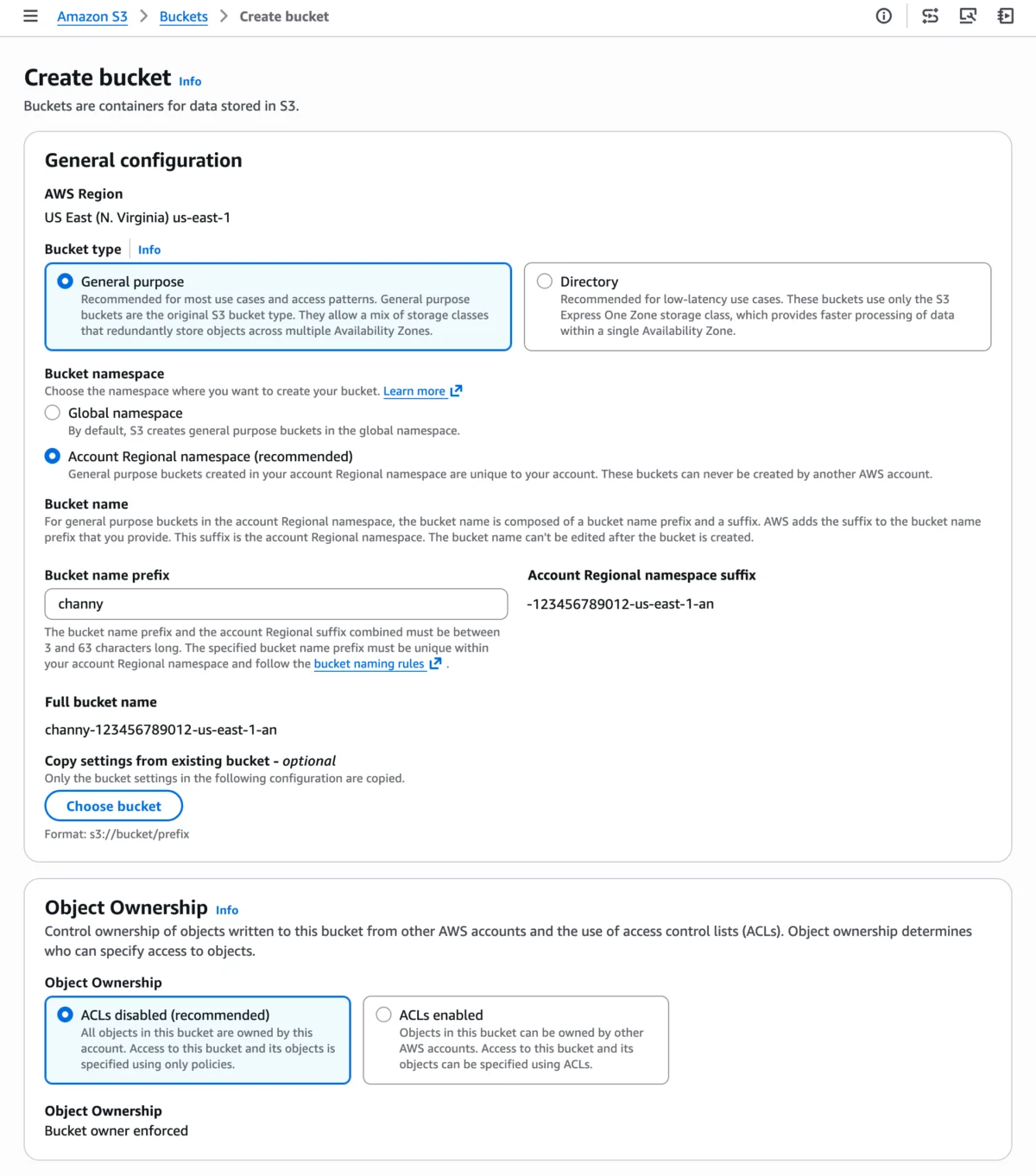
The new feature empowers AWS customers to predictably name and create general purpose buckets by leveraging their account’s unique suffix within the requested bucket name. Specifically, users can define a desired bucket name prefix, and AWS automatically appends a unique account-regional suffix to it. For instance, a user might request mybucket as a prefix, and the system would construct a final bucket name like mybucket-123456789012-us-east-1-an. In this example:
mybucketrepresents the user-defined prefix.123456789012is the unique 12-digit AWS account ID.us-east-1denotes the specific AWS Region where the bucket is created.-anis a standard suffix indicating an account-regional namespace bucket.
The crucial aspect of this design is that the complete bucket name, including the suffix, is guaranteed to be unique only within that specific AWS account and region. If another AWS account attempts to create a bucket using the same bucket name prefix and their own account’s suffix, their request will be automatically accepted, as long as it’s unique within their account and region. Conversely, if another account tries to use your account’s suffix, their request will be rejected, ensuring the integrity of your namespace. This paradigm shift liberates developers and architects from the burden of global name coordination, enabling greater agility and consistency.
Operational Benefits and Enhanced Management for Enterprises
The implications of this update for operational efficiency and data management are substantial, particularly for large enterprises and organizations with complex multi-account, multi-region strategies:
- Simplified and Predictable Naming: Developers can now use intuitive and consistent naming conventions for their S3 buckets across different projects, environments, and regions, without fear of external conflicts. This reduces cognitive load and accelerates resource provisioning.
- Scalability and Automation: The predictable nature of account regional bucket names significantly enhances the ability to automate infrastructure deployments. CI/CD pipelines can now reliably create S3 buckets with predefined naming patterns, reducing manual intervention and potential errors. This is crucial for organizations adopting a fully automated, Infrastructure as Code approach.
- Reduced Friction in Development: By removing the bottleneck of unique global naming, development teams can spin up storage resources more rapidly, accelerating testing, prototyping, and deployment cycles for new applications and services.
- Improved Resource Governance: For organizations with dozens or hundreds of AWS accounts, this feature facilitates better internal governance. Centralized IT or cloud platform teams can establish clear, enforced naming standards that ensure consistency across the entire organization’s AWS footprint, without external naming pressures.
- Consistent Multi-Region Deployments: Applications designed for global reach often require data storage in multiple regions. The new namespace allows for identical logical bucket names (e.g.,
myapp-logs) to exist in different regions, each appended with its respective account-regional suffix, simplifying application logic and configuration management.
Enhanced Security and Governance with IAM and AWS Organizations
Beyond operational convenience, the account regional namespace feature also brings robust security and governance capabilities. AWS Identity and Access Management (IAM) policies and AWS Organizations Service Control Policies (SCPs) can now be leveraged to enforce the adoption of this new naming convention.
A new condition key, s3:x-amz-bucket-namespace, has been introduced. Security teams can use this key to mandate that employees and automated processes only create buckets within their account regional namespace. For instance, an SCP at the organizational unit (OU) level could explicitly deny the creation of S3 buckets that do not utilize the account-regional namespace, thereby ensuring compliance with internal naming and management standards across all linked accounts. This level of granular control is critical for enterprises that need to maintain strict security postures and adhere to various regulatory requirements. By standardizing bucket creation, organizations can simplify auditing, apply consistent access controls, and streamline data lifecycle management.
Technical Implementation and Developer Workflow
AWS has integrated the new feature seamlessly across its ecosystem, providing multiple avenues for creation:
Amazon S3 Console
Users can create account regional namespace buckets directly from the Amazon S3 console. During the bucket creation wizard, selecting "Account regional namespace" as the desired option allows users to provide any name unique to their account and region. This intuitive graphical interface ensures ease of use for quick provisioning.
AWS Command Line Interface (CLI)
For command-line enthusiasts and scripting, the AWS CLI supports the new namespace with a straightforward parameter. The create-bucket command now accepts a --bucket-namespace account-regional flag along with the desired bucket name, which includes the account-regional suffix.
$ aws s3api create-bucket --bucket mybucket-123456789012-us-east-1-an
   --bucket-namespace account-regional
   --region us-east-1
AWS SDKs (e.g., Python Boto3)
Developers can integrate the feature into their applications using AWS SDKs. The AWS SDK for Python (Boto3) provides a clear example:
import boto3

class AccountRegionalBucketCreator:
    """Creates S3 buckets using account-regional namespace feature."""

    ACCOUNT_REGIONAL_SUFFIX = "-an"

    def __init__(self, s3_client, sts_client):
        self.s3_client = s3_client
        self.sts_client = sts_client

    def create_account_regional_bucket(self, prefix):
        """
        Creates an account-regional S3 bucket with the specified prefix.
        Resolves caller AWS account ID using the STS GetCallerIdentity API.
        Format: <prefix>-<account_id>-<region>-an
        """
        account_id = self.sts_client.get_caller_identity()['Account']
        region = self.s3_client.meta.region_name
        bucket_name = self._generate_account_regional_bucket_name(
            prefix, account_id, region
        )

        params =
            "Bucket": bucket_name,
            "BucketNamespace": "account-regional"

        if region != "us-east-1": # us-east-1 does not require LocationConstraint
            params["CreateBucketConfiguration"] =
                "LocationConstraint": region


        return self.s3_client.create_bucket(**params)

    def _generate_account_regional_bucket_name(self, prefix, account_id, region):
        return f"prefix-account_id-regionself.ACCOUNT_REGIONAL_SUFFIX"

if __name__ == '__main__':
    s3_client = boto3.client('s3')
    sts_client = boto3.client('sts')

    creator = AccountRegionalBucketCreator(s3_client, sts_client)
    response = creator.create_account_regional_bucket('test-python-sdk')

    print(f"Bucket created: response")
This Python example demonstrates how to programmatically construct the bucket name by dynamically retrieving the AWS account ID and current region, then making the CreateBucket API call with the BucketNamespace parameter. This approach ensures maximum flexibility and adherence to the naming convention.
AWS CloudFormation for Infrastructure as Code (IaC)
AWS CloudFormation, a critical tool for managing infrastructure as code, has also been updated to support the new namespace. CloudFormation’s pseudo-parameters, AWS::AccountId and AWS::Region, can be used to construct the full bucket name dynamically within templates:

BucketName: !Sub "amzn-s3-demo-bucket-$AWS::AccountId-$AWS::Region-an"
BucketNamespace: "account-regional"
Even more conveniently, CloudFormation introduces a BucketNamePrefix property. With this, users only need to provide the customer-defined portion of the bucket name, and CloudFormation automatically appends the account-regional suffix based on the requesting AWS account and Region:
BucketNamePrefix: 'amzn-s3-demo-bucket'
BucketNamespace: "account-regional"
These CloudFormation integrations are invaluable for organizations seeking to standardize and automate their S3 infrastructure deployments, ensuring consistency and compliance across their entire cloud footprint.
Scope, Limitations, and Distinctions
It is important to note the specific scope of this new feature:
- General Purpose Buckets Only: The account regional namespace is currently supported exclusively for general purpose S3 buckets. Other specialized S3 bucket types, such as S3 table buckets, vector buckets, and directory buckets, already operate within account-level or zonal namespaces, and thus are not affected by this change.
- No Renaming Existing Buckets: Existing global namespace S3 buckets cannot be renamed to adopt the new account regional naming convention. Customers wishing to utilize the feature for existing data would need to create new account regional buckets and migrate their data.
- Character Limits: The combined length of the bucket name prefix and the account regional suffix must be between 3 and 63 characters long, adhering to standard S3 naming conventions.
This distinction highlights AWS’s ongoing commitment to evolving its storage services to meet diverse customer needs, providing tailored solutions for different data access patterns and performance requirements.
Broader Industry Impact and Expert Perspectives
The introduction of the account regional namespace for S3 general purpose buckets is more than just a convenience feature; it reflects a broader trend in cloud architecture and AWS’s responsiveness to its enterprise customer base. As organizations mature in their cloud adoption journey, managing complexity at scale becomes paramount. This update addresses a long-standing pain point, particularly for heavily regulated industries and large corporations that operate vast, multi-region cloud environments.
Industry analysts suggest that this enhancement underscores AWS’s commitment to refining its core services, making them more adaptable to complex enterprise environments and robust governance requirements. "The global uniqueness constraint for S3 buckets has been a minor but persistent source of friction for cloud architects for years," stated a prominent cloud infrastructure analyst. "This move by AWS signifies a continuous effort to simplify operations, reduce developer toil, and empower customers with greater control over their cloud resources, especially as data volumes and the number of AWS accounts per organization continue to grow exponentially."
The predictable naming and enhanced governance capabilities are expected to accelerate cloud adoption for new workloads and facilitate easier migration of on-premises applications to S3, as enterprises can now more confidently map their existing naming conventions and security policies to the cloud. It allows for a more distributed, yet uniformly governed, approach to data storage, aligning with modern decentralized IT strategies.
Conclusion
The new ability to create general purpose buckets in an account regional namespace represents a significant step forward in simplifying Amazon S3 management. By eliminating global naming conflicts and integrating seamlessly with AWS IAM, AWS Organizations, and popular developer tools like the AWS CLI, SDKs, and CloudFormation, AWS has provided a powerful mechanism for enterprises to enhance their operational efficiency, strengthen security governance, and accelerate their cloud initiatives. This feature is now available across 37 AWS Regions at no additional cost, inviting customers to experience a more streamlined and predictable approach to cloud storage. AWS encourages users to explore this new capability through the Amazon S3 console and provide feedback via AWS re:Post for Amazon S3 or their usual AWS Support channels, ensuring continuous improvement of the service.