
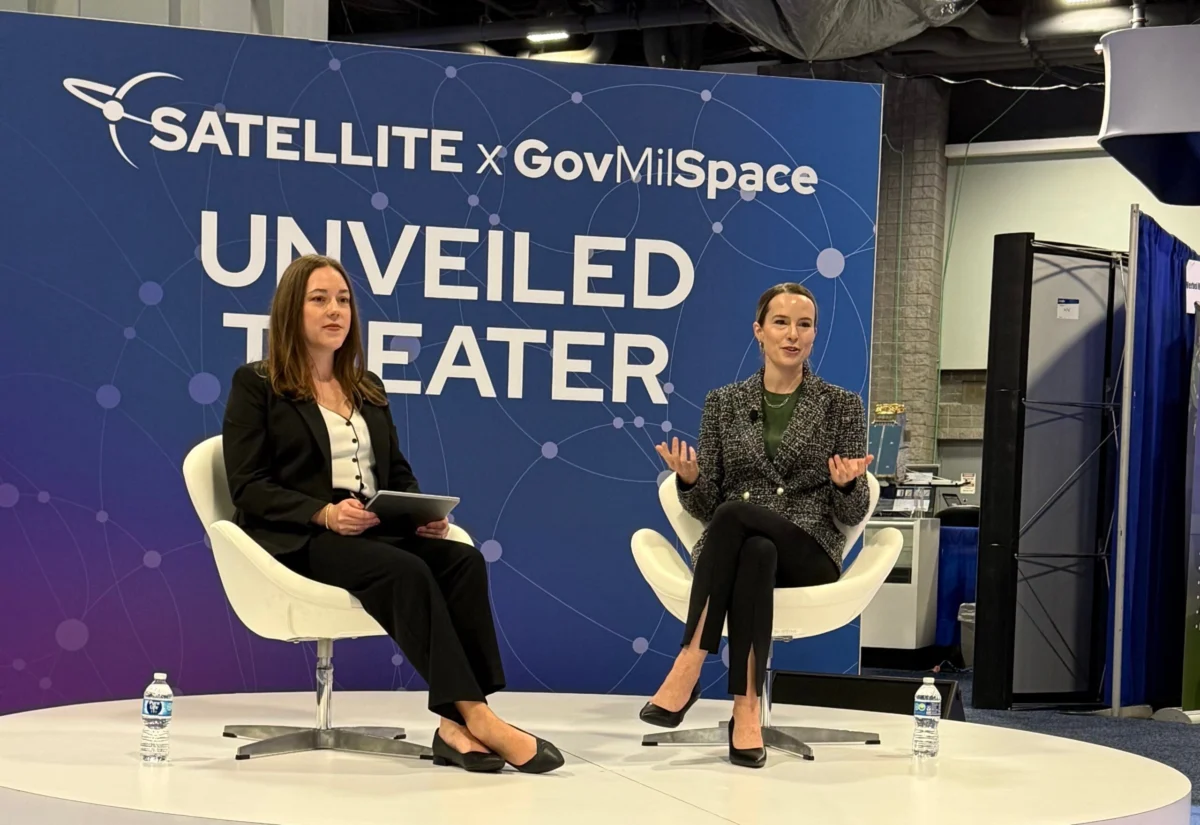

The satellite industry is currently grappling with a significant bottleneck that threatens to stifle the rapid expansion of orbital assets: the aging and often prohibitively expensive ground segment. Speaking at the closing fireside chat of SATShow Week, Bridgit Mendler, CEO and co-founder of Northwood Space, detailed how her company is addressing what she termed the “gnarly problem” of satellite ground infrastructure. By developing an end-to-end ground system designed for rapid deployment and mass production, Northwood Space aims to synchronize the capabilities of Earth-bound hardware with the exponential growth of spacecraft in orbit.
Mendler’s appearance at the premier industry event drew significant attention, not only for her background as a high-profile entertainer but for the technical rigor and aggressive growth strategy Northwood Space has displayed since emerging from stealth. The core of Mendler’s message was a warning to the industry: the proliferation of mega-constellations in Low-Earth Orbit (LEO) will outpace the human ability to manage them if ground systems remain tethered to legacy costs and slow installation timelines.
Addressing the Infrastructure Bottleneck
The "New Space" era has been defined by a dramatic reduction in launch costs and the miniaturization of satellite technology. However, the ground segment—the physical antennas and networks required to communicate with these satellites—has historically lagged behind. Traditional ground stations often require months of site preparation, specialized engineering teams, and significant capital expenditure.
“There will continue to be exponentially more spacecraft going up into orbit,” Mendler stated during the session. “We’re going to lose track of that if the ground systems are still ballooning in cost. So, you need to be able to build something that can actually match that proliferation.”
Northwood Space’s solution is the "Portal" system, a phased array ground station designed to be modular and easily deployable. Unlike traditional parabolic dishes that must physically move to track a satellite across the sky, phased arrays use a flat panel of antennas to steer beams electronically. This allows for faster switching between satellites and the ability to track multiple spacecraft simultaneously, a necessity for the high-density LEO environment.
Mendler emphasized that Northwood’s goal is to make ground infrastructure as accessible and scalable as cloud computing. By streamlining resource allocation and capacity planning, the company intends to remove the physical complexities that currently act as "pain points" for satellite operators.
Technical Innovation: The Portal Phased Array
The Portal system represents a shift toward "Ground-Station-as-a-Service" (GSaaS) but with a focus on proprietary hardware that prioritizes speed of installation. Mendler revealed that the design criteria for the Portal was to create a modular system that is as easy to install as a common household appliance.
“We want ground to be like cloud in the sense where it is immediately available,” Mendler explained. To achieve this, Northwood has utilized high-volume, commercially available components. This strategy not only lowers the bill of materials but also ensures supply chain resilience—a critical factor given the global shortages that have plagued the aerospace industry in recent years.
The operational efficiency of the Portal system has already been demonstrated in the field. Mendler noted that the first Portal unit took only three months from the start of manufacturing to final installation. Subsequent deployments have been even faster; reports indicate that one specific site was installed in a mere 12 hours and began successful satellite communications the following day. This rapid turnaround is unprecedented in an industry where ground station setup typically spans several months or even years.
Strategic Growth and Manufacturing Expansion
To support the massive demand for its technology, Northwood Space is transitioning from a research-and-development phase into high-rate production. Mendler announced that the company has secured a new 180,000-square-foot manufacturing facility. This site is intended to support the production of hundreds of antennas annually, a scale required to service the thousands of satellites expected to launch over the next decade.
The company’s ability to scale is backed by significant financial tailwinds. In January 2026, Northwood Space closed a $100 million Series B funding round, bringing in capital from prominent venture firms. This funding is being channeled directly into manufacturing infrastructure and global deployment efforts.
The manufacturing process itself has undergone rigorous testing. Mendler highlighted a recent “manufacturing sprint” in which the first eight Portal units were produced in just four weeks. This capability to move from raw materials to a finished, deployable product in such a short window is central to Northwood’s value proposition to both commercial and government clients.
The U.S. Space Force Partnership
A major validation of Northwood’s technology came with its selection by the U.S. Space Force to support the Satellite Control Network (SCN). The SCN is the backbone of military satellite operations, providing telemetry, tracking, and communication (TT&C) for a wide array of national security assets.
The contract focuses on providing S-band links, which are essential for the primary command and control of satellites. Northwood’s Portal system will provide the Space Force with a more flexible, rapidly deployable alternative to the aging fixed-site antennas currently in use. Mendler confirmed that Northwood’s technology operates primarily in the S-band and X-band, providing coverage from Low-Earth Orbit (LEO) all the way to Geostationary Orbit (GEO).
For the Department of Defense, the ability to rapidly reconstitute ground capabilities is a strategic priority. In a conflict scenario where fixed ground stations might be targeted or degraded, the modular and mobile nature of the Portal system offers a layer of resilience that traditional infrastructure cannot match.
From Disney to Deep Tech: The Mendler Evolution
The fireside chat also touched upon Mendler’s unique trajectory. While she gained international fame as a Disney Channel actress and singer, her transition into the tech sector was driven by a return to her academic and familial roots. Raised in an engineering household, Mendler pursued graduate studies at the Massachusetts Institute of Technology (MIT) and Harvard Law School.
The genesis of Northwood Space was a collaborative effort involving her husband and the company’s CTO, Griffin Cleverly, who brought a background in aerospace and defense technology. Mendler noted that the idea for Northwood was crystallized during a pandemic-era project. Observing the rapid advancements in launch technology by companies like SpaceX and the innovations in satellite bus manufacturing, she realized that the ground segment was the missing link in the modern space ecosystem.
“The ground needed to have its own transformation,” she said, reflecting on the realization that led to the company’s founding. Her dual perspective—understanding both the high-level strategic "star power" and the granular technical requirements—has positioned her as a unique leader in the industry.
Global Deployment and Operational Outlook
Northwood Space is already a global entity, with operational units deployed in Australia and another undisclosed continent. Mendler revealed that the company currently maintains five legal entities in different countries to facilitate its international expansion.
As the company scales, the logistical challenges of deploying hardware to remote locations have fostered a unique internal culture. Mendler shared an anecdote about the “Northwood Naturalist Society,” a dedicated Slack channel where team members post photos of local wildlife—from kangaroos in the Australian outback to diverse flora in other regions—encountered during ground station installations.
“We’ll be doing a lot of different global deployments this year,” Mendler said. “So, looking forward to more flora and fauna around the world.”
The priority for the coming year is clear: transitioning from pilot programs to full-scale operations. Northwood intends to handle complex customer missions, requiring a seamless integration of their hardware with existing satellite constellations. This includes refining the software layer that manages the Portal units, ensuring that capacity can be allocated dynamically as satellite orbits shift.
Analysis: Implications for the Satellite Industry
The success of Northwood Space could signal a broader shift in the economics of the space industry. For years, the "Ground Segment" was viewed as a necessary but stagnant cost center. By commoditizing ground station hardware through mass production and modular design, Northwood is lowering the barrier to entry for smaller satellite operators and providing a scalable solution for the industry’s giants.
Furthermore, the focus on phased array technology addresses the technical limitations of parabolic dishes. As LEO constellations grow to include thousands of satellites, the ability to communicate with multiple assets simultaneously becomes a requirement rather than a luxury. Northwood’s "Portal" is positioned at the intersection of this technical necessity and economic opportunity.
The company’s decision to use commercially available components is also a strategic move toward sustainability. By avoiding the long lead times associated with bespoke aerospace parts, Northwood can iterate faster and respond to market demands with more agility than traditional defense contractors.
As SATShow Week concluded, the sentiment among attendees was that the ground segment is no longer the "forgotten" part of the space industry. With $100 million in fresh capital, a major military contract, and a massive new manufacturing footprint, Northwood Space is poised to lead the transformation of how the world connects with the stars. For Bridgit Mendler, the journey from the screen to the stratosphere is just beginning, with the goal of ensuring that as more satellites reach for the sky, the ground is ready to catch their signals.