
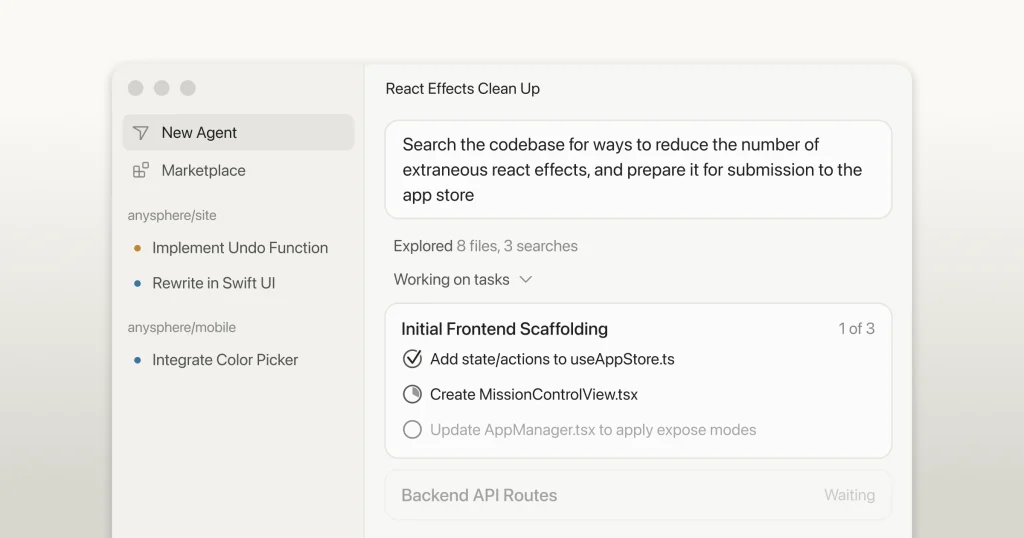

Last week, Cursor, the AI code editor lauded for its rapid revenue growth, unveiled a product that dramatically reconfigures the developer experience, moving away from its core offering. Cursor 3, developed under the codename "Glass," introduces an agent management console as its primary interface, relegating the traditional Integrated Development Environment (IDE) to a secondary role. While engineers can still write code within this new paradigm, the product’s design prioritizes dispatching AI agents, reviewing their output, and strategically managing these automated workflows. The prominent prompt box now occupies the space traditionally reserved for the file tree, signaling a profound shift in how developers interact with their tools.
This strategic pivot by Cursor underscores a broader trend in the software development landscape: AI models are increasingly eclipsing traditional coding tools in importance. Cursor 3 represents a bold bet by a company that has achieved a $2 billion annualized revenue run rate, fully embracing this thesis by redesigning its entire product surface around agent management. This mirrors a transformation already experienced by infrastructure engineers, who transitioned from SSH terminals to cloud dashboards and from manual server provisioning to Kubernetes controllers. The current shift positions the orchestration layer as the primary interface, superseding the code editor, a tool that has been central to development for four decades. The stakes are significantly higher this time, as the abstraction being demoted is one deeply ingrained in the developer’s workflow.
Cursor 3: A New Architecture for Agent-Centric Development
Launched in 2022 as a fork of VS Code, Cursor has now developed a distinct sibling product built from the ground up with agents at its core. Cursor 3’s interface, meticulously crafted around agents, treats the traditional IDE as an optional fallback. The new workspace is inherently multi-repository, allowing both human developers and AI agents to operate concurrently across multiple codebases. A unified sidebar displays all visible agents, aggregating them from various surfaces Cursor interacts with, including mobile sessions, web clients, Slack, GitHub, and Linear. Cloud-based agents can generate demonstrations and screenshots of their work, enabling engineers to review outcomes without the need to pull code locally to understand changes.
A standout feature is "Cloud Handoff," which allows users to seamlessly move a running agent session from their local machine to Cursor’s cloud infrastructure mid-task. This enables the agent to continue working while the developer closes their machine, with the session retrievable locally for editing and testing. Conversely, tasks initiated in the cloud can be brought down for full local control. This level of session portability between local and cloud environments has been a notable gap in many competing tools. The analogy here is akin to the evolution of infrastructure management: moving from managing individual servers to orchestrating a fleet through a central control plane. While SSH access to individual servers remains, the control plane is where strategic decisions are made, workloads are assigned, and the overall system state is monitored. Cursor 3 applies this same principle to AI agents, with "Glass" serving as the control plane and the IDE acting as the equivalent of SSH.
The Strategic Imperative Behind Cursor’s Pivot
The timing of Cursor 3’s release is not coincidental. The company has undertaken an accelerated product offensive in recent weeks. A feature in Fortune published in late March framed Cursor’s situation as a classic "innovator’s dilemma." This narrative gained traction following Bloomberg’s report in early March that Cursor’s annualized revenue run rate had crossed $2 billion, doubling in just three months.
However, the competitive landscape is intensifying. Claude Code, Anthropic’s terminal-first coding agent, launched barely a year ago, reportedly achieved a $2.5 billion run rate with over 300,000 business customers, according to Fortune. Developers have publicly expressed a shift from Cursor to Claude Code, and some investors noted that several startups in their portfolios were reducing their reliance on Cursor. Amidst these reports, Cursor was reportedly seeking a new funding round at a valuation of approximately $50 billion, even as its growth narrative appeared to be fracturing.
In response, Cursor initiated a rapid series of strategic moves. On March 5th, the company launched "Automations," a system designed to trigger agents in response to GitHub events, Slack messages, and timers without direct human intervention. On March 19th, Cursor introduced Composer 2, its proprietary coding model built on the open-source Kimi K2.5 from Moonshot AI. Cursor claims Composer 2 outperformed Claude Opus 4.6 on its proprietary CursorBench benchmark, achieving a score of 61.3 compared to 58.2, while operating at a substantially lower token cost. It is important to note that CursorBench is Cursor’s internal evaluation suite. Also in March, Cursor enabled self-hosted cloud agents, allowing large enterprises to run Cursor’s agents on their own infrastructure. The subsequent release of Cursor 3, featuring a complete interface rebuild and three major product launches within a single month, highlights a company that perceives its category to be undergoing a fundamental redefinition.
A Structural Shift in Developer Tooling
Cursor’s strategic pivot is significant as it exemplifies a pattern extending beyond a single company. Major players in AI-assisted development now widely acknowledge the need for a dedicated orchestration surface for AI agents. The key divergence lies in where this surface should reside, representing the most compelling architectural conflict in developer tooling today.
Anthropic’s approach with Claude Code is strictly terminal-first, eschewing a traditional IDE entirely. The command-line interface (CLI) serves as the orchestration layer, with developers interacting through natural language commands in their shells. While Anthropic later introduced a browser-based interface and a desktop application, the terminal remains the central point of interaction. In this model, the orchestration layer exists entirely separate from the code editor.

OpenAI has adopted a more distributed strategy with Codex. It offers a standalone desktop application, a CLI, an IDE extension for VS Code and its derivatives, and a cloud interface. The desktop application is positioned as the "command center" for managing parallel agents, reviewing code changes, and executing work across projects. OpenAI’s bet is that the orchestration layer should be ubiquitously accessible, available from any interface a developer might be using.
Google’s approach with Antigravity, developed after a $2.4 billion licensing agreement with Windsurf and the subsequent hiring of its CEO and key engineers into DeepMind, lands closest to Cursor’s strategy. Antigravity is an agent-first IDE featuring two distinct modes: an "Editor View" for traditional coding and a "Manager Surface" for spawning, orchestrating, and observing multiple agents working in parallel across various workspaces. Here, agent orchestration and code editing are integrated within the same application, albeit in separate views.
Cursor 3 builds upon this IDE-integrated console model but pushes the emphasis further. "Glass" makes the agent console the default view, with the IDE serving as a fallback. Google’s Antigravity treats both views as coequal. This difference in emphasis suggests Cursor’s conviction that developers will increasingly dedicate their time to managing and directing agents rather than directly writing code.
The analogy to cloud infrastructure management is instructive. When AWS introduced its management console, SSH usage did not cease, but it ceased to be the primary locus for infrastructure decision-making. The console became the control plane, and SSH evolved into a tool for occasional debugging. Anthropic and OpenAI are wagering that the orchestration layer can thrive as a standalone application, independent of the IDE. In contrast, Cursor and Google are betting that integration with the editor is essential, anticipating that developers will need to intervene directly when agents produce errors. The industry consensus is that agent orchestration is the new primary surface; the architectural implementation remains an open question.
Implications for Developers in the Evolving Landscape
The practical ramifications of this shift for developers can be categorized into three key areas:
1. Model Choice Becomes an Infrastructure Decision:
Cursor 3 defaults to its Composer 2 model but retains the flexibility for developers to switch to Claude, GPT-5.4, and Gemini on a per-conversation basis. The choice of AI model powering an agent now represents an infrastructure decision, akin to selecting a database or a cloud region. At scale, token economics become a significant factor. Cursor 2’s published pricing for standard Composer 2 is $0.50 per million input tokens and $2.50 per million output tokens (as of March 2026), notably lower than the pricing for frontier models from Anthropic and OpenAI. For teams operating dozens of parallel agents, these cost differentials can heavily influence tool selection, often outweighing feature comparisons or user interface preferences.
2. The VS Code Moat Erodes:
Cursor initially forked VS Code to leverage its extensive extension ecosystem and gain immediate distribution. With Cursor 3, the company is actively diverging from this foundation to establish unique differentiation. If the agent-first interface gains widespread adoption, the relevance of VS Code extensions may diminish. Microsoft, the steward of VS Code, will need to monitor this trend closely. The long-held assumption that VS Code serves as the central hub for developer tooling, an assumption that has prevailed for nearly a decade, is showing signs of weakening. JetBrains faces similar pressures. As the primary interaction surface shifts from file editing to agent management, the traditional IDE’s competitive advantages in code intelligence and refactoring tools may become less critical.
3. Workflow Evolution Precedes Job Title Changes:
Engineers utilizing Cursor 3 will likely spend more time reviewing agent-generated code diffs, verifying screenshots of cloud agent outputs, strategizing task allocation between local and cloud environments, and managing pull request workflows. This represents a distinct skill set from traditional code writing, leaning more towards the responsibilities of an engineering manager or a platform operator. The role of a software engineer is increasingly converging with that of a systems operator who functions at the application layer. Cursor’s own trajectory exemplifies this evolution. The company acquired the code review platform Graphite in December 2025, a move CEO Michael Truell explained was necessary because code review was becoming a bottleneck as AI accelerated code generation. Cursor 3 extends this logic: if agents write the code and Graphite reviews it, the engineer’s primary role becomes orchestrating both processes, with the IDE relegated to a secondary function.
The Road Ahead: Architecting the Future of Development
The orchestration layer for AI coding agents has definitively emerged as a distinct product category, with every major industry player releasing its own iteration. The critical open question remains architectural: will this layer reside within the IDE, external to it, or be accessible across all surfaces simultaneously? Anthropic and OpenAI are placing their bets on standalone tools, while Cursor and Google are advocating for IDE-integrated consoles. The resolution of this architectural debate will likely determine which companies capture developer loyalty over the next decade, mirroring the impact of the cloud control plane wars of the early 2010s on infrastructure ownership.
For forty years, the code editor has defined how software is built. Cursor 3 represents a significant bet that supervising AI agents will become more crucial than directly editing files. Cursor has not eliminated the IDE; rather, it has demoted its prominence. If this strategic gamble proves successful, the last truly memorable code editor might well be the one developed by the company that pioneered the next evolution in software development. The industry is watching closely.