
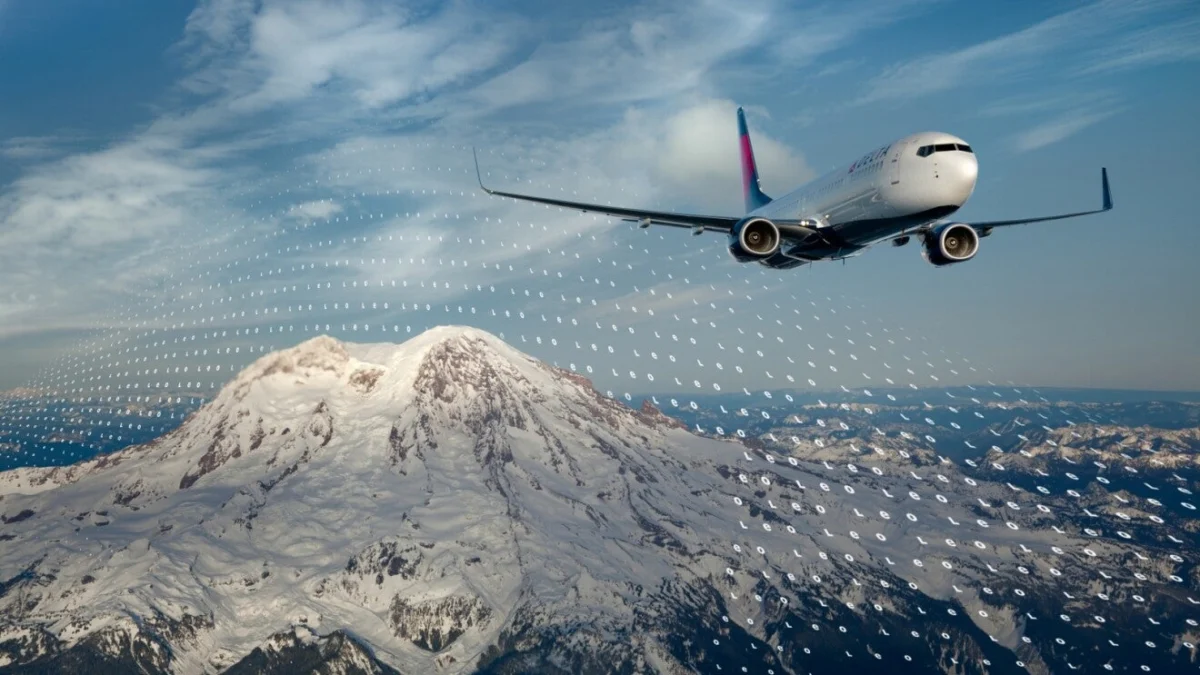

Delta Air Lines has officially entered into a transformative agreement with Amazon to integrate the Amazon Leo low-Earth orbit (LEO) satellite communications service into its fleet, marking a significant escalation in the race to provide seamless, high-speed internet in the aviation sector. Under the terms of the multi-year deal, Delta will begin equipping 500 of its aircraft with Amazon Leo’s In-Flight Connectivity (IFC) technology starting in 2028. This move positions Delta as the largest global carrier to adopt Amazon’s satellite network, following a similar, albeit smaller, agreement reached by JetBlue Airways in late 2025. The partnership represents a deepening of the relationship between the Atlanta-based airline and the technology giant, leveraging Amazon Web Services (AWS) and advanced satellite hardware to deliver what both companies describe as a "home-like" connectivity experience at 35,000 feet.
A New Era of In-Flight Speed and Capacity
The centerpiece of the agreement is the deployment of the Amazon Leo Ultra terminal, the most powerful hardware in Amazon’s satellite lineup. Specifically engineered for the demanding environment of commercial aviation, the Leo Ultra is designed to support download speeds of up to 1 Gbps. This level of throughput is intended to eliminate the traditional bottlenecks associated with airplane Wi-Fi, such as high latency and limited bandwidth, which often prevent passengers from streaming high-definition video, participating in video conferences, or playing online games.
By utilizing a LEO constellation, Amazon Leo offers a distinct advantage over legacy geostationary (GEO) satellites. While GEO satellites orbit at approximately 35,000 kilometers and often suffer from latency delays of 500 milliseconds or more, LEO satellites operate at altitudes between 500 and 2,000 kilometers. This proximity reduces latency to levels comparable to ground-based fiber-optic networks, typically below 50 milliseconds. For Delta, this technological shift is critical to fulfilling its promise of providing a digital experience that mirrors the connectivity passengers enjoy in their homes or offices.
Leveraging the AWS Ecosystem and AI Integration
The collaboration extends beyond hardware and satellite bandwidth. Delta and Amazon have emphasized the integration of Amazon Leo with Amazon Web Services (AWS), which has served as Delta’s primary cloud provider since 2020. By combining satellite connectivity with cloud computing and artificial intelligence, the companies aim to revolutionize the "connected cabin" ecosystem.
The integration is expected to facilitate real-time data processing and edge computing on the aircraft. For passengers, this could mean more personalized entertainment recommendations and more responsive customer service via the Delta Sync platform. For Delta’s operational teams, the low-latency link to AWS will allow for better real-time monitoring of aircraft systems, more efficient crew communications, and dynamic flight path adjustments based on live weather data. Delta CEO Ed Bastian noted that the agreement deepens a partnership with a global leader that shares the airline’s ambition to "build what’s next," emphasizing that the technology is not just about internet access, but about fostering "stronger human connection" through improved reliability and speed.
Delta’s Multi-Vendor Connectivity Strategy
Despite the massive scale of the Amazon Leo deal, Delta is maintaining a "multi-vendor" strategy to ensure global coverage and technological redundancy. The airline confirmed that its existing partnerships with Viasat and Hughes remain "hugely important" components of its connectivity roadmap.
Currently, Viasat provides Ka-band IFC services to a large portion of Delta’s domestic and international fleet, while Hughes supplies its Fusion system—a hybrid solution that intelligently switches between LEO and GEO orbits to optimize performance. A Delta spokesperson clarified that the airline intends to continue working with these partners to ensure that the "right aircraft is equipped with the right technology" based on its specific route profile and regional requirements. This diversified approach protects the airline from potential service outages and allows it to leverage the strengths of different satellite architectures as the global IFC market evolves.
The Competitive Landscape: Amazon vs. SpaceX
The agreement with Delta signals Amazon’s aggressive entry into a market that has recently been dominated by SpaceX’s Starlink. According to data from Valour Consultancy, Starlink has secured contracts for more than 5,000 aircraft globally, capitalizing on its first-mover advantage in the LEO space. However, the IFC market remains vastly underserved; industry analysts estimate that less than 50% of the world’s active commercial aircraft are currently equipped with high-speed connectivity, with significant gaps remaining in markets like China and parts of the Global South.
Amazon’s Project Kuiper, rebranded for commercial applications as Amazon Leo, is moving rapidly to close the gap. As of March 2026, the constellation has 212 satellites in orbit, with a robust launch schedule planned for the remainder of the year. Amazon has secured a record-breaking 77 heavy-lift launches from providers including Blue Origin, United Launch Alliance (ULA), and Arianespace to deploy its full constellation of over 3,200 satellites. Chris Weber, Vice President for Leo Business at Amazon, recently noted that more than 200 satellites are currently at the Cape Canaveral processing facility awaiting launch, underscoring the company’s ability to scale operations quickly.
Timeline and Implementation Strategy
The rollout on Delta aircraft is scheduled to begin in 2028, a timeline that aligns with Amazon’s expectations for full commercial service availability. While Delta has not yet specified which specific aircraft models will receive the Amazon Leo Ultra terminals, the initial 500-plane commitment suggests a focus on the airline’s core narrow-body and wide-body fleets.
The implementation will likely involve a mix of line-fit installations on new aircraft deliveries and retrofits on existing planes during scheduled maintenance intervals. Delta’s connectivity journey has been one of the most aggressive in the industry; the airline reached a milestone of 1,000 connected aircraft in late 2024 and is currently approaching 1,200. In 2023, Delta set a new industry standard by making in-flight Wi-Fi free for all SkyMiles loyalty members on Viasat-equipped aircraft, a move that has significantly increased passenger engagement with the airline’s digital platforms.
Economic and Operational Implications
The decision to invest heavily in Amazon Leo is a calculated move to drive passenger loyalty and ancillary revenue. In an era where "free Wi-Fi" is becoming a baseline expectation for premium travelers, the quality of that connection becomes a key brand differentiator. By offering 1 Gbps speeds, Delta aims to capture a larger share of the business travel market, where the ability to work uninterrupted is a primary factor in airline selection.
Furthermore, the cost-effectiveness of the Amazon Leo system was highlighted by Ed Bastian as a primary driver for the deal. As satellite technology matures and the number of LEO providers increases, the cost per bit of data is expected to decrease, allowing airlines to offer higher speeds without a corresponding increase in operational expenses.
From a technical perspective, the adoption of the Leo Ultra terminal represents a shift toward more aerodynamic and efficient hardware. Modern phased-array antennas used in LEO systems are flatter and lighter than traditional gimbaled GEO antennas, reducing drag on the aircraft and contributing to fuel efficiency—a critical concern for Delta as it pursues its long-term sustainability goals.
Broader Industry Impact
The Delta-Amazon partnership is expected to send ripples through the aerospace and telecommunications industries. It validates the LEO satellite model as the future of mobile connectivity and puts pressure on other major carriers, such as United, American, and Southwest, to upgrade their existing IFC offerings.
Industry analysts suggest that the competition between Amazon Leo and SpaceX Starlink will accelerate innovation in satellite hardware and ground station infrastructure. For passengers, the ultimate result will be a more reliable and faster internet experience across the globe, eventually bridging the "digital divide" that has long existed between ground-based and in-flight environments.
As Amazon CEO Andy Jassy noted, the impact of LEO technology extends beyond simple web browsing. It is poised to change "what’s possible while traveling," potentially enabling new forms of in-flight entertainment, such as cloud gaming and immersive virtual reality, that were previously impossible due to bandwidth constraints.
Conclusion
The agreement between Delta Air Lines and Amazon marks a pivotal moment in the digital transformation of the aviation industry. By committing to the Amazon Leo service for 500 aircraft, Delta is not only securing its position as a technological leader among global carriers but is also betting on a future where the sky is no longer a limit for high-speed data. As the 2028 rollout approaches, the industry will be watching closely to see how this fusion of satellite power and cloud intelligence redefines the passenger experience and sets a new benchmark for the "connected world."