
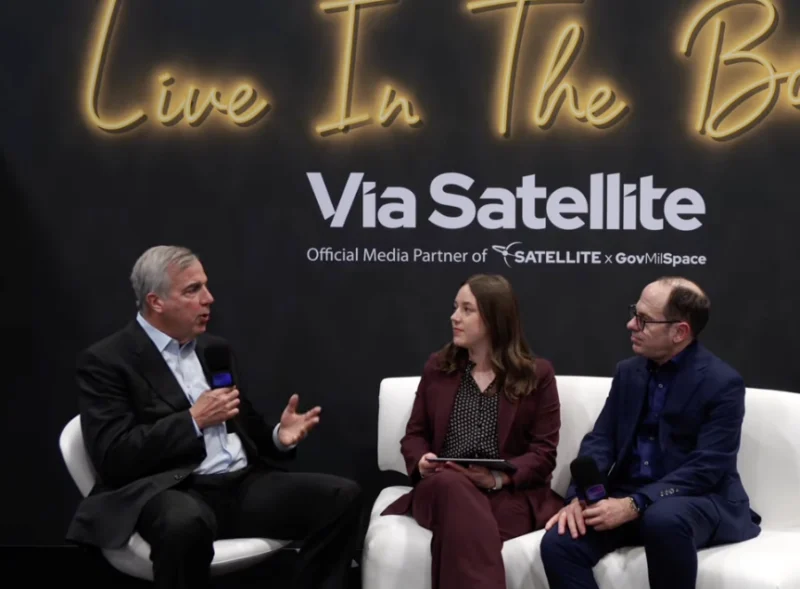

During the annual SATELLITE 2024 conference held in Washington, D.C., Iridium Communications Inc. signaled a significant pivot in its operational strategy, focusing on the integration of standardized non-terrestrial network (NTN) capabilities into its existing low-Earth orbit (LEO) constellation. Chief Executive Officer Matt Desch, in an interview with Via Satellite editors Rachel Jewett and Mark Holmes, detailed the rollout of Iridium NTN Direct, a service designed to bridge the gap between traditional satellite communications and global cellular standards. The move positions Iridium as the first provider to offer a standardized, narrowband satellite Internet of Things (IoT) service with truly global coverage, leveraging the company’s established infrastructure to capture a burgeoning market in the automotive and mobile sectors.
The announcement comes at a critical juncture for the satellite industry, which is currently undergoing a transition from proprietary, closed-loop systems to open standards defined by the 3rd Generation Partnership Project (3GPP). By adopting these standards, Iridium aims to eliminate the hardware and software barriers that have historically prevented mass-market adoption of satellite connectivity. Desch’s "Live in the Booth" session provided a comprehensive look at how Iridium is adapting to this changing landscape, emphasizing pragmatism over industry hype and focusing on the immediate utility of its L-band spectrum.
The Architecture of Iridium NTN Direct
The core of Iridium’s new strategy is the deployment of Iridium NTN Direct. Unlike many competitors who must launch new "cell tower in space" satellites to support standard cellular protocols, Iridium is implementing this technology on its existing fleet of 66 cross-linked LEO satellites. This constellation, which completed its "NEXT" refresh in early 2019, was designed with programmable processors that allow for significant software-defined upgrades.
Iridium NTN Direct is built upon the 3GPP Release 17 standards, which specifically address NTN for IoT devices. This standardization allows manufacturers of chipsets and modules—such as Qualcomm, Mediatek, and Sony Semiconductor—to integrate Iridium connectivity into their products using the same development cycles they use for terrestrial cellular tech. For Iridium, this represents a shift from being a niche provider of specialized satellite hardware to a foundational layer of the global telecommunications ecosystem.
According to Desch, the primary advantage of Iridium’s approach is its global reach. While many terrestrial-to-satellite initiatives are limited by regional spectrum licenses or the lack of satellite cross-links, Iridium’s mesh architecture ensures that a device can communicate from any point on Earth, including the poles and the middle of the ocean. This "standardized and global" nature is the primary differentiator Desch highlighted as the service begins its rollout this year.
Targeting the Automotive Industry and Safety Applications
One of the most significant revelations from Desch’s interview was the company’s aggressive pursuit of the automotive sector. Historically, car manufacturers have been hesitant to adopt satellite technology due to the high cost of proprietary antennas and the lack of interoperability between different satellite providers. However, as vehicles become increasingly software-dependent, the need for ubiquitous connectivity has moved from a luxury feature to a safety requirement.
Desch noted that Iridium is currently in discussions with major automotive OEMs (Original Equipment Manufacturers) worldwide. These companies are looking for narrowband applications that can function when a vehicle leaves the range of terrestrial 4G or 5G towers. Key use cases include:
- Airbag Deployment and Emergency Response: In the event of an accident in a remote area, Iridium NTN Direct can transmit critical telemetry and location data to emergency services, ensuring help is dispatched even without a cell signal.
- Software-Defined Vehicle (SDV) Updates: While massive firmware-over-the-air (FOTA) updates still require high-bandwidth connections, critical security patches or "heartbeat" diagnostic data can be transmitted via narrowband satellite links to ensure the vehicle’s fleet management systems remain updated.
- Emergency Location Services: Similar to the emergency SOS features found in modern smartphones, automotive companies are looking to bake this functionality directly into the car’s telematics unit.
"They [automotive companies] may have other technologies over time, but cell phones don’t cover everything in the world," Desch stated during the interview. He emphasized that Iridium would serve as a "low-cost" service provider, making the integration of satellite connectivity a viable standard feature rather than an expensive add-on.
Pragmatism in the Direct-to-Device (D2D) Market
The Direct-to-Device (D2D) market—often referred to as "satellite-to-phone"—has seen a surge in investment and media attention, fueled by partnerships like Apple and Globalstar, and SpaceX’s collaboration with T-Mobile. Despite the surrounding excitement, Desch remains a self-described pragmatist. He cautioned against the "hype" often associated with the valuation of satellite spectrum and the technical challenges of connecting unmodified smartphones to satellites.
Iridium’s approach to D2D, branded internally as "Project Stardust," focuses on using the company’s existing L-band spectrum. Unlike the "Supplemental Coverage from Space" (SCS) model, which uses terrestrial cellular frequencies (like those owned by T-Mobile or AT&T) to reach satellites, Iridium uses dedicated satellite spectrum. Desch argues that this is a more stable and regulatory-compliant path for global roaming.
The Iridium CEO noted that while the industry is racing toward high-bandwidth D2D (such as video calling or web browsing), the immediate and most reliable value lies in messaging, emergency alerts, and low-data IoT. By refusing to over-promise on the capabilities of current satellite technology, Iridium positions itself as the reliable "fail-safe" layer for the mobile industry. This pragmatic stance is reflected in the company’s financial strategy, which prioritizes steady service revenue and shareholder returns over speculative, high-burn R&D projects.
Advancements in Resilient PNT (Positioning, Navigation, and Timing)
Beyond communications, Desch highlighted significant progress in Iridium’s Positioning, Navigation, and Timing (PNT) services. As global reliance on GPS (and other GNSS systems like Galileo and GLONASS) increases, so do the risks associated with signal jamming and spoofing. Iridium’s PNT service, often referred to as Satellite Time and Location (STL), provides an essential alternative.
Iridium’s PNT signals are approximately 1,000 times stronger than GPS signals because they originate from LEO satellites (roughly 780 km altitude) rather than MEO satellites (approximately 20,000 km altitude). This increased signal strength allows the service to penetrate buildings and resist common jamming techniques.
Earlier this year, Iridium announced its acquisition of Satelles, Inc., the primary provider of STL technology. This vertical integration allows Iridium to fully control the development of PNT solutions. Desch explained that as autonomous systems, power grids, and financial markets require increasingly precise and resilient timing, Iridium PNT is becoming a critical piece of national infrastructure. The service is being adopted by government agencies and commercial enterprises that require a backup to GPS to prevent catastrophic system failures during outages.
Chronology of Innovation: Iridium’s Evolution
To understand the significance of Iridium NTN Direct, it is necessary to view the company’s trajectory over the last two decades. Iridium’s journey from a 1990s-era bankruptcy to a modern LEO powerhouse is one of the most cited turnaround stories in the aerospace sector.
- 1998-2000: Iridium launches its original constellation but fails to find a mass market for expensive satellite phones, leading to Chapter 11 bankruptcy.
- 2001-2016: The company focuses on niche markets, including maritime, aviation, and government/military contracts, establishing a stable revenue base.
- 2017-2019: Iridium completes the $3 billion "Iridium NEXT" campaign, replacing its entire constellation using SpaceX Falcon 9 rockets. These new satellites are equipped with the processing power necessary for today’s software-defined services.
- 2023: Iridium announces "Project Stardust," its entry into the 3GPP-standardized D2D and IoT space.
- 2024: The formal rollout of Iridium NTN Direct and the acquisition of Satelles mark the company’s transition into a standardized telecommunications and PNT provider.
This timeline illustrates that Iridium is not just reacting to current trends but is leveraging a multi-billion dollar investment made years ago to stay ahead of the technological curve.
Industry Implications and Market Analysis
The shift toward 3GPP standards by a major player like Iridium has profound implications for the broader satellite industry. It signals the end of the "walled garden" era where satellite providers dictated the hardware requirements for their networks.
Market analysts suggest that Iridium’s move will force other LEO operators to accelerate their own standardization efforts. For the IoT market, the availability of a global, standardized L-band service reduces the "Total Cost of Ownership" (TCO) for enterprises. Companies managing global supply chains, for instance, can now use a single SKU (Stock Keeping Unit) for their tracking devices, knowing they will work on both terrestrial cellular networks and Iridium’s satellite network without needing hardware modifications.
Furthermore, Iridium’s focus on the automotive sector highlights a growing convergence between the aerospace and transportation industries. As the European Union and other jurisdictions mandate more sophisticated emergency calling (eCall) systems, the "always-on" nature of satellite connectivity becomes a mandatory requirement rather than an optional feature.
Conclusion: A Future Defined by Standards
In closing his interview at SATShow Week, Matt Desch emphasized that the pace of change in the satellite industry has never been faster. However, he maintained that long-term success belongs to those who integrate seamlessly with the existing global telecommunications fabric.
By prioritizing Iridium NTN Direct and standardized IoT, the company is betting that the future of satellite is not as a standalone alternative to cellular, but as an invisible, ubiquitous extension of it. As 2024 progresses, the deployment of these services will serve as a litmus test for the viability of standardized NTN, potentially setting the benchmark for how satellite constellations interact with the billions of devices currently populating the Earth. Through a combination of resilient PNT, strategic automotive partnerships, and a pragmatic approach to D2D, Iridium is positioning itself as an indispensable utility in the modern connected world.