
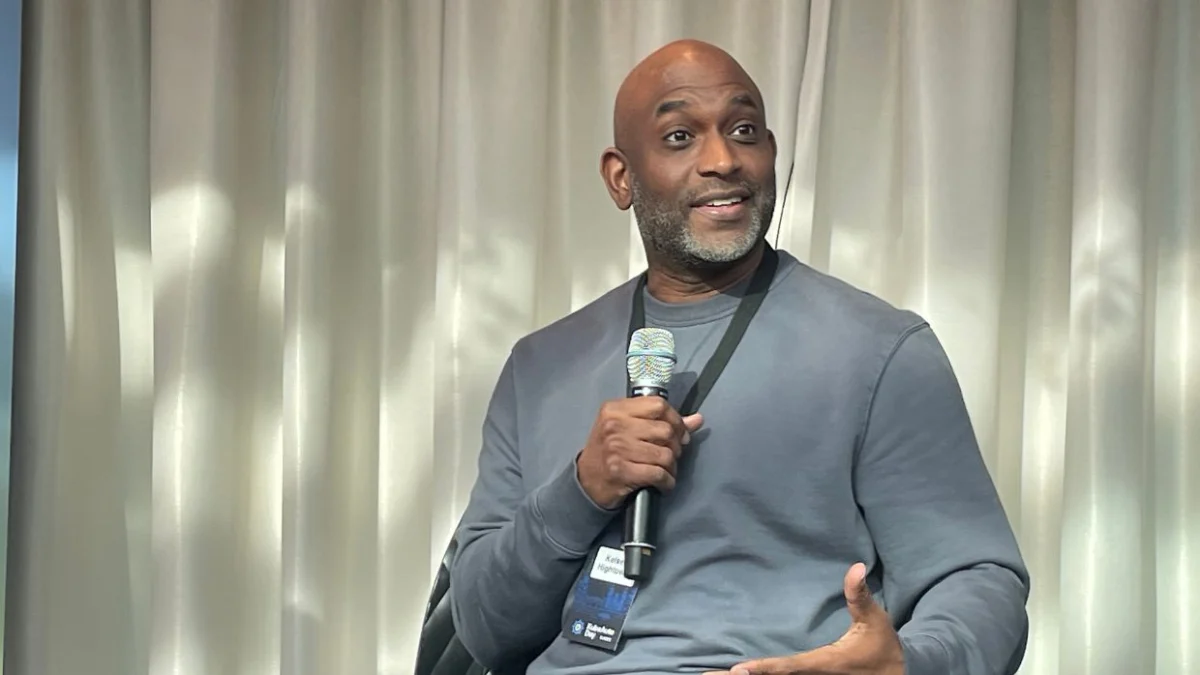

Kristina Kondrashevich, site reliability product manager at Electrolux, vividly recalls the transformative impact of a presentation by Kelsey Hightower, a luminary in the cloud-native and Kubernetes space. Her experience at KubeCon 2023, where Hightower discussed open-source projects, provided the foundational insights that guided Electrolux in building and open-sourcing their developer platform, InfraKitchen. "I still have notes from that day, which we followed for building and open-sourcing our developer platform, InfraKitchen," Kondrashevich shared with The New Stack. This profound influence motivated the Electrolux team to seek out Hightower again at KubeCon Europe 2026 in Amsterdam. Kondrashevich expressed her team’s gratitude, stating, "We asked him for a photo, and I said he inspired my team and me to be brave and go [open-source their project]." Hightower’s engagement extended beyond a brief photo opportunity; he invited Kondrashevich and her colleague Gang Luo to demonstrate InfraKitchen to him. Despite rigorous questioning, Hightower was ultimately impressed, offering his endorsement of their work, as evidenced by a photograph featuring Hightower alongside Kondrashevich and Luo.
This personal mentorship and validation are hallmarks of Hightower’s approach, extending far beyond his well-deserved reputation as the "first big Kubernetes and cloud-native evangelist," a captivating speaker, and the author of the seminal "Kubernetes the Hard Way." For many in the developer community, like Kondrashevich, Hightower’s enduring legacy is built upon his dedication to engaging directly with and empowering others.
Hightower’s presence at KubeAuto Day Europe 2026, a co-located event with KubeCon + CloudNativeCon, brought into sharp focus the pressing questions surrounding the impact of artificial intelligence on open source, codebases, and individual careers. His discussions also touched upon his rumored departure from the public tech stage, following his retirement from Google in 2023 at the age of 42.
The Evolving Landscape of Open Source in the Age of AI
The recent deprecation of Ingress NGINX served as a stark reminder at this year’s KubeCon of the critical need for companies to actively support the open-source projects they rely upon. Discussions frequently revolved around strategies for ensuring project sustainability, including the implementation of software bills of materials (SBOMs) for open-source dependencies and a sustained commitment to funding and supporting project maintainers and contributors. However, this year’s discourse introduced a new tension: the argument that with AI nominalizing the cost of software creation, organizations might opt to build proprietary solutions rather than depend on open source.
Hightower articulated a firm stance against this prevailing sentiment. "If they won’t contribute to open source and maintain open source, they have no chance with this [AI] stuff," he stated unequivocally. He emphasized the immense advantage provided by the open-source community, noting, "You have a thing where a community has given you the biggest head start ever. Lots of other people are using [open source software] in production, and there’s an industry behind it." Hightower posited that AI-generated solutions, at best, would be rudimentary and ultimately require significant self-maintenance, often leading to neglect. He predicted that organizations attempting this route would quickly retreat upon encountering their first security vulnerability.
Drawing an analogy to culinary traditions, Hightower explained, "This is why there are only so many recipes. It’s why people make scrambled eggs roughly the same way. Humans are a community. Community turns into culture, and most people want to be a part of something."
The record attendance of 13,500 at KubeCon Europe 2026 suggests that the AI era is fostering a deeper engagement with the open-source community, rather than an exodus. However, this growing reliance reignites a long-standing debate: is the current model of open-source development sustainable? For two decades, open-source advocates have grappled with convincing corporate leadership to allocate adequate funding for what is often still mistakenly perceived as merely "free software."
Hightower highlighted the direct link between open source and commercial success: "Open source underpins some of our commercial projects, so in those cases, it’s kind of a direct one-to-one to revenue – we make money off of this." He advocates for companies to earmark a percentage of their resources to support open-source communities, including hiring dedicated personnel and contributing to database maintenance.
He issued a cautionary note to enterprises: "I do think every enterprise needs a little reminder; we are getting really far off the back of others, and if they were to deprecate it like the Ingress controller from NGINX, then look, lots of enterprises are scrambling now, and not one of them that I’ve met has thought about maybe they fork it and step up to maintain it." Hightower stressed that the essence of open source extends beyond acquiring software without cost; it encompasses the responsibility of contributing to its maintenance. "I think a lot of people have to remind themselves that open source wasn’t about getting software for free from someone else. It’s also about stepping up to maintain it when the time comes. And that’s much easier to do if you’re actively contributing along the way."
He further suggested that supporting open-source dependencies doesn’t necessarily require senior engineers. Engaging junior developers or interns in this process can foster early and consistent contribution, proving far more cost-effective than addressing patches later or undertaking complex migrations if a project becomes defunct.
Hightower encapsulated his enduring philosophy: "It’s always been the same question. It’s always been the same answer. Nothing’s changed. AI didn’t change that question. You should have asked that question when you first started: How can I be better at this? And if you aren’t sure, you go find someone that you thought was better at this and learn from them."
He also addressed the unbridled pursuit of AI growth: "Their objective is to return profit to shareholders, and if you have to burn down the rain forest to do it, that is the objective. So let’s not pretend there’s another objective."
Navigating Economic Headwinds: Building Resilience in the Tech Industry
The current economic climate presents both familiar challenges and emergent opportunities for tech professionals. Hightower emphasized the criticality of business acumen, stating, "If you cannot speak to business, you will lose." The primary shift, he noted, is the heightened sense of urgency. In an era increasingly shaped by AI, engineers must actively cultivate their business skills to remain relevant.

"If we’ve democratized your ‘hardcore’ skills, and now those are no longer as valuable as they used to be, then you’ve got to go learn some additional skills. So I think a lot of those people are going to get forced to broaden the scope of what their abilities are," Hightower observed. He reiterated the imperative for engineers to maintain a posture of continuous curiosity and learning.
"It’s always been the same question. It’s always been the same answer. Nothing’s changed. AI didn’t change that question," Hightower reassured attendees. "You should have asked that question when you first started: ‘How can I be better at this?’ And if you aren’t sure, you go find someone that you thought was better at this and learn from them."
This principle becomes even more vital for individuals who have been in the same role for extended periods. As job security becomes a growing concern due to rapid technological advancements, maintaining industry awareness and actively seeking knowledge from peers, even across different organizations, is paramount. Hightower underscored this point by stating, "Everyone is a junior engineer when it comes to AI."
"If you don’t know where you stand in the industry, then you’re not competitive. You are competing, you realize, with everyone else that is making progress," he asserted. Hightower advised a pragmatic approach to AI adoption: "Take the hype, leverage your experience, and figure out, do you need it now? Maybe your company does need some of these AI tools. My guess is, go find someone actually using it in production. Can I get 30 minutes with you? I have some honest questions. What breaks? Why should I not use this? And I think if you keep doing those things, you’ll be much better off as an engineer."
He cautioned against premature boasts of significant productivity gains, particularly when product or service improvements are not visibly apparent. "Learn the patterns," Hightower urged, highlighting that just as AI excels at pattern recognition, so too do adept business-focused engineers. "Take notes. Be the person who says: ‘Hey, from experience, this is what works. This is what doesn’t work.’"
During his fireside chat at KubeAuto Day, Hightower’s consistent message was to maintain a critical perspective: "Is it worth it?" He further emphasized the symbiotic relationship between human ingenuity and AI development: "Who do you think trained the models we did? These are our ideas. They’re mimicking our creativity. So when I write the docs, and I write the code, those are my experiences being committed and serialized."
The Enduring Value of Full-Stack Expertise in an AI-Dominated World
Hightower addressed the notion that AI might diminish the need for comprehensive technical understanding: "I think some people hope that AI becomes this magic sauce you can rub on your YAML files and user experience pops out."
However, he argued that in an AI-pervaded landscape, engineers who possess a holistic understanding of entire systems—from development to operations—may become more valuable than ever. "It’s important that if you’re going to manage these systems, you need to know how they work. Does every developer need to know how to run Kubernetes the hard way? Absolutely not. But if you’re a practitioner and it is your responsibility to make sure Kubernetes actually works, that [is something] I think you need to understand."
He pointed to a concerning trend where security, despite being universally acknowledged as important, is often treated with a degree of detachment, leading to an over-reliance on external tools. This approach is becoming increasingly perilous as AI-related vulnerabilities proliferate and compromise the security of these very tools.
"A lot of people have said they have lost the ability to understand if something is secure or not. What use are you at that point?" Hightower questioned. "This is the danger of any system that removes people’s understanding, because when it’s time to understand, you won’t be able to."
Whether this trend contradicts or supports the idea that engineers will perform less hands-on engineering in the age of AI, Hightower remains a staunch advocate for the value of understanding the entire technology stack by building it "the hard way" at least once.
Despite his cautious outlook on the immediate return on investment for AI, Hightower concluded with his characteristic optimism: "2026 isn’t the deadline for all human endeavors, all human experience. There are species we still haven’t discovered because we haven’t yet gone to the very depths of the ocean or to the edge of the universe. It’s not over yet. This is just a checkpoint."
He urged the audience to remain intellectually engaged: "And don’t think that means we stop thinking. I hope you won’t stop thinking, even if everyone else decides to stop."