
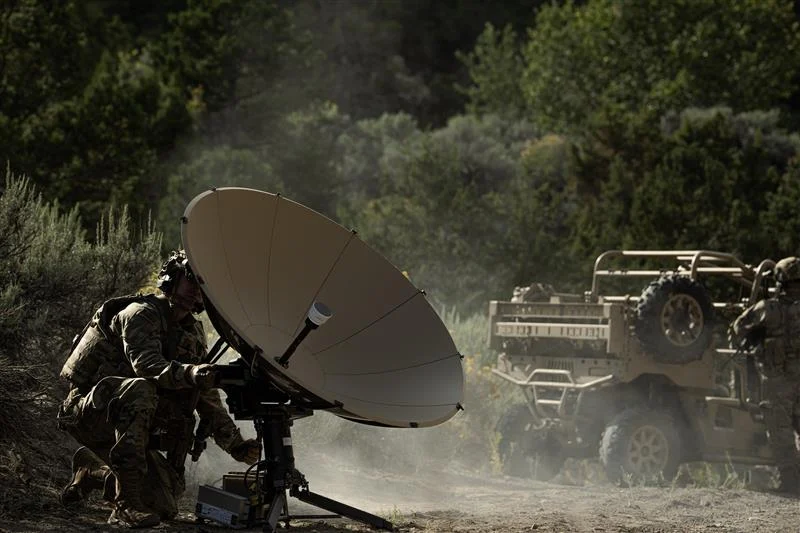

The strategic landscape of global military communications has undergone a significant transformation with the recent announcement by L3Harris Technologies and Comtech of a new multi-orbit, tactical satellite communications (SATCOM) embeddable modem. This technological advancement, centered on the 5650C2/MP modem, represents a pivotal shift in how modular hardware and software-defined architectures are utilized to provide resilient, high-bandwidth connectivity for personnel operating in contested and remote environments. As the first embeddable modem designed to bridge the gap between commercial and sovereign military satellite networks, the 5650C2/MP is positioned as a critical asset for the United States Department of Defense (DoD) and its international allies.
The collaboration marks a significant milestone in the long-standing relationship between L3Harris, a leader in aerospace and defense technology, and Comtech, a premier provider of ground station infrastructure and advanced communication solutions. By integrating Comtech’s sophisticated modem technology directly into L3Harris’s field-proven tactical terminals, the two companies have created a solution that addresses the urgent need for "multi-transport" capabilities. This ensures that even if one satellite network is compromised or jammed, tactical units can seamlessly transition to another orbital regime without hardware changes or significant downtime.
Technical Specifications and Terminal Compatibility
The 5650C2/MP is engineered to be an "embeddable" solution, a design choice that prioritizes the reduction of Size, Weight, and Power (SWaP) requirements—a perennial concern for expeditionary forces. Traditionally, switching between different satellite constellations required bulky external modems and complex cabling, which increased the physical burden on operators and introduced multiple points of failure. By embedding the modem directly into the terminal chassis, L3Harris and Comtech have streamlined the user experience while enhancing system durability.
The modem is built upon Comtech’s proprietary software-defined architecture. This allows the hardware to remain constant while the software can be reconfigured or updated in the field to support new waveforms, security protocols, or frequency bands. This flexibility is essential for modern "day-zero" readiness, where the ability to adapt to an adversary’s electronic warfare (EW) tactics can determine mission success.
Compatibility is a cornerstone of this rollout. The 5650C2/MP is specifically designed to work with L3Harris’s flagship tactical terminals, including the Panther II Very Small Aperture Terminal (VSAT) and the HawkEye Fly-Away series. The Panther II is widely recognized for its portability and ease of setup, often used by special operations and rapid-response units. The HawkEye series provides higher throughput capabilities for command-and-control hubs. By enabling these terminals with the new modem, L3Harris provides operators with a unified interface to access a diverse range of orbital assets.
Bridging the Gap: WGS and SES mGS Integration
The most significant achievement of the 5650C2/MP is its status as the only embeddable modem capable of operating across both the U.S. Space Force’s Wideband Global Satcom (WGS) system and SES’s Medium Earth Orbit Global Services (mGS). This dual-path capability provides a unique blend of sovereign military security and commercial high-throughput performance.
The WGS system is the backbone of the U.S. military’s high-capacity satellite communications, providing essential X-band and Ka-band frequencies for global operations. It is a constellation of Geostationary Orbit (GEO) satellites that offer wide-area coverage but are subject to the inherent latency of high-altitude orbits. Conversely, the SES mGS leverages the O3b mPOWER constellation, which operates in Medium Earth Orbit (MEO). MEO satellites are much closer to the Earth, significantly reducing latency and enabling high-bandwidth applications such as real-time high-definition video feeds, cloud computing, and advanced sensor data fusion.
The ability to switch between these two systems means that a tactical unit can utilize the WGS for secure, low-probability-of-intercept (LPI) command data while simultaneously leveraging the SES mGS for bandwidth-intensive tasks. This "best of both worlds" approach is a direct response to the Pentagon’s Joint All-Domain Command and Control (JADC2) initiative, which seeks to connect every sensor and every shooter across all branches of the military.
Chronology of Development and Certification
The development of the 5650C2/MP follows several years of R&D focused on the convergence of software-defined networking and satellite hardware. The partnership between L3Harris and Comtech was formalized to address specific gaps in the tactical SATCOM market, specifically the lack of interoperability between different orbital altitudes.
The timeline for the modem’s rollout began with intensive laboratory testing to ensure the software-defined architecture could handle the rapid switching requirements of multi-orbit transitions. Following successful internal trials, the modem was announced to the public on March 31. Currently, the modem is undergoing a rigorous certification process with the U.S. Space Force Delta 8. Delta 8 is the specific unit within the Space Force responsible for satellite communications and the maintenance of the WGS constellation.
Securing Delta 8 certification is a critical hurdle for any hardware intended for military use. This process involves verifying that the modem meets stringent security standards, does not interfere with other users on the WGS network, and can operate reliably in the harsh electromagnetic environments typical of modern combat zones. Once certification is finalized, the 5650C2/MP will be cleared for widespread procurement and deployment across the various branches of the U.S. armed forces.
Strategic Context: The Shift to Multi-Orbit Resiliency
The release of this modem comes at a time when the strategic importance of "space resiliency" has never been higher. Military planners have expressed growing concerns regarding the vulnerability of traditional GEO satellites to kinetic and non-kinetic threats from near-peer adversaries. By diversifying the orbital regimes available to a single terminal, the 5650C2/MP provides a "graceful degradation" capability. If a GEO satellite is jammed, the modem can shift the link to a MEO or even a High Earth Orbit (HEO) asset, ensuring that the mission-critical data flow remains uninterrupted.
Furthermore, the integration of MEO capabilities addresses the increasing demand for data at the "tactical edge." As artificial intelligence and machine learning (AI/ML) tools become more prevalent in field operations, the need for low-latency, high-speed data transfer has transitioned from a luxury to a requirement. The SES mGS constellation is uniquely suited to meet this demand, and the 5650C2/MP is the key that unlocks this capability for L3Harris terminal users.
Official Responses and Industry Impact
Chris Aebli, President of Mission Critical Communications for L3Harris, emphasized the collaborative nature of the project and its impact on the end-user. He noted that the pairing of L3Harris terminal technology with Comtech’s modem architecture "significantly enhances operator effectiveness and overall mission success." Aebli highlighted the uniqueness of the solution, stating that the ability to operate between the mGS and WGS constellations makes it the "only satcom solution of its kind in the marketplace."
While Comtech has historically focused on the ground segment and infrastructure, this partnership underscores its move toward more integrated, end-to-end solutions. The company’s focus on software-defined architecture aligns with broader industry trends toward virtualization, where hardware becomes a general-purpose host for specialized software applications. This shift allows for faster innovation cycles, as new features can be deployed via software updates rather than requiring the manufacturing and shipping of new physical components.
Industry analysts suggest that this move will likely prompt competitors to accelerate their own multi-orbit development programs. Companies like Viasat, Kratos, and Gilat are also vying for dominance in the tactical modem space, but the L3Harris-Comtech partnership gains an early advantage by securing a "first-mover" status in the WGS/mGS integration niche.
Implications for Future Tactical Operations
Looking ahead, the deployment of the 5650C2/MP is expected to influence the procurement strategies of defense departments globally. As more nations look to build out their own sovereign satellite capabilities while also leveraging commercial constellations, the demand for "agnostic" modems—those that do not lock a user into a single provider—will grow.
The broader impact of this technology extends beyond the military. Rapid-response teams, disaster relief organizations, and border security agencies often operate in environments where infrastructure is non-existent or destroyed. The ability to deploy a single terminal that can hunt for the best available satellite signal—whether it be from a high-altitude GEO bird or a fast-moving MEO satellite—provides a level of reliability that was previously unattainable for portable units.
In conclusion, the L3Harris and Comtech 5650C2/MP modem represents more than just a hardware upgrade; it is a foundational shift toward a more integrated and resilient global communication network. By prioritizing interoperability, software-defined flexibility, and multi-orbit access, the two companies have provided a roadmap for the future of tactical SATCOM. As the modem nears the final stages of Space Force certification, the defense community will be watching closely to see how this "unique pairing of technologies" performs in the complex and unpredictable theaters of the 21st century.