
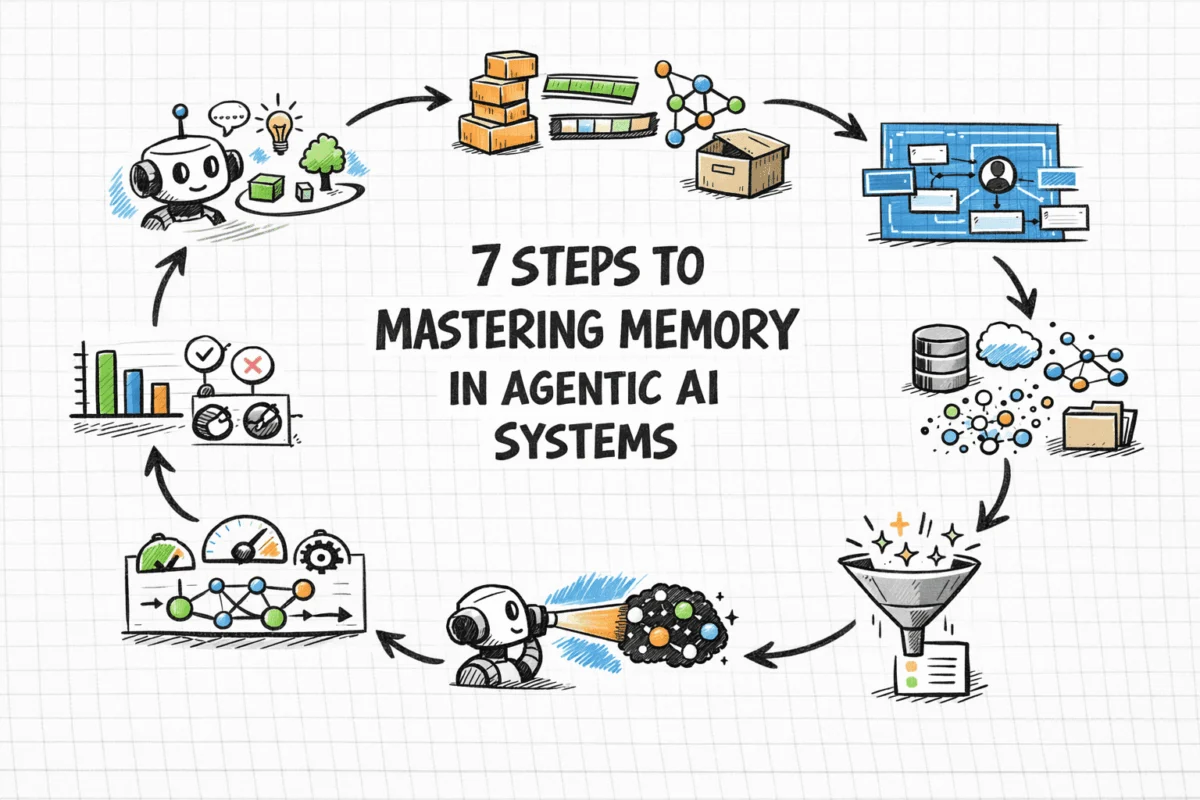

The reliability, personalization, and long-term effectiveness of agentic AI applications hinge critically on their ability to remember and learn from past interactions. Far from being a mere feature, robust memory management is emerging as a foundational architectural requirement for intelligent agents, transforming them from stateless tools into adaptive, evolving entities. Without sophisticated memory systems, every AI interaction begins from a blank slate, devoid of context, user preferences, or accumulated knowledge, severely limiting an agent’s capabilities in multi-step workflows or sustained user engagement. This comprehensive guide delves into the essential principles and practical steps for designing, implementing, and evaluating memory systems that empower AI agents to become more intelligent and indispensable over time.
The Evolving Landscape: Why AI Needs Memory More Than Ever
The rapid evolution of artificial intelligence, particularly with the advent of large language models (LLMs), has brought us closer to truly agentic systems capable of complex problem-solving and autonomous operation. However, a significant bottleneck quickly became apparent: the inherent statelessness of most LLM interactions. Early chatbots and single-turn query systems could operate effectively within a limited context window, processing information presented in the immediate prompt. As the ambition for AI agents grew—envisioning systems that manage projects, provide continuous customer support, or act as personal assistants—the limitations of short-term, ephemeral context became glaring.
Industry reports highlight this challenge, with a recent survey by AI analytics firm ‘Cognitive Insights’ indicating that over 65% of enterprise AI deployments struggle with maintaining user context across sessions, directly impacting user satisfaction and operational efficiency. This data underscores the shift from viewing AI as a series of isolated prompts to understanding it as an ongoing, interactive process. The demand for agents that can recall prior conversations, learn individual user preferences, remember past successes and failures, and adapt their behavior accordingly is no longer a luxury but a necessity for real-world application.
Memory: A Foundational Systems Architecture Challenge
The initial instinct for many developers grappling with AI memory issues is to simply expand the context window of their underlying LLM. However, this approach, while seemingly straightforward, has been widely documented to degrade performance and escalate costs. Researchers at institutions like Chroma have termed this phenomenon "context rot," observing that indiscriminately stuffing an enlarged context window with information leads to reduced reasoning quality. The model’s attention budget becomes diluted by noise, hindering its ability to discern signal from irrelevant data.
"Treating memory as a mere context window expansion is akin to solving a storage problem by simply buying a bigger RAM stick without optimizing data access or management," explains Dr. Lena Petrova, a leading AI architect specializing in agentic systems at Tech Solutions Inc. "Memory is fundamentally a systems architecture problem. It requires deliberate design decisions on what to store, where to store it, when to retrieve it, and, crucially, what to forget."
Unlike simple reflex agents, which respond to immediate stimuli without internal state, complex goal-oriented agents require memory as a core architectural component, not an afterthought. This necessitates approaching memory design with the same rigor applied to any production data system, considering aspects like write paths, read paths, indexing strategies, eviction policies, and consistency guarantees from the outset. Neglecting this foundational design phase can lead to scalable performance issues and unpredictable agent behavior in production environments.
A Taxonomy of AI Agent Memory Types
Drawing parallels from cognitive science, AI agent memory can be categorized into distinct types, each serving a unique purpose and mapping to specific architectural implementations:
-
Short-Term or Working Memory: This is analogous to the LLM’s context window—the immediate information the model can actively reason over in a single inference call. It includes the system prompt, current conversation history, tool outputs, and any documents retrieved for the immediate turn. Like RAM, it’s fast and immediate but typically reset at the end of a session. It’s often implemented as a rolling buffer or conversation history array, sufficient for simple, single-session tasks but lacking persistence across interactions.
-
Episodic Memory: This type records specific past events, interactions, and their outcomes. For instance, an agent recalling a user’s software deployment failure last week due to a specific configuration error is leveraging episodic memory. It’s invaluable for case-based reasoning, allowing agents to learn from past experiences to inform future decisions. Episodic memories are commonly stored as timestamped records in vector databases, retrieved via semantic or hybrid search to surface relevant past occurrences.
-
Semantic Memory: This holds structured factual knowledge, encompassing user preferences, domain-specific facts, entity relationships, and general world knowledge pertinent to the agent’s scope. A customer service agent remembering a user’s preference for email updates over phone calls, or their operational context within the healthcare industry, draws upon semantic memory. This is often implemented through incrementally updated entity profiles, combining relational storage for structured data with vector storage for flexible, fuzzy retrieval.
-
Procedural Memory: This encodes "how-to" knowledge—workflows, decision rules, and learned behavioral patterns. It manifests as explicit system prompt instructions, few-shot examples, or agent-managed rule sets that evolve through experience. An example would be a coding assistant that has learned to always check for API version compatibility before suggesting library upgrades.
Effective, capable production agents typically integrate all these memory layers, allowing them to operate cohesively and leverage different forms of recall as needed.
Demystifying RAG vs. Agent Memory: A Critical Distinction
One of the most persistent sources of confusion in agentic system development is the conflation of Retrieval-Augmented Generation (RAG) with true agent memory. While both involve retrieving information to inform an LLM, they solve fundamentally different problems.
RAG is primarily a read-only retrieval mechanism. Its purpose is to ground the LLM in external, universal knowledge sources—such as a company’s documentation, product catalogs, or legal policies—by finding relevant textual chunks at query time and injecting them into the context window. RAG is stateless; each query is treated independently, with no inherent concept of the individual asking or their prior interactions. It excels at answering general factual questions like "What is our return policy?" but is unsuited for questions like "What did this specific customer discuss about their account last month?"
Agent Memory, conversely, is read-write and user-specific. It enables an agent to learn about individual users, recall what actions were attempted and their results, and adapt its behavior over extended periods. The crucial differentiator is that RAG treats relevance as a property of the content itself, whereas memory treats relevance as a property of the user and their unique journey with the agent. According to a recent benchmark conducted by ‘AI Solutions Labs,’ agents that strategically leverage both RAG for factual grounding and personalized memory for user context achieve up to 25% higher user satisfaction scores and a 15% reduction in hallucination rates compared to agents using only one or the other. Most sophisticated production agents benefit from both mechanisms operating in parallel, contributing diverse signals to the final context window.
Designing for Robust Recall: Four Pillars of Memory Architecture
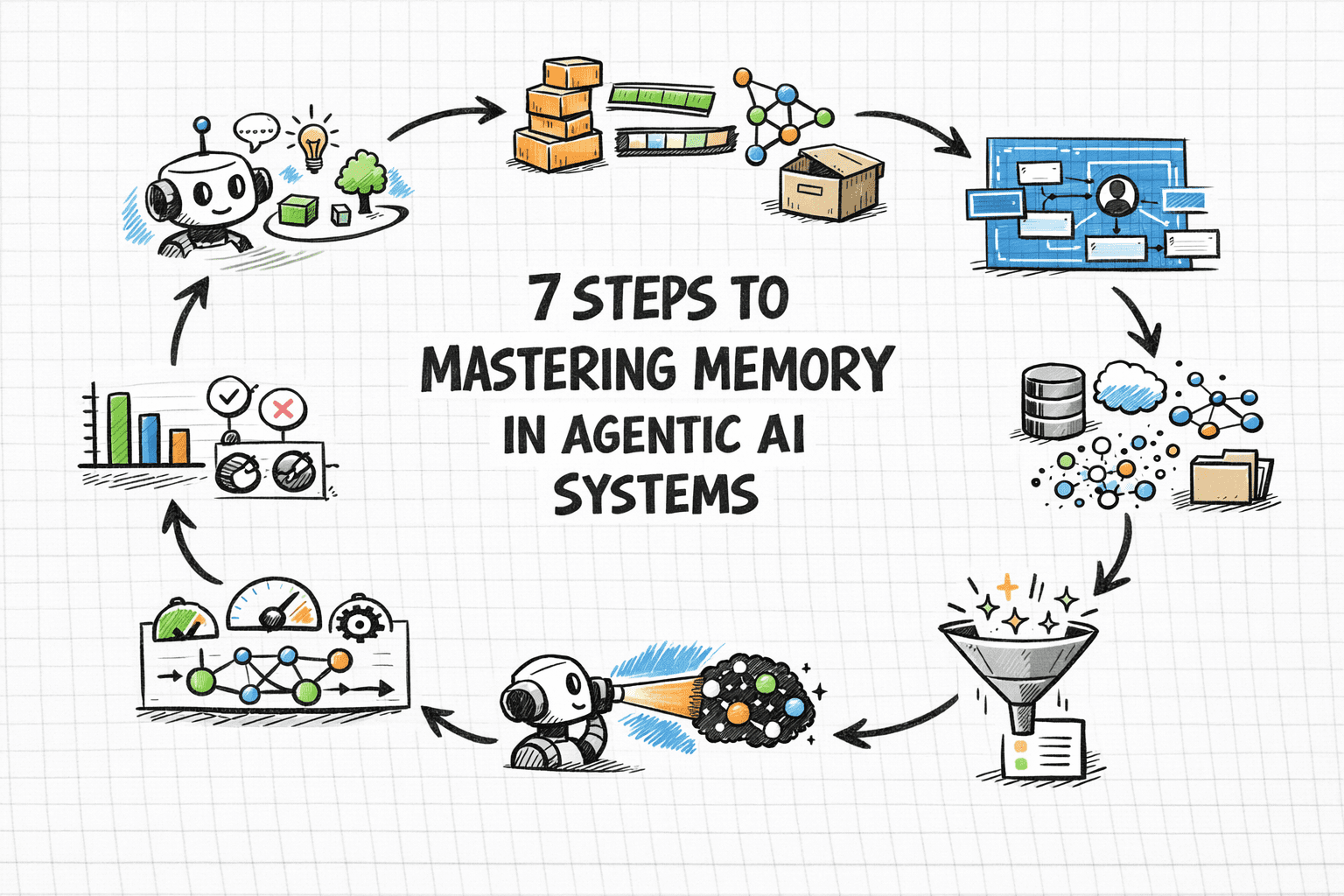
Effective memory architecture demands upfront design, as decisions concerning storage, retrieval, write paths, and eviction policies profoundly impact the entire system. Before writing any agent code, four fundamental questions must be addressed for each memory type:
-
What to Store? Simply logging raw conversation transcripts as memory units often leads to noisy retrieval. Instead, the design should focus on distilling interactions into concise, structured memory objects. This involves extracting key facts, explicit user preferences, and the outcomes of past actions before persistence. This extraction process, often powered by smaller LLMs or rule-based systems, represents a significant portion of the memory design effort.
-
How to Store It? The choice of storage backend depends on the memory type and retrieval needs. Vector databases are ideal for episodic and unstructured semantic memories, enabling semantic similarity search. Relational databases excel at storing structured user profiles and domain facts, allowing for precise key lookups and complex queries. Graph databases can represent intricate relationships between entities and events, beneficial for highly interconnected semantic and procedural knowledge. Hybrid approaches, combining these technologies, are common for comprehensive memory systems.
-
How to Retrieve It? Retrieval strategies must be tailored to the memory type. Semantic vector search is effective for finding similar past events or conceptual knowledge. Structured key lookups are superior for retrieving specific user profiles or procedural rules. Hybrid retrieval, combining embedding similarity with metadata filters (e.g., "what did this user say about billing in the last 30 days?"), handles the complex real-world queries agents frequently encounter.
-
When (and How) to Forget What You’ve Stored? Memory without forgetting can be as detrimental as no memory at all, leading to system bloat, increased retrieval costs, and degraded relevance. Memory entries should be equipped with timestamps, source provenance, and explicit expiration conditions. Implementing decay strategies, where older, less relevant memories are weighted lower in retrieval scoring, or utilizing native TTL (Time-To-Live) policies in the storage layer to automatically expire stale data, is crucial. "Forgetting is as critical as remembering to prevent system bloat and maintain relevance," asserts John Chen, CTO of a leading AI solutions provider, emphasizing the importance of proactive data management.
Treating the Context Window as a Constrained Resource
Even with a sophisticated external memory layer, all information eventually flows through the LLM’s context window, which remains a finite and valuable resource. Indiscriminately stuffing this window with retrieved memories often degrades rather than enhances reasoning, as evidenced by phenomena like "context poisoning"—where incorrect or stale information leads to compounding errors—and "context distraction"—where the model is overwhelmed, defaulting to historical patterns rather than fresh reasoning.
Managing this scarcity requires deliberate engineering. This involves not just what to retrieve, but also what to exclude, compress, and prioritize. Principles for effective context management include:
- Summarization: Condensing lengthy conversation histories or memory chunks into salient points before injection.
- Prioritization: Ranking retrieved memories by relevance, recency, or explicit user importance.
- Filtering: Removing redundant, irrelevant, or potentially harmful information.
- Dynamic Paging: Inspired by research projects like MemGPT (now productized as Letta), this approach treats the context window as RAM and external storage as disk, giving the agent explicit mechanisms to page information in and out on demand. This transforms memory management from a static pipeline decision into a dynamic, agent-controlled operation, significantly improving efficiency and reasoning quality.
Intelligent Retrieval Within the Agent Loop
Automated, pre-populated memory retrieval before every agent turn is often suboptimal and resource-intensive. A more effective pattern involves empowering the agent with retrieval as a tool—an explicit function it can invoke when it intelligently recognizes a need for past context. This mirrors human cognitive processes: we don’t replay every memory before every action, but we know when to pause and recall specific information.
Agent-controlled retrieval results in more targeted queries and ensures memories are surfaced at the most relevant moment within the reasoning chain. In ReAct-style frameworks (Thought → Action → Observation), memory lookup naturally fits as one of the available tools. After observing a retrieval result, the agent evaluates its relevance before incorporating it, providing an online filtering mechanism that meaningfully improves output quality.
For multi-agent systems, shared memory introduces additional complexities. Agents might inadvertently read stale data written by a peer or overwrite each other’s episodic records. Designing shared memory requires explicit ownership, versioning, and consistency guarantees to prevent data corruption and ensure coherent multi-agent collaboration. It is prudent to start with a conversation buffer and a basic vector store, introducing working memory (e.g., explicit reasoning scratchpads) for multi-step planning and graph-based long-term memory only when relationships between memories become a clear bottleneck for retrieval quality. Premature architectural complexity can significantly hinder development velocity.
Continuous Evaluation and Iterative Improvement
Evaluating the memory layer of an agentic system is uniquely challenging because failures are often subtle and invisible. An agent might produce a plausible-sounding answer that is nonetheless grounded in a stale memory, an irrelevant chunk, or a missing piece of crucial context. Without deliberate evaluation, these issues can remain hidden until they impact user experience.
Defining memory-specific metrics beyond general task completion rates is essential. Key performance indicators should isolate memory behavior, tracking aspects like:
- Retrieval Precision and Recall: How accurately relevant memories are retrieved and how many truly relevant memories are missed.
- Context Relevance Score: A quantitative measure of how pertinent the injected memories are to the current query.
- Memory Eviction Effectiveness: How well stale or irrelevant memories are purged.
- Cost Per Interaction: Analyzing the computational cost associated with memory operations.
Benchmarking efforts, such as AWS’s work with AgentCore Memory and evaluation against datasets like LongMemEval and LoCoMo, set a high standard for measuring retention across multi-session conversations. Building retrieval unit tests—a curated set of queries paired with their expected memory retrievals—allows for isolating memory layer problems from reasoning errors. Monitoring memory growth, retrieval latency, index size, and result diversity over time is also critical, alongside planning for periodic memory audits to identify and prune outdated or low-quality entries.
Crucially, user corrections in production environments provide invaluable training signals. When a user corrects an agent, it indicates either an incorrect memory retrieval, a lack of relevant memory, or a failure to utilize existing memory effectively. Closing this feedback loop, treating user corrections as systematic input for improving retrieval quality and memory refinement, is one of the most powerful mechanisms for continuous improvement in production agent teams. A study published by ‘Applied AI Journal’ demonstrated that companies implementing continuous memory evaluation cycles coupled with user feedback mechanisms reported a 10-15% improvement in agent accuracy month-over-month.
The Path Forward: Building Smarter Agents
Memory in agentic systems is not a static component but a dynamic, continuously evolving system. The tooling ecosystem has matured significantly, with purpose-built memory frameworks, advanced vector databases, and hybrid retrieval pipelines making robust memory implementation more practical today than ever before. Starting with established frameworks can save considerable development time.
However, technology alone is not sufficient. The core decisions—what knowledge to preserve, what to discard, how to retrieve it efficiently, and how to integrate it intelligently into the agent’s reasoning loop—remain paramount. Good memory design is synonymous with intentionality in data management, ensuring that agents learn, adapt, and perform better over extended interactions. Agents that master memory will undoubtedly define the next generation of reliable, personalized, and effective AI applications.