
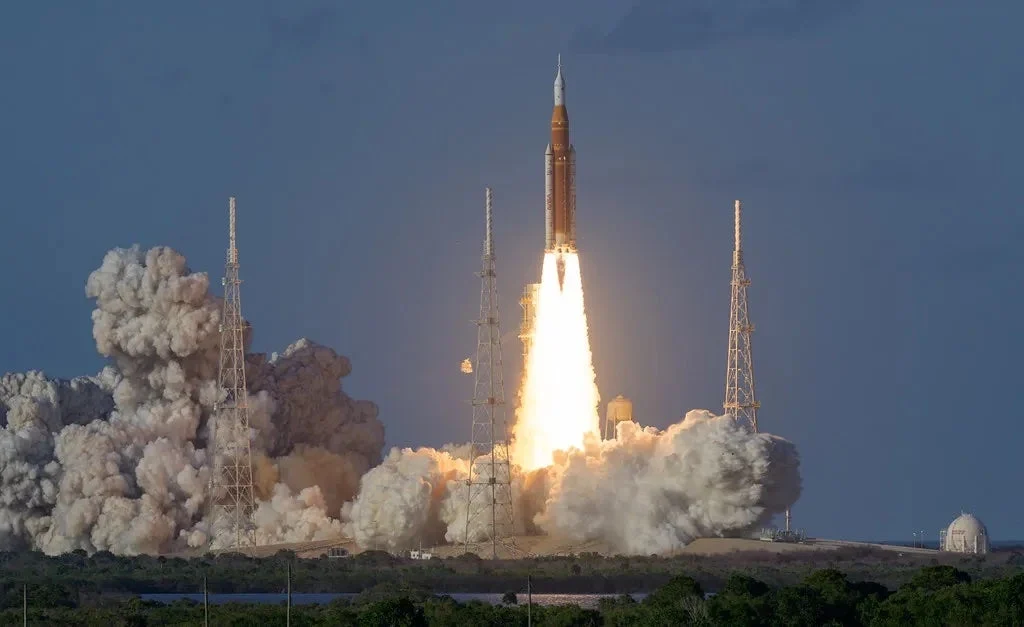

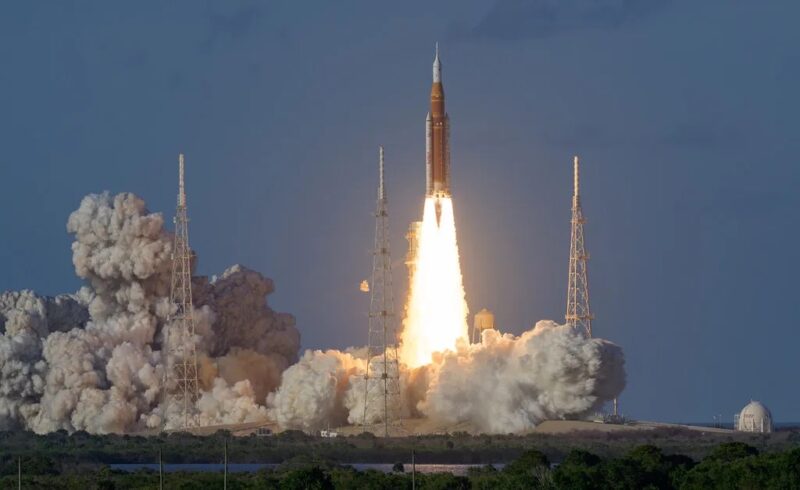
The National Aeronautics and Space Administration (NASA) successfully launched the Artemis II mission on Wednesday evening, signaling the beginning of a new era in deep-space exploration and marking the first time humans have traveled toward the Moon since the conclusion of the Apollo program in 1972. At 6:35 p.m. EDT, the Space Launch System (SLS) rocket ignited on Launch Pad 39B at the Kennedy Space Center in Cape Canaveral, Florida, carrying the Orion spacecraft and a crew of four international astronauts into the evening sky. This mission serves as the ultimate proving ground for the technologies and life-support systems required to establish a long-term human presence on the lunar surface and, eventually, to facilitate the first human voyage to Mars.
The successful liftoff represents the second triumph for the Boeing-built SLS, the most powerful rocket currently in operation. Building on the success of the uncrewed Artemis I mission in late 2022, Artemis II is a critical flight test that validates the integration of human crew members into the complex architecture of the Orion spacecraft. As the mission progresses, the crew will push the boundaries of current spaceflight capabilities, testing the spacecraft’s ability to sustain life in the harsh radiation environment beyond Earth’s protective magnetosphere.
A Historic Crew for a New Generation
The four-member crew of Artemis II represents a diverse cross-section of modern space exploration. Commander Reid Wiseman, a veteran of the International Space Station (ISS), leads the mission alongside Pilot Victor Glover, who previously served as the pilot on the SpaceX Crew-1 mission. Joining them are Mission Specialists Christina Koch, who holds the record for the longest single spaceflight by a woman, and Jeremy Hansen, a colonel in the Royal Canadian Air Force representing the Canadian Space Agency (CSA).
This crew is notable not only for its technical expertise but also for its historical significance. Victor Glover is the first person of color to be assigned to a lunar mission, while Christina Koch is the first woman to travel to the vicinity of the Moon. Jeremy Hansen’s inclusion marks the first time an international partner has ventured beyond Low-Earth Orbit (LEO), underscoring the collaborative nature of the Artemis Accords and the global effort to return to the lunar frontier.
Throughout their 10-day journey, the astronauts will be more than mere passengers. They are tasked with manual handling of the Orion spacecraft, specifically during the proximity operations demonstration. Shortly after reaching orbit, the crew will use Orion’s onboard systems to maneuver the craft near the SLS rocket’s spent upper stage—the Interim Cryogenic Propulsion Stage (ICPS). This exercise is vital for testing the spacecraft’s handling qualities and the precision of its manual flight controls, which will be essential for future missions involving docking with the Lunar Gateway or the Human Landing System (HLS).
Technical Execution and the TDRS Communication Event
The launch sequence proceeded with nominal performance from the SLS rocket’s twin solid rocket boosters and its four RS-25 engines, built by L3Harris Technologies. However, the mission encountered its first technical hurdle approximately 51 minutes into the flight. NASA Administrator Jared Isaacman confirmed during a post-launch press briefing that ground control experienced a temporary, partial loss of communication with the crew.
The issue occurred during a critical "handover" period between NASA’s Tracking and Data Relay Satellite (TDRS) network nodes. While the crew continued to receive uplink data from the ground, the downlink—the transmission of data and voice from the spacecraft back to Earth—was briefly interrupted. NASA engineers worked quickly to resolve the discrepancy, and full two-way communication was restored shortly thereafter. Isaacman emphasized that the spacecraft remained healthy throughout the event and that the redundancy built into the Orion’s communication suite performed as intended.
The Orion spacecraft, a joint project between NASA and lead contractor Lockheed Martin, is designed to be the safest and most advanced crew module ever built. During the first 24 hours of the mission, Orion will remain in a high-Earth orbit to allow the crew to verify the performance of the Environmental Control and Life Support System (ECLSS). This is the first time these systems have been tested with a full crew of four, and monitoring the atmospheric scrubbing, temperature regulation, and water recycling systems is a primary objective before the spacecraft is cleared for Trans-Lunar Injection (TLI).
Flight Trajectory and Mission Objectives
The Artemis II flight path is a "free-return trajectory," a safety-conscious route that uses the Moon’s gravity to naturally pull the spacecraft back toward Earth without requiring a major engine burn for the return trip. After completing two initial elliptical orbits around Earth, the Orion will perform a TLI burn to propel the crew toward the Moon.
The spacecraft will reach a point approximately 4,600 miles beyond the far side of the Moon. Depending on the specific timing of the lunar flyby, the crew may become the first humans to witness the lunar far side in person under specific lighting conditions that were not available during the Apollo missions. During this phase, the astronauts will conduct a series of scientific observations, documenting the lunar surface with high-resolution photography and audio recordings. These records are intended to provide both scientific data for future landing site selection and historical documentation for the global public.
Radiation protection is another cornerstone of the Artemis II mission. The spacecraft is equipped with a reinforced radiation shelter where the crew can retreat during solar energetic particle events. Throughout the flight, the crew will monitor radiation sensors to gather data on how deep-space radiation affects the human body, providing essential information for the multi-month missions planned for the 2030s.
The Role of Global Industry and Secondary Payloads
The Artemis program is supported by a vast industrial base involving thousands of companies and several international space agencies. Beyond the primary mission of the Orion capsule, the SLS rocket also served as a launch vehicle for four secondary payloads. These "cubesats" were developed by the space agencies of Argentina, Germany, South Korea, and Saudi Arabia.
Released into a High-Earth Orbit, these small satellites are designed to perform a variety of scientific tasks, from mapping lunar minerals to testing new propulsion technologies. The inclusion of these payloads highlights NASA’s commitment to fostering a global space economy and providing opportunities for emerging space nations to participate in deep-space exploration.
Key industrial partners played a pivotal role in the success of the Wednesday launch. Amentum provided the necessary ground support and launch operations at Kennedy Space Center, while Northrop Grumman was responsible for the solid rocket boosters that provide the majority of the initial thrust. Teledyne Brown Engineering manufactured the launch vehicle stage adapter, which connects the core stage to the upper stage, and United Launch Alliance (ULA) worked alongside Boeing to develop the ICPS.
Broader Implications for the Artemis Program
Artemis II is the final bridge to the Artemis III mission, which aims to land the first woman and the next man on the lunar South Pole. The data gathered over the next 10 days will be scrutinized to ensure that the Orion spacecraft and its crew interfaces are ready for the complexities of a lunar landing.
"Artemis II is the start of something bigger than any one mission," NASA Administrator Jared Isaacman stated. "It marks our return to the Moon, not just to visit, but to eventually stay on our Moon Base, and lays the foundation for the next giant leaps ahead."
The strategic goal of the Artemis program is the establishment of the "Artemis Base Camp" at the lunar South Pole and the construction of the Gateway, a small space station that will orbit the Moon. These assets will serve as a hub for scientific research and a staging point for Mars missions. By testing the Orion’s capabilities in the lunar vicinity, NASA is validating the "Moon to Mars" architecture that defines the agency’s long-term vision.
Global Reaction and Future Outlook
The international community has reacted with widespread acclaim to the successful launch. Heather Pringle, CEO of the Space Foundation, noted the cultural impact of the mission, stating, "Today, people around the world share this generation’s Moon moment and celebrate the Artemis II crew and the extraordinary team supporting them." She added that the mission brings humanity "one step closer" to a permanent presence on the lunar surface.
As Orion continues its journey toward the Moon, NASA will provide 24/7 coverage of the mission, allowing the public to follow the crew’s progress in real-time. Upon completion of the mission, the spacecraft will perform a high-speed reentry into Earth’s atmosphere, traveling at speeds of nearly 25,000 miles per hour. The mission will conclude with a splashdown in the Pacific Ocean, where U.S. Navy and NASA recovery teams will be waiting to retrieve the capsule and its history-making crew.
The success of Artemis II reaffirms the United States’ leadership in space and demonstrates the efficacy of public-private partnerships in achieving monumental scientific goals. With the crew now en route to the Moon, the focus of the global space community shifts to the data they will bring back—data that will dictate the pace of human expansion into the solar system for decades to come.