
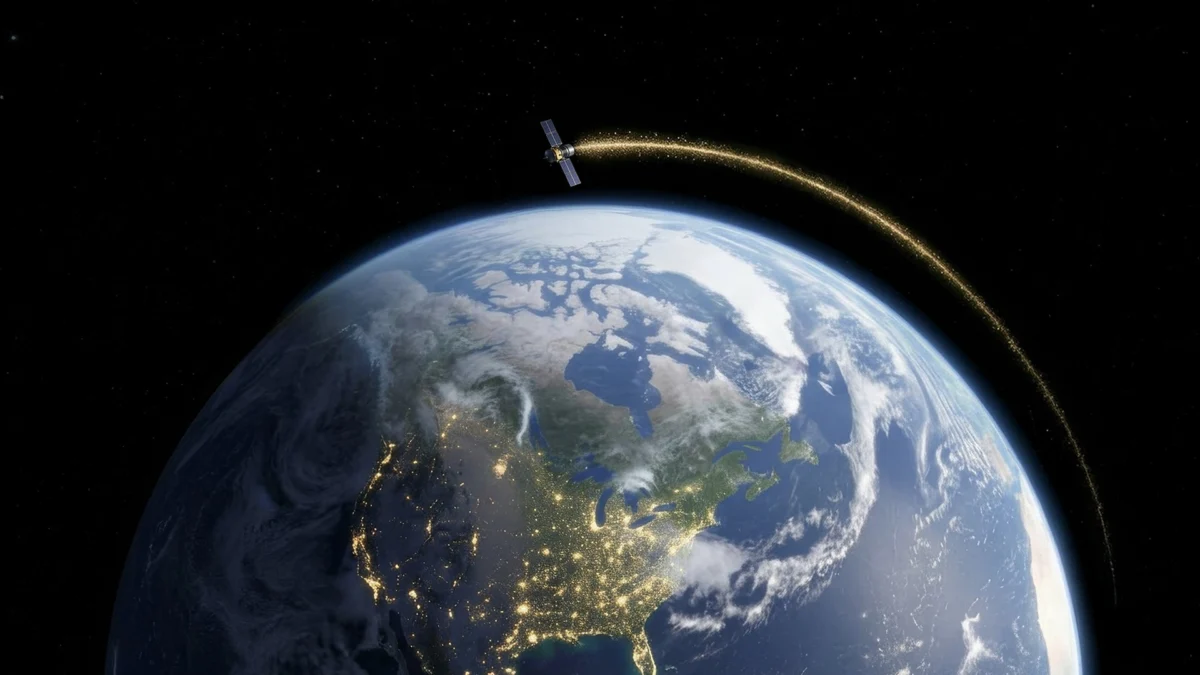

Nvidia has officially signaled its intent to dominate the burgeoning orbital computing market with the announcement of its new Space-1 Vera Rubin Module, a dedicated accelerated computing platform designed to bring data-center-class artificial intelligence to the harsh environment of Earth’s orbit and beyond. Unveiled by CEO Jensen Huang during the company’s GTC 2026 conference, the suite of hardware and software is engineered to support the deployment of large language models (LLMs), advanced foundation models, and autonomous navigation systems directly on spacecraft. This move marks a significant pivot for the world’s most valuable chipmaker, transitioning from terrestrial AI dominance to establishing the infrastructure for what Huang described as the "final frontier" of the digital age.
The announcement comes at a critical juncture for the aerospace industry, which is currently grappling with a massive influx of data generated by an ever-growing number of low-Earth orbit (LEO) satellites. By processing data at the source—the "edge" in space—Nvidia aims to eliminate the massive latency and bandwidth bottlenecks associated with downlinking raw data to Earth-based stations for analysis. The Space-1 Vera Rubin Module is supported by a robust ecosystem of industry partners, including Aetherflux, Axiom Space, Kepler Communications, Planet, Sophia Space, and Starcloud, all of which are integrating Nvidia’s silicon into their upcoming missions to enable real-time geospatial intelligence and autonomous orbital operations.
Technical Specifications and the Vera Rubin Architecture
The centerpiece of Nvidia’s space strategy is the Space-1 Vera Rubin Module. Named after the pioneering astronomer who provided the first evidence for dark matter, the platform is designed to provide the massive computational throughput required for modern generative AI and deep learning. Unlike previous generations of space-hardened processors that prioritized reliability over speed, the Vera Rubin Module seeks to bridge the gap between terrestrial data center performance and the strict size, weight, and power (SWaP) constraints of satellite bus systems.
In addition to the flagship Vera Rubin Module, Nvidia introduced specialized iterations of its existing platforms for orbital use. The IGX Thor and Jetson Orin platforms have been adapted to deliver energy-efficient, high-performance AI inference and image sensing. These modules are intended for smaller CubeSats and tactical reconnaissance satellites that require high-speed data processing in a compact form factor. The IGX Thor, in particular, focuses on industrial-grade reliability and functional safety, making it suitable for human-rated missions and critical infrastructure management in orbit.
The Vera Rubin architecture is specifically optimized for transformer-based models, which are the backbone of modern AI. By enabling these models to run locally on a satellite, operators can implement "smart filtering," where the satellite only transmits relevant, high-value information back to Earth, such as the detection of a specific maritime vessel or the early signs of a wildfire, rather than gigabytes of raw optical data.
A Chronology of Nvidia’s Expansion into the Aerospace Sector
The journey toward the GTC 2026 announcement has been several years in the making. Nvidia’s involvement in space began in the early 2020s through experimental deployments of Jetson modules on research satellites to test the effects of cosmic radiation on non-hardened commercial-off-the-shelf (COTS) hardware.
In 2023, Nvidia began formal collaborations with the European Space Agency (ESA) and NASA to explore the use of digital twins—powered by Nvidia Omniverse—to simulate orbital mechanics and satellite interference. By 2024, the company had established a dedicated "Space Computing" division, hiring veterans from the aerospace industry to address the unique thermal and radiation challenges of silicon in a vacuum.
The 2025 roadmap saw the introduction of radiation-tolerant software layers that could detect and correct bit-flips caused by solar flares and cosmic rays, a necessary precursor to the hardware launch seen today. The debut of the Space-1 Vera Rubin Module at GTC 2026 represents the culmination of these efforts, moving Nvidia from a component supplier to a platform provider for the global space economy.
Strategic Partnerships and Industrial Applications
The success of the Space-1 platform is tied to its adoption by key players in the commercial space sector. Each partner brings a specific use case that highlights the versatility of the Vera Rubin architecture.
Aetherflux, a startup focused on orbital energy and compute, plans to utilize the Space-1 Vera Rubin Module to create the world’s first solar-powered AI hubs in orbit. "At Aetherflux, we’re pioneering a new paradigm for power and compute in space," said Baiju Bhatt, founder and CEO of Aetherflux. "Nvidia Space-1 Vera Rubin Module delivers high-performance, energy-efficient AI at the edge in orbit, powered by solar energy. This enables autonomous operations and mission-critical services, and unlocks scalable, space-based AI infrastructure beyond Earth."
Kepler Communications is leveraging the Jetson Orin platform to manage the complex routing of data across its high-speed optical constellation. According to Kepler CEO Mina Mitry, the ability to process routing logic and network optimization in real-time is essential for maintaining the "Internet of Space."
Axiom Space, the company currently building the first commercial space station, is expected to use Nvidia’s technology to support onboard research and station maintenance. By running AI-driven diagnostic tools locally, the station can operate with a higher degree of autonomy from ground control, a requirement for future missions to the Moon and Mars where communication delays become a significant factor.
Addressing the Challenges of the Space Environment
Deploying high-performance GPUs in space presents hurdles that do not exist in terrestrial data centers. The most significant of these are radiation and thermal management. In the absence of an atmosphere, heat can only be dissipated through radiation, making the cooling of high-wattage chips incredibly difficult.
Nvidia’s Space-1 modules utilize advanced liquid-to-radiator cooling interfaces and underclocking algorithms that balance performance with thermal limits. Furthermore, the chips utilize a multi-layered approach to radiation hardening. Instead of relying solely on expensive, slow, radiation-hardened-by-design (RHBD) silicon, Nvidia employs a "system-level" hardening strategy. This includes redundant processing cores and a sophisticated software-defined error correction layer that can identify and re-run calculations if a radiation-induced error is detected.
This hybrid approach allows Nvidia to offer performance levels that are orders of magnitude higher than traditional space-grade processors while maintaining the reliability necessary for multi-year missions in the harsh environment of LEO and Geostationary Orbit (GEO).
Market Context and Economic Implications
The global space economy is projected to reach $1.8 trillion by 2035, according to reports from the World Economic Forum and McKinsey. A significant portion of this growth is expected to come from data services and "space-to-Earth" applications. By positioning itself as the primary provider of the "brains" for these satellites, Nvidia is tapping into a market that is increasingly dependent on high-fidelity data.
Industry analysts suggest that the introduction of the Space-1 platform will lower the barrier to entry for startups looking to deploy intelligent constellations. By providing a standardized AI platform, Nvidia allows developers to use the same CUDA programming language and software tools they use on Earth, drastically reducing the development time for space-based applications.
Furthermore, the move has geopolitical implications. As nations compete for "orbital supremacy," the ability to process intelligence in real-time provides a significant strategic advantage. Nvidia’s entry into this market reinforces the role of private enterprise in providing the dual-use technology that will define 21st-century defense and climate monitoring.
Future Outlook: The Era of Self-Navigating Spacecraft
Looking ahead, the integration of AI into spacecraft is expected to lead to the development of fully autonomous systems. Jensen Huang emphasized that as we explore deeper into the solar system, the reliance on Earth-bound decision-making becomes impossible. "Intelligence must live wherever data is generated," Huang stated. "AI processing across space and ground systems enables real-time sensing, decision-making, and autonomy, transforming orbital data centers into instruments of discovery and spacecraft into self-navigating systems."
This vision includes satellites that can autonomously avoid orbital debris, a growing concern as LEO becomes increasingly crowded. With the Vera Rubin Module, a satellite could potentially process radar and optical data to calculate evasive maneuvers in milliseconds, without waiting for instructions from ground stations.
As Nvidia continues to refine its space-grade silicon, the line between Earth-based and space-based computing will continue to blur. The GTC 2026 announcement is not merely about a new chip; it is about the extension of the global compute fabric into the stars, ensuring that the AI revolution is not limited by the boundaries of Earth’s atmosphere. With the Space-1 Vera Rubin Module, Nvidia has laid the groundwork for a future where the next great data center may not be located in a warehouse in Virginia, but in a stable orbit 500 kilometers above the planet.