

The burgeoning popularity of OpenClaw, an open-source AI agent, has captured global attention, reaching a crescendo with recent reports highlighting its profound impact. A compelling account in Forbes, citing a Reuters dispatch, vividly illustrates this phenomenon: "On a Friday afternoon in March, nearly 1,000 people lined up outside Tencent’s headquarters in Shenzhen to get a piece of software installed on their laptops." This unprecedented turnout underscores the immense demand and widespread adoption of AI agents, prompting a closer examination of the underlying technological shifts and competitive landscape.
The question of why engineers from a tech behemoth like Tencent, valued at approximately $650 billion, would facilitate the deployment of an Austrian-developed open-source AI agent onto personal devices reveals a deeper trend. Many Chinese AI startups are reportedly encouraged by government initiatives to "raise a lobster," a colloquialism suggesting the pursuit of significant technological breakthroughs and market dominance. This national push, combined with the inherent appeal of accessible AI tools, has fueled a rapid expansion of the AI agent ecosystem.

This surge follows closely on the heels of innovations like NanoClaw, a more secure iteration of its predecessor, suggesting a continuous evolution in AI agent design. The fundamental architecture of OpenClaw, now observed in various implementations, comprises three core components: a Large Language Model (LLM) agent, access to local file systems, and control via mobile messaging applications. This confluence of familiar technologies—LLMs, local storage, and ubiquitous mobile communication—has created a potent combination that resonates with a broad user base. The ability for individuals to perform tangible work with AI through interfaces they already master has rapidly transitioned from a niche concept to a mainstream expectation, setting a high bar for competitors.
The Hardware Underpinning the AI Revolution
Azeem Azhar’s insightful observation regarding Apple’s hardware capabilities is particularly relevant. While Apple has not historically been at the forefront of AI software development, its current hardware, particularly its Apple Silicon chips, is exceptionally well-suited for agentic computing tasks. These chips excel at local, on-device inference, a crucial capability for running sophisticated AI models efficiently and privately. This has led to a surprising surge in demand for devices like the Mac Mini, a product that a younger generation might be unfamiliar with, now experiencing stockouts in retail stores. The underlying computational power and efficiency of modern hardware are critical enablers of the widespread adoption of AI agents.

OpenClaw’s inherent flexibility, characterized by its less stringent security boundaries and guardrails, has been both a strength and a potential vulnerability. This openness allows for extensive experimentation, where novel applications and functionalities can emerge organically. However, it also presents challenges for commercial entities, particularly those operating under strict regulatory scrutiny, who must prioritize security and mitigate potential risks.
Anthropic’s Evolving Approach: From Claude Remote Control to Claude Dispatch
Anthropic, a prominent player in the AI space, has been actively exploring ways to integrate its LLM, Claude, into user workflows. Their initial foray into mobile-driven AI interaction was the "Claude Remote Control," launched last month. While this feature aimed to provide a bridge between users and Claude Code, it was described by tech commentator Simon Willison as "janky," indicating a less-than-seamless user experience. This initial iteration highlighted the complexities of creating intuitive and reliable remote control mechanisms for AI agents.

The subsequent release of "Claude Dispatch for Cowork" marks a significant step forward for Anthropic in this domain. This new feature, available to Pro plan users as a research preview, integrates two of the three core elements of the OpenClaw paradigm: AI agents that interact with local file systems without requiring deep technical expertise. The integration within Claude Desktop, accessible via a dedicated tab, streamlines the process for users.
The user experience begins with ensuring Claude Desktop is updated to the latest version. Upon restarting the application, users are presented with the "Dispatch" option, which guides them through the setup process. A key component of this new functionality is the requirement for a companion mobile application. While this necessitates the installation of an additional app, a departure from the seamless integration often expected from existing messaging platforms like WhatsApp, it represents a more secure and deliberate approach by Anthropic. The installation of the dedicated Claude app on an Android device was necessary to complete the chain of interaction.
The final setup configuration provides insight into Anthropic’s broader strategy. One notable element observed during the setup was "Claude in Chrome," which appeared to be another beta plugin, hinting at further integrations into web browsing environments, potentially building upon earlier work like WebMCP.

The Persistent Thread: A New Paradigm for AI Interaction
A core advancement with Claude Dispatch is the establishment of a persistent conversational thread. Unlike traditional session-based interactions that reset after each task, this continuous thread allows Claude to retain context from previous interactions. This enables users to seamlessly pick up where they left off, whether on their laptop or mobile phone. The persistent nature of this thread makes it notably difficult to inadvertently restart a session, ensuring continuity.
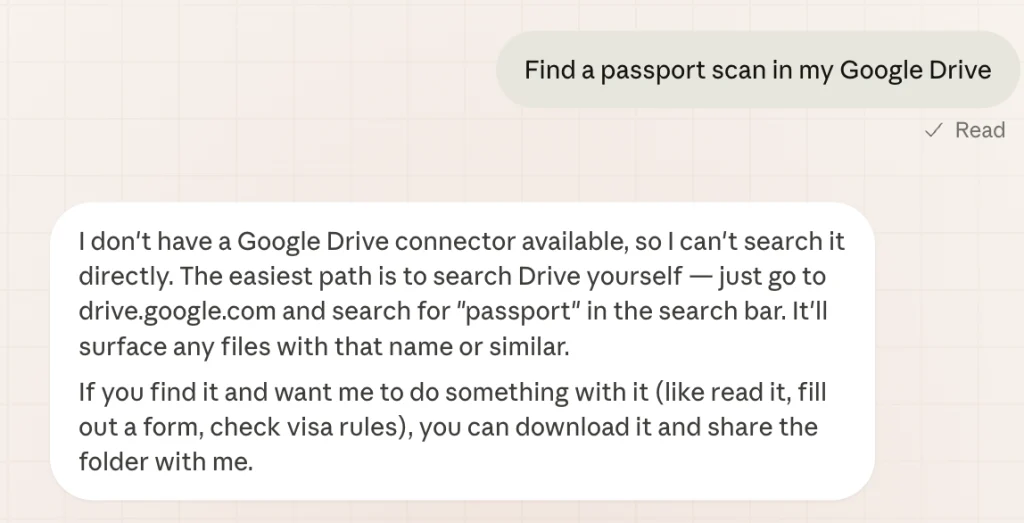
Upon successful login and initial configuration on the mobile device, the link to the Dispatch thread was established, enabling interaction. An initial test involved attempting to locate a passport scan, a task suggested within the Claude Cowork hints. The process began on the laptop to assess the capabilities.

Navigating Data Access and Integration Challenges
The attempt to access Google Drive revealed a common challenge in AI agent integration: the need for explicit connectors and permissions. While Claude did not initially recognize its ability to interface with Google Drive, the broader web ecosystem provided a solution through the addition of a connector. However, a peculiar observation was that Claude seemed to access Google Drive via the web interface rather than directly interacting with local folders, a nuance that may affect performance and user expectations.
Despite granting access, the interaction functioned akin to a walkie-talkie, with requests typed on the phone being "dispatched" to the laptop for processing. Unfortunately, after multiple permission requests, the query ultimately failed, indicating ongoing challenges in robust data access and command execution.

While the remote control aspect of the feature appeared to function effectively, the overall experience raised questions about whether this development sufficiently addresses the momentum generated by OpenClaw. The current approach, while a promising start, relies heavily on Anthropic-specific infrastructure. Users are seeking efficient ways to accomplish tasks, such as finding a passport scan, rather than a specialized "walkie-talkie" to a specific AI session.
The Path Forward: Bridging Security and Flexibility
The development of Claude Dispatch highlights the ongoing effort to balance security with flexibility in the AI agent space. While Anthropic’s focus on a more secure, app-based integration is understandable, it risks creating a proprietary ecosystem that might lag behind the rapid, open innovation seen with projects like OpenClaw. The challenge for Anthropic, and indeed the broader AI industry, lies in finding the optimal framing that fosters user adoption by minimizing the friction between initial curiosity and tangible utility, all while maintaining robust security measures. The "raising a lobster" phenomenon signifies a broader ambition, and the successful navigation of these integration and usability challenges will be critical in determining the future landscape of AI agents. The market is clearly signaling a desire for powerful, accessible AI tools, and the companies that can best bridge the gap between raw capability and intuitive user experience will ultimately lead the charge.