
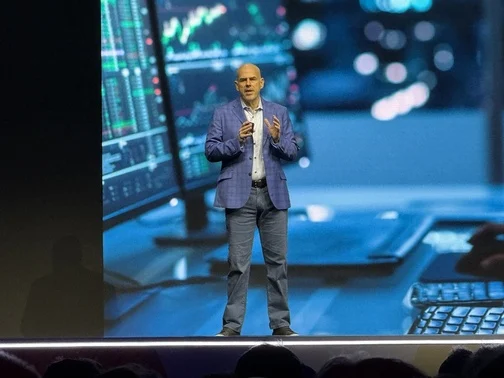

The global enterprise software landscape underwent a significant shift this week as Oracle Corporation unveiled twenty-two new Fusion Agentic Applications and a major expansion of its AI Agent Studio during the AI World conference in London. This strategic move signals a departure from traditional "passive systems of record" toward what Oracle executives describe as "systems of outcomes." By introducing autonomous agents capable of reasoning, decision-making, and execution, Oracle aims to transform how businesses manage everything from supply chains to human resources, moving beyond the incremental productivity gains offered by first-generation generative AI assistants and copilots.
From Record-Keeping to Autonomous Execution
For over three decades, Enterprise Resource Planning (ERP) and Customer Relationship Management (CRM) systems have functioned primarily as digital ledgers—repositories where human operators manually input data to document business activities. Oracle’s latest announcement seeks to invert this relationship. Steve Miranda, Executive Vice President of Applications Development at Oracle, emphasized that the goal is to create software that does not merely wait for instructions but actively pursues defined business objectives.
The shift represents a fundamental change in the user interface and the underlying logic of enterprise applications. While generative AI tools like "copilots" have gained popularity for summarizing documents or drafting emails, Oracle’s agentic applications are designed to operate with a degree of autonomy. These agents do not just suggest actions; they execute them within the guardrails of the organization’s existing policies. This evolution moves the needle from "AI as an assistant" to "AI as a workforce participant."
The Evolutionary Timeline of Oracle AI
The announcement in London marks the third major phase in Oracle’s AI roadmap, which has moved at an accelerated pace over the last eighteen months. To understand the significance of today’s launch, it is necessary to view it through the lens of this rapid chronology:
- Phase One: Embedded Generative AI (Late 2023): Oracle began by embedding large language models (LLMs) into the Fusion suite to handle text-heavy tasks. This included generating job descriptions in HCM (Human Capital Management), creating product summaries in SCM (Supply Chain Management), and drafting marketing copy in CX (Customer Experience). These tools provided incremental efficiency but remained tethered to human-initiated prompts.
- Phase Two: Discrete Task Agents (Early 2024): The company introduced individual agents designed to handle specific, isolated steps in a larger business process. For example, in a recruitment workflow, one agent might handle candidate shortlisting while another managed interview scheduling. While more advanced than simple text generation, these agents still required human "orchestration" to bridge the gaps between tasks.
- Phase Three: Coordinated Agentic Ecosystems (Present): The new Fusion Agentic Applications represent the arrival of coordinated teams of agents. These systems can look at a high-level business goal—such as "reduce days sales outstanding" or "optimize warehouse staffing for a holiday surge"—and coordinate multiple sub-agents to achieve that goal across different functional silos.
Oracle CEO Mike Sicilia likened this transition to the mid-20th-century shift in aviation from propeller planes to jet engines. Sicilia noted that while the fundamental objective of moving people and goods remained the same, the change in underlying technology expanded the boundaries of speed, distance, and market reach. In the same vein, agentic AI is expected to expand the capabilities of the enterprise, allowing for faster decision cycles and more complex operations that were previously limited by human cognitive bandwidth.
Detailed Breakdown of the 22 New Applications
The twenty-two applications announced at AI World cover the breadth of the Oracle Fusion Cloud suite. These are not general-purpose chatbots but specialized workspaces tailored to specific business functions. Key highlights include:
- Collectors Workspace: Designed for finance departments, this application targets the reduction of Days Sales Outstanding (DSO). It analyzes payment histories, identifies high-risk accounts, and autonomously initiates collection workflows, prioritizing efforts based on the likelihood of recovery and the value of the debt.
- Workforce Operations App: Aimed at HR and operations managers, this tool focuses on eliminating payroll errors and optimizing shift scheduling. It can predict potential scheduling conflicts caused by local labor laws or employee availability and suggest—or implement—adjustments before they impact the bottom line.
- Design-to-Source Workspace: This supply chain application automates the process of finding and vetting suppliers for new product designs. It evaluates potential partners based on cost, sustainability metrics, and historical reliability, significantly shortening the time-to-market for new iterations.
- Cross-Sell Program Workspace: Aimed at sales organizations, this tool identifies expansion opportunities within the existing customer base by analyzing usage patterns and contract data, then automatically drafting tailored outreach programs for sales representatives to review.
Architecture and Governance: Solving the CIO’s Primary Concern
A significant portion of the London event was dedicated to addressing the "governance gap" that has slowed AI adoption in large enterprises. Recent industry surveys indicate that Chief Information Officers (CIOs) are increasingly wary of "bolted-on" AI solutions that create new security risks or operate outside established audit trails.
Oracle’s architectural response is to run these agents natively within the Fusion environment. Natalia Rachelson, who leads Fusion Applications product management, explained that these agentic applications inherit the entire governance framework of the core system. This means they are subject to the same Role-Based Access Controls (RBAC), data residency requirements, and approval hierarchies that govern human users. If an employee does not have permission to view sensitive payroll data, the agent acting on their behalf is similarly restricted.
Furthermore, Oracle has introduced a "traceability-by-design" approach. Every decision made by an agent, the data it used to reach that decision, and the specific LLM logic employed are recorded in a comprehensive audit trail. This transparency is intended to satisfy regulatory requirements and provide a safety net for organizations that are hesitant to grant autonomy to software.
The Model-Agnostic Advantage
One of the technical highlights of the announcement is Oracle’s commitment to a model-agnostic infrastructure. Through the AI Agent Studio, customers can leverage various large language models depending on the specific requirements of the task. Because Oracle Cloud Infrastructure (OCI) hosts multiple leading models, the system can dynamically select the most efficient or accurate model for a given process—whether that involves complex reasoning, high-speed data processing, or natural language nuances.
This flexibility protects enterprises from "model lock-in." As the landscape of LLMs evolves and new, more efficient models emerge, Oracle’s agentic framework can pivot to utilize the best available technology without requiring a complete overhaul of the business logic.
Economic Implications and the Shift in Pricing Models
Oracle also hinted at a fundamental change in how enterprise software is valued and sold. Historically, the industry has relied on seat-based or user-based pricing. However, as autonomous agents begin to perform tasks previously handled by humans, the "per-seat" metric becomes less relevant.
Steve Miranda suggested that Oracle is preparing for a transition toward transaction-based or company-size-based metrics. Currently, agentic AI capabilities are included in existing Fusion subscriptions up to a certain threshold, with additional usage measured in "action units." This consumption-based model aligns the cost of the software with the actual business value generated, rather than the number of people logged into the system.
Organizational Impact: The Challenge of Human Re-Engineering
While the technology is ready, both Oracle executives and industry analysts acknowledge that the biggest hurdle remains organizational. Agentic AI does not respect traditional departmental silos; an agent tasked with optimizing a supply chain may need to pull data from finance, logistics, and sales simultaneously.
This cross-functional capability requires companies to rethink their operating models. Miranda noted that while AI may automate 60% of a specific role’s tasks, the remaining 40% will require a more strategic, human-centric focus. The challenge for digital leaders is to reorganize teams around these new capabilities, a process that Miranda admitted is still in its early stages across the global market.
Final Analysis: A New Playbook for the Enterprise
The launch of the 22 Fusion Agentic Applications marks a pivotal moment for Oracle as it seeks to maintain its lead against competitors like SAP and Salesforce. By moving from a "system of record" to a "system of outcomes," Oracle is betting that the future of enterprise software lies in its ability to act, not just inform.
The success of this initiative will depend on two factors: the reliability of the autonomous agents in complex, real-world scenarios and the willingness of corporate leadership to trust these systems with critical business processes. For CIOs, the "native governance" story provides a compelling reason to move forward, but the path to a truly agentic enterprise will require a significant cultural and structural shift that goes far beyond the software itself. As Oracle has laid out the technical framework, the "playbook" for the human side of this transformation is currently being written in real-time by the organizations bold enough to adopt it.